Introduction
Advanced waste management software benefits businesses by cutting fuel and labor costs, tightening regulatory compliance, and giving managers real-time visibility into fleet and pickup status. Fuel costs are climbing. Compliance requirements keep expanding. And customers now expect real-time visibility into their pickups — not a phone call the next morning. For waste haulers managing these pressures through spreadsheets and static route sheets, the margin for error is shrinking fast.
Waste management software does more than digitize paperwork. It functions as an operational control system — replacing disconnected processes with a single, reliable environment for scheduling, tracking, compliance, and reporting.
This article covers 7 concrete benefits — the kind operations managers can measure in fuel spend, compliance status, and missed pickup rates.
Key Takeaways
- Route optimization reduces fuel spend — a 2024 municipal study documented an 11.6% fuel cost reduction from optimized collection routes
- Automated compliance documentation eliminates the single biggest source of audit risk: incomplete manual records
- Real-time fleet visibility shifts management from reactive firefighting to proactive problem-solving
- Scaling manually means hiring more people; software automates scheduling, dispatch, and reporting without proportional headcount growth
- ROI accelerates when software connects across billing, CRM, fleet, and compliance systems
What Is Waste Management Software?
Waste management software is a platform that helps businesses manage the collection, tracking, scheduling, disposal, and reporting of waste across commercial or municipal operations.
It applies across a wide range of operators:
- Waste haulers and recyclers managing multi-vehicle collection fleets
- Municipalities running residential and commercial pickup programs
- Healthcare and construction firms with regulated waste streams
- Any business where waste generation, routing, or compliance must be systematically tracked
The real value is what it replaces. A peer-reviewed survey of 130 German waste firms found that many operations were still running on manual processes:
- 17% used pen-and-paper or whiteboards for route planning
- 17% relied on spreadsheets
- 73% processed proof-of-performance documents as hand-signed printouts
Waste management software consolidates those fragmented workflows into one system — covering routing, compliance tracking, and billing in a single platform.
7 Key Benefits of Waste Management Software for Businesses
The benefits below focus on operational impact — each tied to outcomes that waste operations teams actually measure: cost, compliance status, route efficiency, and service quality. Businesses evaluating the best software for waste management should weigh these benefits against fleet size, regulatory exposure, and how many disconnected systems (billing, CRM, dispatch) currently need to be reconciled by hand.
Benefit 1: Optimized Route Planning and Reduced Fuel Costs
Route optimization is one of the most direct cost-reduction levers available to waste haulers. By calculating the most efficient sequence of collection stops, software eliminates redundant mileage and idle time across the entire fleet on every shift.
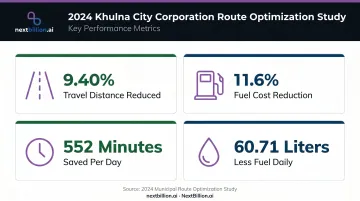
The numbers are concrete. A 2024 study on municipal solid waste route optimization for Khulna City Corporation found that optimized routes reduced:
- Travel distance by 9.40%
- Fuel costs by 11.6%
- Travel time by 552 minutes per day
- Fuel consumption by 60.71 liters per day
A separate 2021 study in the Monterrey Metropolitan Area reported 9–20% reductions in distance covered and greenhouse-gas emissions. Those reductions compound across every vehicle in a fleet, year over year.
Software-driven routing vs. static schedules
Modern route optimization accounts for vehicle capacity, service time windows, driver shift limits, turn restrictions, and vehicle-specific road access — not just point-to-point distance. When a stop is missed or a road closes mid-shift, dynamic re-routing adjusts the plan in real time rather than leaving dispatchers to guess.
For waste haulers building or upgrading their software stack, NextBillion.ai's Route Optimization API supports 50+ hard and soft constraints relevant to waste collection operations:
- Multi-dimensional capacity planning (residential, commercial, and hospital bin sizes)
- Return-to-dump logic and curbside pickup requirements
- Driver shift compliance and turn restrictions
- Distance matrix support up to 5,000×5,000 — no 25×25 cap limiting large multi-zone fleets
KPIs this affects: fuel cost per route, miles driven per shift, stops completed per vehicle per day, idle time percentage, missed pickup rate.
Route optimization delivers its highest ROI at scale — fleets of 10+ vehicles, multi-zone operations, and businesses onboarding new service areas where institutional route knowledge is limited. When comparing routing software for the waste industry, prioritize platforms that handle waste-specific constraints like bin capacity by stream, return-to-dump logic, and driver hours-of-service limits, not generic last-mile routing tools.
Benefit 2: Automated Regulatory Compliance and Reporting
Waste management is among the most heavily regulated industries. Operators must track hazardous waste manifests, consignment notes, disposal records, and — increasingly — digital submissions required by government agencies.
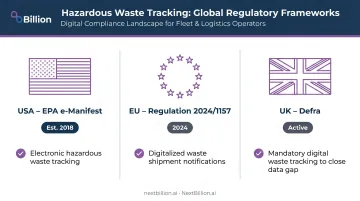
The regulatory direction is clear:
- The EPA's e-Manifest system, launched in 2018, mandates electronic tracking of hazardous waste shipments across the US
- EU Regulation 2024/1157 introduces digitalized waste shipment notifications and information exchange across member states
- Defra (UK) has acknowledged that despite producing over 200 million tonnes of waste per year, the UK lacks a single comprehensive tracking system — a gap that mandatory digital waste tracking is designed to close
Software creates this advantage by automatically capturing every transaction in the waste chain — collection, transfer, treatment, disposal — and generating audit-ready records without manual data entry. Compliance gaps are flagged in real time rather than discovered during an inspection.
Beyond avoiding fines: companies that produce clean compliance documentation on demand are better positioned to win enterprise and government contracts, where proof of regulatory standing is a standard procurement requirement.
KPIs this affects: compliance exceptions flagged, time to produce audit documentation, penalty incidents per year, percentage of consignments with complete digital records.
This benefit is most critical for operations handling hazardous, medical, or electronic waste — where documentation requirements are strictest — and for any business targeting regulated contract markets.
Benefit 3: Real-Time Data Insights and Smarter Decision-Making
Waste management software consolidates data from vehicle GPS, scheduling systems, and customer records into a single operational dashboard — giving managers live visibility into what's happening across every route at any moment.
The operational difference real-time visibility makes
Without it, supervisors learn about problems through customer complaints or end-of-day reports. With it, they can intervene before problems escalate:
- Reroute a vehicle around a road closure before the driver loses 30 minutes
- Reassign a pickup when a truck falls behind schedule
- Identify an underperforming zone before it affects service agreements
For waste management software providers building this capability into their platforms, NextBillion.ai's Live Tracking API surfaces real-time vehicle location (up to 1-meter accuracy), live ETAs based on actual traffic conditions, geofence and route deviation alerts, and job completion status.
It integrates with Geotab, Samsara, and Motive — platforms many waste haulers already run — enabling bidirectional data flow between route planning and fleet tracking without manual reconciliation.
KPIs this affects: on-time completion rate, customer complaint rate, average response time to service exceptions, vehicle utilization rate, cost per collection.
Real-time visibility has its highest operational value in multi-site operations and businesses managing dispersed driver fleets — which describes virtually every commercial waste operation at moderate scale.
Benefit 4: Smart Collection Scheduling and Automation
Static timetables are efficient until they're not. Customer volumes change, vehicles go out of service, and seasonal demand shifts — but fixed schedules don't adjust automatically.
Automated scheduling replaces manual planning with dynamic, data-informed pickup plans built around actual waste generation patterns, service agreements, and vehicle availability. The operational outcome:
- Fewer missed collections — schedules reflect real capacity, not outdated assumptions
- Lower overtime costs — workloads are distributed based on availability, not guesswork
- Better resource utilization — vehicles and drivers are matched to demand rather than assigned by habit
For context on how missed pickups are measured: official UK benchmarks track missed waste collections per 100,000 collections, with a widely cited target below 90 per 100,000. That's a tight operational standard — one that's difficult to maintain when scheduling is manual and reactive.
Benefit 5: Centralized Data Management and Improved Customer Transparency
Many waste operators run 5–10 disconnected systems — billing, CRM, routing, compliance, weighbridge — each with its own data format and update cycle. The result is version control problems, duplicate entries, and information gaps that slow decision-making and create customer service failures.
How a unified platform changes daily operations:
- A single source of truth for invoicing, job completion, compliance, and customer history
- Reduced administrative burden across scheduling, billing, and reporting teams
- Faster resolution of disputes or service exceptions because all data is in one place
On the customer-facing side, automated notifications and self-service portals give clients real-time visibility into pickup schedules and completion confirmations — reducing inbound service calls and building retention.
As commercial customers face their own sustainability reporting requirements, waste operators who can provide clean data exports and waste diversion metrics gain a real competitive advantage.
Routeware's ReCollect platform, used by hundreds of municipalities and haulers across North America and the UK, has sent over 2 billion notifications to date — a figure that signals customer-facing transparency is now table stakes in waste service delivery, not a differentiator.
Benefit 6: Scalability Without Proportional Cost Growth
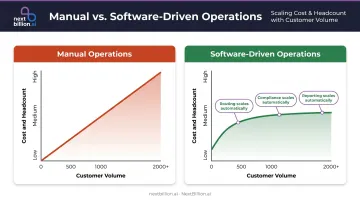
Manual operations scale linearly. Add 50 new commercial customers and you add scheduling time, compliance tracking, dispatch coordination, and reporting overhead — all of which require proportional staff increases.
Software-driven operations don't scale the same way. Scheduling, dispatch, and reporting are automated. Each new customer or service zone added to a digital system carries a fraction of the administrative cost it would in a manual environment.
Where this compounds:
- A new service area is onboarded with existing routing logic, not institutional knowledge that lives in one dispatcher's head
- Compliance documentation scales automatically — no additional data entry staff required
- Reporting for new contract customers is generated from the same system already handling existing accounts
This benefit is most visible when comparing two operations at the same revenue point: one running on software, one on spreadsheets. The software operation typically carries significantly less administrative overhead per customer — and that gap widens as both businesses grow.
Benefit 7: Reduced Missed Pickups Through Better Scheduling and Dispatch
Missed pickups are the most visible service failure in waste management. They generate customer complaints, require costly reroutes for recollection, and — at scale — put contract relationships at risk.
The factors that drive missed pickups are largely preventable with the right tooling:
- Static routes that don't account for vehicle downtime or driver absences
- No real-time visibility into whether a stop has been completed
- Dispatch decisions made on outdated information
Software addresses all three. When scheduling, tracking, and dispatch work from the same live data, a missed stop triggers reassignment automatically — before the customer files a complaint or a service credit is owed.
The consequences of failure compound quickly. A single missed stop becomes a reroute cost, a service credit, and a logged complaint. At the contract renewal stage, patterns of missed pickups are difficult to explain away — and easy for competitors to exploit.
What Happens When Waste Management Software Is Missing
That peer-reviewed survey of 130 waste firms found 25% were fully analog — using none of the six digital technologies studied. The consequences of operating without dedicated software follow a recognizable pattern.
The downstream consequences follow a predictable pattern:
- Rising fuel costs from static, unoptimized routes that don't adapt to changing stop density or traffic
- Compliance exposure from incomplete manual records: printed proof-of-service documents that get lost, go unsigned, or contain inconsistencies
- Customer attrition driven by missed pickups and no proactive communication
- Inability to scale — every new service area adds proportional administrative overhead
- Reactive management — problems surface through complaints rather than through operational data
At small scale, these friction points are annoying but workable. Past a certain volume — more trucks, more routes, more service contracts — they stop being inefficiencies and start blocking growth entirely.
How to Get the Most Value from Waste Management Software
Software delivers maximum value when it's connected to all parts of the operation — not deployed as a standalone tool alongside the same disconnected systems it was meant to replace.
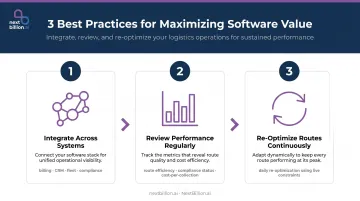
Three practices that determine outcomes:
Integrate across systems — connect billing, CRM, fleet management, and compliance into the same data environment. Disconnected systems recreate the silos software is meant to eliminate.
Review performance on a defined cadence — route efficiency, compliance status, and cost-per-collection metrics need regular analysis. Confirming things are "good enough" isn't the same as identifying where the next 10% improvement comes from.
Re-optimize routes on a running basis, not a fixed schedule — a route that was efficient six months ago may not reflect current stop density, traffic patterns, or vehicle allocation. NextBillion.ai's route optimization engine supports continuous re-optimization using live constraints. Routes can be rerun within a 24-hour window at no additional cost, making daily re-optimization practical rather than quarterly.
For waste management software vendors embedding routing into their platforms, NextBillion.ai's API supports:
- Direct integration with Geotab, Samsara, and Motive
- Bidirectional data sync with SAP, Oracle, and Microsoft Dynamics
- CSV import/export for operations not yet on a full telematics stack
Conclusion
Waste management software's value isn't any single feature. It's the compounding effect of optimized routing reducing fuel spend, real-time visibility preventing service failures, and automated compliance documentation eliminating audit risk. Those systems work together, consistently, across every shift — and that consistency is where the real return comes from.
Businesses that treat it as an ongoing operational practice — reviewing performance data regularly and acting on what they find — will see those benefits compound over time. The difference between marginal gains and meaningful cost reduction usually comes down to how actively a team engages with what the data is telling them. Route-level analytics, exception alerts, and service verification logs are only useful if someone is acting on them.
Frequently Asked Questions
What are the benefits of advanced waste management software for businesses?
Advanced waste management software delivers cost reduction through route optimization, compliance assurance through automated documentation, and operational efficiency through real-time visibility. What separates advanced platforms is integration: these capabilities work together in a single system rather than as disconnected tools.
How does waste management software help reduce operational costs?
Cost reductions come from three primary sources: reduced fuel spend through optimized routing, lower labor costs through automated scheduling, and fewer compliance penalties through accurate recordkeeping. Route optimization alone can reduce fuel costs by over 11% based on documented municipal implementations.
What features should businesses look for in waste management software?
Core features to evaluate: route optimization, real-time GPS fleet tracking, automated compliance and reporting, scheduling automation, customer portal capabilities, and integration with existing billing and CRM systems. API integration capability matters for businesses that need the software to connect with telematics platforms like Geotab or Samsara. Also check whether the routing engine accounts for truck restrictions such as height, weight and hazmat rules, since generic consumer mapping tools do not.
How does waste management software support regulatory compliance?
The software automatically captures and timestamps every transaction in the waste chain — collection, transfer, disposal — generating audit-ready documentation that satisfies regulatory requirements like EPA e-Manifest without manual data entry. Compliance gaps are flagged in real time rather than discovered during an inspection.
Can small waste management businesses benefit from this software?
Yes, though ROI scales with operational size. Even smaller operations benefit from automated scheduling, compliance tracking, and route planning. Cloud-based SaaS models with per-vehicle or per-order pricing (such as NextBillion.ai's flexible pricing structure) lower the barrier to entry compared to legacy on-premise systems. Smaller fleets also avoid heavy upfront IT investment, since these platforms run on existing phones and tablets rather than requiring dedicated in-cab hardware.
How does route optimization technology fit into waste management software?
Route optimization is typically embedded as a core module or integrated via API. It calculates the most efficient daily collection sequences based on vehicle type, capacity, service windows, and real-world traffic, directly reducing miles driven per shift. Purpose-built APIs handle constraints generic mapping tools cannot, including truck-specific routing and large-scale multi-stop matrices.
What is the best routing software for the waste industry?
The best routing software for waste operations is built for the constraints of the industry, not generic mapping. That means truck-specific routing accounting for vehicle height, weight and turn restrictions, dynamic re-sequencing for pickup exceptions, and API access so it plugs into existing dispatch and billing systems. Look for platforms like NextBillion.ai that expose these capabilities as APIs rather than locking them inside a closed, one-size-fits-all app.
Does waste management software improve driver safety and compliance with hours-of-service rules?
Yes. By optimizing routes and schedules, the software reduces unnecessary driving time, which helps fleets stay within FMCSA hours-of-service limits and avoid fatigue-related incidents. Automated logs and real-time tracking also make it easier to demonstrate compliance during DOT audits, since trip data is captured automatically rather than reconstructed from paper records after the fact.