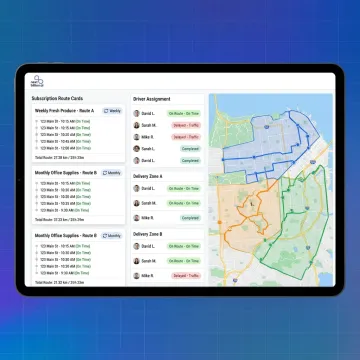
What is recurring and subscription delivery route optimization?
There is no single best route optimization software for every use case. The right choice depends on stop volume, delivery frequency, constraint complexity, and how the software fits into existing fleet and dispatch systems. For recurring and subscription delivery operations specifically, look for platforms that support repeat-stop scheduling, route consistency over time, flexible re-optimization, and API-based integration rather than one-off route generation.
How is recurring route optimization different from standard last-mile routing?
Standard last-mile routing often focuses on same-day or one-time orders, while recurring route optimization is built around repeat stops, fixed service frequencies, and long-term route consistency. It helps operators preserve efficient territory structures, maintain balanced workloads, and refine routes over time using historical performance. That makes it especially useful for subscription delivery, scheduled replenishment, and repeat-service logistics models.
Can NextBillion.ai handle weekly and monthly recurring delivery schedules?
Yes. NextBillion.ai supports recurring route planning for weekly, monthly, and other repeat delivery cadences. Teams can optimize routes around service frequency, time windows, vehicle capacity, shift rules, and depot logic. This makes it easier to manage subscription deliveries, scheduled replenishment, and repeat-stop operations without relying on spreadsheets or rebuilding route plans from scratch each cycle.
Does the platform support route changes when recurring orders shift?
Yes. The platform is designed for operational change, including customer additions, cancellations, skipped deliveries, and mid-cycle demand shifts. Teams can re-optimize routes as stop volumes change, rebalance workloads across drivers, and update dispatch plans without starting over. This flexibility is important for subscription businesses where recurring schedules are predictable overall but still change week to week.
How many stops can NextBillion.ai optimize for recurring delivery operations?
NextBillion.ai’s route optimization platform can solve routing problems with up to 10,000 stops in seconds, depending on the workflow and constraints used. That scale is valuable for recurring delivery operators managing dense route networks, multi-depot planning, or large subscription customer bases. It also supports large distance matrix calculations to improve assignment, clustering, and territory planning before optimization runs.
What constraints can be used for subscription delivery route planning?
The platform supports more than 50 hard and soft constraints, including vehicle capacity, delivery time windows, service time per stop, driver shifts, break rules, multi-depot logic, customer priority, and route duration limits. For recurring delivery operations, these constraints help create routes that are not only efficient on paper but also practical for repeat execution across weekly or monthly schedules.
Can NextBillion.ai integrate with our existing delivery or fleet systems?
Yes. NextBillion.ai offers APIs, SDKs, and integration support for logistics platforms, fleet systems, and operational software. It integrates with tools such as Geotab, Samsara, Salesforce, SAP, and Microsoft Dynamics 365, and supports custom workflows through its API-first platform. Teams can embed optimization, dispatch, tracking, and geofencing into existing systems rather than replacing their entire stack.
How quickly can we test and deploy the platform?
Most teams can begin with a trial API key for one to two weeks of evaluation and testing. With solutions engineering support, production go-live can happen within one week for many implementations. Timelines vary based on integration complexity, the number of systems being connected, and how many routing constraints and workflows need to be configured before recurring delivery routes go live in production.
Can AI do route optimization for recurring delivery schedules?
Yes. AI-driven route optimization can process large numbers of stops, constraints, and historical patterns faster than manual planning, and can re-optimize routes as conditions change, such as cancellations or new subscription sign-ups. For recurring delivery, AI helps identify patterns across cycles, refine routes based on past performance, and rebalance driver workloads without requiring planners to rebuild schedules from scratch each time.
How can I optimize my delivery route for recurring stops?
Start by grouping stops by frequency and service window, then apply routing constraints such as vehicle capacity, driver shifts, and depot location. Software-based optimization can automate this process, factoring in more variables than manual planning allows. For recurring delivery, it also helps to track performance across cycles and re-optimize routes as customer volumes, cancellations, or new stops change the underlying stop pattern.