Introduction
UPS ORION's AI route optimization delivers savings by cutting fuel use, mileage, and delivery time across the fleet — more than $320 million by the time full deployment finished, with $300–$400 million estimated annually at scale. UPS delivers 20.8 million packages daily across a fleet of roughly 125,000 vehicles. At that volume, even a single wasted mile per driver compounds into tens of millions in avoidable costs — which is exactly why the company spent over a decade building something no carrier had attempted at this scale.
ORION (On-Road Integrated Optimization and Navigation) is UPS's AI-powered route optimization system — the operational engine behind the world's largest small-package delivery network. By the time it reached full deployment in 2016, INFORMS reported it had already saved UPS more than $320 million, before the rollout was even complete.
This article covers how ORION works, what it cost to build, what it saved, and how its evolution into a real-time dynamic system offers a blueprint for the broader logistics industry.
Key Takeaways
- ORION is UPS's AI route optimization system, 10+ years in development, deployed to 55,000 drivers by 2016
- It saved UPS more than $320M by December 2015 and is estimated to deliver $300–$400M in annual savings at full scale
- The system cuts 100 million miles per year across the fleet — roughly 8 fewer miles per driver per day
- Dynamic ORION (2020) added real-time mid-route rerouting, saving an additional 2–4 miles per driver per day
- Route optimization at this scale is now replicable via API-based platforms — giving logistics operators access to the same constraint-based, ML-driven planning without building it from scratch
What Is UPS ORION and Where Did It Come From?
ORION didn't emerge from a hackathon. It was built on top of a decade of data infrastructure.
The Foundation: Package Flow Technology (2003)
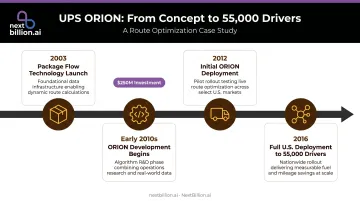
Before ORION existed, UPS launched Package Flow Technology (PFT) in 2003 — a system that digitized pickup and delivery operations by combining package data, address information, and analytical tools into a unified platform. PFT was significant on its own: according to INFORMS, it reduced fuel consumption by 8.5 million gallons and cut 85,000 metric tons of CO2 annually before ORION even launched. Those are the baseline numbers. ORION's savings are on top of those gains.
The Development Timeline
| Milestone | Year |
|---|---|
| Package Flow Technology launched | 2003 |
| ORION development begins (10+ years in the making) | Early 2010s |
| Initial ORION deployment begins | 2012 |
| Full U.S. deployment to 55,000 drivers | 2016 |
That timeline came with a price tag: $250 million. Early algorithmic approaches worked in controlled environments but broke down in the field. The team ultimately had to blend operations research with what ORMS Today describes as 108 years of UPS delivery practice — a compromise that pushed ORION toward route suggestions drivers would actually follow, rather than theoretically optimal paths they wouldn't.
How UPS ORION's AI Route Optimization Works
The Computational Challenge
Each UPS driver serves roughly 160 customers per day. The number of possible sequences for those stops exceeds anything a human planner could evaluate manually. ORION's job is to process those combinations and surface the optimal sequence before drivers leave the facility each morning. This is also where hours-of-service constraints under FMCSA rules matter operationally: a route sequence has to fit within a driver's available on-duty window, not just minimize distance, so any optimization model for commercial delivery fleets has to treat drive-time limits as a hard constraint rather than an afterthought.
The system draws on multiple real-time data inputs:
- GPS telematics from vehicles
- Live traffic feeds and weather conditions
- Customer delivery windows and package specifications
- 250 million address data points used for optimized routing
- Historical delivery patterns and stop-level performance data
The Left-Turn Strategy
One of ORION's most discussed insights is left-turn minimization. According to UPS's Routes to the Future, the system is specifically programmed to reduce left-hand turns because they create disproportionate idle time, fuel waste, and safety risk.
The math is straightforward: a driver waiting 45 seconds through a left-turn light sounds trivial. Multiply that across 55,000 daily routes and it becomes millions of wasted minutes and gallons of fuel.
Avoiding unnecessary left turns doesn't require a longer route — it requires a smarter sequence. ORION optimizes stop order specifically to reduce left-turn exposure, not just total mileage.
Real-Time Adaptability via DIAD
ORION also adjusts routes mid-delivery, not just at the start of each shift. Drivers interact with the system through handheld DIADs (Delivery Information Acquisition Devices), which mount to the dashboard and feed live data back to ORION.
When road conditions change, a pickup is added, or a delivery window shifts, ORION pushes updated routing guidance to the driver without requiring manual intervention.
Measuring ORION's Impact: The Numbers That Proved AI Can Transform Logistics
The business case for ORION is unusually clear-cut. Here's what the verified data shows:
Financial Returns
| Metric | Figure |
|---|---|
| Estimated project cost | $250 million |
| Savings by December 2015 (before full deployment) | More than $320 million |
| Estimated annual savings at full scale | $300–$400 million |
The ROI payback happened before the project was complete — most enterprise technology deployments at this scale take years post-launch to break even, if they ever do. That timing matters for anyone evaluating route optimization savings as a business case: the numbers show payback tied to operational deployment milestones, not a fixed calendar date, which is the more realistic way to model returns for a fleet of any size.
Operational Impact
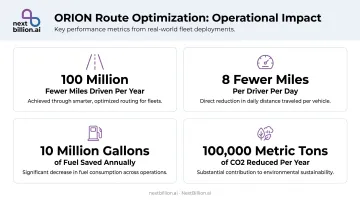
- 100 million fewer miles driven per year across the fleet
- 8 fewer miles per driver per day under the original ORION system
- 10 million gallons of fuel saved annually
- 100,000 metric tons of CO2 reduced per year
To put the mileage figure in perspective: 2 fewer miles per driver sounds negligible. Across 55,000 drivers running 250 days a year, that's 27.5 million miles saved from a single small change. The fuel and emissions reductions follow the same logic: no single route change produces the headline number. The aggregate of millions of marginally better decisions does.
Industry Recognition
The scale of these results drew formal recognition from the operations research community:
- 2016 Franz Edelman Award for Achievement in Operations Research and Management Sciences
- 2020 INFORMS Prize for Longstanding Contributions in Operations Research and Analytics
- Tom Davenport described ORION, in remarks cited by INFORMS, as "arguably the world's largest operations research project"
From Static to Dynamic: How ORION Evolved
ORION 1.0 vs. Dynamic ORION
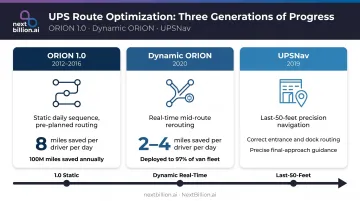
The original system was static — it generated an optimized sequence at the start of each day, and that was the route. Useful, but limited. Real-world logistics doesn't stay static past 8 AM.
In January 2020, UPS announced Dynamic ORION: a third-generation upgrade that recalculates routes throughout the day based on changing traffic, new pickup commitments, and shifting delivery priorities. Supply Chain Dive reported that by 2021, dynamic routing had been deployed to 97% of the ORION-enabled van fleet, adding an incremental 2–4 miles of savings per driver per day beyond what ORION 1.0 already achieved.
That incremental gain adds up. Combined with the original 8-mile reduction, Dynamic ORION pushes per-driver savings to roughly 10–12 miles per day — a meaningful compounding effect across a fleet of tens of thousands of drivers.
UPSNav: Solving the Last 50 Feet
Sequence optimization tells drivers where to go next. UPSNav — announced in December 2018 and deployed in 2019 — tells them precisely how to get there: which entrance to use, where the loading dock is, which side of the building accepts freight.
In dense urban environments with complex building access, that gap adds up fast. A driver who spends four minutes locating the correct entrance at each of 160 stops loses over ten hours weekly across a modest fleet. UPSNav targets exactly that inefficiency — working alongside ORION's sequence logic, not replacing it.
The Hidden Challenges Behind ORION's Rollout
The Human Adoption Problem
The technology worked in testing. Getting experienced drivers to trust it was harder.
Drivers with years of experience on familiar routes encountered algorithm-generated sequences that sometimes looked wrong — counterintuitive detours, unfamiliar orderings, routes that didn't match their mental map of the territory. ORMS Today notes that INFORMS judges were specifically impressed by UPS's ability to achieve driver acceptance at this scale, calling it a significant organizational accomplishment.
UPS addressed the resistance through:
- Extensive driver training programs tied to ORION deployment
- Performance metrics tracking the percentage of time drivers followed ORION routes
- Ongoing refinement based on driver feedback to improve algorithm accuracy
That dynamic applies to any AI deployment in field operations: the people whose behavior the system is trying to optimize are also the ones who decide whether to use it. Getting the algorithm right is only half the work.
The Technical Integration Challenge
The people challenge ran in parallel with a significant technical one. Connecting ORION to existing fleet systems required custom integration work, and scaling it to handle the address and routing data of the entire U.S. small-package network in near-real time demanded substantial infrastructure investment.
UPS's 2021 technology presentation references cloud infrastructure and SaaS capabilities as part of the broader stack. The specific architectural choices behind ORION remain proprietary — but the scale alone signals what any organization should expect: real-time route optimization across tens of thousands of daily routes is an infrastructure problem as much as an algorithms problem.
What ORION Teaches the Rest of the Industry
The Core Lesson
ORION proves that route optimization — when built on quality data, real-time inputs, and constraint-aware algorithms — delivers compounding returns that show up in fuel receipts, mileage logs, and P&L statements. The efficiency gains aren't projections. They're auditable.
The mechanism is the same regardless of fleet size: smaller per-vehicle improvements multiplied across more routes and more days produce disproportionate total savings.
The Build vs. Access Reality
UPS spent over $250 million and more than a decade building ORION from its own operational data, engineering teams, and institutional knowledge. That path isn't available to most logistics operators — and it doesn't need to be.
What ORION relies on — multi-stop sequence optimization, real-time rerouting, constraint-aware routing, truck-specific road restrictions — is now accessible through API-based platforms built specifically for logistics operators.
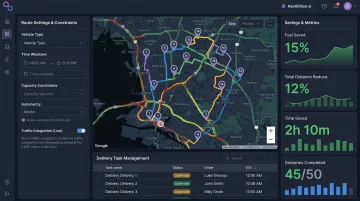
NextBillion.ai's route optimization platform, for instance, supports 50+ hard and soft constraints. Key capabilities include:
- Delivery time windows, driver shift limits, and vehicle dimension restrictions
- Hazmat routing and axle load compliance
- Mid-day order insertion with route sequences recalculated in seconds
- Live traffic integration without proprietary infrastructure
The platform has helped optimize 10.9+ million deliveries and field tasks, delivered $11+ million in documented cost savings across more than 150 businesses globally, and navigated over 557 million miles. Xpress Global Systems, one documented customer, achieved a 13% reduction in miles driven per month alongside a 35% reduction in operating costs — a result pattern that maps directly to what ORION demonstrated at UPS scale.
For logistics operators, ORION settled the proof-of-concept question in 2015. What remains is execution: accessing the same optimization logic — constraints, real-time rerouting, sequence recalculation — without a decade-long build.
Frequently Asked Questions
How much does ORION save UPS on route optimization costs?
ORION is estimated to save UPS $300–$400 million annually at full deployment. By December 2015 (before full rollout was complete), it had already generated more than $320 million in savings against a $250 million project cost. The system also cuts approximately 100 million miles per year across the fleet.
Does UPS still use ORION?
Yes. ORION remains active and has continued to evolve significantly since its initial 2012 deployment. The system progressed from static daily routing to Dynamic ORION with real-time rerouting, now covering 97% of the ORION-enabled van fleet. UPSNav was added in 2019 to address last-mile navigation precision.
Does UPS ORION use AI to optimize routes?
ORION combines operations research (mathematical optimization) with machine learning for predictive analytics on traffic, weather, and delivery patterns. It learns continuously from historical GPS and telematics data, processing roughly 250 million address points to generate each day's optimized sequences. This hybrid approach is the same pattern most commercial routing APIs follow: deterministic optimization for hard constraints, machine learning layered on top for prediction, rather than pure black-box AI.
What is Dynamic ORION and how is it different from the original system?
The original ORION optimized delivery sequences once at the start of each day. Dynamic ORION, announced in 2020, recalculates routes throughout the shift based on live traffic, new pickups, and changing conditions. The dynamic upgrade adds approximately 2–4 incremental miles of savings per driver per day on top of the original system's gains.
How did UPS get drivers to adopt ORION?
Initial resistance was real — experienced drivers were skeptical of sequences that looked counterintuitive. UPS responded with structured training programs, route-following performance metrics, and feedback loops that incorporated driver input into algorithm updates. INFORMS recognized the driver adoption process when awarding UPS its Franz Edelman Award for achievement in operations research.
Can smaller logistics companies use ORION-like route optimization?
Building a system like ORION in-house requires a scale of investment most logistics operators can't justify. API-based platforms now make the same core capabilities — multi-stop optimization, real-time rerouting, 50+ routing constraints — accessible without the decades-long build cycle. Integration timelines run days, not years. Fleets also inherit compliance-aware planning, meaning routes can factor in driver hours-of-service limits and vehicle restrictions without building that logic from scratch.
Does ORION account for FMCSA hours-of-service rules when planning routes?
Public information on ORION does not detail how it handles hours-of-service compliance specifically. In general, route optimization systems built for US commercial fleets need to account for FMCSA hours-of-service limits, mandatory breaks, and CDL-related constraints when sequencing stops, since a route that looks efficient on paper can still put a driver over legal driving limits. This is a standard requirement for any US-based fleet routing tool, not just ORION.