Introduction
Real-time waste collection software is a platform that tracks trucks live via GPS, recalculates routes mid-shift, and gives dispatchers a continuously updated view of every stop, exception, and delay as they happen. Most waste collection fleets still operate on plans built the night before. Fixed routes, fixed schedules, dispatchers relying on phone calls — and then reality hits: a truck breaks down at stop 14, traffic backs up on the main arterial, and a commercial client calls in an unplanned pickup. By 9 AM, the day's plan is already wrong.
The costs compound fast. Missed collections trigger resident complaints and service credits. Drivers run overtime covering gaps. Fuel burns on redundant mileage. Supervisors have no live view to course-correct. Research on municipal waste collection shows it can represent 50–70% of total waste management costs — which means operational inefficiency hits budgets hard.
For 2026, the pressure is sharper. Three forces are converging on waste operations:
- Budget constraints: Muhlenberg Township's 2025 trash fee increase followed a $500,000 operating shortfall — a pattern repeating across municipalities
- Sustainability mandates: Contract renewals now carry emissions and diversion-rate conditions that fixed-route operations struggle to meet
- Procurement requirements: GPS tracking and monthly performance reporting have become standard contract terms, not optional add-ons
This guide covers what real-time waste collection software actually is, why traditional operations can't keep pace, the core features that matter, how route optimization works in practice, and what to look for when evaluating platforms.
Key Takeaways
- Real-time waste collection software connects GPS, driver apps, dispatch dashboards, and route optimization into a single operational view
- Dynamic routing recalculates stop sequences mid-shift — not just overnight — based on traffic, breakdowns, and new pickups
- Municipal contracts increasingly require GPS proof-of-service and monthly tonnage/service reporting
- When evaluating platforms, prioritize constraint depth, mid-shift recalculation speed, and pricing model (per-vehicle vs. per-API-call)
- Integration with existing telematics (Geotab, Samsara, Motive) avoids rebuilding your entire operation
What Is Real-Time Waste Collection Software?
Real-time waste collection software is a digital operations platform that unifies live GPS telemetry, dynamic route optimization, driver mobile tools, and dispatch dashboards into a single operational view. Legacy scheduling tools handle static route planning or billing — but go dark the moment trucks leave the depot. Real-time platforms don't. Evaluating the best software for waste management comes down to whether it holds up under these three layers, rather than which vendor has the longest feature list.
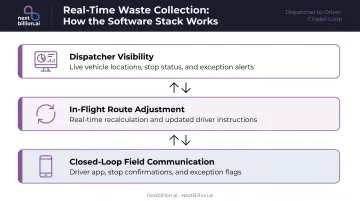
The Three Technology Layers
Layer 1 — Dispatcher visibility: Vehicle locations stream continuously to a central dashboard, showing which trucks are on route, which stops are complete, and where exceptions are developing.
Layer 2 — In-flight route adjustment: When a traffic incident, breakdown, or emergency pickup hits, the optimization engine recalculates and pushes updated instructions to affected drivers within seconds — not hours.
Layer 3 — Closed-loop field communication: Drivers receive updated stop sequences, turn-by-turn navigation, and dispatch messages on a mobile app. Service confirmations and exception flags flow back automatically.
IoT fill-level sensors fit as an optional fourth layer — smart bin data can feed the routing engine to prioritize overflow-risk containers — but it's an advanced add-on, not a baseline requirement.
Who Uses It
- Municipal solid waste authorities managing residential collection contracts with regulatory reporting requirements
- Private residential and commercial haulers competing on service reliability and cost efficiency
- Roll-off and dumpster operators managing on-demand pickups with variable stop sets
- Recycling fleet managers routing by material stream and disposal facility constraints
The operational details vary by segment, but the core need is identical: knowing what every truck is doing, right now, and being able to act on it.
Why Traditional Waste Collection Operations Fall Short
The Fixed-Route Problem
The standard model sends trucks over every segment of every route, whether bins are full or not. Dispatchers manage exceptions by phone. Route changes — a broken truck, an added commercial stop, a school zone delay — require manual coordination with no live view of what's actually happening on the road.
A 2021 study of refuse truck operations found average fuel economy of just 1.9 miles per diesel-gallon equivalent, with 53% of operational time spent idling — including during collection activity. That's the fuel baseline you're working with before accounting for routing inefficiency on top.
Without live fleet visibility, supervisors cannot:
- Confirm which stops have been serviced and which were missed
- Redeploy resources when a truck breaks down mid-route
- Resolve resident service disputes with any evidence beyond driver memory
- Respond to last-minute commercial pickup requests without disrupting the whole route
The Compliance and Reporting Gap
Paper-based and spreadsheet workflows fail against modern contract requirements. Two active procurement documents illustrate how specific these mandates have become:
- Nolanville, TX (2024 MSW contract): GPS tracking on every vehicle, stored data available to the city on written request, monthly reports due by the 10th
- GreenNY (2025 organic waste spec): Reporting of actual or estimated weight, volume, and processing facilities for all covered services
These aren't future requirements — they're already in signed contracts. Fleets without automated data capture are building these reports by hand, which creates both audit exposure and the near-certainty of gaps when contract renewal comes around.
Core Features of Real-Time Waste Collection Software
Real-Time GPS Fleet Tracking
Live vehicle location on a dispatcher dashboard answers the questions that matter operationally: Where is each truck right now? Which stops are confirmed? Where is the exception developing? For drivers, the best app for collecting waste pairs that same GPS feed with turn-by-turn stop sequences and two-way dispatch messaging, so the crew in the field and the dispatcher watching the map are always working from the same information.
The Wasatch Front Waste and Recycling District reviews missed-pickup reports using truck cameras, GPS activity, and route data — a documented example of how GPS evidence replaces disputed driver logs in service verification. Key operational benefits include:
- Exception response: When a truck breaks down, a dispatcher with live visibility can identify the nearest available vehicle and redirect it within minutes
- Service verification: GPS timestamps and camera footage resolve customer disputes without requiring driver statements
- Audit trail: Route activity logs support compliance reporting and performance reviews
Without that live view, the same breakdown scenario involves phone calls, guesswork, and delayed service recovery.
Dynamic Route Optimization
GPS tracking tells you where trucks are. Dynamic optimization determines where they should go next — and recalculates that answer continuously throughout the shift.
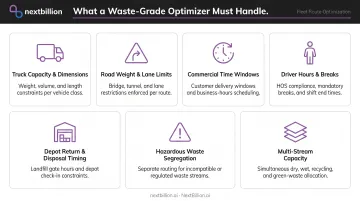
Static route planning produces a sequence the night before. Dynamic optimization recalculates that sequence as conditions change mid-shift. Waste routing is more complex than consumer navigation. A capable optimization engine accounts for:
- Truck capacity and vehicle dimensions
- Legal road weight limits and lane restrictions
- Time windows at commercial facilities (hospitals, schools, gated sites)
- Driver hours, mandatory breaks, and shift limits
- Depot return timing and disposal site capacity
- Hazardous waste segregation and multi-compartment truck assignments
- Multi-dimensional capacity across different waste streams
NextBillion.ai's route optimization engine handles 50+ constraints simultaneously, including truck-compliant routing, incompatible load type restrictions, and dump site coordination for return-to-depot logic when trucks reach capacity. When conditions change mid-shift, the engine recalculates and delivers updated routes with sub-second latency.
Driver Mobile App and In-Cab Navigation
Drivers receive turn-by-turn guidance, updated stop sequences, and dispatch messages on a mobile app — no paper manifests, no radio coordination. The NextBillion.ai Driver App delivers lane-level navigation with speed limits and road restriction awareness, which matters when routing heavy trucks through urban routes with alleys, low bridges, and school zone restrictions. Route changes reach drivers the moment a dispatcher acts, and proof-of-delivery capture closes the loop between field execution and back-office confirmation.
Data Capture, Analytics, and Customer Notifications
Every completed stop generates operational data that feeds compliance documentation and performance reporting. That data includes:
- Service timestamps and GPS-confirmed stop completion
- Exception flags for missed, partial, or delayed collections
- Driver activity logs for shift audits and SLA reporting
Automated customer-facing notifications about schedule changes and missed collection status reduce inbound call volume without requiring dispatcher intervention. Together, these data streams give operations managers a continuous feedback loop — from planned route to confirmed service to customer communication — without manual follow-up at each step.
How Real-Time Route Optimization Powers Smarter Waste Collection
Constraint-Aware Optimization in Practice
A dispatcher inputs the day's stops, vehicle roster, and shift windows. The engine generates the best route sequence across all constraints. As conditions change, it recalculates and pushes updated instructions to affected drivers.
What separates a true constraint-aware optimizer from a basic route planner is the depth of operational logic it can apply simultaneously. Consumer GPS apps optimize for distance and time. Waste fleet optimization must also handle:
- Which truck carries which waste stream (no cross-contamination)
- When each truck needs to divert to a transfer station before it's over capacity
- Which stops have time windows that can't flex
- Which roads are off-limits for the truck's specific weight and dimensions
NextBillion.ai's engine supports multi-compartment truck planning, zone-based territory management, and multi-depot configurations — meaning a fleet operating across several service zones can optimize routes from each depot independently while still balancing workload distribution across the fleet.
Integration Layer
Real-time optimization only works if it's receiving live data. Platforms need documented integrations with telematics providers to pull vehicle location and status, and with billing or CRM systems to confirm stop completion.
NextBillion.ai maintains pre-built integrations on the Samsara, Geotab, and Motive marketplaces, enabling two-way data flow: vehicle and order data pull in from existing telematics, and optimized route plans push back out to driver apps. This API-first architecture lets waste operators embed intelligent routing into their existing software stack with no operational rebuild required.
That flexibility extends to custom deployments. SIR, a Mexico City environmental solutions provider, integrated NextBillion.ai's Route Optimization, Directions, Geofencing, and Clustering APIs directly into their existing navigation system — improving truck routing efficiency and resource allocation without replacing their operations platform.
IoT Fill-Level Sensors: An Advanced Integration
When smart bin sensors report fill levels, the routing engine can deprioritize low-fill containers and prioritize overflow risks — shifting from time-based to demand-driven collection. The underlying routing logic already exists: waste routing research has used waste filling level as a route-priority input since at least 2020.
The practical constraint is deployment infrastructure. A 2024 IDB analysis identified high device costs and digital-literacy requirements as the primary barriers to IoT adoption in solid waste systems. Sensor integration suits fleets that have already stabilized their real-time GPS and dynamic routing layer. Demand-driven optimization is the next step, not the starting point.
Scalability
Multi-depot fleets, seasonal demand spikes (post-holiday surge volumes), and fleet size growth all test an optimization platform's architecture. NextBillion.ai handles multi-depot planning by assigning trucks to specific depots with route logic that minimizes deadhead miles across service zones.
At scale, the distance matrix is where limitations show. NextBillion.ai supports matrices up to 5,000×5,000 elements, compared to Google Maps Platform's 25×25 standard limit. That headroom matters when planning hundreds of stops per shift without batching workarounds.
Business Benefits of Real-Time Waste Collection Software
Operational Cost Reduction
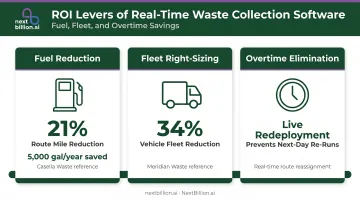
The ROI case for budget holders rests on three levers:
- Optimized routes cut fuel spend by eliminating redundant mileage, avoiding congestion with live traffic rerouting, and skipping near-empty bins when sensor data is available. The Cascais Ambiente study recorded a baseline of 6.28 L/tonne and 100.40 L/100 km — the gap that better routing closes.
- Fewer route miles mean fewer vehicles on the road. A Casella Waste Systems project reduced route miles by 21% and cut fuel use by 5,000 gallons per year; a Meridian Waste deployment freed 34% of solid waste vehicles in one market.
- Efficient routing reduces extended shifts for missed stops. When a breakdown occurs, live redeployment completes service without sending a full truck back out the next day.
Compliance and Service Verification
Automated GPS confirmation and timestamped service records replace disputed driver logs. Two common compliance needs this addresses directly:
- Dispute resolution: When a resident reports a missed collection, GPS activity and route data provide documented evidence — the approach already used by Wasatch Front Waste and Recycling District.
- Contract reporting: Automated data capture produces monthly tonnage, facility usage, and service verification documentation without manual spreadsheet work.
Environmental and Sustainability Impact
Fewer unnecessary collection runs mean lower fleet emissions. This matters increasingly for contract renewals: the UK Government's 2024 Carbon Reduction Schedule makes reducing contract-level GHG emissions an explicit procurement requirement, and the European Court of Auditors' 2025 report confirms EU waste policy is tightening legal requirements on collection and recycling targets.
For US municipal operators, ESG reporting requirements in contract renewals are trending the same direction. Route optimization data provides the mileage and efficiency metrics that support those reports.
How to Choose the Right Real-Time Waste Collection Software
Define Your Operational Scope First
Before evaluating vendors, answer these questions — they determine which platforms belong on your shortlist:
- Fleet size (number of vehicles across all depots)
- Service mix: residential, commercial, roll-off, recycling, or combined
- Number of depots and service zones
- Existing telematics hardware (Geotab, Samsara, Motive, or other)
- Whether billing or CRM integration is required for stop confirmation
- Regulatory reporting requirements (monthly tonnage, facility usage, GPS proof-of-service)
Evaluate Routing Engine Depth
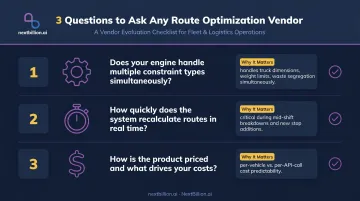
Ask vendors three specific questions:
- How many simultaneous constraints does the engine support? A basic route planner handles distance and time windows. A waste-grade optimizer handles truck dimensions, weight limits, road restrictions, waste segregation, disposal site capacity, and driver hours — all at once.
- What is route recalculation latency when conditions change mid-shift? This matters every time a truck breaks down or a new stop is added during the day.
- How does pricing scale at high recalculation frequency? Per-API-call models charge for every recalculation request, making costs unpredictable when routes change frequently. NextBillion.ai's per-vehicle pricing tracks vehicles over a 12-month period with no cap on API calls — so cost stays predictable no matter how often routes are reoptimized mid-shift.
Assess Integration Readiness and Security
Check whether the platform offers:
- Pre-built telematics integrations with the hardware already on your trucks
- Cloud and on-premise deployment options — NextBillion.ai supports AWS, Google Cloud, Azure, and Kubernetes-based private data center deployment
- Security certifications relevant to municipal procurement: SOC 2 Type II, ISO/IEC 27001, GDPR, and CCPA compliance
Implementation Timeline and Support
Some platforms require months of custom implementation. Others deploy core functionality in weeks. NextBillion.ai's onboarding takes approximately one week to tune the route planning objective function for a specific operation's constraints, with ongoing support from dedicated solution engineers at no additional cost — no separate support contract required.
When vetting any vendor, ask for:
- Reference customers of similar fleet size
- Documented support response times for mid-shift operational issues, not just onboarding
Frequently Asked Questions
What is real-time waste collection software?
A digital operations platform that combines live GPS fleet tracking, dynamic route optimization, and driver communication tools into a single operational view. Unlike static scheduling tools, it updates routes and dispatches driver instructions as conditions change throughout the shift.
How does real-time GPS tracking improve waste collection efficiency?
Live vehicle visibility lets dispatchers confirm service completion, redirect drivers around traffic incidents, and redeploy available trucks when a breakdown occurs — instead of finding out about problems hours later via phone. It also provides the GPS evidence needed to resolve resident service disputes. For municipal contracts, this same data supports FMCSA hours-of-service compliance and gives fleet managers a defensible record when addressing DOT inquiries or audits.
What is the difference between static and dynamic route optimization in waste collection?
Static optimization produces a fixed sequence planned overnight and updated in bulk. Dynamic optimization recalculates that sequence continuously during the shift based on live traffic data, new stop additions, vehicle breakdowns, and capacity events — pushing updated instructions to drivers within seconds. Static plans work for stable, low-variability routes, but dynamic optimization matters most in dense urban service areas or during weather events, holiday volume spikes, and other conditions that change collection demand mid-route.
How does waste collection software integrate with existing fleet management systems?
Through API-based integrations with telematics providers like Geotab, Samsara, and Motive. Vehicle and order data pull into the optimization platform; optimized routes push back out to driver apps and fleet management dashboards — no manual CSV handling required.
What features should I prioritize when evaluating waste collection route optimization software?
Three non-negotiables to evaluate:
- Constraint depth — truck weight limits, road restrictions, time windows, waste segregation rules, and disposal site capacity
- Recalculation speed — how fast routes update during mid-shift disruptions
- Pricing structure — per-vehicle pricing is more cost-predictable than per-API-call when routes recalculate frequently
How does real-time waste collection software reduce fuel costs?
Three factors drive the reduction:
- Optimized routes eliminate redundant mileage
- Live traffic rerouting keeps trucks out of congestion
- Fill-level sensor integration (where available) skips near-empty bins
Combined, these lower fuel burn per ton collected — and collection typically accounts for the largest share of waste management operating cost.
What is the best software for waste management?
There is no single best platform for every operation — the right choice depends on fleet size, route density, and existing telematics stack. Look for software that handles real-time route optimization, integrates with your current GPS and fleet management systems, and supports the constraint types specific to waste collection, such as weight limits, disposal site capacity, and time windows, rather than a generic delivery-routing tool retrofitted for waste.
What are 7 types of solid wastes?
Common classifications used in US municipal and commercial waste management include municipal solid waste, construction and demolition debris, industrial waste, hazardous waste, biomedical waste, electronic waste, and agricultural waste. Each category typically follows different collection, transport, and disposal rules, which is why route optimization software needs to account for vehicle-specific compatibility and segregation requirements rather than treating all stops as identical.