Introduction
Eco-friendly delivery route optimization software plans delivery routes that cut fuel use, vehicle emissions, and idle time while still meeting delivery windows and cost targets — treating environmental impact as a routing constraint, not an afterthought. Delivery fleets are under pressure from two directions: regulators tightening emissions standards, and consumers making purchasing decisions based on measurable sustainability progress — with 72% of consumers preferring companies with strong environmental practices. Eco-friendly delivery route optimization is the process of planning routes that minimize fuel consumption, vehicle emissions, and environmental impact while keeping operations running efficiently.
The urgency is real. According to IPCC AR6, transport accounts for roughly 15% of total global greenhouse gas emissions and approximately 23% of global energy-related CO2 emissions. The World Economic Forum adds a sharper warning for fleet operators: without further action, delivery vehicle numbers and carbon emissions could rise by as much as 60% by 2030.
This guide breaks down how eco-friendly route optimization works, what strategies actually move the needle, and which mistakes to avoid before they cost you.
Key Takeaways
- Eco-friendly route optimization treats emissions reduction as an explicit objective—not a byproduct of cutting distance or time
- Key levers: traffic-aware routing, idle time reduction, load consolidation, vehicle-type-specific routing, and off-peak scheduling
- The shortest route is not always the greenest route—congested corridors generate disproportionate emissions through idling
- EV routing requires specialized logic that conventional routing tools can't handle
- Route-level emissions data now drives Scope 3 reporting and procurement compliance decisions
What Is Eco-Friendly Delivery Route Optimization?
Eco-friendly delivery route optimization applies algorithms and real-time data to identify delivery routes that reduce fuel consumption, minimize idle time, and lower greenhouse gas emissions—treating environmental performance as a first-class optimization constraint alongside cost and speed. For US fleets, this software can also factor in state-level considerations such as California's low-emission zone rules and IFTA fuel-tax reporting requirements, so route plans align with compliance obligations as well as sustainability goals.
The outcomes it targets:
- Fewer vehicle miles traveled per delivery
- Less time spent idling in traffic
- Fuller vehicle loads per trip
- Measurable reductions in CO2 and NOx emissions without sacrificing delivery reliability
How It Differs From Standard Route Optimization
Standard optimization minimizes distance or time. Eco-friendly optimization may deliberately accept a marginally longer route if doing so avoids a congestion-heavy corridor that causes excessive idling, or if it enables load consolidation that eliminates a second vehicle trip entirely.
That distinction matters more than it sounds. A diesel van idling in stop-and-go urban traffic burns fuel at an outsized rate with zero productive output. The DOE reports that idling for more than 10 seconds uses more fuel and produces more CO2 than simply turning the engine off and restarting it.
Optimizing for emissions means routing around those corridors, not through them.
Why Eco-Friendly Route Optimization Matters for Delivery Businesses
Regulatory and Compliance Pressure
Low-emission zones are no longer theoretical. The European Commission reports that 73% of Urban Vehicle Access Regulations are already low- or zero-emission zones, with access rules tied to vehicle type, emission class, and toll payments. Route optimization software that can't account for zone eligibility is creating compliance risk for fleet operators in affected cities.
In the UK, the government has confirmed the end of new purely internal combustion engine car and van sales by 2030. The EU's Corporate Sustainability Reporting Directive (CSRD) requires the first covered companies to report on their 2024 financial year—meaning the demand for auditable, route-level emissions data is not coming; it's already here.
Consumer Demand and Brand Exposure
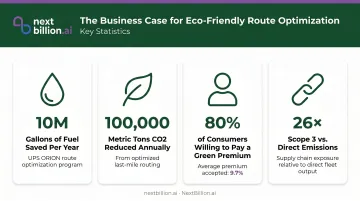
Last-mile delivery is a visible, brand-facing touchpoint. PwC's 2024 Voice of the Consumer Survey found that 80% of consumers are willing to pay more for sustainably produced or sourced goods, with an average willingness-to-pay premium of 9.7%. Fleets that can document per-delivery emissions reductions have a measurable sustainability story — one that directly supports premium pricing, customer retention, and partner tender eligibility.
The Business Case
That consumer premium feeds directly into the financial case. Better routing — not a new fleet — is where most of the savings come from:
- Fewer miles driven and less idle time directly reduce fuel costs
- Lower daily utilization extends maintenance intervals and defers repair costs
- Consolidated routes mean fewer trips per day, reducing driver hours
- Route-level CO2 metrics feed directly into procurement scorecards — CDP's supply-chain program reports roughly 45,000 suppliers were asked to disclose emissions data
The UPS ORION route optimization program benchmarks what's achievable at scale: full deployment was projected to save 10 million gallons of fuel and reduce CO2 by 100,000 metric tons annually, according to INFORMS.
How Eco-Friendly Route Optimization Works
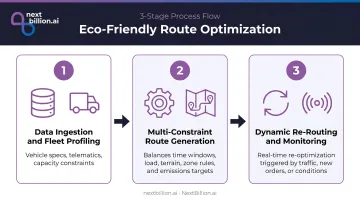
Eco-friendly route optimization works by treating emissions reduction as a first-class objective alongside delivery speed and cost — not something bolted on after the routes are already built. The system ingests stop locations, delivery windows, vehicle specifications, fleet size, and real-time traffic data, then runs optimization algorithms that simultaneously balance fuel efficiency, load utilization, time compliance, and environmental performance. This is where AI-driven route optimization adds value: machine learning models can weigh dozens of constraints at once — traffic patterns, driver hours-of-service limits under FMCSA rules, vehicle type, and delivery windows — far faster than manual planning allows. The output is sequenced, vehicle-assigned routes where green outcomes are baked into the plan from the start.
Step 1: Data Ingestion and Fleet Profiling
The optimizer needs to know what it's working with. Without vehicle-specific profiles, the system can't distinguish between routing a fuel-efficient hybrid and a heavier diesel van—and it can't assign the right vehicle to the right route.
NextBillion.ai's Route Optimization API supports vehicle-specific profiles across mixed fleets including EVs, vans, and trucks, with over 50 hard and soft constraints that can be configured to reflect real operational parameters: vehicle capacity, weight limits, preferred road attributes, and EV-specific range parameters.
The platform also integrates directly with telematics systems including Geotab, Samsara, and Motive—pulling live vehicle data and pushing optimized routes back to driver apps without manual CSV exports.
Step 2: Multi-Constraint Route Generation
Unlike standard routing tools, the eco-optimization engine must balance competing demands simultaneously:
- Delivery time windows (hard or soft)
- Vehicle capacity and payload limits
- Driver hours and shift constraints
- Fuel consumption targets
- Zone access restrictions (low-emission zones, truck routes)
- Terrain and road grade
Terrain isn't a minor variable. ORNL research found that for Class-8 vehicles, increasing total vehicle weight to 96,000 lb produced a 24% fuel-efficiency decrease compared to the standard 70,000–80,000 lb range at highway speeds—meaning heavier loads on hilly terrain can dramatically inflate per-delivery emissions independent of route distance.
Step 3: Dynamic Re-Routing and Monitoring
Eco-friendly routing isn't a dispatch-time plan that runs itself. Conditions change — traffic incidents, new orders, weather — and routes need to adapt in real time to stay fuel-efficient.
NextBillion.ai's Route Optimization API supports dynamic re-routing and event-triggered re-optimization, inserting new orders into ongoing routes with minimal disruption rather than rebuilding from scratch. A plan built at 6 AM on historical traffic data may already be suboptimal by 8 AM. Live optimization closes that gap.
Key Eco-Friendly Route Optimization Strategies
Load Consolidation and Vehicle Utilization
The single highest-impact lever in eco-friendly routing isn't optimizing each individual trip—it's reducing the total number of trips. Sending out a van at 60% capacity twice is almost always worse than a single run at full utilization.
NextBillion.ai's optimization engine supports load consolidation through multi-dimensional capacity planning: matching load types to vehicles by weight, dimensions, and constraints, and sequencing deliveries to minimize empty miles. One customer, a health-tech logistics company, reduced rider count and travel distances enough to achieve 25% cost savings while enabling 35% more visits per rider—driven by consolidation logic applied at the planning stage, before a single route is sequenced.
To evaluate your current position: audit vehicle fill rates by route. Consistent fill rates below 70–75% signal consolidation opportunity. Set utilization targets as named constraints in your optimizer.
EV and Alternative Vehicle Routing
Zero-emission cargo vans now make up 89% of all zero-emission truck deployments in the US, according to CALSTART's 2025 market update, with approximately 46,677 deployed as of December 2024. EV routing for last-mile fleets is no longer a planning exercise: it's an operational requirement with real consequences for missed windows and stranded vehicles.
The challenge: EV routing requires fundamentally different logic than combustion vehicle routing.
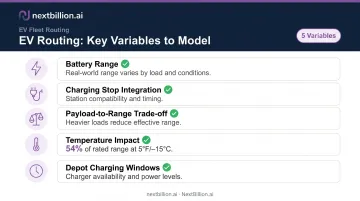
Key EV-specific variables that must be modeled:
- Battery range limits and real-world range variation
- Charging stop integration and station compatibility
- Payload-to-range trade-offs (heavier loads reduce range)
- Temperature effects—Geotab data shows EVs can drop to 54% of rated range at 5°F (-15°C)
- Depot charging windows and charger power availability
NextBillion.ai's routing engine supports EV-specific constraints including range parameters, charging stop planning, and terrain-aware battery consumption estimates. Applying a generic combustion-vehicle routing algorithm to an EV fleet will produce inefficient routes that trigger range anxiety, unplanned charging stops, and missed delivery windows.
Off-Peak and Delivery Window Optimization
Moving deliveries to off-peak hours reduces idle time—and idle time is pure emissions waste. The DOE reports heavy-duty truck idling consumes approximately 0.8 gallons of fuel per hour. In dense urban corridors during peak hours, vehicles can spend 20–30% of drive time crawling or stopped—generating emissions with zero productive output.
Off-peak scheduling is one of the lowest-cost sustainability interventions available because it requires no capital investment. The main friction is customer expectation management. Earlier or later windows tend to be more reliable, and that reliability is a real selling point for customers open to adjusted timing.
NextBillion.ai's Route Optimization API accepts delivery time windows as soft constraints, allowing the engine to favor lower-congestion periods where flexibility exists without violating hard window requirements.
Carbon Footprint Tracking and Reporting
Eco-friendly routing without a measurement layer is just routing. Businesses need per-route, per-vehicle, and per-delivery data to validate sustainability progress and satisfy regulatory reporting requirements.
The commercial stakes are real. CDP reports that Scope 3 emissions average 26 times a company's direct operational emissions—so for most retailers, the biggest climate exposure sits in supply chain and delivery, not the warehouse. Route-level mileage, fuel consumption, idle time, and failed-delivery data feed directly into customer Scope 3 reports and supplier ESG scorecards.
Failed deliveries deserve specific attention here. A Transportation Research Record study found that a second delivery attempt can increase CO2 emissions per drop by 9% to 75%, depending on the failure rate. Three specific measures cut redelivery emissions at the source:
- Accurate, tight delivery windows that match actual vehicle availability
- Proactive customer notifications before the first attempt
- Alternative drop-off options (parcel lockers, neighbor authorization) when recipients are unavailable
Each of these is a service improvement. Each is also a direct emissions reduction.
Common Misconceptions About Eco-Friendly Route Optimization
Four misconceptions consistently trip up logistics teams when they first approach eco-friendly routing. Here's what the evidence actually shows.
"The shortest route is the greenest route." Not quite. A route through a congested urban corridor may cover fewer miles but generate more emissions per delivery than a longer route on free-flowing roads, because of idle time and stop-start fuel burn. Distance-minimization and emissions-minimization are related but distinct objectives.
"Eco-friendly routing is a one-time software deployment." Route optimization requires continuous re-evaluation as fleet composition changes, new delivery zones open, and traffic patterns shift. Set-and-forget implementations degrade quickly. Effective platforms re-optimize on a schedule or in response to operational events — not just at dispatch.
"You need a fully electric fleet before eco-routing is worth implementing." Significant emissions reductions are achievable with existing combustion fleets through better routing, load consolidation, and idle time reduction. Electrification amplifies the benefit but is not a prerequisite.
"Eco-friendly routing works everywhere." In very sparse rural networks, stop density makes consolidation structurally impossible. In on-demand same-day models, speed requirements override consolidation opportunities. In both cases, routing optimization alone won't close the gap. Pair it with other levers — alternative vehicles, carbon offsetting, or infrastructure changes — to get the full benefit.
Frequently Asked Questions
What is the best eco-friendly delivery route optimization software?
Look for multi-constraint optimization that includes emissions parameters, real-time traffic integration, vehicle-type-specific routing, and EV routing capability. NextBillion.ai's Route Optimization API covers all of these, with 50+ configurable constraints and per-vehicle pricing that avoids the per-call cost spikes common with general-purpose mapping providers.
How does route optimization reduce carbon emissions?
Optimization reduces emissions by minimizing total miles driven, eliminating idle time through traffic-aware routing, consolidating loads to cut vehicle trips, and matching vehicle type to route characteristics. Each lever directly reduces fuel burned—or energy consumed—per delivery.
What is the difference between eco-friendly routing and standard route optimization?
Standard optimization minimizes distance or time. Eco-friendly optimization treats emissions reduction as an explicit objective, which can produce different route choices—particularly around congestion avoidance, load consolidation, and vehicle assignment for mixed fleets.
Can route optimization work for electric vehicle fleets?
Yes, but EV routing requires specialized logic that accounts for vehicle range, charging stop locations, payload-to-range trade-offs, and temperature effects on battery performance. Standard tools built for combustion vehicles typically assume unlimited range and no charging stops, so they are insufficient for mixed or all-EV fleets. Fleets running EVs alongside gas or diesel vehicles need a router that can apply different constraint sets per vehicle type within the same optimization run, not two separate systems.
How much fuel can route optimization actually save?
Xpress Global Systems achieved a 13% reduction in miles driven per month using NextBillion.ai's Route Optimization API. UPS's ORION program was projected to save 10 million gallons of fuel annually. Results vary based on current fleet efficiency and route complexity.
Does eco-friendly route optimization slow down deliveries or hurt customer service?
Well-implemented eco-friendly routing typically maintains or improves on-time performance because traffic avoidance reduces delays. The only real trade-off appears when delivery windows need to shift to off-peak hours—which requires proactive customer communication but usually produces more reliable delivery times, not worse ones.
Can AI do route optimization?
Yes. AI-based optimization engines use algorithms — often combining heuristics, machine learning, and operations-research techniques — to solve routing problems with many variables at once: time windows, vehicle capacity, driver hours, traffic conditions, and emissions targets. This differs from basic mapping tools that only calculate shortest paths between points. For fleets with more than a handful of stops or vehicle types, AI-driven optimization generally finds better solutions faster than manual planning or rule-based sequencing.
How can I optimize my delivery route?
Start by defining your constraints: delivery time windows, vehicle capacity, driver hours (relevant under FMCSA hours-of-service rules for commercial fleets), and stop priorities. Then use a routing tool that factors in real-time traffic rather than static distance, and sequence stops to minimize backtracking. For fleets with more than a few vehicles or daily stops, manual planning in spreadsheets breaks down quickly — an optimization API can recalculate routes automatically as conditions change.