Introduction
Field service dispatch is one of the most complex scheduling problems in operations management. Most organizations are still solving it manually.
On any given morning, a dispatch manager juggles technician availability, skill certifications, customer time windows, parts on hand, and live traffic conditions — all at once, often across spreadsheets and phone calls. One emergency job or an overrun appointment and the entire plan unravels.
Static GPS routing and manual scheduling weren't built for this. A delivery driver visiting fixed stops in sequence is a different problem entirely from a technician with variable job durations, specific certifications, and priority calls that land mid-morning.
Machine learning route optimization for service technicians works by continuously processing dozens of simultaneous constraints — technician skills, time windows, parts availability, and live traffic — to rebuild the optimal schedule as conditions change, rather than producing a single static plan each morning. It adapts in real time and learns from historical patterns to make each day's schedule smarter than the last.
This guide walks through how ML routing works for field service, which constraints it handles, and what to look for when evaluating a platform.
Key Takeaways
- Manual dispatch fails because technician routing involves too many simultaneous variables for human planners to solve reliably
- ML route optimization learns from historical data and continuously re-optimizes the entire fleet as conditions change during the day
- Field service constraints like skill matching, SLA tiers, parts availability, and emergency insertion require purpose-built optimization tools, not delivery-focused ones
- Forrester TEI research for ServiceNow documents 20–30% travel time reduction and nearly 400% ROI over three years
- Evaluating platforms on constraint depth, integration quality, and pricing structure (per-vehicle vs. per-API-call) determines long-term value
The Limits of Traditional Technician Dispatch
Why Field Service Routing Is Different
Delivery routing is difficult. Field service routing is a different category of problem.
A parcel driver visits stops in sequence, with predictable dwell times and no skill requirements. A service technician operates under entirely different constraints: variable job durations (a routine HVAC inspection takes 45 minutes; a compressor replacement takes 3 hours), certification requirements that must match the work order, and the constant possibility that an emergency call mid-morning reshuffles the entire day.
Pre-built routes become obsolete within hours. The ripple effects are concrete:
- Missed service windows trigger SLA penalties and erode customer trust
- A technician arriving without the right certification or part creates a repeat visit — field service benchmarks show a failed first visit leads to an average 2.5 additional visits and 20 days of mean time to resolution
- Unnecessary mileage inflates fuel costs and technician hours across the fleet
At 10 technicians, a dispatcher can manage exceptions manually. At 50 or 200+, each of these failure modes multiplies — and the scheduling burden becomes unworkable.
The Combinatorics Problem
There's a structural reason manual dispatch fails, not just a capacity one.
Routing 10 stops involves over 3.6 million possible ordered sequences. MIT's analysis of the Traveling Salesman Problem confirms the factorial growth of multi-stop route combinations — before layering in technician certifications, hard time windows, or same-day schedule changes. No dispatcher, regardless of experience, can evaluate more than a fraction of these combinations in real time.
The Service Council's 2022 KPI benchmark found that SLA attainment sits at 67% for low performers and only 82% for average performers — meaning the majority of field service organizations are consistently missing service commitments, largely because their scheduling tools can't match the actual complexity of the problem.
How Machine Learning Route Optimization Works
From Static Planning to Continuous Learning
The core shift with ML routing goes beyond speed: the system learns from every job it processes.
A traditional route planner calculates a route based on current inputs and stops there. An ML system ingests historical operational data — job durations by technician type, traffic patterns by time of day, cancellation rates, seasonal demand — and applies that learning to improve scheduling decisions continuously.
Over time, it becomes accurate about how long jobs actually take in your operation, which routes tend to run late, and which technicians perform best on specific job types. No static optimization tool does that.
Algorithms Behind the Optimization
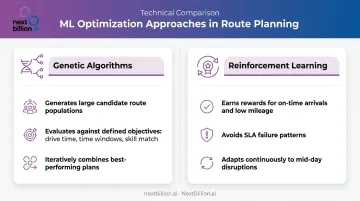
Two algorithmic approaches dominate enterprise field service optimization:
Genetic algorithms generate large populations of candidate route plans and evaluate each against defined objectives: minimize drive time, respect time windows, match skill requirements. The best-performing plans are combined iteratively to produce better solutions. Google's OR-Tools uses exactly this approach — testing combinations at a scale no human dispatcher could replicate manually.
Reinforcement learning works differently. The system earns rewards for good decisions (on-time arrivals, low mileage, no overtime violations) and adjusts to avoid patterns that trigger SLA failures. A 2024 MDPI study on deep reinforcement learning for dynamic vehicle routing shows how RL agents handle environments where new requests arrive mid-day — the exact conditions field service dispatchers deal with constantly. This addresses a common question operators ask when evaluating these tools: yes, AI can perform route optimization dynamically, not just generate a fixed plan at the start of the day, because both genetic algorithms and reinforcement learning are designed to recompute routes as new information arrives.
A reinforcement learning model trained on your operation reflects your fleet's actual behavior, not generalized industry benchmarks.
Real-Time Adaptation
Static route optimization produces a plan once. ML route optimization keeps that plan current throughout the workday.
When a job overruns, a traffic incident blocks a route, or an emergency call arrives at 10:30 AM, the system doesn't just reroute the affected technician — it re-optimizes remaining assignments across the entire fleet to absorb the disruption with minimal downstream impact. That fleet-wide re-sequencing is what separates ML routing from dispatcher-driven exception handling.
The data inputs enabling this include:
- GPS telemetry and real-time traffic feeds
- Job completion status from technician mobile apps
- Historical speed profiles by route and time of day
NextBillion.ai's platform processes real-time traffic data alongside historical driver behavior and operational patterns to produce continuously updated ETAs and route adjustments.
Field Service-Specific Constraints ML Can Optimize
Generic routing tools (including most GPS navigation and delivery-focused optimization platforms) treat every stop as equivalent. Field service operations don't work that way.
Enterprise-grade ML optimization built for field service handles 50+ simultaneous hard and soft constraints. The distinction between constraint types matters, and it is also why the best route optimizer or best AI for route planning for a service business is rarely a generic delivery-routing tool — the right choice depends on whether the platform can natively enforce field service constraints like certification matching and SLA tiers rather than treating every stop as interchangeable:
- Hard constraints are never violated — a technician without HVAC certification will not be assigned an HVAC job, regardless of proximity
- Soft constraints allow controlled flexibility — acceptable lateness within defined bounds, overtime within approved limits
Key Constraint Categories
| Constraint Type | What It Governs | Field Service Impact |
|---|---|---|
| Skill/certification matching | Job-to-technician assignment | Eliminates mis-dispatches |
| Customer time windows | Arrival window compliance | Drives SLA adherence |
| SLA priority tiers | Service priority ordering | Protects high-value accounts |
| Parts/inventory awareness | Pre-dispatch confirmation | Reduces repeat visits |
| Working hours and breaks | Technician shift limits | Prevents overtime violations |
| Emergency job insertion | Mid-day priority changes | Handles urgent calls without rebuilding schedules |
| Territory boundaries | Geographic assignment rules | Maintains logical coverage zones |
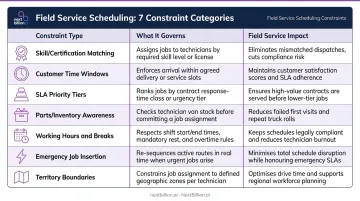
Skill and certification matching drives first-time fix rates more than any other constraint. A mis-dispatch — sending an unqualified technician because they were closest — wastes a full job slot, erodes customer trust, and triggers a repeat visit that costs labor and travel twice over.
When an urgent call arrives mid-morning, the optimizer identifies the best-qualified, best-positioned technician based on current location, remaining workload, and skill profile, then re-sequences their remaining stops to absorb the new job. NextBillion.ai's platform handles this through real-time reoptimization with SLA-at-risk alerts that flag potential delays before they become missed commitments.
Parts-aware routing connects the optimizer to inventory data before dispatch. If a technician doesn't carry the required part, sending them anyway guarantees a repeat visit: full travel cost, full labor cost, and a customer who now expects a faster resolution the second time around.
Measurable Benefits for Field Service Operations
Drive Time and Fuel Savings
The most consistent documented benefit from ML route optimization in field service is travel time reduction. Forrester's Total Economic Impact study of ServiceNow's Field Service Management platform found 20–30% reduced travel time alongside a 16% improvement in overall field service efficiency.
For a fleet of 50 technicians averaging 90 minutes of daily drive time, a 25% reduction recovers more than 18 technician-hours per day — time that translates directly into additional service capacity or reduced overtime.
Technician Capacity
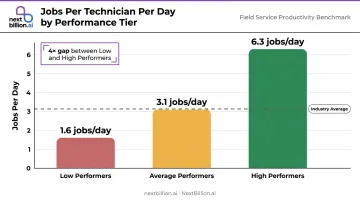
More efficient routing means more jobs per technician per day without adding headcount. The Forrester TEI study on Microsoft Dynamics 365 Field Service documented a 14% technician productivity improvement. Service Council workforce utilization benchmarks show how wide the spread actually is:
More efficient routing means more jobs per technician per day without adding headcount. The Forrester TEI study on Microsoft Dynamics 365 Field Service documented a 14% technician productivity improvement. Service Council workforce utilization benchmarks show how wide the spread actually is:
- Low performers: 1.6 jobs per technician per day
- Average performers: 3.1 jobs per technician per day
- High performers: 6.3 jobs per technician per day
Closing that gap is, at its most basic level, an optimization and scheduling problem — one ML-driven dispatch directly targets.
Dispatcher Productivity
The same Forrester TEI study on Dynamics 365 Field Service documented a 40% dispatcher productivity improvement — consistent with field service customers describing their dispatch teams shifting from manual schedule-building to exception handling and customer communication.
NextBillion.ai's ServiceTitan integration enables scheduling teams to cut scheduling time within the first month of deployment, as the Hawx Pest Control implementation demonstrated.
First-Time Fix Rate
The Service Council's 2022 benchmark found first-time fix rates ranging from 52% for low performers to 92% for top performers. Each failed visit triggers an average of 2.5 additional service calls and 20 days of mean time to resolution — a cost that scales directly with fleet size.
Skill matching and parts-aware dispatch address the two most preventable causes of repeat visits. That combination is what drove results at one health-tech logistics firm working with NextBillion.ai: 35% more visits per rider alongside 25% cost savings, by ensuring the right technician reached the right location with the right resources.
Customer Experience
Real-time ETA updates based on live route progress give customers accurate arrival information rather than the broad four-hour windows that historically characterized field service scheduling. Platforms that track live route progress can provide proactive communication when schedules shift — cutting inbound "where is my tech?" calls and measurably lifting satisfaction scores.
What to Look for in an ML Route Optimization Platform
Constraint Depth
This is the most important differentiator. A platform built for parcel delivery may handle time windows and vehicle capacity, but it won't handle skill certification requirements, SLA priority tiers, or the specific task sequencing logic that field service operations depend on.
When evaluating platforms, ask directly: how many simultaneous constraints does the engine process, and can you define hard vs. soft treatment for each? NextBillion.ai's route optimization API supports 50+ hard and soft constraints with optimization problems handling up to 10,000 stops, built specifically for field service complexity rather than last-mile delivery.
Integration Depth
An optimizer that doesn't receive live job status updates from the field falls out of sync with reality within hours. The platform must connect with:
- FSM platforms (ServiceTitan, Salesforce Field Service) to track job status and technician availability in real time
- Telematics providers (Samsara, Geotab) for live GPS feeds that reflect actual vehicle positions
- CRM systems for customer priority tiers and escalation rules
- ERP systems to pull SLA commitments and service contract data
NextBillion.ai maintains native integrations with Geotab, Samsara, Salesforce, SAP, and Microsoft Dynamics 365, with bidirectional data flow so route adjustments always reflect what's actually happening in the field.
Pricing Model
Per-API-call pricing is easy to underestimate at first. Once you factor in multiple re-routes per technician per day, overnight batch planning runs, and real-time insertions, those calls compound fast across a large fleet.
Per-vehicle or per-order pricing removes that uncertainty. NextBillion.ai offers both asset-based and task-based pricing models with fixed monthly fees that absorb fluctuations in API call volume, including:
- Seasonal demand spikes that double daily dispatch volume
- Re-optimization cycles triggered by cancellations or urgent add-ons
- Overnight batch runs for next-day planning across large technician pools
No surprise overages at the end of the month.
Measuring ROI from ML Route Optimization
Operational Metrics to Establish as Baselines
Before deployment, document current performance across:
- Miles driven per technician per day
- Fuel cost per completed job
- Daily appointments completed per technician
- Dispatcher hours spent on scheduling per week
These baselines make post-implementation improvements measurable rather than anecdotal.
Service Quality Metrics
Optimization should improve service quality, not trade it off for efficiency. Track:
- First-time fix rate (benchmark: 92% for top performers per Service Council)
- SLA attainment rate (benchmark: 96% for high performers per Service Council 2022 survey)
- On-time arrival rate against contracted windows
- Customer satisfaction scores tied to appointment experience
Financial ROI Calculation
A straightforward ROI calculation for ML route optimization combines:
- Direct savings: fuel reduction + overtime reduction + fewer repeat visits
- Revenue gains: additional daily appointments × average job revenue
- Minus platform cost: annual license fees
Forrester's TEI study on Microsoft Dynamics 365 Field Service documented 346% ROI over three years, with a $42.65M total benefit against a $9.5M investment and payback in under six months. The ServiceNow study found nearly 400% ROI over the same period. In the Microsoft study, a 12% reduction in second-visit truck rolls drove a meaningful share of that return — which points to repeat-visit elimination as one of the fastest paths to payback.
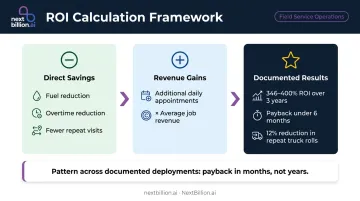
Payback timelines vary by fleet size and starting inefficiency, but the pattern across documented deployments is consistent: months, not years.
Frequently Asked Questions
How is ML route optimization different from the GPS navigation technicians already use?
GPS navigation finds a single path for one vehicle at a time. ML route optimization simultaneously plans and continuously re-plans the entire fleet across dozens of constraints — technician skills, customer time windows, SLA tiers, parts availability — and adapts all routes in real time when conditions change mid-day. No GPS app does this. It also accounts for traffic patterns, road restrictions, and vehicle-specific rules like weight or hazmat limits that a consumer navigation app has no visibility into.
What types of constraints can ML route optimization handle for field service teams?
Enterprise platforms process 50+ simultaneous constraints — technician certifications, customer time windows, SLA priority tiers, equipment availability, working hours, geographic territories, multi-day recurring schedules, and emergency job insertion. Each constraint is configurable as hard (never violated) or soft (flexible within defined limits).
Can ML route optimization handle same-day emergency calls?
Yes — dynamic re-routing is one of ML's core strengths for field service. When an urgent job arrives, the system instantly identifies the best-qualified, best-positioned technician and re-sequences their remaining stops without rebuilding the entire fleet's schedule from scratch. This matters for organizations tracking hours-of-service or FLSA-driven shift limits, since the system respects each technician's remaining available hours when inserting the new job rather than overloading their schedule.
What data does an organization need to implement ML route optimization successfully?
The key inputs are accurate customer addresses, technician skill profiles and certifications, historical job duration data by job type, real-time GPS feeds, and parts inventory data. Data quality directly determines optimization quality — better historical data produces more accurate job duration estimates and more reliable schedules.
How long does it typically take to see ROI from ML route optimization?
Most field service organizations see measurable efficiency gains — more appointments completed per day, lower fuel spend — within weeks of deployment. Full financial ROI depends on fleet size; Forrester's TEI studies on enterprise FSM platforms document payback periods under six months. NextBillion.ai customers typically go live within one week.
Does ML route optimization replace dispatchers or work alongside them?
ML handles the computational work of route planning so dispatchers can concentrate on exception handling, customer relationships, and judgment calls the system can't make. The dispatcher's role shifts from manual schedule-building to managing the exceptions the system flags — a canceled job, a technician calling in sick, a customer requesting a different time window. Dispatchers still make the final call on trade-offs between cost, SLA priority, and customer relationships.
Can AI do route optimization?
Yes. AI-based route optimization uses machine learning to evaluate constraints — technician skills, time windows, traffic, vehicle capacity — that traditional route-planning software cannot process at scale or in real time. For field service teams, this means routes adjust automatically as jobs are added, canceled, or delayed, rather than requiring a dispatcher to manually rebuild the schedule each time conditions change.
What is the best AI for route planning?
There is no single 'best' AI route planner — the right choice depends on your fleet size, industry constraints, and integration needs. For field service teams, look for a platform that handles technician skills and certifications, SLA time windows, real-time re-routing, and US-specific regulatory constraints like hours-of-service. NextBillion.ai's routing APIs are built for these field service requirements rather than generic last-mile delivery.