Introduction
Online grocery in the U.S. hit a record $12.7 billion in December 2025 alone — up 32% year over year, according to Brick Meets Click. Online channels now represent 19% of total grocery spending, and that share is still climbing.
For grocers, that growth is both an opportunity and a pressure test. The last mile — the final leg from store, dark store, or fulfillment center to a customer's front door — is where margins get made or destroyed. Thin net profits averaging 1.7% across food retailers leave almost no room for missed windows, spoiled orders, or inefficient routing.
This guide covers what grocery operators need to know: where the market stands today, what makes perishable last-mile logistics uniquely unforgiving, and the specific practices that separate operators who scale profitably from those who can't stop hemorrhaging margin.
Key Takeaways
- Last-mile costs represent 41% of total logistics supply-chain costs — the single largest expense category
- Grocery adds unique constraints: perishability, multi-temperature zones, and compressed delivery windows
- Best practices center on fulfillment model selection, constraint-aware routing, real-time visibility, and scalable infrastructure
- AI-powered route optimization is the primary differentiator for cost-per-delivery and on-time performance
- Flexible, integrated logistics platforms outperform siloed point solutions on cost and reliability
The State of Last-Mile Grocery Delivery
Grocery last mile delivery is the final stage of the supply chain: moving a fulfilled order from a store, dark store, or micro-fulfillment center (MFC) to the customer's door. It's the most consumer-visible leg of the entire operation — and the most expensive, with last-mile costs representing 41% of total logistics supply-chain costs. Thin retailer margins leave almost no room for error at this stage, which is why it's the leg where profitability is won or lost.
What makes grocery last-mile uniquely complex compared to, say, apparel or electronics?
- Perishability: Every delivery has a hard expiration. A delayed electronics shipment is inconvenient. A delayed grocery order may be unsalvageable.
- Multi-temperature requirements: A single order can contain frozen items, refrigerated produce, and ambient shelf goods — all with different handling requirements.
- Compressed windows: Customers expect delivery within hours, not days, and availability matters (someone needs to be home or nearby).
- Volume density: Grocery orders are frequent, geographically concentrated, and often smaller in value — making per-delivery economics tighter.
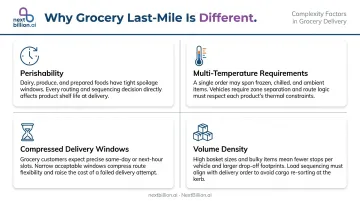
Each of these constraints compounds under volume — and volume is growing fast. Mercatus and Brick Meets Click forecast U.S. online grocery growing at an 11.7% CAGR through 2027. Delivery specifically is projected at 10.8% CAGR, while pickup (BOPIS) grows even faster at 13.6%.
Online grocery is also no longer a pandemic-era behavior. FMI and NielsenIQ report that more than 90% of grocery shoppers now use both online and in-store channels. The omnichannel shopper is the default shopper — which means logistics infrastructure built only for in-store fulfillment simply isn't enough.
Key Challenges in Last-Mile Grocery Logistics
Perishability and Temperature Control
Unlike a delayed package sitting on a porch, a missed grocery delivery window can mean spoiled produce, thawed frozen goods, and a customer experience you can't recover from. There's no "try again tomorrow" for a box of raw salmon.
The complexity compounds when a single route includes frozen items, refrigerated dairy, and ambient dry goods simultaneously. Each temperature zone has different vehicle requirements, sequencing logic, and tolerance for delay. Routing a driver to deliver frozen goods last — because it was geographically convenient — is a serious operational failure.
Effective multi-temperature routing requires:
- Vehicle assignment by compartment capability
- Delivery sequencing that prioritizes frozen and refrigerated stops
- Time-window adherence tighter than standard last-mile categories
- Skills-matching to ensure drivers are trained and certified for cold-chain handling
Delivery Speed and Window Expectations
Consumer expectations have compressed dramatically. Two-hour delivery is increasingly table stakes in urban markets, and Capgemini research found shoppers were willing to pay an average 3.3% premium on a $30 grocery order for two-hour delivery — a signal that speed directly influences purchase behavior.
The operational tension here is real. More frequent, smaller batches improve window compliance but drive up cost-per-order. Batching orders to reduce cost risks missing windows. There's no clean resolution — which is exactly why route and schedule optimization must be treated as a core operational capability, not an afterthought.
Visibility and Exception Management
When dispatchers can't see driver status, traffic conditions, or delivery confirmation in real time, exceptions — a missed stop, a returned order, a late arrival — get caught too late to fix. In grocery, that lag has a direct cost.
An undelivered apparel order waits. An undelivered grocery order containing fresh meat or ice cream doesn't. Proactive alerting, SLA-at-risk notifications, and the ability to re-route drivers dynamically mid-route are table-stakes capabilities in this vertical — without them, most exceptions become unrecoverable.
Last-Mile Cost Pressures
Capgemini's research puts last-mile delivery at 41% of total logistics supply-chain costs — the single largest segment. For grocery operators running on average net margins of 1.7%, there's simply no buffer for inefficiency.
Bain's fulfillment economics analysis shows how wide the margin gap is across fulfillment models:
| Fulfillment Model | Approximate Operating Margin |
|---|---|
| In-store transaction | 2–4% |
| Click-and-collect | ~0% (near breakeven) |
| Third-party delivery | ~-5% |
| Dark store (own fulfillment) | ~-11% |
| Grocer-picked, free delivery | ~-15% |
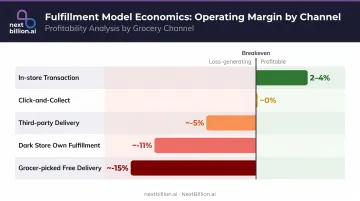
The path to profitability in online grocery runs directly through last-mile cost reduction — smarter routing, fewer failed delivery attempts, and infrastructure that doesn't add cost linearly with volume.
Best Practices for Last-Mile Grocery Delivery
Choose the Right Fulfillment Model
No single fulfillment model works for every grocer. The right choice depends on geography, order volume, customer demographics, and available capital. Here's how the main models compare:
| Model | Speed | Cost | Control |
|---|---|---|---|
| Store-based home delivery | Medium | High | High |
| BOPIS / Curbside pickup | Fast (customer drives) | Low | High |
| Dark store | Fast | Medium | High |
| Micro-fulfillment center | Fast | Medium-High | High |
| Third-party carrier (3PL) | Variable | Low-Medium | Low |
Pickup remains the volume leader — forecast to represent 50.3% of online grocery sales by 2027 — largely because it eliminates the final-mile delivery leg entirely. Dark stores and MFCs offer faster fulfillment cycles: Bain cited one European grocer deploying an MFC pilot in roughly three months, versus two years for a centralized fulfillment center.
NextBillion.ai's platform supports routing from multiple origin types simultaneously — store-based fulfillment, dark stores, and MFCs — within the same routing environment. Multi-depot optimization automatically assigns orders to the most efficient origin hub, reducing empty miles and balancing workloads across facilities.
Optimize Routes for Grocery-Specific Constraints
Standard mapping tools optimize for distance. Grocery last-mile requires optimizing for distance plus time windows, vehicle capacity by temperature zone, delivery sequencing for perishables, real-time traffic, driver skills, and order priority. Generic tools typically ignore temperature zones and multi-stop sequencing constraints — leading to spoiled orders and missed windows.
NextBillion.ai's Route Optimization API is built for exactly this constraint complexity. Relevant capabilities for grocery operations include:
- Enforces precise time windows per job, shipment, and vehicle
- Plans capacity across weight, volume, cube, pallets, cases, and SKU slots
- Matches temperature-sensitive orders only to vehicles with the right compartments
- Blocks incompatible products from being routed together
- Prioritizes perishable and time-critical items in stop sequencing
- Adjusts ETAs dynamically based on live traffic conditions
- Flags at-risk delivery windows before they're missed (SLA-at-risk alerts)
- Re-sequences stops or reassigns drivers when cancellations or delays occur
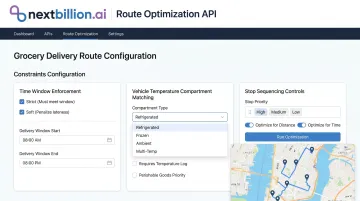
The system's custom cost matrix allows operators to assign lower routing costs to paths that ensure perishables arrive within freshness windows — giving the optimization engine the right incentives, not just the shortest path.
Provide Transparent Customer Communication
Grocery customers have to be home. Or nearby. Or have a cooler ready. A surprise "delivery attempted" notification for a $150 grocery order doesn't just frustrate — it destroys trust and generates a support ticket.
Proactive, accurate communication is the fix. The core requirements:
- Real-time ETAs updated based on live driver location and traffic
- Live tracking links so customers can monitor their order without calling support
- Geofence-triggered alerts as drivers approach the delivery address
- Exception notifications when a window is at risk of being missed
NextBillion.ai's Live Tracking API provides real-time tracking accuracy up to 1 meter, with reliable ETAs that adjust dynamically. Geofence alerts notify customers automatically as drivers approach pickup or delivery locations — reducing WISMO (Where Is My Order) inquiries without requiring manual dispatcher intervention.
Build for Demand Variability and Scalability
Grocery demand doesn't follow a flat curve. Weekends, pre-storm shopping events, holidays, and promotional campaigns create sharp spikes that can overwhelm fixed-capacity logistics infrastructure. Operators who can't scale dynamically either turn away orders or deliver poorly — both outcomes hurt revenue and retention.
Scalable logistics infrastructure needs:
- Dynamic route re-optimization when new orders arrive or conditions change
- Flexible driver/carrier onboarding without disrupting active routes
- Cloud infrastructure that auto-scales with demand rather than requiring manual provisioning
NextBillion.ai's platform handles all three. Cloud infrastructure scales automatically using load balancing and real-time data processing, while the API-first design allows rapid onboarding of additional carriers or crowdsourced drivers. Demand-aware routing accommodates new orders mid-shift without degrading existing delivery plans — and there's no hard cap on simultaneous deliveries or vehicles.
For operators with data sovereignty requirements, on-premise deployment (AWS EKS, GCP GKE, or Azure AKS) delivers up to 20x higher throughput and 3x lower latency compared to standard cloud alternatives.
The Role of Technology in Grocery Last-Mile Optimization
Even the best fulfillment models and routing strategies break down without the technology to execute them. An integrated stack is what separates a well-designed plan from consistent, repeatable delivery performance.
Route optimization, live tracking, automated dispatch, and customer communication need to function as a connected system. When each component operates in isolation, the gaps show up in delivery performance. A properly integrated stack means:
- Tracking data feeds back into live route re-optimization
- Dispatch decisions account for real-time driver location
- Customer ETAs reflect actual road conditions, not static estimates from order placement
AI-Powered Route Optimization
Route optimization is where technology delivers the clearest, most measurable ROI in grocery last-mile. The compounding benefits across a high-volume operation are substantial:
- Fewer miles driven per route
- More stops completed per driver per shift
- Higher on-time delivery rates
- Reduced manual dispatch time and associated labor cost
- Lower fuel consumption
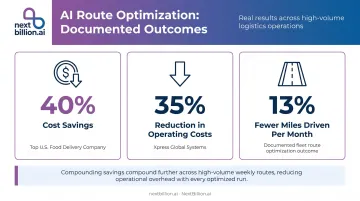
In documented implementations, NextBillion.ai has helped a top U.S.-based food delivery company achieve 40% cost savings through custom mapping and on-premise deployment. Xpress Global Systems achieved a 35% reduction in operating costs and 13% fewer miles driven per month. For grocery operators running thousands of routes per week, percentage improvements in these metrics translate to measurable margin gains.
Sustainability as an Operational Lever
Efficient routing isn't just a cost story — it's also an emissions story. University of Washington research found that grocery delivery trucks produced 20–75% less CO2 than the equivalent personal vehicle grocery trips they replace in modeled scenarios. A 2023 Transportation Research Part D review of prior studies found emissions reductions ranging from 17% to 90% when comparing grocery delivery to individual shopping trips.
Consolidating deliveries, reducing failed attempts, and minimizing miles-per-stop through better routing compounds these sustainability gains. For enterprise grocery operators, that matters beyond ESG reporting — regulators in several U.S. metro markets are increasingly scrutinizing fleet emissions, making operational efficiency and environmental performance the same conversation.
Conclusion
Winning in grocery last-mile delivery comes down to execution across four interconnected areas: the right fulfillment model for your geography and order profile, constraint-aware routing that actually accounts for perishability and temperature zones, real-time visibility that enables proactive exception management, and scalable infrastructure that handles demand variability without degrading service quality.
The operators pulling ahead aren't necessarily those with the biggest networks — they're the ones with the tightest integration between planning, dispatch, tracking, and customer communication.
If your current last-mile stack wasn't built for grocery-specific constraints, that gap shows up directly in failed deliveries, spoilage risk, and margin erosion. NextBillion.ai's route optimization platform supports 50+ hard and soft constraints built for multi-stop, time-sensitive, perishable delivery operations, with per-vehicle or per-order pricing that stays predictable as volume scales.
Frequently Asked Questions
What is the best online grocery delivery service?
The right platform depends on geography, product mix, and delivery model. At scale, Walmart (capturing a record 37% of U.S. eGrocery sales in Q2 2024), Amazon Fresh, and Instacart dominate. Regional grocers are increasingly building proprietary delivery capabilities to maintain margin control and customer relationships.
What are the biggest challenges in last-mile grocery delivery?
The core challenges span operations, cost, and speed: perishability and multi-temperature control, consumer expectations for same-day or two-hour delivery, last-mile costs representing 41% of total supply chain spend, and limited real-time visibility that makes exception management slow and reactive.
How does route optimization improve grocery delivery operations?
Route optimization reduces miles driven, increases stops per driver per shift, enforces time-window compliance for perishables, and cuts manual dispatch time — all of which lower cost-per-delivery and improve on-time rates. A routing API can also factor in vehicle capacity, temperature zones, and driver hours-of-service limits so routes stay compliant as order volume changes throughout the day.
What is the difference between same-day and on-demand grocery delivery?
Same-day delivery fulfills orders placed earlier in the day within a scheduled window. On-demand (or quick commerce) delivery — typically under one to two hours — is triggered in real time and requires dynamic dispatch and routing that can respond to orders as they arrive rather than batching them into planned routes. Same-day models tolerate batch route planning; on-demand models need continuous re-optimization as new orders and driver locations change minute to minute.
How can grocers reduce last-mile delivery costs?
The primary levers are route optimization to reduce miles per route, order batching by geography to increase stops per trip, proactive customer communication to reduce failed delivery attempts, and dynamic driver/carrier scaling to avoid paying for fixed capacity during slow periods.
What technology do grocers need for effective last-mile delivery?
At minimum, grocers need:
- Route optimization software with grocery-specific constraint support
- Real-time GPS tracking and automated customer notifications
- A delivery management platform with multi-carrier integration
- Analytics covering on-time rate, cost-per-delivery, and failed delivery percentage
How to optimize last mile delivery for grocery orders?
Optimizing last-mile grocery delivery means combining route planning with order batching, real-time driver tracking, and dynamic re-routing when conditions change. Grocers should account for delivery windows, vehicle capacity, and temperature-sensitive items when building routes, then measure performance against on-time rate, cost-per-delivery, and failed delivery percentage. A routing API can automate these constraints instead of relying on manual dispatch adjustments.
What companies use last mile delivery for grocery orders?
Large retailers like Walmart, Amazon Fresh, and Instacart operate last-mile grocery delivery at national scale, while regional grocers and independent chains increasingly build their own delivery operations to control cost and the customer relationship instead of routing entirely through third-party marketplaces. Convenience stores and meal-kit providers also rely on last-mile delivery infrastructure, though their routing, batching, and time-window needs differ from full-basket grocery delivery.