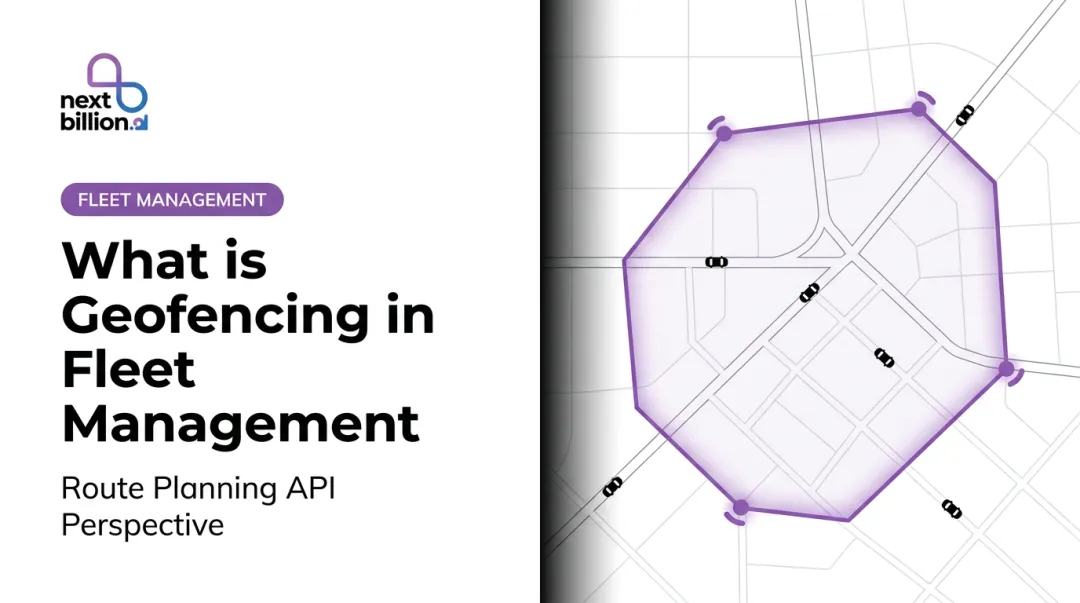
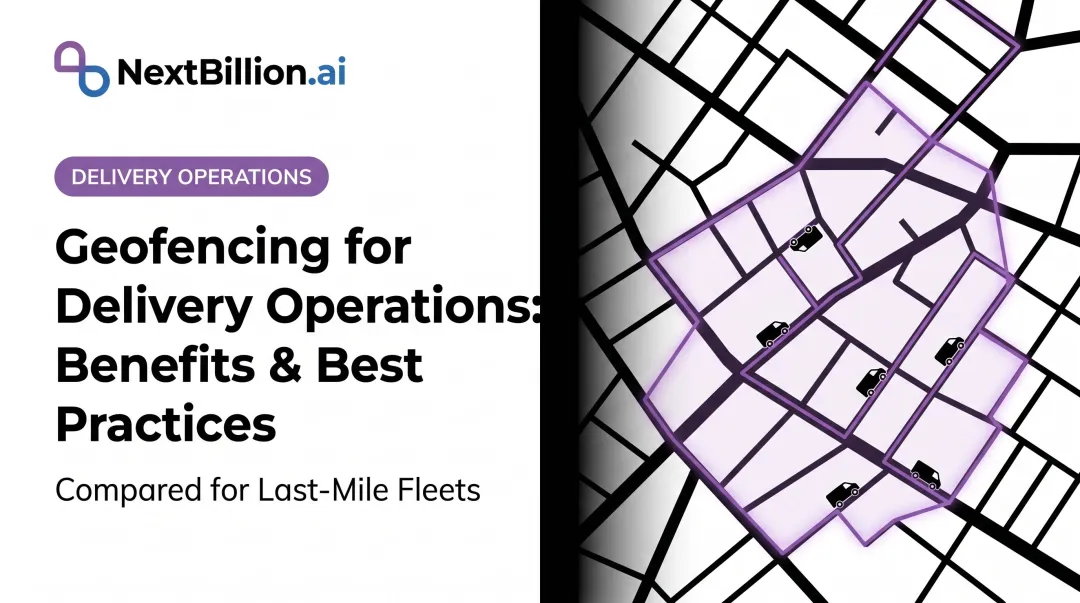
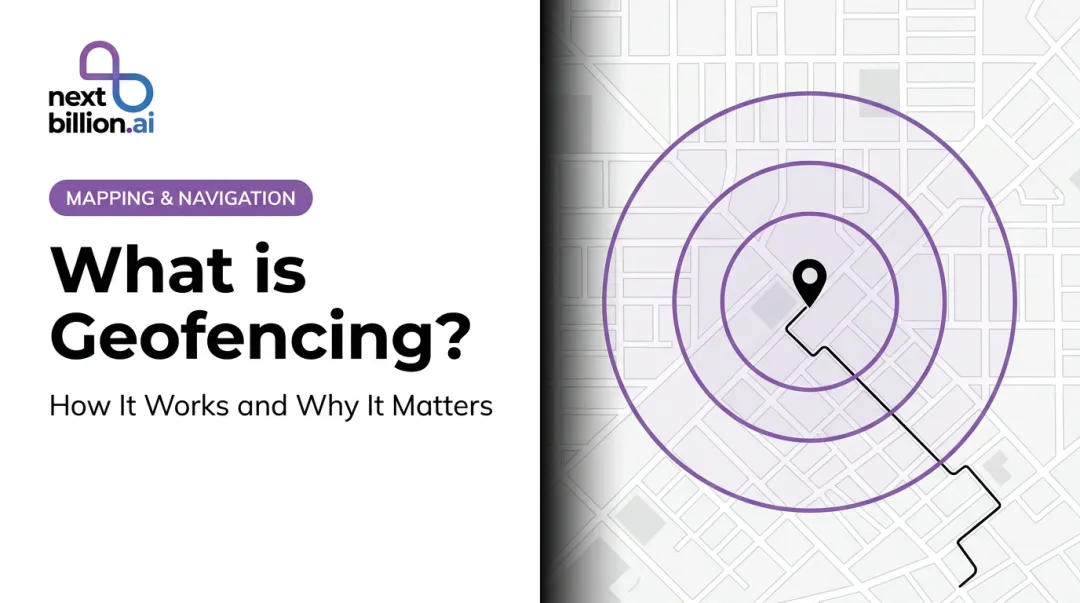
Geofencing exists to turn location into a trigger for action rather than a data point to review later. In field service, that means a virtual boundary automatically starts a timesheet entry, alerts a dispatcher, or notifies a customer when a technician arrives or leaves a site. The purpose is automation and accountability — replacing manual check-ins and self-reported logs with location events that happen without staff input.
Introduction
Geofencing benefits field service workforce management by automating time tracking, enabling proximity-based dispatch, and creating compliance audit trails without manual data entry. Running a field service operation means managing people you can't see, at job sites that change daily, under customer expectations that keep rising. Dispatchers work from static schedules. Managers call technicians to confirm arrivals. Payroll teams reconcile timesheets that don't match job records. These friction points aren't just annoying — they're expensive.
Geofencing gets discussed as a tracking tool, but that framing undersells what it actually does for field service operations. The real value shows up in specific, measurable outcomes: payroll errors caught before they accumulate, dispatchers rerouting based on actual technician positions rather than guesses, and compliance records that exist without anyone manually creating them.
This article covers three practical advantages of geofencing for field service workforce management — the operational impact of each, the metrics they affect, and the real cost of leaving them unaddressed.
Key Takeaways
- Geofencing creates virtual boundaries around job sites that trigger automated actions — clock-ins, alerts, dispatch updates — when field workers enter or exit.
- The three highest-impact benefits: automated time tracking, proximity-based dispatching, and compliance audit trails.
- Without geofencing, payroll errors, reactive scheduling, and undetected SLA breaches grow harder to catch as team size scales.
- Geofencing delivers its full value when integrated with route optimization and dispatch systems, not deployed as a standalone check-in tool.
- Today's location data improves tomorrow's scheduling and builds the proof-of-service record needed for billing and contract compliance.
What Is Geofencing in Field Service?
A geofence is a virtual boundary drawn around a real-world location: a customer address, job site, or service territory. When a field worker's device crosses that boundary, it triggers a predefined action — a clock-in, a dispatcher alert, a customer notification, or a compliance log entry. This is the core purpose of geofencing: replacing manual verification with automatic, location-triggered events, which is also why HR and payroll teams use it to confirm attendance and hours worked without relying on self-reported timesheets.
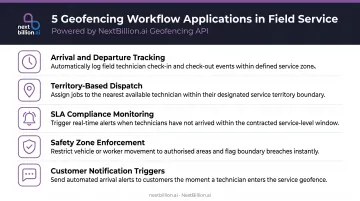
In field service operations, geofencing applies across several workflows:
- Arrival and departure tracking — automatic timestamps when technicians enter or leave a job site
- Territory-based dispatch — zone assignments shaped by real-world boundaries, not arbitrary coordinate grids
- SLA compliance monitoring — real-time alerts when a technician fails to arrive within a contracted window
- Safety zone enforcement — alerts when workers enter restricted or hazardous areas
- Customer notification triggers — automated "technician is on the way" messages
The key distinction: geofencing replaces reactive, manual processes — phone check-ins, paper logs, manual dispatching — with automated workflows that don't require action from either the technician or the dispatcher. The result is operational visibility that runs in the background, surfacing only when something needs attention.
Key Advantages of Geofencing for Field Service Workforce Management
The advantages below are tied to metrics field service businesses actually track: labor cost, dispatch efficiency, compliance rate, and customer satisfaction. They're most pronounced for teams managing more than a handful of mobile workers across multiple simultaneous job sites. Geofencing does have tradeoffs worth weighing, including employee concerns about location tracking outside scheduled work hours and the administrative effort of setting accurate boundaries around job sites, so clear policies and technician communication matter as much as the technology itself.
Advantage 1: Automated Time Tracking and Attendance Verification
Geofencing replaces manual clock-ins with automatic, location-verified timestamps the moment a technician enters or exits a job site boundary. The FSM system logs arrival time, departure time, and on-site duration with no action required from the technician or dispatcher.
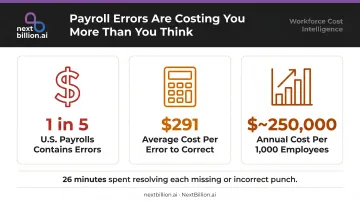
Payroll errors in field service operations are costly, and they tend to go undetected for entire pay periods. According to an Ernst & Young survey cited by Paycom, 1 in 5 U.S. payrolls contains errors, each costing an average of $291 to correct. For organizations with 1,000 employees, time-and-attendance errors run at 1,139 per 1,000 employees annually — roughly $250,000 per year — and missing or incorrect punches take 26 minutes per employee to resolve.
Manual field check-ins make this worse. Technicians calling in from job sites, paper logs submitted at end of day, and self-reported timesheets all introduce the same failure point: human error under time pressure.
Location-verified timestamps solve this cleanly. Every entry and exit is logged automatically with a GPS coordinate and timestamp, creating an audit trail that resolves disputes quickly, whether an employee is claiming unpaid time or a manager is questioning inflated hours.
KPIs impacted:
- Payroll accuracy rate
- Overtime hours logged
- Timesheet correction frequency
- Administrative hours spent on payroll reconciliation
- SLA-verified arrival compliance
When it matters most: This advantage is highest-impact for businesses with large hourly field workforces, multi-site operations, or those in regulated industries where visit verification is legally required. The clearest example: home healthcare providers operating under the 21st Century Cures Act's Electronic Visit Verification mandate, which requires electronic verification of service type, location, provider, and start/end time for Medicaid-funded home health services.
Advantage 2: Smarter Job Dispatching and Real-Time Resource Allocation
Geofencing gives dispatchers real-time visibility into where every field worker actually is, not where the schedule says they should be. When a job cancellation, emergency call, or SLA escalation occurs, the system identifies which technician is genuinely closest and redirects them without rebuilding the entire day's schedule.
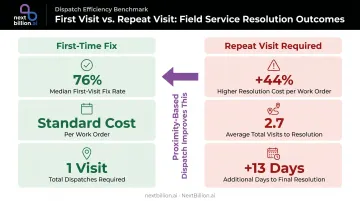
Poor dispatching doesn't just waste fuel — it directly affects service outcomes. The 2024 Field Service Benchmark Report, which analyzed 24 million work orders, found a median first-time fix rate of 76% across industries.
When a service issue isn't resolved on the first visit, resolution cost jumps 44% higher than the standard cost per work order, involves an average of 2.7 total visits, and adds roughly 13 days to resolution time.
Proximity-based dispatching directly attacks these numbers. Sending the right technician based on actual current location, not a static schedule, reduces response times, cuts unnecessary mileage, and improves the probability of a successful first visit.
This is where geofencing and route optimization work together. When geofence entry and exit events feed into a live dispatch picture, routes can be recalculated dynamically as field conditions change. NextBillion.ai's location intelligence platform enables this by integrating real-time geofencing signals with route optimization, allowing field service businesses to move from static daily schedules to adaptive, live-adjusted routing without per-API-call cost penalties. The platform also supports on-demand task insertion into ongoing routes, so emergency jobs get assigned to the nearest available technician without disrupting everyone else's day.
KPIs impacted:
- First-time fix rate
- Average response time
- Fuel cost per job
- Technician utilization rate
- Jobs completed per technician per day
When it matters most: Emergency and same-day service businesses (HVAC, plumbing, utilities) see the largest gains here. So do operations spanning large geographic territories and teams where job complexity causes technician availability to shift unpredictably during the day.
Advantage 3: Workforce Accountability, Compliance, and Reduced Operational Risk
Every geofence entry and exit is automatically logged with a timestamp and GPS coordinates. Managers receive real-time alerts when workers enter restricted zones, skip job sites, or fail to arrive within an SLA window — without needing to manually monitor every technician.
In field service, compliance failures are often invisible until they escalate. A missed SLA, an unauthorized absence, a safety zone breach: none of these surface immediately.
They show up weeks later as a customer complaint, a contract dispute, or a regulatory audit. By then, the opportunity to address the root cause is gone, and the documentation needed to defend the business often doesn't exist.
Geofencing turns these invisible risks into a documented, queryable record. Over 25% of service leaders in 2023 reported that pulling and analyzing performance data was their most difficult operational challenge. Geofencing produces that data automatically, as a byproduct of normal field operations — no extra steps, no manual reporting.
Documented geofence logs also reduce liability exposure. For regulated industries, they demonstrate due diligence. For billing disputes, they provide verifiable proof-of-service records. For safety-regulated environments, OSHA's shipyard standard (29 CFR 1915.84) specifically requires employers to account for employees working alone in confined or isolated locations — geofencing creates that accountability record automatically.
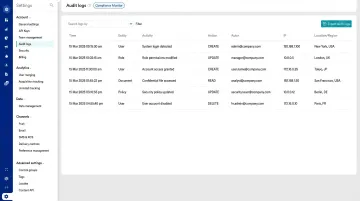
NextBillion.ai's Geofencing API supports audit-grade logging of entry/exit events, with the platform carrying SOC 2 Type II and ISO/IEC 27001:2013 certifications and a 99.9% uptime SLA — relevant for organizations where compliance documentation needs to be both accurate and consistently available.
KPIs impacted:
- SLA compliance rate
- Safety incident rate
- Customer dispute resolution time
- Proof-of-service documentation rate
- On-site time accuracy
When it matters most: Most critical for businesses operating under contractual SLAs with enterprise customers, regulated industries (utilities, healthcare, government contracts), and businesses managing lone workers in remote or hazardous locations.
What Happens When Geofencing Is Missing
The consequences of running a field service workforce without location-verified boundaries aren't dramatic — they're slow, cumulative, and easy to misattribute to other causes.
| Problem | Practical Consequence |
|---|---|
| No verified timestamps | Payroll disputes become routine; managers and employees rely on self-reported logs that regularly don't match |
| No real-time location data | Dispatching stays reactive — jobs assigned by scheduled proximity, not actual proximity |
| No automated arrival confirmation | SLA compliance becomes a phone-call process that doesn't scale past a handful of technicians |
| No alert system for zone breaches | Safety violations and unauthorized absences go undetected until they surface as formal complaints |
| No audit trail | Billing disputes and contract renewals depend on memory and manual records instead of documented evidence |
The combined effect compounds as team size grows. Payroll leakage, excess mileage, missed SLAs, and reactive dispatch each carry their own cost — but they also interact.
A missed SLA that proximity-based dispatch could have prevented leads to a second visit. That second visit adds overtime, inflates payroll, and opens another reconciliation dispute. Each failure feeds the next.
Geofencing interrupts that chain at the source — by giving operations the verified location data needed to act before the cascade starts.
How to Get the Most Value from Geofencing in Field Service
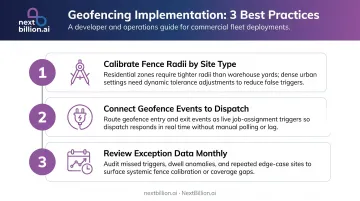
Geofencing delivers its full operational value as part of a broader location intelligence workflow — not as a standalone check-in tool. Three conditions matter most:
1. Calibrate fence radii by site type.
Radius size directly affects accuracy. A single setting applied everywhere creates problems:
- Standard residential stops: 150–200 meters works for most addresses
- Warehouses and access points: Tighter zones prevent check-ins from adjacent docks or neighboring properties
- Dense urban or indoor environments: Use GPS plus Wi-Fi fallback — GPS alone degrades in high-rise areas and inside facilities
Over-tight fences generate false negatives; over-large fences let technicians check in from the wrong address. Neither is acceptable at scale.
2. Connect geofence events to dispatch, not just logs.
Geofencing data stored as historical records has limited operational value. The same data feeding live job assignment decisions is where the gains appear. NextBillion.ai's field service intelligence APIs let geofencing signals directly trigger route optimization and dynamic dispatch — so when a technician departs a job early, the next assignment can be updated before they reach their vehicle.
3. Act on the exception data monthly.
Missed punch patterns, outlier dwell times, and clusters of SLA breaches rarely signal individual failures. They usually point to systemic problems — scheduling misconfiguration, unrealistic job time estimates, or territory assignments that don't reflect actual travel conditions. A monthly review of these patterns converts geofencing from a timestamping tool into an ongoing input for operations improvement.
Conclusion
Geofencing delivers measurable value in field service workforce management by combining verified time and location data with smarter dispatching, tighter resource allocation, and the compliance audit trails needed to reduce risk and protect revenue.
These advantages compound. Accurate data from today's geofence events improves tomorrow's scheduling, reduces next month's overtime, and builds the proof-of-service record needed for contract renewals and dispute resolution. A team that implements geofencing properly doesn't just solve the problems it has now — it builds a data foundation that makes the operation progressively more efficient as it scales.
That compounding effect is what separates geofencing from a simple tracking feature. As workforce size, service territory, and customer expectations grow, the operational discipline built around geofence data grows with them. Tools like NextBillion.ai's Geofencing API give field service teams the infrastructure to put that discipline into practice — without the per-call pricing that makes scaling expensive.
Frequently Asked Questions
What are the benefits of geofencing for field service workforce management?
Geofencing delivers three core operational benefits for field service teams:
- Automated time tracking: Location-stamped timestamps replace manual check-ins
- Proximity-based dispatching: Triggers faster response times and better resource allocation
- Compliance support: Objective geofence logs document arrival times, on-site duration, and territory adherence for SLA and audit purposes
Is geofencing legal in the US for workforce tracking?
Geofencing for workforce tracking is generally permissible in the US when employees are notified of the tracking policy and provide consent. Most states allow location tracking during work hours, but Connecticut, New Jersey, and New York have specific notice requirements for electronic monitoring. Tracking should be limited to shift periods, and consult legal counsel for state-specific requirements.
How accurate is GPS geofencing for field service technicians?
GPS-enabled smartphones are typically accurate within 4.9 meters (16 feet) under open sky, per GPS.gov, but accuracy degrades near buildings, bridges, and dense vegetation. Enterprise FSM implementations counter this with layered verification — GPS plus Wi-Fi plus cellular — and appropriately sized fence radii to maintain reliable accuracy.
What is the difference between geofencing and GPS tracking for field service?
GPS tracking continuously monitors a worker's location and movement path, generating a constant stream of position data that someone has to review. Geofencing triggers specific automated actions — clock-ins, alerts, dispatch updates — only when a worker enters or exits a defined boundary, so managers act on events instead of raw coordinates. The two are complementary: geofencing adds event-driven automation on top of continuous location visibility, cutting the manual review burden that pure GPS tracking creates.
How does geofencing integrate with existing field service management software?
Geofencing integrates via APIs into FSM platforms, payroll systems, and dispatch tools. Entry and exit events automatically update timesheets, trigger job assignments, or send customer notifications — no manual intervention needed. Most modern FSM platforms support this natively or through third-party location intelligence APIs like those offered by NextBillion.ai.
How do you set the right geofence size for field service job sites?
Start with 150–200 meters for residential addresses and adjust based on real punch data from a pilot rollout. Over-tight fences block legitimate check-ins; over-large fences allow arrivals from neighboring properties. Test radii before full deployment — one size rarely fits all site types.
What are the downsides of geofencing for field service teams?
Geofencing has real limits. GPS accuracy degrades near tall buildings or dense vegetation, causing false entry or exit events. Poorly sized fences either block legitimate check-ins or let workers clock in from adjacent properties. Employees may view constant location monitoring as intrusive, raising morale and trust concerns, especially without clear notice. And geofencing only tracks presence, not the quality or completion of work performed on-site — it does not replace supervision.