Most fleet operators have GPS tracking and basic telematics in place. What many still lack is the real-time behavioral layer — the capability to see how drivers are operating vehicles and intervene before an incident occurs rather than after one already has.
This article covers the practical case for driver behavior monitoring: what it is, the measurable advantages it delivers across safety, cost, and performance, and how to extract full value from it as an operational tool — not just a safety checkbox.
Key Takeaways
- Driver behavior monitoring uses telematics, GPS, and AI cameras to flag speeding, harsh braking, distraction, and fatigue in real time.
- The core payoff: fewer accidents, lower costs across insurance, fuel, and maintenance, and coaching grounded in actual trip data.
- Fleets without behavior monitoring manage reactively — learning about unsafe habits only after accidents, complaints, or failed inspections.
- The ROI compounds when data is acted on consistently, not just collected.
What Is Driver Behavior Monitoring?
Driver behavior monitoring is the continuous tracking and analysis of how individual drivers operate their vehicles — covering speed, acceleration, braking, lane discipline, fatigue, and distraction — using telematics sensors, GPS data, and AI-enabled cameras. Common tools include GPS fleet tracking platforms, AI-enabled dash cams, and telematics devices that plug into the vehicle's diagnostics port, often working together rather than as standalone systems. Pricing for GPS tracking hardware and subscriptions varies by provider and by the number of vehicles and features included, so fleets should request quotes based on their own vehicle count and monitoring needs rather than relying on generic figures.
It applies across logistics, last-mile delivery, field services, trucking, and passenger transport. The goal is fleet-wide visibility into on-road behavior, across every vehicle, simultaneously.
More Than Just Surveillance
Behavior monitoring works because it closes the feedback loop between raw driving data and on-road decisions. Fleet managers can intervene in real time, coach based on evidence, and track whether habits actually improve — not just whether scores changed. In practice, monitoring driver behavior means combining telematics alerts, in-cab notifications, and periodic review of trip and event data with drivers, so that feedback is tied to specific incidents rather than delivered as a generic reminder.
That loop is what separates useful monitoring from data that collects dust. Without it, unsafe patterns go unaddressed. With consistent follow-through, fleets have documented reductions in incidents, fuel waste, and insurance claims.
Key Advantages of Driver Behavior Monitoring
Each advantage below maps directly to operational metrics fleet managers track weekly. These aren't abstract safety goals — they're measurable outcomes tied to cost, liability, and performance.
Advantage 1: Accident Prevention and Liability Reduction
Real-time behavior monitoring detects high-risk actions — speeding, tailgating, distracted driving, harsh braking — as they happen. AI dash cams and telematics send instant in-cab alerts to drivers and simultaneous notifications to fleet managers, creating a dual-intervention mechanism that stops risky behavior before it becomes an incident.
The scale of the problem this solves is significant. According to FMCSA's Large Truck Crash Causation Study, driver-related critical reasons were assigned to 87% of large trucks coded with a crash cause — with decision errors (38%), recognition errors (28%), non-performance (12%), and performance errors (9%) as the primary categories.
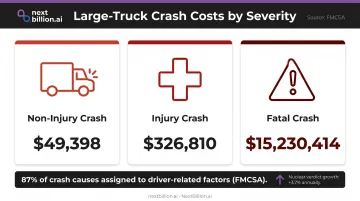
The financial exposure attached to those crashes is just as significant. FMCSA's 2025 crash-cost methodology estimates large-truck crash costs at $49,398 for non-injury crashes, $326,810 for injury crashes, and $15,230,414 for fatal crashes in 2023 dollars.
Beyond prevention, behavior monitoring strengthens legal and insurance positioning when incidents do occur:
- Road-facing dash cam footage exonerates commercial drivers in approximately 63% of cases, according to an ATRI survey cited by Gallagher
- Driver-facing units exonerate in roughly 49% of cases
- A Teletrac Navman survey found 70% of respondents said combining cameras with telematics data drastically reduced time needed to process accident claims
For fleets in high-litigation industries, the nuclear verdict risk alone justifies monitoring. Tractor-trailer tort cases have grown at 3.7% annually from 2014–2023, with a median nuclear verdict of $36M in 2022 — roughly 50% higher than 2013.
KPIs impacted: accident frequency rate, incident cost per vehicle, liability claim volume. Impact is highest in urban operations, long-haul routes, and industries with significant litigation exposure.
Advantage 2: Measurable Cost Reduction Across the Fleet
Behavior monitoring cuts costs across fuel consumption, vehicle maintenance, and insurance — three line items that compound quickly at fleet scale.
Fuel and Maintenance
Aggressive driving — rapid acceleration, hard braking, excessive idling — burns more fuel and accelerates wear on brakes, tires, and engines. The U.S. Department of Energy reports that aggressive driving can lower fuel efficiency by 15–30% at highway speeds and 10–40% in stop-and-go traffic.
Real-time alerts and scoring that discourage these patterns reduce consumption and extend vehicle lifespan. Fleet-reported results from a Verizon Connect/Bobit survey back this up:
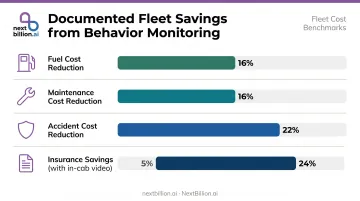
- 16% average fuel-cost reduction reported by GPS fleet tracking users
- 16% average maintenance-cost reduction for the same group
- 22% average accident-cost reduction across the fleet
Insurance
Insurers treat behavior monitoring as evidence of proactive risk management. Fleets with documented safety programs and lower incident histories qualify for premium reductions. The trend making this more urgent: trucking auto liability premiums rose 36% per mile over the past eight years, per ATRI — with premiums reaching $0.099 per mile in 2023.
Fleets with in-cab video monitoring most commonly reported 5–24% insurance savings in the same Verizon Connect survey. Even a 5% reduction compounds meaningfully across a 50-vehicle fleet paying commercial auto rates.
KPIs impacted: cost per mile, fuel spend per vehicle, maintenance cost per vehicle, insurance premium. Impact is greatest for fleets with 20+ vehicles where per-vehicle savings aggregate at scale.
Advantage 3: Data-Driven Driver Coaching and Performance Improvement
Behavior monitoring creates the data infrastructure for structured, individualized coaching — moving fleet safety management away from generic annual training toward continuous, behavior-specific feedback tied to real events.
How Coaching Works in Practice
Driver safety scores, aggregated from telematics and camera data, identify both high-risk drivers who need immediate intervention and high performers who can serve as benchmarks. Managers pair video clips with score trends to run targeted coaching sessions — specific, evidenced, and harder to dismiss than general feedback.
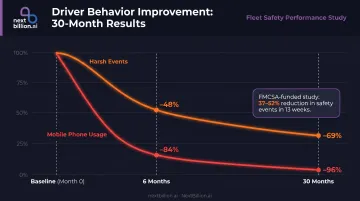
The results from structured programs are documented. A peer-reviewed FMCSA-funded study found that video monitoring combined with behavioral coaching reduced safety-related events per 10,000 miles by 37% at Carrier A and 52.2% at Carrier B during a 13-week intervention period.
Vendor-reported data shows similar patterns. Samsara reports fleets with 175+ vehicles saw harsh events decrease 48% in the first six months and 69% by 30 months, with mobile phone usage falling 84% in six months and 96% by 30 months.
The Retention Angle
Driver turnover is expensive. The American Trucking Associations reported truckload driver turnover at 91% as recently as 2019, and the cost per driver lost is substantial — an older but frequently cited industry study from North Dakota State University put average truckload driver turnover cost at approximately $8,234 per driver.
When monitoring is framed as coaching and development rather than surveillance, drivers engage with the feedback differently. Safety scores improve faster, and the cultural shift toward accountability tends to become self-sustaining. That cultural shift also generates documented evidence of due diligence, which holds up in regulatory audits and litigation alike.
KPIs impacted: driver safety score, incident recurrence rate, driver retention rate, coaching completion rate. This advantage is most impactful for fleets with high turnover or a mix of experienced and new drivers.
What Happens When Driver Behavior Monitoring Is Missing
Without real-time behavior data, fleet managers operate reactively. They learn about unsafe driving habits after an accident, a customer complaint, or a failed inspection — at which point the cost is already incurred.
The consequences stack up fast:
- Incident rates climb with no early-warning mechanism to break the pattern
- Insurance costs rise based on claims history, not managed risk
- Vehicle wear accelerates from aggressive driving that nobody flagged
- Coaching becomes impossible without behavioral data to build improvement plans from
- Legal exposure grows when there's no documented evidence or due diligence trail
The insurance trajectory alone makes inaction expensive. Auto liability premiums for trucking have risen 36% per mile over eight years. Fleets without safety programs have no leverage to push back against that trend.
How to Get the Most Value from Driver Behavior Monitoring
The technology only delivers full value when behavior data is reviewed and acted on consistently. Monitoring without follow-through produces data without outcomes. The feedback loop — detection, coaching, behavior change — is where the ROI lives.
Integration Amplifies Impact
Layering behavior monitoring data with route optimization and GPS tracking produces insights that neither system delivers alone. When behavior events are mapped against specific route segments, fleet managers can answer questions that pure telematics can't:
- Is harsh braking concentrated on a specific corridor that warrants a route change?
- Are speeding events linked to scheduling pressure on certain runs?
- Are new drivers struggling on routes with higher complexity?
Platforms that integrate telematics data with routing intelligence (connecting sources like Samsara, Geotab, Motive, and Netradyne with route optimization and live tracking) make this kind of analysis possible. NextBillion.ai's Live Tracking API monitors vehicle behavior in real time with configurable alerts for speeding, idling, and route deviations.
Its Post Trip Route API reconstructs actual routes taken for post-trip analysis. That tracking and reconstruction layer, combined with telematics partner data, gives fleet managers a complete picture of both what happened and where — across every run, not just flagged incidents.
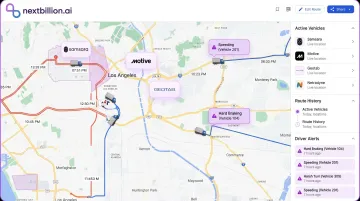
Since joining Velocitor Solutions in 2025, NextBillion.ai pairs that routing intelligence with fleet visibility and driver performance monitoring in a single connected platform.
Driver Buy-In Accelerates Results
Introduce monitoring transparently. Be clear about how data will be used — for coaching and development, not discipline. When drivers understand the system exists to help them improve rather than catch mistakes, they engage with feedback, safety scores improve faster, and the cultural shift holds.
A few practices that accelerate buy-in:
- Share safety scores regularly so drivers track their own progress
- Use high performers as benchmarks, not just outliers as warnings
- Publicly acknowledge improvement — recognition reinforces the behavior change the data is designed to produce
Conclusion
Driver behavior monitoring works because it turns the most unpredictable variable in fleet operations — driver actions behind the wheel — into measurable data fleet managers can act on before the next incident happens.
Its three core advantages — accident prevention and liability reduction, measurable cost savings, and coaching-driven performance improvement — compound over time. Fleets that monitor consistently build the safety culture and cost discipline that separate scalable operations from ones perpetually reacting to the last incident.
A single serious accident can exceed $500,000 in direct and indirect costs. Monitoring doesn't eliminate risk entirely, but it gives fleet managers the visibility to reduce it systematically — and that visibility pays for itself faster than most expect.
Frequently Asked Questions
What types of driver behaviors does a monitoring system track?
Modern systems track speeding, harsh braking and acceleration, distracted driving, lane departure, fatigue and drowsiness, tailgating, and seatbelt non-compliance. These behaviors are captured through telematics sensors, GPS data, and inward- and outward-facing AI cameras working together.
How does driver behavior monitoring lower insurance premiums?
Insurers view behavior monitoring as evidence of proactive risk management. Fleets with documented safety programs and lower incident histories qualify for premium reductions, and video evidence from monitoring systems also reduces fraudulent claim payouts — directly improving claims history.
What is a driver safety score and how is it used?
A driver safety score is an automated rating generated from behavior data (harsh events, speeding frequency, distraction incidents) aggregated over time. Fleet managers use scores to identify high-risk drivers, prioritize coaching sessions, and track whether interventions are producing measurable improvement.
How does real-time monitoring differ from reviewing data after the fact?
Real-time monitoring enables in-the-moment intervention, alerting drivers and managers to unsafe behavior as it happens. Post-trip reporting identifies patterns only after risk has already been taken — it can document what went wrong, but not stop it. Pairing real-time alerts with live tracking lets dispatchers see where an event occurred alongside route context, so coaching addresses the specific road, load, or stop conditions involved, not just the behavior in isolation.
Can driver behavior monitoring help with driver retention?
When monitoring is framed as a coaching tool rather than surveillance, it supports retention by giving drivers clear, fair, data-backed feedback and a visible path for skill development — reducing the perception of arbitrary management that contributes to turnover.
What technology is required to implement driver behavior monitoring?
Core components include an AI-enabled dual-facing dash cam, a telematics device, GPS fleet tracking, and a fleet management platform that aggregates and analyzes the data. Most integrated platforms combine these into a single system, with routing and live tracking APIs connecting behavioral data to broader fleet operations. For fleets under FMCSA hours-of-service rules, this same data layer can also support ELD compliance and IFTA mileage reporting, so behavior tracking and regulatory recordkeeping run on shared infrastructure rather than separate tools.
How do you monitor driver behavior?
Driver behavior is monitored by combining telematics data (speed, braking, acceleration, cornering) with GPS location and, increasingly, AI dash cams that detect distraction, drowsiness, and unsafe following distance. This data feeds a fleet management platform that scores drivers, flags events for review, and triggers real-time alerts. Managers use the aggregated reports for coaching, while live alerts let dispatchers intervene before a minor issue becomes an incident on the road.
How much does fleet GPS tracking cost?
Cost depends on fleet size, hardware (OBD dongle versus hardwired unit versus AI dash cam), and whether you need a bundled telematics platform or are integrating tracking into an existing system via APIs. Typical pricing structures include a one-time hardware cost plus a recurring per-vehicle subscription fee. Fleets building custom dispatch or routing tools often reduce costs by integrating tracking APIs directly rather than paying for a full third-party platform.