Introduction
Delivery route optimization is the process of using algorithms to assign stops to vehicles and sequence each driver's stops to minimize total cost, distance, or time across an entire fleet, rather than planning each route by hand. Managing 20 delivery stops manually is tedious but doable. Managing 200 is where cracks appear. Managing 2,000 is where operations break.
The problem isn't linear — it's exponential. As stops, vehicles, time windows, and driver constraints multiply, the number of possible route configurations grows faster than any dispatcher can process. According to the Capgemini Research Institute, last-mile delivery already accounts for 41% of total supply chain costs. Suboptimal delivery models can erode profitability by up to 26%. Inefficient routing compounds both — and scale makes it worse.
This guide breaks down what route optimization actually means at scale, five strategies that address different dimensions of complexity, and the technical capabilities that separate routing tools that work at 200 stops from those that hold up at 20,000.
Key Takeaways
- Route optimization determines the best stop sequence and vehicle assignment across an entire fleet, not just the fastest path between two points.
- Manual planning works at small volumes but fails on accuracy, cost control, and speed as operations grow.
- Five strategies (zone clustering, service time modeling, VRP, dynamic rerouting, and cost-aware planning) each target a distinct scalability bottleneck.
- Constraint-based optimization — handling time windows, vehicle capacity, and driver hours together — separates scalable platforms from basic route planners.
- Pricing model and integration depth matter as much as the algorithm itself.
What Is Route Optimization for Scalable Delivery?
Navigation finds the fastest road between two points. Route optimization solves a different problem entirely: given 300 stops, 20 vehicles, and a stack of operational constraints, what's the best way to assign stops to drivers — and in what sequence should each driver run them? The best route optimizer for a given operation is the one that models these constraints together rather than treating stop sequencing and vehicle assignment as separate problems.
The distinction matters more than most dispatchers expect.
Planning vs. Optimization
Route planning is manual and sequential — a dispatcher works through stops one by one, applying judgment and experience. Route optimization uses algorithms to evaluate millions of possible configurations simultaneously and return the best one given all active constraints.
The difference shows up at scale. A dispatcher managing 15 stops can produce a reasonable plan in 20 minutes. The same dispatcher facing 300 stops across 15 vehicles, with varying time windows and load capacities, can't produce that plan accurately — and certainly not fast enough to adapt when conditions change mid-route.
The Computational Reality
The underlying math is the Travelling Salesman Problem (TSP): finding the optimal sequence to visit all stops and return to the depot. Princeton's computer science program notes that brute-force TSP search produces approximately N! possible routes. At 20 stops, that's roughly 2.4 quintillion combinations. At fleet scale, it's computationally intractable for humans.
Route optimization software operationalizes this through the Vehicle Routing Problem (VRP), which extends TSP to handle multiple vehicles, multiple depots, and layered operational constraints. VRP is what lets a 50-truck operation plan its entire day in seconds rather than hours.
Key Route Optimization Strategies for Scalable Delivery
Scalable route optimization isn't a single technique. It's a combination of complementary approaches that each address a different source of complexity. Here are five that matter most.
Zone-Based Territory Clustering
Zone clustering divides a service area into geographic territories, each assigned to a specific driver or vehicle. Rather than optimizing all stops globally and simultaneously, the operation segments first — then optimizes within each zone.
Why this matters at scale:
- Reduces computational complexity by shrinking each optimization problem
- Eliminates cross-territory driving that global optimization can produce
- Lets drivers build route familiarity, which reduces errors and shortens actual service times over time
Research published in INFORMS Transportation Science confirms that territory-based routing is commonly used in small package shipping precisely because it improves service consistency. The tradeoff: zone clustering can reduce day-to-day routing flexibility compared to full daily re-optimization. High-volume parcel operations typically favor fixed zones; lower-frequency or demand-variable routes benefit from hybrid approaches that blend zoning with daily re-optimization.
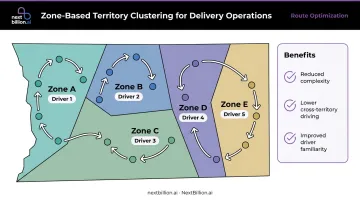
NextBillion.ai's Clustering API handles this as a pre-processing step, grouping large stop volumes by proximity before optimization runs. The result is cleaner driver assignments and faster computation — particularly useful for multi-depot networks where orders need to be allocated to the most efficient facility first.
Accounting for Variable Service Times
Most basic route planners optimize drive time. That's not the same as optimizing total route time.
Every stop includes dwell time — the time a driver spends completing the delivery once the vehicle is parked. Research from the Urban Freight Lab measured commercial vehicle dwell times in downtown Seattle ranging from 1.5 to 107.4 minutes, with a mean of 16.4 minutes. Deliveries to multiple destinations at a single stop averaged 29.1 minutes; hotel deliveries averaged 9.7 minutes.
Treating all stops as equal ignores this variance entirely. ETA errors compound across the day — a five-minute underestimate at stop three can become a 45-minute gap by stop twelve. Missed time windows follow, along with failed deliveries that require costly reattempts.
NextBillion.ai's Route Optimization API models service time per stop as a configurable parameter, allowing operators to differentiate between quick drop-offs, white-glove installations, and bulk unloading jobs. When multiple shipments consolidate at a single address, cumulative service time is calculated before optimization runs — not after.
Applying VRP at Scale
VRP is the algorithmic backbone of multi-vehicle route optimization. Given a set of stops, a fleet with capacity and time constraints, and one or more depots, VRP finds the optimal assignment of stops to vehicles and sequences each route to minimize total cost or distance. The purpose of VRP is to answer both questions at once — which vehicle serves which stop, and in what order — so that constraints like time windows, capacity, and driver hours are satisfied simultaneously rather than checked after the fact. Different VRP variants exist because delivery operations differ: some need time-window compliance, others need capacity limits or multi-depot assignment, and many need a combination of all three.
Modern platforms implement several VRP extensions that are directly relevant to enterprise delivery:
| VRP Variant | What It Handles |
|---|---|
| VRPTW | Time windows — visits must occur within specified intervals |
| CVRP | Capacity constraints — vehicles have maximum load limits |
| Multi-Depot VRP | Multiple starting locations — vehicles originate from different facilities |
The enterprise benchmark for VRP at scale comes from UPS ORION, documented by INFORMS. At full deployment, ORION was projected to save $300M–$400M annually, reduce fuel use by 10 million gallons, and optimize approximately 55,000 routes per day. The scale of those savings reflects what happens when VRP stops being a planning exercise and becomes an operational system running daily across every route.
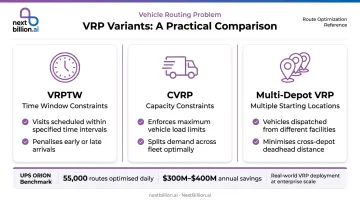
NextBillion.ai's Route Optimization API supports all three VRP variants as configurable parameters within the same API — no separate endpoints needed. The platform handles up to 10,000 stops in a single request.
Dynamic Rerouting During Execution
Even the best pre-dispatch plan degrades once routes are live. Traffic incidents, failed first attempts, last-minute order additions, and vehicle breakdowns are routine occurrences.
Dynamic rerouting means the system monitors active conditions, identifies where the current plan will fail, and generates updated route assignments that account for the full fleet — not just the affected driver. Rerouting one driver around traffic while ignoring the downstream ripple effect on other vehicles misses most of the value.
What triggers a re-optimization event in practice:
- Traffic incident blocks a planned road segment
- Delivery attempt fails; stop needs reassignment
- New order added mid-route
- Driver running behind; downstream time windows at risk
NextBillion.ai's platform handles last-minute cancellations, rescheduling, and new order insertion into ongoing routes. Routes regenerate in seconds, eliminating the need for dispatchers to manually rework assignments every time conditions shift.
Integrating Delivery Cost Calculation into Route Planning
A route that minimizes drive distance doesn't necessarily minimize total cost. Driver overtime and inefficient stop grouping can erode margins even on short routes.
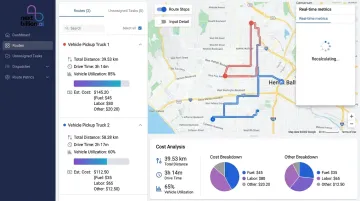
Cost-aware planning computes the financial implications of route configurations before trucks are loaded. NextBillion.ai's Route Optimization API supports per-vehicle cost parameters including fixed costs, per-hour rates, per-kilometer costs, and per-order fees. The system favors lower-cost routes while still respecting time windows and other constraints.
The Route Planner App surfaces these metrics visually: total distance, total drive time, vehicle utilization, and estimated costs per route — visible to dispatchers before any route is committed to dispatch. Manual adjustments trigger real-time metric recalculations, so the cost impact of any change is visible immediately.
This changes the planning decision. Dispatchers can identify overtime risk before it happens, batch high-cost stops with nearby lower-cost ones, and make profitability-aware decisions rather than pure efficiency decisions.
Constraint-Based Optimization: The Engine Behind Scalability
Algorithms and strategies only produce usable routes when the optimization engine can model the real world accurately. Constraint handling is what separates a system that works in demos from one that holds up at operational scale.
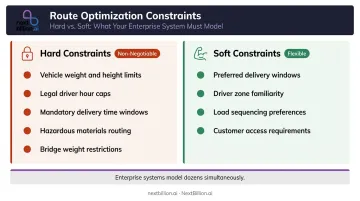
Hard vs. Soft Constraints
Hard constraints must be satisfied — they represent non-negotiable operational or legal requirements:
- Vehicle weight and height limits
- Legal driver hour caps (Hours of Service)
- Mandatory delivery time windows
- Hazardous materials routing restrictions
- Bridge weight limits for heavy vehicles
Soft constraints should be satisfied when possible but can flex:
- Preferred customer delivery windows
- Driver zone familiarity
- Load sequencing preferences
- Customer access requirements
A basic optimizer handles five or six constraints — workable for a simple courier operation. Enterprise delivery networks require modeling dozens simultaneously. Ignoring even one hard constraint can invalidate an otherwise optimal route: a truck routed across a weight-restricted bridge produces an unusable plan regardless of how efficient the rest of the sequence is.
Why Constraint Count Scales With Volume
At 100 orders per day, a system that silently ignores a constraint causes an occasional problem — manageable with manual oversight. At 5,000 orders per day, the same gap causes visible, recurring operational failures across hundreds of routes.
The value of each additional constraint a system can model rises with volume — edge cases multiply at the same rate as order count. A constraint the system couldn't handle last year may be hitting 300 routes per week at current volume.
That's where constraint depth becomes a practical requirement, not a feature comparison point. NextBillion.ai's Route Optimization API supports 50+ hard and soft constraints configured simultaneously — covering vehicle-specific attributes (dimensions, weight, cargo type), driver-level rules (HOS compliance, shift hours, break requirements), multi-compartment load configurations, hazmat rules, and delivery time windows.
The results bear that out. According to internal data, a Canadian fleet management platform serving over 50,000 companies achieved 95% accurate arrival times after implementing constraint-capable routing — with ETA modeling that incorporated historical patterns and real-time traffic data simultaneously.
The Customer Experience Connection
Constraint accuracy directly affects ETA reliability. The more real-world variables a system incorporates, the more the predicted arrival time reflects what will actually happen. McKinsey research found that 85% of consumers will not return to a retailer after one poor delivery experience, and 88% will abandon an online cart because of poor shipping terms.
For operations scaling past a few hundred daily orders, ETA accuracy becomes one of the highest-leverage inputs to customer retention — and constraint modeling is what makes accurate ETAs possible.
Choosing Route Optimization Technology Built to Scale
When evaluating route optimization platforms for scalable operations, the algorithm is only one piece. Four other dimensions determine whether a platform holds up as your operation grows.
Key Capability Questions
1. Constraint coverage and configurability How many constraints does the system support, and can they be configured without engineering effort? A platform requiring custom code to add a new constraint type creates operational debt that compounds as your business rules evolve.
2. Distance matrix size Many entry-level tools cap at a 25×25 distance matrix. At that size, operators must batch large datasets into dozens of smaller requests, introducing latency and calculation inconsistencies. NextBillion.ai's Distance Matrix API supports up to 5,000×5,000 elements — processing 25 million distance and ETA pairs in a single call. A livestock services provider previously making multiple API calls to Google's API reduced that to a single call, with significant latency improvements.
3. Recalculation latency Real-time rerouting requires returning updated routes in seconds, not minutes. NextBillion.ai generates optimized routes in seconds and supports Driver Assignment API with latency under one second for driver-task matching.
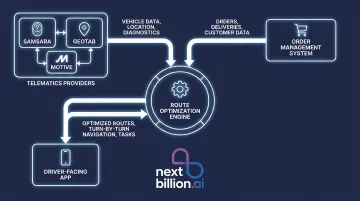
4. Integration depth A route optimization platform connected natively to your telematics provider, OMS, and driver app eliminates the manual data handoffs that become bottlenecks at volume. NextBillion.ai integrates natively with Samsara, Geotab, Motive, Netradyne, and Verizon Connect, pulling vehicle and order data in and pushing optimized routes back out without manual CSV handling.
Pricing Model Alignment
Capability evaluation and cost modeling go hand in hand. Per-API-call pricing becomes expensive as optimization frequency increases — and at scale, it increases fast. Re-optimization cycles, dynamic rerouting, and real-time distance matrix calls multiply the API call count well beyond the number of actual deliveries.
NextBillion.ai's per-order pricing model decouples API cost from API call count. Re-optimizing a route for the same order within a 24-hour period counts as one order, not as multiple calls. Internal data shows this approach saves customers 30–60% on annual API spend versus equivalent usage on per-call billing — particularly relevant for operations with seasonal demand spikes or high rerouting frequency.
When evaluating platforms, model your total cost at 2× and 5× current volume — not just at current usage. If the numbers don't hold at 5× volume, that's the answer.
Frequently Asked Questions
What is delivery route optimization?
Delivery route optimization uses algorithms to determine the most efficient sequence of stops and assignment of deliveries across a fleet — factoring in vehicle capacity, time windows, driver schedules, and other constraints — to minimize cost and maximize on-time delivery. Unlike basic navigation, it solves the full fleet planning problem at once, and in the US it also has to account for FMCSA hours-of-service limits, IFTA reporting needs, and DOT vehicle restrictions on certain roads.
What is the purpose of VRP in delivery route optimization?
VRP (Vehicle Routing Problem) is the algorithmic framework underlying multi-vehicle route optimization. It determines the optimal assignment of stops to vehicles and the sequence of those stops — given constraints like capacity, time windows, and depot locations — to minimize total cost or distance across the fleet.
What is an example of delivery route optimization?
A beverage distributor with 200 daily stops and a 12-vehicle fleet uses route optimization software to cluster stops by zone, assign loads by vehicle capacity, sequence stops within time windows, and dynamically reroute around a midday traffic incident. The result: lower total drive time and fuel spend compared to a manually planned route, plus schedules that stay within each driver's legal hours-of-service limit for the day.
How does route optimization reduce delivery costs?
Optimization reduces costs by shortening total drive distance (lowering fuel spend), maximizing stops per route (improving driver productivity), preventing overtime through realistic scheduling, and minimizing failed deliveries through accurate ETAs and time window compliance.
What constraints should route optimization software handle?
Enterprise-grade software should handle both hard constraints (vehicle weight/height limits, legal driver hour caps, mandatory delivery windows, hazmat rules) and soft constraints (preferred delivery times, driver zone familiarity, load sequencing). All of these should be configurable without custom engineering work.
Can route optimization software adjust routes in real time?
Modern platforms can dynamically recalculate routes during execution when triggered by traffic incidents, failed deliveries, or new order additions. This requires low-latency computation and live integration with telematics or GPS data feeds from fleet management systems. Re-optimization should also respect driver hours-of-service limits so a new route doesn't push a driver past legal on-duty time, and should flag when a reroute risks a missed delivery window.
How do you optimize delivery routes for a fleet?
Start by mapping all stops, time windows, and vehicle capacities, then feed that data into a VRP solver that assigns stops to vehicles and sequences them for minimum cost. Layer in real constraints such as driver hours-of-service limits, depot hours, and hazmat rules. Finally, connect live GPS or telematics feeds so routes can be recalculated when traffic, delays, or new orders disrupt the plan.
What are the different types of VRP used in delivery routing?
Common variants include Capacitated VRP (limited by vehicle load), VRP with Time Windows (stops must be served in a set window), Multi-Depot VRP (routes originate from several depots), and Pickup-and-Delivery VRP (paired pickup and drop-off points). Real-world delivery operations often combine several variants at once, since a fleet may have multiple depots, capacity limits, and customer time windows simultaneously.