Introduction
According to a 2020 study published in the American Journal of Public Health, 5.8 million Americans delayed medical care in 2017 because they lacked transportation. A more recent AHRQ report found that 6.2% of US adults in 2021 reported missing appointments, work, or meetings due to unreliable transportation. That gap hasn't closed. It's grown.
NEMT exists to close it. And for entrepreneurs willing to operate in a regulated environment, it's a durable business opportunity: Medicaid-backed revenue, repeat customers with recurring appointments, and structural demand driven by an aging population. In the US, Medicaid is the single largest payer for NEMT trips, which means most operators are building a business around a public-sector reimbursement cycle rather than consumer marketing — a very different growth path than rideshare or courier work.
But this is not a simple service business. It sits at the intersection of healthcare compliance, ADA vehicle standards, Medicaid billing, and state-specific licensing. The operators who succeed plan thoroughly before they spend a dollar on vehicles.
This guide walks through everything you need to know: from understanding the business model and early decisions to licensing, fleet setup, operations technology, and securing your first contracts.
Key Takeaways
- NEMT transports patients to non-urgent medical appointments, backed by Medicaid and consistent structural demand
- Startup costs cover vehicles, modifications, licensing, insurance, and operating expenses before reimbursements begin
- Success hinges on state licensing, ADA-compliant vehicles, proper insurance, and Medicaid or broker enrollment
- Route optimization and scheduling software are operational necessities, not optional tools
- Plan for 3–6 months before consistent revenue — compliance and contracts take time
What Is a NEMT Business?
NEMT — non-emergency medical transportation — provides rides to people who need to reach scheduled, non-urgent medical appointments but cannot use standard transportation due to age, disability, or lack of access. Common trips include dialysis, chemotherapy, physical therapy, and specialist visits.
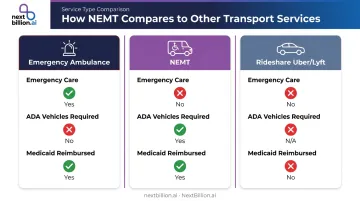
How It Differs From Other Transport Services
| Service Type | Emergency Care | ADA Vehicles Required | Medicaid Reimbursed |
|---|---|---|---|
| Emergency Ambulance | Yes | N/A | Yes |
| NEMT | No | Yes (for disability trips) | Yes |
| Rideshare (Uber/Lyft) | No | No | Generally no |
NEMT is governed federally under 42 CFR 431.53 (assurance of transportation) and 42 CFR 440.170(a) (transportation as a covered Medicaid service). Congress codified it as a statutory requirement in the Consolidated Appropriations Act, 2021.
Common Business Formats
- Owner-operator: Single vehicle, founder drives — lowest capital, highest personal time commitment
- Small fleet: 2–5 vehicles with employed drivers — requires hiring, dispatch systems, and operational processes
- Contract-based operation: Multiple vehicles under broker or facility contracts — highest revenue potential, most compliance complexity
Most first-time operators start as owner-operators and add vehicles once they have stable contracts and cash flow. That sequence keeps early risk contained while you learn the compliance and dispatch side of the business.
Why Start a NEMT Business?
The US NEMT market was valued at $6.58 billion in 2023 and is projected to reach $13.43 billion by 2031 — a 9.3% compound annual growth rate. That growth is unevenly distributed across states, since each state Medicaid agency sets its own broker contracts, coverage rules, and reimbursement rates — which is why the same business idea can be far more or less profitable depending on where you launch it. Two structural forces drive this:
- The US population aged 65 and older reached 55.8 million in 2020, up 38.6% from 2010 (US Census), and that cohort continues to grow
- Medicaid expansion under the ACA extends transportation benefits to adults up to 138% of the federal poverty level, expanding the eligible population in most states
Why the Business Model Works
- Medicaid and broker contracts pay on a per-trip basis with regular billing cycles, not the unpredictable swings of consumer demand
- Dialysis patients travel 3x per week; oncology patients have weekly appointments — the customer base is built-in and recurring
- Many markets are underserved in specific vehicle types (wheelchair transport, rural coverage) or basic reliability, which is a real opening for operators who show up consistently
The business rewards consistency, not speed. A 3–5 vehicle operation with full Medicaid enrollment and solid broker relationships can generate meaningful annual revenue — but reaching that point takes deliberate preparation.
Early Decisions That Matter When Starting a NEMT Business
Legal Structure
Form your legal entity before applying for any license, insurance, or broker enrollment. An LLC is the standard choice for NEMT operators, because it provides liability separation and is the structure most brokers and insurers expect to see. A sole proprietorship carries unlimited personal liability and creates complications when applying for your NPI and commercial insurance. Most state Medicaid agencies and NEMT brokers will only contract with a registered legal entity, so this step is not just a liability question — it can determine whether you're eligible to apply for enrollment at all.
Before you apply for anything else, complete these three steps in order:
- Register your LLC with your state
- Obtain an EIN from the IRS
- Open a dedicated business bank account
Building an Honest Startup Budget
Underestimating costs is the most common early mistake. Your budget needs to cover:
- Vehicle purchase (new or used, accessible or to-be-converted)
- Vehicle modification costs — wheelchair lifts and securement systems typically range from $10,000 to $35,000+ (Aero Mobility)
- Insurance deposits and first-year premiums
- Licensing and application fees (varies significantly by state)
- Broker enrollment fees and credentialing costs
- 3 months of operating expenses before Medicaid reimbursements begin flowing
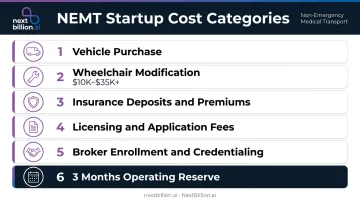
Most new operators skip that 90-day cash buffer — and it's where many fail early. Medicaid billing cycles, broker credentialing, and contract approvals don't move fast. Budget to cover payroll, fuel, and overhead with zero incoming revenue for at least three months.
State-by-State Variation
NEMT licensing is not uniform across the US; every state handles it differently:
- California: Providers apply through DHCS via the PAVE portal
- New York: Applicants must submit a Letter of Support from Medical Answering Services (MAS)
- Virginia: DMV handles NEMT carrier registration with capacity-based insurance requirements
- Louisiana: All NEMT providers register through the Medicaid Enrollment Portal
Research your specific state's Department of Health and Department of Transportation requirements before committing capital. A misread requirement — such as applying through the wrong agency or missing a certificate of need filing — can reset your timeline by 60 to 90 days. Because there is no single federal NEMT license, treat your state's Medicaid agency and DOT as the two authorities that matter most, and confirm directly with each before you sign a lease, buy a vehicle, or hire a driver.
How to Start a NEMT Business — Step by Step
The most common failure mode is spending on vehicles before completing compliance and contracting. The six steps below are sequenced intentionally — each one is a prerequisite for the next. (Use this as your launch checklist.)
Step 1 – Research Your Market and Define Your Niche
Choose your service type before you choose your vehicles. The three main categories are:
- Ambulatory: Walking passengers, standard accessible van
- Wheelchair transport: Requires lifts, 4-point securement, accessible ramp
- Stretcher transport: Highest modification cost, most specialized
Starting with ambulatory or wheelchair transport is more realistic for a first-time operator. Trying to serve all three with limited capital spreads your resources too thin.
Map your local market before writing a business plan. Look for:
- Density of dialysis centers, cancer treatment facilities, and nursing homes
- Gaps in existing NEMT coverage (rural areas, specific vehicle types, reliability issues)
- Which brokers are active in your state — this shapes your enrollment priorities
Step 2 – Build a Business Plan and Register Your Business
Your business plan needs to answer four questions brokers will ask directly:
- What are your startup costs and funding sources?
- What's your projected timeline to Medicaid enrollment?
- How many months until you're cash-flow positive?
- How will you acquire contracts in your first year?
Registration checklist:
- Form your LLC with your state's Secretary of State
- Obtain your EIN from the IRS (free, takes minutes online)
- Open a dedicated business bank account
- Apply for your National Provider Identifier (NPI) — required for Medicaid billing
Complete these before applying for any license or insurance. They're prerequisites, not afterthoughts.
Step 3 – Get Licensed, Insured, and Compliant
Core licensing requirements (most states):
- Business license
- NPI (10-digit identifier used in all HIPAA-standard Medicaid transactions)
- State-specific NEMT or medical transportation permit, where required
- Motor Carrier Permit, where applicable
Insurance is required before any vehicle operates. Coverage types needed:
- Commercial auto liability (often $1M+ per vehicle — Virginia, for example, requires $350,000 for 1–6 passengers and $1.5M for 7–15 passengers)
- General liability
- Workers' compensation
- Professional liability
Driver compliance requirements vary by state but typically include:
- Criminal background check
- Drug screening
- Clean driving record
- CPR and first aid certification
- Wheelchair securement training
- A CDL is required if your vehicle is designed to carry 16 or more passengers including the driver (FMCSA)
Build training time and costs into your pre-launch schedule. A driver who isn't certified cannot legally operate.
Step 4 – Acquire Vehicles and Prepare Your Fleet
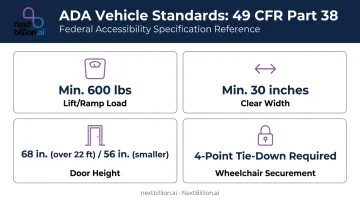
ADA vehicle standards under 49 CFR Part 38 set the federal floor for accessible vehicles:
- Lift or ramp design load: minimum 600 pounds
- Clear width: minimum 30 inches
- Door height: minimum 68 inches for vehicles over 22 feet, 56 inches for smaller vehicles
- Wheelchair securement: 4-point tie-down systems required
Vehicle cost reference points:
- BraunAbility lists a 2026 Chrysler Pacifica Select Safety at $47,935 MSRP with a Power XT conversion at an additional $40,750 MSRP
- Post-purchase wheelchair-accessible conversions currently range from $10,000 to $35,000 and upward (Aero Mobility)
Used vehicles with existing conversions can reduce upfront costs significantly — but verify they meet your state's inspection requirements before purchase.
Step 5 – Build Your Operations and Use Technology to Stay Efficient
Define your core processes before the first ride:
- How trips are requested, confirmed, and assigned
- How drivers are dispatched and updated
- How cancellations and same-day changes are handled
- How billing records are captured per trip
NEMT operations run on time-window precision. One late pickup creates cascading delays across a full day's schedule.
Route optimization is not optional. Managing multiple vehicles and 30+ daily trips manually fails quickly. NEMT-specific scheduling needs include:
- Hard time-window enforcement for appointment arrivals
- Passenger-to-vehicle matching based on accessibility equipment
- Real-time rerouting when traffic disrupts schedules
- GPS logging for Medicaid billing documentation
NextBillion.ai's Route Optimization API handles each of these constraints directly: it matches patients to vehicles based on wheelchair lift availability and enforces strict arrival windows across multi-stop routes with up to 10,000 stops.
The platform's GPS tracking and Snap-to-Road API produce road-accurate trip records for Medicaid billing audits, including the GPS breadcrumb data now required in states like New York (effective April 2023).
The results from actual NEMT deployments are documented: Ride Care, a mental health transportation provider in Oklahoma, reduced route planning time from half a night to 2 hours and scaled from 60 to nearly 200 daily rides using NextBillion.ai's Routing & Dispatch App. GOIN, a paratransit and NEMT platform, achieved 40% cost reduction and 30% reduction in driver idle time after switching to NextBillion.ai.
For small operators (1–5 vehicles), per-vehicle pricing is more cost-predictable than per-API-call models: costs don't spike when you re-optimize routes throughout the day.
That pricing predictability matters most when you're also selecting billing software. Invest in a platform that integrates dispatch, GPS, and billing from the start. Retrofitting these systems after launch is expensive and error-prone.
Step 6 – Secure Contracts and Market Your Services
NEMT revenue comes from three channels:
- Direct Medicaid enrollment — enroll as a transportation provider in your state's program. Slower to set up, but highest per-trip reimbursement
- NEMT brokers — companies like MTM, ModivCare, and Access2Care manage transportation benefits for states and health plans. Brokers retain a portion of the reimbursement rate; the remainder passes to you. The fastest path to first revenue
- Direct facility contracts — dialysis centers, nursing homes, and hospitals sometimes contract directly with NEMT providers. NC Medicaid explicitly encourages providers to pursue both broker and facility contracts
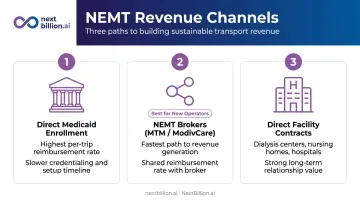
Most new operators start with brokers while pursuing direct Medicaid enrollment in parallel. Once you have a track record, direct facility outreach becomes much easier.
For direct outreach to healthcare facilities:
- Lead with safety record, vehicle accessibility specs, and on-time performance
- Have a basic website listing your service area, vehicle types, and contact information
- Consider connecting with NEMTAC (the national conference focused exclusively on NEMT) to build broker and provider relationships
Conclusion
Starting a NEMT business is achievable — but it requires more compliance preparation than most transportation businesses. The operators who succeed are those who complete licensing, insurance, and contract enrollment before spending heavily on vehicles and staff.
That compliance foundation is also what drives the business model: NEMT rewards reliability, not speed. Medicaid clients with recurring appointments, broker relationships, and direct facility contracts build over months and last years when service quality holds. Once routes are established, tools like route optimization software help operators maintain that reliability at scale — keeping schedules tight and reducing missed pickups as volume grows.
Start with the research and legal setup steps. They cost little upfront but will tell you exactly whether NEMT is viable in your specific state and market — before you commit significant capital.
Frequently Asked Questions
What is a non-emergency medical transportation (NEMT) business?
NEMT provides rides to scheduled, non-urgent medical appointments — such as dialysis, chemotherapy, or therapy — for people who cannot use standard transportation due to age, disability, or lack of access. Unlike ambulance services, no emergency care is involved, but vehicles must meet accessibility standards and drivers require specific training.
Who pays for NEMT services?
Medicaid is the primary payer, covering eligible members' rides to covered appointments under federal regulations at 42 CFR 431.53 and 440.170(a). Private insurance and self-pay clients also contribute. Most state Medicaid NEMT programs are administered through brokers who coordinate trip scheduling and payments.
How much do NEMT brokers charge?
Brokers retain a percentage of the Medicaid reimbursement rate as their management fee, passing the remainder to the transportation provider. The exact split varies by broker and state contract — research the specific broker active in your state before building revenue projections.
How much does it cost to start a NEMT business?
Startup costs cover vehicles, modifications, licensing, insurance, and 3+ months of operating reserves before Medicaid reimbursements flow consistently. Vehicle conversions alone run $10,000–$35,000+. Build your budget from real component costs, not broad estimates. Add dispatch and routing software to that list: manual scheduling works for one or two vehicles, but once you add drivers, missed pickups and wasted mileage start costing more than the software itself.
Do you need a special license to start a NEMT business?
Licensing requirements vary by state. Some states require a specific NEMT or medical transportation permit; others require only standard business licensing plus Medicaid enrollment and broker credentialing. Always verify with your state's Department of Health or Department of Transportation before committing capital. Drivers typically need background checks, a clean driving record, and CPR or first-aid certification, and vehicles must pass periodic inspections for ADA-compliant accessibility equipment. Build licensing timelines into your launch plan, since credentialing with brokers can take longer than the state permit itself.
How much can a NEMT business make per year?
Earnings depend on fleet size, contract volume, and operational efficiency. Operators running 3–5 vehicles with recurring Medicaid contracts — especially serving repeat-appointment clients like dialysis patients — can build a sustainable revenue base. Securing direct facility contracts alongside broker enrollment accelerates that growth. Trip volume alone does not guarantee margin: fuel, no-show rates, driver idle time, and route inefficiency all cut into what looks like strong top-line revenue, so track cost per completed trip, not just contracts signed.
Is a NEMT business profitable?
NEMT businesses can be profitable, but margins are thin and depend on reimbursement rates, trip density, and how efficiently vehicles are routed. Operators who fill vehicles with multiple same-direction trips, minimize deadhead miles, and keep no-show rates low fare better than those relying on volume alone. Profitability usually improves after the first year, once broker contracts stabilize and route planning is dialed in.
How to start a non-emergency medical transportation company?
Start by researching your state's Medicaid NEMT broker requirements and licensing rules, then secure vehicles that meet accessibility standards, driver credentials, and insurance coverage. Enroll as a Medicaid provider or subcontract under an existing broker while building direct relationships with clinics and care facilities. Set up scheduling and routing before taking on multiple vehicles, since manual dispatch does not scale past a small fleet.