Introduction
This guide explains what waste management software does, the types available, and how to evaluate a platform for your fleet — starting with the market context: the U.S. solid waste collection industry generates $66.9 billion in annual revenue and employs over 131,000 collectors — yet many operations still run on spreadsheets, paper manifests, and phone-based dispatch.
That combination holds up at small scale. It breaks down fast when you're managing dozens of trucks, strict pickup windows, EPA compliance deadlines, and fuel costs that represented $470 million (2.9% of revenue) for Republic Services alone in 2024.
SWANA's 2022 labor report documented an 80,000-driver gap in 2021 — projected to reach 160,000 by 2030. Squeezing more productivity from existing crews is now the primary lever most operators have left to pull.
This guide covers what operations leaders at waste collection companies, municipalities, and recycling firms need to evaluate waste management software — types available, must-have features, measurable ROI, how route optimization drives results, and the three most common buying mistakes to avoid.
Key Takeaways
- Waste management software replaces paper dispatch, manual manifests, and spreadsheet planning with a unified operational system
- Route optimization is the single highest-ROI feature — poor routing wastes fuel, labor, and truck capacity simultaneously
- EPA compliance (e-Manifest, RCRA) is increasingly electronic-first, making software a regulatory requirement as much as an efficiency tool
- Purpose-built routing handles weight limits, restricted roads, and landfill time windows that generic mapping APIs ignore
- Evaluate platforms on integration depth, regulatory update cadence, and pricing model (per-API-call billing scales poorly)
What Is Waste Management Software?
Waste management software centralizes the planning, tracking, dispatch, compliance documentation, and reporting of waste collection and disposal operations. The goal is replacing fragmented point tools — separate spreadsheets for scheduling, paper manifests for compliance, phone calls for dispatch — with a single operational system. The best software for waste management depends on your operation's size and waste stream: municipal haulers prioritize route planning and missed-pickup tracking, while hazardous and specialty waste operators need EPA e-Manifest integration and chain-of-custody documentation built in.
The real cost of manual processes isn't just inefficiency — it's the compounding effect of data blind spots: missed pickups that violate service agreements, compliance gaps that invite EPA scrutiny, and billing errors that trigger invoice disputes. Those problems stay manageable at 10 trucks, but at 50 they get expensive, and at 200 they become genuinely hard to control.
Modern platforms have expanded well beyond simple tracking. Today's waste management software typically includes:
- Route optimization and dispatch — automated job creation, driver assignment, and real-time status
- Compliance documentation — waste transfer notes, e-Manifest submissions, audit trails
- Fleet and asset management — vehicle tracking, bin inventory, preventive maintenance
- Customer portals — self-service access to service history and compliance reports
- ESG and sustainability reporting — diversion rates, emissions data, regulatory dashboards
Fortune Business Insights projects the global digital waste management solution market will grow from $3.67 billion in 2026 to $9.37 billion by 2034 at a 12.4% CAGR — a pace that reflects how quickly operators are committing budget to replace manual workflows.
Types of Waste Management Software
By Operational Category
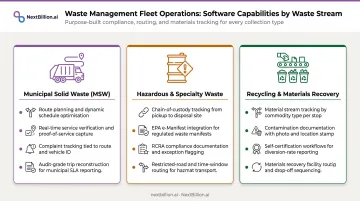
Waste management software falls into three primary categories, each built around distinct operational requirements:
Municipal Solid Waste (MSW) software — built for local governments and large contractors managing residential and commercial collection. Core functions are route planning, service verification, customer complaint tracking, and missed-pickup reporting.
Hazardous and specialty waste software — designed for companies handling chemicals, medical waste, or e-waste. Chain-of-custody documentation, EPA e-Manifest integration, and RCRA compliance are mandatory — gaps in any of them carry direct regulatory exposure.
Recycling and Materials Recovery software — used by MRFs and commodity brokers to track material streams, document contamination, and satisfy state-level self-certification requirements (Wisconsin DNR, for example, requires MRF annual self-certification by March 30 ).
End-to-End vs. Modular Architecture
The build-vs-buy decision matters here. Enterprise operators often prefer integrated suites — one vendor managing dispatch, compliance, billing, and reporting. Mid-market operators and software builders frequently favor modular, API-first approaches where best-in-class components for routing, compliance, and billing are assembled and integrated.
Neither is universally better. The right choice depends on your existing tech stack and how much customization your operation requires.
Industry-Specific Variants
Beyond those three buckets, several sub-verticals have enough distinct requirements — different compliance rules, load types, or scheduling logic — to justify purpose-built tools:
- Food waste platforms — tuned for commercial kitchens and food service compliance
- Construction and demolition (C&D) software — handles permit tracking and debris manifest requirements
- Skip hire / dumpster rental management — optimizes roll-off routing with empty/full load sequencing
Core Features Every Waste Management Platform Needs
Dispatch and Job Management
Manual phone-based dispatch creates a single point of failure: if the dispatcher doesn't know a truck is blocked or a stop was skipped, no one does until a customer calls.
Automated dispatch replaces that with real-time operational control. Core capabilities typically include:
- Digital work orders pushed to drivers automatically at the start of each shift
- Live crew progress visibility showing stop completion status across the entire route
- Exception alerts for blocked access, missed stops, or contamination — flagged in real time
- Browser-based truck reassignment when conditions change mid-route
Compliance and Chain-of-Custody Documentation
This is where software pays for itself in risk avoidance. The EPA's FY 2024 enforcement results included 1,851 civil cases, 121 criminal defendants, and over 8,500 inspections. Penalties in the waste sector are real: one Allied Waste settlement reached $671,000; Heritage-Crystal Clean paid over $1.1 million in civil penalties in the same reporting period.
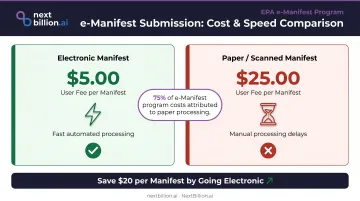
Software auto-generates time-stamped waste transfer notes, manifests, and audit trails tied to specific pickups, vehicles, and disposal facilities. For hazardous waste operators, EPA e-Manifest integration is increasingly mandatory — and financially advantageous. The FY 2026–2027 user fee for a fully electronic manifest is $5.00 versus $25.00 for a scanned paper upload. EPA has attributed 75% of e-Manifest program costs to processing paper manifests and has proposed a 100% electronic system for 2026.
The platform should support EPA RCRA requirements, state-level regulations like California SB 1383 (which requires annual route-level contamination inspections), and update documentation templates as rules change. Waste management steps generally follow a sequence — generation, collection, transport, processing, disposal, monitoring, and reporting — and software should provide documentation and visibility at each stage rather than only at collection.
Fleet and Asset Management
Fleet management features address the cost side of operations directly:
- Real-time vehicle tracking lets dispatchers reroute or reassign trucks the moment a breakdown occurs
- Container and bin inventory management keeps asset location current without manual audits
- Preventive maintenance scheduling extends vehicle life — Republic Services alone runs 17,600 collection vehicles, where deferred maintenance compounds fast
Analytics, Reporting, and ESG Dashboards
Operational dashboards give managers the numbers to benchmark performance and negotiate contracts with evidence rather than estimates. Key metrics to look for:
- Cost-per-service and route efficiency by driver, zone, or vehicle
- Recycling diversion rates and missed pickup trends over time
- ESG reporting outputs — customers and regulators now expect documented sustainability metrics, not rough figures
Billing, Invoicing, and Customer Portals
Integrated billing generates invoices directly from completed service records, eliminating the manual reconciliation step that produces most billing disputes. Customer portals extend that efficiency outward: commercial clients can view service history, download compliance reports, and submit requests without a phone call — freeing up your team for higher-priority work.
Why Route Optimization Is the Heart of Waste Collection Software
The Unique Routing Challenge
Waste collection isn't parcel delivery. Trucks don't follow point-to-point sequences — they must cover entire service zones while managing:
- Vehicle weight and capacity limits
- Truck-restricted roads and bridge weight limits
- Time windows at transfer stations and landfills
- Return-to-dump logic when trucks reach capacity
- Real-time changes from blocked roads, crew changes, or IoT-reported full bins
That complexity makes generic routing tools — Google Maps, HERE — genuinely inadequate. Google Maps focuses on consumer-grade driving routes and does not support truck routing or hazmat restrictions. HERE cannot optimize truck routes beyond 190 km or define custom cost structures. These aren't minor gaps; they create compliance and safety risks in heavy fleet operations.
What Poor Routing Actually Costs
NYC's DSNY found that private waste trucks travel over 23.1 million miles per year across the city. Their Commercial Waste Zones analysis found that route restructuring could reduce vehicle miles traveled by 49% to 68%. A peer-reviewed municipal waste routing study documented a 25.44% reduction in daily mileage — translating to roughly 1,810 km saved per vehicle annually.
Given that fuel represented 2.9% of revenue and labor 20% of revenue for Republic Services in 2024, even modest routing improvements compound into significant cost reductions. A separate IoT-integrated waste routing study reported a 32% route efficiency improvement and 29% decrease in fuel consumption when optimization was deployed with sensor data.
What Purpose-Built Route Optimization Brings
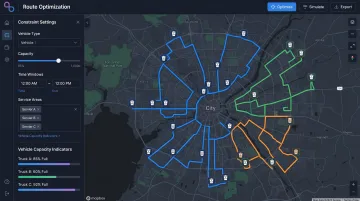
For operations teams building or enhancing waste platforms, NextBillion.ai's Route Optimization API is purpose-built for the constraints waste collection actually requires:
- 50+ hard and soft constraints — vehicle capacity, time windows, service frequency, axle weight limits, truck-restricted roads
- Return-to-dump logic — automatically plans the most efficient unload timing so trucks minimize off-route travel
- Curbside pickup sequencing — correct street-side approach to minimize U-turns and crew safety risks
- Material route segmentation — routes by waste type (recycling, municipal, C&D) to prevent cross-contamination
- Large-scale distance matrix — supports matrices up to 5,000×5,000 elements, handling thousands of origin-destination pairs in a single request (versus the standard 25×25 cap in most APIs)
- Dynamic rerouting — adjusts live routes in response to blocked roads, traffic changes, or new pickups mid-shift
- Native integrations with Geotab and Samsara — pulls vehicle data and pushes optimized plans directly to driver apps without CSV exports
The pricing model matters too. NextBillion.ai offers per-vehicle and per-order pricing as an alternative to per-API-call billing. For waste platforms running frequent re-optimizations, daily distance matrix calculations, and dynamic rerouting throughout shifts, per-call billing scales unpredictably.
One transportation software operator documented an 82% reduction in API costs by switching to asset-based pricing while processing 800,000 matrix calls per month.
Operations teams without developer resources can access the same 50+ constraint engine through NextBillion.ai's no-code Route Planner App — importing stop lists from CSV, configuring constraints, reviewing on an interactive map, and dispatching to driver apps entirely in-browser.
Routing's Downstream Impact on Sustainability
Every mile eliminated by better routing cuts fuel consumption and reduces emissions — and that data doesn't just stay internal. Waste operators increasingly need documented efficiency metrics to satisfy ESG reporting requirements and support sustainability commitments in commercial contract negotiations. Route optimization makes those numbers real and auditable.
The ROI of Digitizing Waste Operations
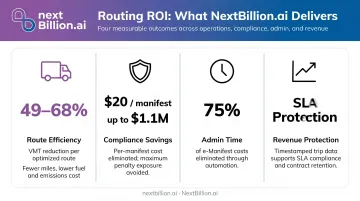
Waste management software delivers ROI through multiple cost levers at once — route efficiency, compliance exposure, administrative overhead, and contract retention all move in the right direction when operations go digital.
Operational Cost Reduction
Route optimization addresses fuel and labor together — two of the largest cost lines in any hauling operation. The efficiency gains are well-documented:
- NYC DSNY's analysis found route restructuring could cut fleet VMT by 49–68%
- Academic research has documented 25%+ reductions in daily mileage
- Labor runs roughly 20% of revenue for major haulers; fuel runs close to 3%
A 10–15% improvement in route efficiency produces measurable cost savings across both categories simultaneously.
Compliance Cost Avoidance
EPA enforcement is active — 1,851 civil cases and 8,500+ inspections in FY 2024. Individual penalties in the waste sector have reached $671,000 to over $1.1 million per settlement. Software-generated, inspection-ready documentation with automatic timestamps and chain-of-custody records directly reduces exposure to these costs. The $20-per-manifest savings from electronic versus paper submission compounds fast — at 500 manifests per month, that's $10,000 in annual savings on processing alone.
Administrative Time Reclaimed
Paper manifests, manual billing reconciliation, and spreadsheet-based scheduling all consume back-office hours that don't scale. EPA's own data attributes 75% of e-Manifest program costs to paper processing — a direct signal of how much administrative burden paper workflows create. Automated workflows shift that time toward dispatch, customer service, and exception handling instead.
Revenue Protection
Better service data protects existing contract revenue. When you can demonstrate service completion rates, material weights, and SLA adherence with timestamped records, missed-pickup disputes resolve faster and contract renewals go more smoothly. That same performance record also works offensively — when bidding new contracts, verified service metrics beat unsubstantiated claims from competitors who can't show the data.
How to Choose the Right Waste Management Software
Picking the wrong platform costs more than the subscription fee — it costs months of integration work, compliance gaps, and retraining. Three questions should anchor your evaluation before you look at any feature list.
Match Platform to Operation Type
Start with the basics:
- What waste streams do you handle? MSW, hazardous, recycling, and C&D have different compliance requirements
- What's your operational scale? Single depot versus multi-region changes integration and data architecture requirements
- What systems are already in use? ERP, billing, telematics — platforms that don't integrate cleanly create new manual handoffs
The Three Most Common Buying Mistakes
Generic fleet tools lack waste-specific compliance modules. E-Manifest compatibility, RCRA reporting support, and route-review documentation aren't standard in general fleet platforms — and you'll notice that absence fast.
Integration complexity gets underestimated. A platform requiring months of custom work to connect to your billing system erases the efficiency gains before day one.
Per-API-call pricing scales against you. Operators running optimization multiple times daily — re-optimization, dynamic rerouting, matrix calculations — watch costs climb unpredictably. Per-vehicle or per-order pricing structures are worth seeking out, especially for teams embedding routing into existing software.
Non-Negotiable Vendor Criteria
Before signing:
- Regulatory update cadence — does the vendor track EPA rule changes and update documentation templates automatically?
- Uptime SLA — mission-critical dispatch requires 99.9%+ uptime with defined support response times
- Deployment flexibility — municipalities and enterprise operators with data sovereignty requirements need cloud-agnostic or on-premise options. Look for SOC 2 Type II, ISO/IEC 27001:2013, GDPR, and CCPA certifications, and confirm the vendor supports your preferred infrastructure (AWS, GCP, Azure, or private Kubernetes). NextBillion.ai, for example, supports all four alongside fully on-premise deployment
- Comparable implementation evidence — ask for references at similar operational scale, not just generic case studies
Frequently Asked Questions
What is waste management software?
Waste management software is a digital platform that centralizes waste collection dispatch, fleet tracking, compliance documentation, and reporting. It replaces paper manifests, manual scheduling, and phone-based coordination with automated workflows — improving operational efficiency and keeping compliance documentation inspection-ready.
What types of businesses need waste management software?
Municipal waste contractors, private haulers, recycling and MRF operators, hazardous waste specialists, skip hire companies, and construction/demolition firms all benefit. If your operation involves collection fleets and regulatory compliance around waste, you're a likely fit. Fleets subject to DOT and FMCSA rules, along with operators tracking hazardous loads under PHMSA and RCRA requirements, gain the most from centralized dispatch and documentation.
What are the most important features in waste management software?
Route optimization, real-time dispatch and job management, automated compliance documentation, fleet tracking, and integrated billing drive the most operational value. Compliance documentation — especially e-Manifest and RCRA support — is a baseline requirement for hazardous waste operators.
How does route optimization improve waste collection?
It reduces miles driven, fuel use, and crew overtime by sequencing stops efficiently within capacity and time windows. Purpose-built routing tools also handle truck-specific restrictions — weight limits, restricted roads, landfill time windows — that generic mapping APIs do not support.
How long does it take to see ROI from waste management software?
Most operators see measurable returns within 3–6 months, with route efficiency and compliance administration delivering the fastest gains. Unifying routing, compliance, and billing in one platform — rather than juggling separate tools — accelerates that timeline. Timelines shift with fleet size, route complexity, and how much manual paperwork the software replaces, so treat this as a directional range rather than a guarantee for every operation.
Can waste management software scale with business growth?
Yes. API-first platforms handle additional vehicles, service zones, and data volume without architectural changes — meaning you can add or swap capabilities as your operation grows, without replacing the entire platform.
What is the best software for waste management?
There is no single best option — the right choice depends on fleet size, whether you handle hazardous waste, and how much you need to integrate routing, dispatch, and compliance documentation. Operators should prioritize platforms with route optimization built for truck restrictions, real-time dispatch, and compliance tracking aligned to DOT, FMCSA, or RCRA requirements, rather than generic mapping tools.
What are the 7 R's of waste management?
The 7 R's typically referenced in waste management are Rethink, Refuse, Reduce, Reuse, Repurpose, Recycle, and Rot (compost). They extend the traditional three R's into a fuller framework for reducing waste generation and diversion from landfills. Software supports these principles operationally by tracking material streams, reporting diversion rates, and documenting recycling volumes for compliance and reporting purposes.