Introduction
Water delivery routing software is a platform that plans, sequences, and adjusts driver routes automatically, accounting for vehicle capacity, delivery windows, and bottle returns instead of leaving dispatchers to work it out by hand. Running a water delivery operation sounds straightforward on paper — load the truck, drop off bottles, collect empties, repeat. The reality is messier. Drivers cover dozens of stops per day with heavy 5-gallon jugs, recurring subscription accounts that expect precise windows, and empty-bottle returns that complicate every load calculation. Most operators coordinate this with spreadsheets, phone calls, or mapping tools built for package delivery, not bulk water distribution.
Poor routing costs more than extra miles. Overtime pay, missed delivery windows, customer service calls, and routes so inefficient that adding a fifth driver doesn't actually increase capacity — these are the real consequences. The math behind it is staggering: according to Verizon Connect, a single vehicle with just 10 stops creates over 3.6 million possible route combinations. Five vehicles push that number past 37 quadrillion.
This guide covers the real cost of poor route planning in water delivery, what dedicated route management software actually does differently, the features that matter for this industry specifically, and how to choose the right platform for your operation.
Key Takeaways
- Manual routing creates zig-zag patterns that waste fuel and driver hours across every route, every day.
- Route management software automates stop sequencing, dispatching, GPS tracking, and proof of delivery.
- Water delivery has unique constraints — bottle returns, subscriptions, weight limits — that generic tools routinely miss.
- The right software pays for itself through reduced fuel spend, more stops per day, and fewer missed windows.
The Real Cost of Poor Route Planning in Water Delivery
Why Density Doesn't Automatically Mean Efficiency
Water delivery should be one of the more fuel-efficient last-mile operations. Routes repeat weekly, customers cluster in neighborhoods, and stops are predictable. That density advantage only materializes when routes are properly sequenced.
Without it, drivers cover the same neighborhoods in inefficient loops — passing a customer at 9 AM, circling back at 2 PM, then finishing the day near where they started.
Routific documented one routing implementation that reduced mileage by 37% and eliminated 8 vehicles from the fleet — with route planning time dropping from 4 hours to 3 minutes. That case wasn't water delivery, but the mechanics are identical: dense stops plus poor sequencing equals wasted miles.
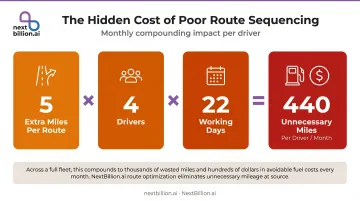
The compounding math is what hurts operators most:
- 5 extra miles per route
- × 4 drivers
- × 22 working days
- = 440 unnecessary miles per month, per driver
Across a modest fleet, that's thousands of dollars in fuel and hours — before factoring in wear and driver overtime.
Beyond Fuel: The Downstream Effects
Poor sequencing doesn't just inflate fuel costs. It creates a cascade:
- Missed delivery windows generate customer service calls and churn, especially for commercial accounts with strict access hours
- Driver overtime accumulates when routes run long — subscription customers notice when their regular window starts slipping
- Capacity constraints hit earlier when vehicles aren't loaded or sequenced optimally, limiting how many stops each route can absorb
A business running 5 drivers manually might absorb the inefficiency. At 15–20 drivers, the same disorganization becomes a structural problem — one that shows up in overtime costs, missed windows, and drivers who can't take on new stops even when demand grows.
What Route Management Software Does for Water Delivery Operations
From Mapping Tool to Operational System
Route management software isn't a fancier version of Google Maps. Gartner defines vehicle routing and scheduling solutions as applications that create routes and schedules while accounting for multiple constraints simultaneously. For water delivery, that means the platform handles the full workflow: order intake, route creation, driver dispatching, real-time tracking, and delivery confirmation, all from a single system.
The difference matters because water delivery decisions aren't isolated. Adding a stop mid-morning affects vehicle capacity for the afternoon. A delayed commercial delivery cascades into residential windows. A manual system can't see these dependencies; purpose-built software can.
Core Capabilities
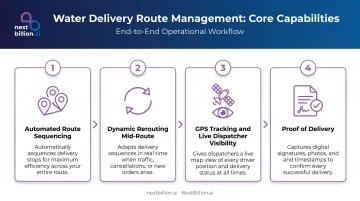
Here's how that plays out across the four functions that matter most in a water delivery operation.
Automated route sequencing takes every stop for a given day, clusters them by geographic density, and arranges them in the optimal order based on distance, time windows, vehicle capacity, and driver constraints. What takes a dispatcher 3–4 hours manually happens in seconds. NextBillion.ai's Clustering API groups stops by proximity before optimization runs, so dense urban territories get processed as intelligently as spread-out suburban zones.
Dynamic rerouting mid-route handles common disruptions: a last-minute order from a commercial account, a road closure, a driver running late. Rather than requiring a dispatcher phone call or driver judgment, the system inserts the change with minimal disruption to the rest of the route. NextBillion.ai supports real-time reoptimization that accommodates new stops without triggering a full recalculation of every other driver's workload.
GPS tracking and live dispatcher visibility means dispatchers see every driver's location, progress against planned stops, and estimated arrival times in real time. Delays get flagged before they cascade — not after a customer calls. NextBillion.ai's Live Tracking API supports up to 1-meter location accuracy, with configurable alerts for route deviations, excessive idling, and geofence events.
Proof of delivery closes the loop at every stop. Drivers capture photos, digital signatures, or OTP confirmation via mobile app, creating a timestamped record that resolves disputes, confirms billing, and supports customer communication. The Coastal Water Store case study specifically notes drivers obtaining electronic proof of delivery through pictures and signatures, with empty bottle collection recorded automatically in the admin panel.
Must-Have Features in Water Delivery Route Management Software
Not every routing platform is built for this type of operation. Here's what to require before committing. This is also where the distinction between a general-purpose free route planner and dedicated water delivery routing software shows up — free apps typically optimize a single day's stops without accounting for recurring subscriptions, weight limits, or bottle returns, which forces dispatchers back into manual adjustments anyway.
Multi-Stop Optimization with Real Constraint Support
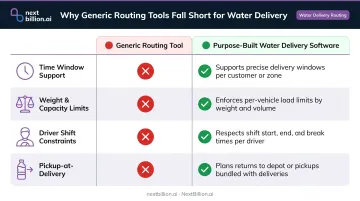
"Shortest path" algorithms fail water delivery operators because they ignore the constraints that actually govern the workday. Your software must handle:
- Delivery time windows — residential customers have different availability than commercial accounts
- Vehicle weight and capacity limits — 5-gallon bottles are heavy; a route that ignores cumulative load creates safety and compliance problems
- Driver shift constraints — hours-of-service compliance matters even on local routes
- Pickup-at-delivery — empty bottle returns change vehicle capacity calculations stop by stop
NextBillion.ai's Route Optimization API supports 50+ configurable hard and soft constraints, including multi-dimensional capacity planning (weight, volume, quantity simultaneously), time-window enforcement, driver shift limits, and pickup/delivery attribute pairing. This means dispatchers configure routes around how their operation actually runs — not the other way around.
Subscription and Recurring Delivery Management
Water delivery runs on schedules. A good platform recognizes recurring stop patterns and auto-populates route plans — dispatchers shouldn't rebuild routes each day. NextBillion.ai supports automated recurring delivery scheduling, allowing operators to configure route preferences once and reuse them. Import recurring stop data via CSV/XLS or connect directly to your CRM/ERP.
Driver Mobile App
Drivers need three things in the field:
- Turn-by-turn navigation to each stop
- A stop-by-stop task list with delivery instructions
- Proof-of-delivery capture (photo, signature, OTP)
Open-source routing engines can technically provide navigation, but they generally require in-house development to add dispatch, proof of delivery, and subscription handling on top — work most water delivery operators are not staffed to take on. NextBillion.ai's driver app supports all three, with routes dispatched directly from the dispatch platform. Offline tracking in low-connectivity zones ensures location history stays accurate even in rural or basement delivery areas.
Telematics Integration
The field data your drivers generate — stops completed, deviations, delivery times — only becomes actionable when it feeds back into your fleet systems. That requires bidirectional integration, not just a CSV export at day's end. NextBillion.ai connects natively with Samsara, Geotab, and Motive, pulling vehicle data in and pushing optimized routes back, so route planning and fleet management share a single operational view.
Analytics and Reporting
The software should surface route-level and driver-level performance data — on-time rates, stops per hour, fuel per route, deviation from planned path. With consistent reporting, dispatchers can spot which routes are underperforming, identify drivers who need support, and make incremental adjustments that compound over a full season.
Water Delivery's Unique Routing Constraints Generic Tools Miss
Empty Bottle Return Logistics
Most last-mile delivery is one-directional. Water delivery isn't. Drivers pick up empties at the same stop where they drop off full jugs — and according to IBWA, 3- and 5-gallon cooler bottles are reused more than 35 times before recycling. That means every stop involves both a delivery and a pickup.
Generic tools treat stops as drop-off events. Purpose-built platforms treat them as vehicle routing problems with simultaneous delivery and pickup (VRPSDP), recalculating available capacity after each stop in both directions. This affects how many stops each vehicle can handle and in what sequence.
Apartment and Multi-Unit Building Access
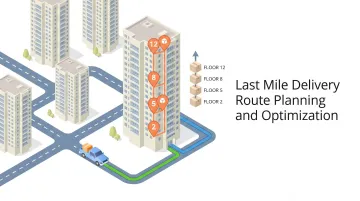
The capacity and sequencing logic from empty-bottle returns compounds when routes pass through dense residential buildings. One apartment complex might house 20 subscription customers. A generic routing tool plots 20 separate address points. A water delivery operator needs those 20 stops grouped into a single building visit — with floor-by-floor sequencing — to avoid multiple trips through the same lobby and freight elevator.
NextBillion.ai's Clustering API groups stops by geographic proximity with configurable parameters, and the platform accounts for building access constraints including elevator dwell times and access codes. For operators with dense urban accounts, poor clustering can add 30–45 minutes of redundant lobby time per route — costs that compound across every driver, every day.
Seasonal and Demand-Surge Handling
PNAS research on national bottled water sales documents consistent summer demand spikes in bottled water consumption. The software needs to let dispatchers add stops to active routes or spin up overflow routes without manually re-sequencing every driver's workload. NextBillion.ai supports ad-hoc stop insertion into ongoing routes with minimal re-optimization, keeping the rest of the route intact.
How to Choose Route Management Software for Your Water Business
Match the Software to Your Scale
A 3-driver operation has different needs than a 20-vehicle fleet running multiple zones. Before evaluating vendors, assess:
- Does pricing scale predictably as you add vehicles or orders?
- Are multi-depot management and API access available when you need them?
- Can the platform handle your peak-day stop volume without hitting request limits?
Per-call API billing, such as the model Google's Route Optimization API uses (charged per shipment), can escalate quickly as volume grows. NextBillion.ai offers per-vehicle and per-order pricing with annual licenses and no monthly caps — operators know what they're paying before route volume changes.
Prioritize Integration Depth
The software shouldn't sit in isolation. It should connect with your order management system, CRM, and telematics platform. For operators who want to embed routing logic into a proprietary dispatch or customer-facing platform, an API-first approach gives full control.
NextBillion.ai's Route Optimization API is built for that kind of deep integration:
- Handles up to 10,000 stops per request
- REST-based, fits into existing tech stacks without custom middleware
- Includes a 2–3 week free evaluation with hands-on solutions engineers
Evaluate Total Cost of Ownership
Vendor pricing isn't just the subscription fee. Factor in:
- Implementation timeline (cloud-based platforms deploy in days to weeks; enterprise configurations can take 8–12 weeks per Locus, or 2–4 weeks for simpler platforms like Onfleet)
- Support model — 24/7 live support versus ticket-only matters when a route goes sideways at 6 AM
- Hidden per-transaction costs that inflate as volume scales
NextBillion.ai includes 24/7 support in the base price, with dedicated solutions engineers on hand from day one through go-live.
Frequently Asked Questions
What is route management software for water delivery?
It's a platform that automates route planning, driver dispatching, real-time GPS tracking, and delivery confirmation for water delivery operations. It replaces manual coordination — spreadsheets, phone calls, driver judgment — with data-driven workflows that optimize every stop sequence and surface operational issues before they compound. For fleets subject to DOT hours-of-service rules, this also means routes are built with driver duty limits in mind, not just delivery efficiency.
How does route optimization reduce fuel costs for water delivery businesses?
By clustering stops geographically and sequencing them optimally, the software eliminates the zig-zag patterns that add unnecessary miles to every route. Vendor case studies document mileage reductions of 25–37% after switching from manual planning, and those savings compound across every driver on every shift. Less idle time and fewer backtracks also reduce wear on brakes and tires, lowering maintenance spend alongside fuel.
What features should I look for in water delivery route management software?
Prioritize platforms that cover these core capabilities:
- Multi-stop optimization with constraint support (capacity, time windows, shift limits)
- Driver mobile app with proof-of-delivery capture
- Real-time GPS tracking
- Recurring delivery management
- Native integration with fleet telematics and order management systems
Can route management software handle recurring subscription deliveries?
Yes — purpose-built platforms auto-generate daily routes from recurring stop schedules, so dispatchers aren't rebuilding routes manually each morning. NextBillion.ai allows operators to configure route preferences once and reuse them, with recurring stop data pulled directly from CRM or ERP integrations.
What is the best delivery route planner?
"Best" depends on your constraint complexity, fleet size, and integration requirements. Evaluate platforms on constraint depth (can it handle pickup-at-delivery and weight limits simultaneously?), pricing model (per-vehicle vs. per-call), and API flexibility for embedding routing into existing systems — not on brand recognition alone. For water delivery specifically, also check whether the platform supports recurring stop schedules and container/tank capacity constraints out of the box.
How long does it take to implement route management software for a water delivery business?
Most cloud-based platforms deploy within days to a few weeks for standard configurations. Complex enterprise setups with multi-depot management and deep integrations can take 8–12 weeks. Vendors with dedicated onboarding support, including sandbox testing and solutions engineer assistance, typically reach production faster than self-service implementations.
What is the best free app to plan delivery routes?
Free route planning apps typically cap the number of stops per route and lack constraint handling for capacity, time windows, or recurring schedules — fine for a handful of daily stops, but not for a fleet running dozens of water delivery routes. As stop counts and constraints grow, operators generally move to paid platforms or APIs like NextBillion.ai that support multi-vehicle, multi-constraint optimization.
What is the best open-source routing software?
Open-source routing engines such as OSRM, GraphHopper, and OR-Tools provide the underlying algorithms for distance calculation and route optimization, but they require engineering resources to deploy, maintain, and integrate with dispatch, mapping, and driver apps. They suit teams with in-house development capacity; most water delivery operators use a managed platform or API layer built on top of these engines instead.