The right waste management software changes that equation. Instead of treating waste as an unpredictable liability, manufacturers can track streams, automate compliance reporting, and tighten logistics costs — all within a single operational framework.
Key Takeaways
- Manufacturing waste software covers hazardous waste manifesting, RCRA compliance, and disposal logistics — not just recycling
- Top platforms for 2026: SafetyCulture, AMCS Platform, Chemical Safety Software, Intelex, and NextBillion.ai
- No single tool does everything — most manufacturers need compliance, tracking, and logistics tools working together
- Key selection criteria: regulatory coverage, hazardous waste tracking, ERP/EHS integration, and multi-site scalability
- Fleets handling waste transport should pair route optimization with their core compliance stack
What Is Waste Management Software for Manufacturing?
Waste management software for manufacturing is a compliance and logistics platform — not a digital recycling tracker. It handles waste stream creation, storage, transport, disposal profiling, hauler cost management, and EPA-compliant e-Manifest generation across the full waste lifecycle. For manufacturers asking which software is best for their operations, the answer typically depends on whether the priority is hazardous waste compliance, EHS-wide reporting, or transport logistics, since few platforms cover all three equally well.
Manufacturing operations produce waste profiles that generic municipal or food-service apps simply weren't built for. The EPA's own industry guidance lists examples like:
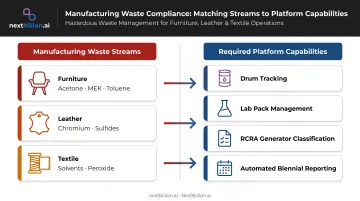
- Furniture manufacturing: acetone, MEK, toluene, pigments
- Leather manufacturing: chromium, toxic sulfides, suspended solids, wastewater
- Textile manufacturing: hydrogen peroxide, sodium hydroxide, tetrachloroethylene
These aren't household waste categories. Platforms built for them need drum tracking, lab pack management, RCRA generator classification, and automated biennial reporting — each a requirement of regulated industrial compliance, not a nice-to-have feature.
The platforms reviewed below were evaluated specifically against manufacturing applicability, not general waste management market share.
Best Waste Management Software for Manufacturing in 2026
Platforms were evaluated on regulatory compliance depth, manufacturing-specific waste tracking, integration flexibility, usability for EHS teams, and real-world operational impact. There is no single best waste management software overall; the right choice depends on generator classification, plant count, and whether transport logistics are managed in-house or through a hauler.
SafetyCulture
SafetyCulture is an operations and compliance platform used across manufacturing, construction, and energy industries, with strong inspection, audit, and corrective action workflows. It's adopted by 85,000+ teams globally — including manufacturers like Toyota and Siemens — and has powered 50M+ inspections across 80+ countries.
For manufacturing EHS teams, its value is in the inspection layer. Frontline workers can complete waste audits on mobile devices, flag non-compliant handling, and trigger corrective action workflows that route to the right supervisor. Trend dashboards make it easy to spot recurring issues across shifts or plant locations.
| Category | Details |
|---|---|
| Key Features | Customizable waste audit checklists, scheduled inspections, issue reporting, corrective action workflows, trend dashboards |
| Best For | Manufacturing EHS teams needing compliance auditing and frontline waste inspection management |
| Pricing | Free plan up to 10 users; Premium at $24/seat/month (billed annually) with 30-day trial; available on iOS, Android, and web |
Capterra: 4.6/5 (353 reviews) · G2: 4.6/5 (241 reviews)
AMCS Platform
AMCS is an enterprise-grade waste ERP serving 5,000+ customers and managing 600M+ tonnes of material annually. It's purpose-built for complex waste and recycling operations — including commercial and industrial streams.
For manufacturers with multi-site waste operations, AMCS provides a single operational backbone: integrated compliance and ESG reporting, Vision AI for contamination and overfill detection, dynamic route re-optimization for waste hauling fleets, and scale house operations management. AMCS's own data suggests route optimization can deliver 10–20% savings in waste collection costs.
| Category | Details |
|---|---|
| Key Features | AI contamination/overfill detection, dynamic route optimization, fleet and asset management, sustainability and ESG reporting, scale house operations |
| Best For | Large manufacturers with multi-site waste operations needing an end-to-end waste ERP system |
| Pricing | Enterprise custom pricing; demo required (contact AMCS directly) |
Capterra: 3.3/5 (10 reviews) — limited review base given enterprise focus
Chemical Safety Software
Chemical Safety Software is a purpose-built hazardous waste management platform tracking chemical waste from generation through certificate of destruction. It's designed specifically for organizations with regulated chemical streams.
Manufacturers handling industrial solvents, lab chemicals, or hazardous byproducts benefit from its drum and lab pack tracking, barcode label printing, and automated CERCLA Biennial Report generation. That last capability alone removes significant manual burden — Large Quantity Generators must submit Biennial Reports to the EPA by March 1 of every even-numbered year, and manual preparation is time-consuming and error-prone.
| Category | Details |
|---|---|
| Key Features | Waste item and drum tracking, lab pack management, barcode label printing, automated CERCLA Biennial Report, waste consolidation tracking |
| Best For | Manufacturers managing hazardous chemical waste streams requiring full-chain traceability and EPA reporting |
| Pricing | Hazardous Waste module: $169/month or $1,849/year; EHS Suite: contact for quote; 30-day free trial; available on web, iOS, and Android |
Capterra: 4.7/5 (3 reviews) — limited review base
Intelex
Intelex (part of the Fortive portfolio) is a leading EHS management platform used by major manufacturers worldwide, covering environmental compliance, incident management, audit management, and waste tracking within a unified sustainability framework.
Its waste management module tracks waste creation, storage, transport, and disposal — including waste profiles, hauler costs, and EPA-compliant e-Manifests. The platform connects via RESTful API to existing business systems, reducing data redundancy across ERP and EHS stacks.
For ESG-driven manufacturers, Intelex feeds waste-reduction metrics directly into sustainability disclosures. That matters: 96% of G250 companies now report on sustainability, and GRI 306 requires granular waste disclosure by composition and disposal method.
| Category | Details |
|---|---|
| Key Features | EHS compliance management, environmental performance tracking, incident and audit workflows, RESTful API integration, ESG waste-reduction reporting dashboards |
| Best For | Mid-to-large manufacturers needing an integrated EHS and environmental compliance platform with enterprise system connectivity |
| Pricing | Quote-based; demo available at intelex.com |
Gartner Peer Insights: 4.3/5
NextBillion.ai
NextBillion.ai is an AI-powered route optimization and location intelligence platform that solves the logistics side of manufacturing waste management — getting waste from plant sites to treatment, storage, and disposal facilities efficiently.
Manufacturers that operate or contract waste transport fleets face a specific challenge: scheduling pickups across multiple plants, managing vehicle capacity by waste type, complying with truck weight and hazmat routing restrictions, and keeping hauling costs predictable. NextBillion.ai addresses all of these through constraint-based optimization.
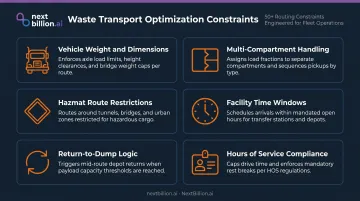
The platform supports 50+ hard and soft constraints, including:
- Vehicle weight limits and dimensions
- Multi-compartment truck handling for separate waste streams
- Hazmat route restrictions and restricted zone avoidance
- Time windows for facility access and disposal site schedules
- Return-to-dump logic when trucks reach capacity
- Hours of Service (HOS) compliance for drivers
Real-time GPS tracking is available natively through NextBillion.ai's Live Tracking API (up to 1-meter accuracy), or through plug-and-play integrations with Geotab, Samsara, and Motive. The platform also supports truck-compliant routing via its Road Editor Tool, allowing operators to lock in approved routes and flag prohibited areas.
For manufacturers with data residency or security requirements, NextBillion.ai offers three deployment options: on-premise within your own Kubernetes environment, private cloud on AWS, GCP, or Azure, or standard multi-tenant cloud.
The platform is SOC 2 Type II and ISO/IEC 27001:2013 certified.
SIR, a waste management operator in Mexico City with 20+ years in the field, uses NextBillion.ai's Route Optimization, Directions, Geofencing, Clustering, and Tracking APIs to manage heavy truck routing under real-world road restrictions — a direct analog for manufacturers coordinating waste pickups across complex urban or industrial corridors.
NextBillion.ai has delivered $11M+ in documented cost savings across its customer base, with predictable per-vehicle or per-order pricing that eliminates the runaway API costs common with usage-based mapping providers.
| Category | Details |
|---|---|
| Key Features | Route optimization with 50+ hard/soft constraints, real-time GPS fleet tracking, truck-compliant and hazmat routing, distance matrix computation, telematics integrations (Geotab, Samsara, Motive) |
| Best For | Manufacturers managing waste transport fleets or coordinating third-party waste hauler pickups who need cost-efficient, optimized routing |
| Pricing | Per-vehicle or per-order pricing (no per-API-call billing); contact NextBillion.ai for a custom quote; 24x7 solution engineer support included |
How We Chose the Best Waste Management Software for Manufacturing
Most software evaluation frameworks lean on general criteria — UI design, pricing tiers, ease of use — without testing whether the tool actually handles industrial waste types or regulatory obligations. This list skips that shortcut.
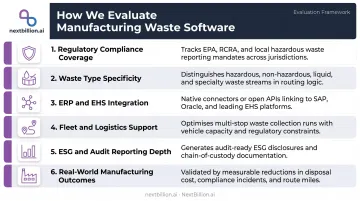
Each tool was evaluated on manufacturing-specific factors:
- Regulatory compliance coverage — RCRA generator category tracking (VSQG, SQG, LQG thresholds), e-Manifest support, Biennial Report generation, and OSHA alignment
- Waste type specificity — hazardous chemical streams, drum and lab pack tracking, multi-stream industrial waste (not just recyclables)
- ERP/EHS integration — RESTful API connectivity to existing systems, avoiding data silos
- Fleet and logistics support — route optimization, fleet tracking, and hauler coordination for waste transport
- ESG and audit reporting depth — structured data outputs for GRI 306, CDP, and internal sustainability disclosures
- Real-world manufacturing outcomes — documented use cases in industrial environments, not just general enterprise deployments
Beyond these core criteria, pricing model transparency, deployment flexibility (cloud vs. on-premise), and vendor support quality were also evaluated. The stakes are concrete: a compliance gap in waste software carries real financial consequences, as demonstrated by the $306,436 fine the EPA levied against a Southern California manufacturing facility for RCRA violations in 2025.
Conclusion
Manufacturing waste management has moved well past the compliance-checkbox era. The right software stack can reduce disposal costs, minimize regulatory exposure, and generate the structured data that ESG reporting programs now demand.
The challenge is that no single platform covers everything. EHS teams typically need a combination of tools — a compliance and audit platform like SafetyCulture or Intelex, hazardous waste tracking via Chemical Safety Software, and an enterprise waste ERP like AMCS for large multi-site operations. The logistics layer — routing and tracking for waste transport fleets — is often the missing piece.
Evaluate tools against your actual waste streams and operating model:
- Site footprint: single plant vs. multi-site with centralized dispatch
- Fleet ownership: company-operated trucks vs. third-party haulers
- Waste classification: hazardous vs. non-hazardous mix and disposal requirements
A platform suited to a pharmaceutical manufacturer won't necessarily fit a metal fabrication shop — and vice versa.
For manufacturers moving significant waste volumes via internal or contracted fleets, the logistics routing layer deserves the same scrutiny as compliance tools. Route optimization platforms like NextBillion.ai handle the constraints that generic mapping tools miss — truck weight limits, time windows, hazmat routing rules, and multi-stop pickup sequencing — making them a practical complement to core waste management software.
Frequently Asked Questions
Frequently Asked Questions
What is the best waste management software for manufacturing companies in 2026?
The right tool depends on your waste type, compliance obligations, and whether you run your own transport fleet. For compliance auditing, SafetyCulture or Intelex; for hazardous waste tracking, Chemical Safety Software; for waste hauling logistics, NextBillion.ai. If your manufacturing site dispatches its own trucks to haul waste between facilities, transfer stations, or disposal sites, route optimization and fleet tracking APIs become as important as the compliance layer, since fuel, driver hours, and stop sequencing directly affect disposal cost per load.
What features should I look for in waste management software for manufacturing?
Prioritize hazardous waste tracking, RCRA/EPA reporting (including Biennial Report generation), integration with existing ERP or EHS systems, and multi-site support. Add fleet route optimization if your operation manages its own waste transport.
How does waste management software support RCRA compliance in manufacturing?
Compliant platforms automate waste generation records, manifest tracking, and regulatory report generation — including Biennial Reports required by March 1 of even-numbered years for LQGs. This reduces manual documentation burden and simplifies audit preparation.
Can waste management software reduce disposal costs for manufacturers?
It can, through better waste stream visibility, optimized hauling routes, and diversion from landfill to recycling. EPA case studies document individual manufacturers achieving cost reductions ranging from tens of thousands to over a million dollars annually through structured waste reduction programs.
What is the difference between EHS software and waste management software?
EHS software covers the full range of environmental, health, and safety compliance. Waste management software focuses specifically on waste tracking, manifesting, disposal logistics, and stream reporting. Platforms like Intelex offer both under one roof.
Is waste management software necessary for small and mid-size manufacturers?
For manufacturers handling hazardous waste or managing RCRA reporting obligations, the answer is yes. Several platforms offer tiered pricing accessible to smaller operations, and the compliance risk of going without software generally outweighs the subscription cost. Smaller manufacturers running even one or two waste-hauling vehicles also benefit from route planning tools, since manual scheduling of pickups across multiple sites tends to waste driver hours and fuel that a small operation cannot easily absorb.
Which software is best for manufacturing companies managing their own waste transport fleet?
If a manufacturer hauls waste with its own trucks rather than contracting a hauler, the priority shifts from pure compliance tracking to logistics. Look for software that combines route optimization, driver hour tracking (relevant to FMCSA hours-of-service rules if trucks cross state lines), and real-time fleet visibility. NextBillion.ai's routing and optimization APIs are built for this layer, working alongside a separate compliance or EHS platform rather than replacing it.