There is no single best option; the right routing software depends on operational needs. Small teams with simple stop sequences may do fine with a basic dispatcher app like Spoke. Businesses with truck restrictions, multi-constraint scheduling, or a need to embed routing into their own product are better served by an API-first platform like NextBillion.ai, which offers deeper constraint handling and predictable per-vehicle pricing at scale.
Introduction
Circuit for Teams was a route planning tool built for small courier operations, known for clean onboarding and a simple dispatch UI — it was rebranded as Spoke Dispatch in late 2025. Users report limited route editing flexibility, rigid optimization constraints, and unpredictable pricing as order volumes grow. That pattern shows up broadly: delivery teams scaling past a few dozen stops per day hit a predictable wall with basic route planning tools. Routes start zigzagging across zones, dispatchers lose visibility into where drivers actually are, and per-stop pricing that seemed reasonable at low volumes becomes a budget problem fast.
Circuit for Teams — rebranded as Spoke Dispatch in late 2025 — built a loyal following among small courier operations for its clean onboarding and straightforward dispatch UI. But user reviews on Capterra and Gartner Peer Insights consistently surface the same friction points:
- Limited editing flexibility once routes are dispatched
- Optimization constraints that don't reflect real-world complexity
- Pricing that scales unpredictably as order volumes grow
Last-mile delivery accounts for up to 53% of total shipment cost, with labor and fuel as the primary cost drivers. That means routing quality isn't a nice-to-have — it directly determines whether delivery operations stay profitable at scale.
The five alternatives below break down where each tool wins — and which operations they're actually built for.
Key Takeaways
- Circuit for Teams (now Spoke Dispatch) works well for small teams but has documented limitations around route editing, constraint depth, and stop-based pricing that scales poorly.
- The five best alternatives range from SMB-friendly drag-and-drop dispatch tools to enterprise API platforms with 50+ routing constraints.
- Key evaluation factors: route quality, pricing model (per-vehicle vs. per-stop), real-time editing flexibility, and integration depth.
- NextBillion.ai is the strongest fit for enterprise teams, fleet operators, and logistics software builders who need API-driven optimization with predictable per-vehicle pricing.
Why Teams Are Looking Beyond Circuit for Teams
The Rebrand First
Circuit for Teams became Spoke Dispatch in October 2025. Circuit Route Planner (the solo driver app) became Spoke Route Planner. Per the official announcement, it was "just a name change" — the core team, values, and product functionality carried over unchanged. Anyone evaluating "Circuit" today is evaluating Spoke Dispatch under new branding.
Where the Product Runs Into Trouble
Three issues come up repeatedly as teams outgrow Spoke Dispatch:
- Route editing constraints — Once routes are sent to drivers, making mid-day changes (reassigning stops, adding urgent deliveries, handling driver no-shows) is cumbersome. Teams often restart planning from scratch rather than editing in place.
- Dispatcher visibility — The platform lacks a timeline view that shows all drivers and their progress against schedule simultaneously, which makes managing multi-driver operations harder than it needs to be.
- Constraint depth — For operations with vehicle capacity limits, driver skill requirements, time windows, or mixed fleet types, the optimization engine doesn't expose enough knobs to reflect real-world requirements.
The Pricing Scalability Problem
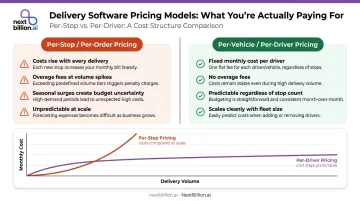
Spoke Dispatch pricing is tiered by monthly stop volume: Starter at $125/month for 1,000 stops, Premium at $200/month for 2,000 stops, Expert at $1,000/month for 12,000 stops. Overage fees apply beyond each tier ($0.04–$0.07 per stop depending on plan).
For teams with seasonal spikes or growing delivery volumes, that model creates real budgeting uncertainty. The alternatives covered below use per-vehicle or per-driver pricing instead — a structure that keeps costs predictable regardless of how many stops you run in a given month.
Best Circuit for Teams Alternatives for Route Planning
These five tools were evaluated on route optimization quality, editing flexibility mid-dispatch, dispatcher visibility tools, pricing transparency, and scalability.
NextBillion.ai
NextBillion.ai is an API-first route optimization platform built for logistics software providers, fleet operators, and enterprise delivery businesses that need more than a dispatcher UI — including companies embedding routing intelligence into their own systems.
Where Spoke Dispatch maxes out at basic constraint handling, NextBillion.ai supports 50+ hard and soft routing constraints:
- Time windows, vehicle load capacity, and driver skills/certifications
- Multi-compartment vehicles, hazmat restrictions, and truck dimension compliance
- EV routing with charging stops and task dependencies
The Distance Matrix API handles matrices up to 5,000×5,000 elements (vs. the industry-standard 25×25 cap), eliminating the need to batch large routing problems into dozens of smaller API calls.
Dispatchers interact with a no-code Route Planner App that renders optimized routes visually, supports manual stop overrides, and integrates directly with Samsara, Geotab, and Motive to push routes into drivers' existing apps. For teams that need map-level customization, the Road Editor App lets operations staff configure road closures, turn restrictions, custom speed limits, and vehicle-specific permissions without developer involvement.
Customers like Service Autopilot by Xplor manage 30,000+ vehicles and technicians using NextBillion.ai's Route Optimization API. GOIN, an NEMT provider, reduced driver idle time by 30% and achieved 95% ETA accuracy after switching.
| Category | Details |
|---|---|
| Key Features | 50+ routing constraints, large-scale distance matrix (5,000×5,000), truck routing, Road Editor App, Samsara/Geotab/Motive integrations, on-premise deployment, SOC 2 Type II + ISO/IEC 27001 certified |
| Pricing | Per-vehicle or per-order pricing; no per-API-call charges; custom enterprise plans available |
| Best For | Enterprise logistics teams, fleet management software builders, last-mile operators, and field service businesses needing API-driven optimization at scale |
Routific
Routific produces clean, geographically logical routes through a dispatcher interface that's genuinely easy to use. Unlike tools that optimize mathematically but output routes drivers find confusing, Routific prioritizes real-world navigability.
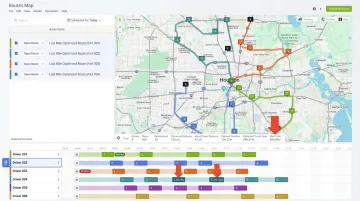
Its standout differentiator is the timeline view: dispatchers can see all drivers simultaneously, track whether each is ahead or behind schedule, and drag-and-drop stops between routes without restarting optimization. The algorithm is designed to minimize criss-crossing and unnecessary toll or bridge crossings.
Customer notifications are automated (email included, SMS available with per-country charges), and proof of delivery captures photos and signatures accessible to dispatchers. For teams not yet ready to pay, Routific offers a free tier for up to 100 orders/month.
| Category | Details |
|---|---|
| Key Features | Timeline view, drag-and-drop route editing, live GPS tracking, SMS/email customer notifications, photo + signature POD, barcode scanning |
| Pricing | Free up to 100 orders/month; from $150/month for up to 1,000 orders |
| Best For | Small to mid-sized delivery teams that prioritize route quality and dispatcher usability over deep constraint handling or API access |
OptimoRoute
OptimoRoute targets more complex scheduling scenarios that basic dispatchers can't handle: multi-day routes planned up to five weeks in advance, return-to-depot mid-shift when drivers need to reload, and detailed driver profiles with skills, service area preferences, and working-hour rules.
Breadcrumb trail tracking overlays the actual path driven against the planned route, giving operations managers a direct way to spot inefficiencies, identify problem areas, and audit driver compliance. Barcode scanning and proof of delivery are available on Pro and Custom plans.
At $35.10/driver/month (annual billing) for the Lite plan, that's one of the lower per-driver prices in this comparison.
| Category | Details |
|---|---|
| Key Features | Multi-day routing (up to 5 weeks), return-to-depot mid-shift, driver profiles with skills/hours, breadcrumb trail tracking, live tracking, barcode scanning + POD (Pro/Custom) |
| Pricing | From $35.10/driver/month (annual); 30-day free trial limited to 250 orders |
| Best For | Field service organizations, operations with fixed driver teams and complex scheduling, businesses running long-distance or multi-day routes |
Onfleet
Onfleet is designed for high-volume, compliance-sensitive delivery operations, particularly alcohol, cannabis, and pharmaceutical delivery. The platform has built-in age verification via government-issued ID (available on Scale and Enterprise plans, US and Canada), barcode scanning, and automated driver dispatch.
Post-delivery customer feedback collection and a developer-rich RESTful API make it a strong fit for businesses building custom delivery workflows. The tradeoff is price: the Launch plan starts at $619/month for 2,500 tasks, which puts it well above most Circuit alternatives in cost.
| Category | Details |
|---|---|
| Key Features | Automated dispatch, age/ID verification, barcode scanning, customer feedback collection, real-time tracking, RESTful API + webhooks |
| Pricing | From $619/month for 2,500 tasks; Scale at $1,349/month for 5,000 tasks |
| Best For | High-volume courier operations, regulated delivery sectors (alcohol, cannabis, pharma), businesses needing deep API integration and workflow automation |
Route4Me
Route4Me is one of the original route planning platforms, known for its modular add-on marketplace that lets businesses configure capabilities for commercial truck routing, territory management, recurring routes, and mixed vehicle fleets.
Commercial vehicle routing handles height, weight, axle-count, and hazardous material restrictions. Territory management and eCommerce integrations with Shopify, WooCommerce, and Magento are built in.
Pricing is where Route4Me gets complicated. Base packages start at $199/month for Route Optimization, but commercial vehicle routing, dynamic geofencing, driver skills, and SMS notifications are all paid add-ons. Expect a sales conversation before you know your actual total cost.
| Category | Details |
|---|---|
| Key Features | Commercial vehicle/truck routing, territory management, recurring routes, geofencing analytics, Shopify/WooCommerce/Magento integrations, modular add-on marketplace |
| Pricing | Base packages from $199/month; advanced features (commercial routing, SMS notifications, driver skills) are paid add-ons; contact sales for full pricing |
| Best For | Fleets with complex routing constraints (commercial vehicles, mixed fleets), businesses needing territory management or deep eCommerce integration |
How We Chose These Alternatives
What We Actually Evaluated
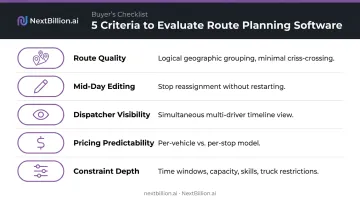
Circuit for Teams fails teams in specific, predictable ways. The evaluation criteria here matched those failure modes directly:
- Route quality — Do optimized routes cluster logically by geography, or do they require drivers to cross the same territory multiple times?
- Mid-day editing — Can dispatchers reassign stops, add urgent deliveries, or swap drivers without restarting the plan from scratch?
- Dispatcher visibility — Is there a timeline or map view that shows all drivers' progress simultaneously?
- Pricing predictability — Does cost scale with fleet size (per-vehicle) or delivery volume (per-stop/order), and which model fits your operation better?
- Constraint depth — Can the tool handle time windows, vehicle capacity, driver skills, and truck-specific restrictions, or does it optimize only for distance?
Each criterion above maps to a real operational gap. The switching mistake below is what happens when teams skip this kind of structured evaluation.
The Common Switching Mistake
Teams evaluating alternatives often focus on feature counts or monthly price without testing actual route quality on their own delivery data. A tool that generates cleaner, denser routes covering fewer total miles outperforms a cheaper option with more features — because driver labor is typically the highest delivery cost, and fuel compounds on top of that.
Request a trial with your own stop data before committing. Demo routes are built to impress — your irregular stop patterns, tight time windows, and mixed vehicle types will stress-test a platform in ways vendor demos never will.
Conclusion
Spoke Dispatch (formerly Circuit for Teams) works well for small, straightforward delivery operations. Once you push past that baseline — more drivers, tighter margins, or routing that needs to integrate with proprietary software — the same gaps emerge: shallow constraint handling, limited dispatcher visibility, and per-stop pricing that compounds fast at volume.
The right alternative depends on where you're hitting the wall:
- Routific — best for teams that need clean routes and a usable dispatcher UI without complexity
- OptimoRoute — best for field service or multi-day scheduling scenarios
- Onfleet — best for regulated, high-volume delivery with compliance requirements
- Route4Me — best for commercial vehicle fleets needing territory management
- NextBillion.ai — best for enterprise operations, logistics software builders, or anyone integrating route optimization at scale with 50+ constraints and predictable pricing
If you're building routing into your own platform or running a fleet where per-stop pricing has already become a cost problem, NextBillion.ai's per-vehicle model and 50+ constraint support are worth a direct look.
Frequently Asked Questions
What are the best alternatives to the Circuit app?
The top alternatives are NextBillion.ai, Routific, OptimoRoute, Onfleet, and Route4Me. The right fit depends on team size, delivery volume, and whether you need a dispatcher UI or an API-first optimization engine for integration into your own systems.
Is Circuit now Spoke?
Yes. Circuit for Teams officially rebranded to Spoke Dispatch in October 2025, and Circuit Route Planner became Spoke Route Planner. Per Circuit's own announcement, it was a name change only — the core product functionality carried over unchanged under the new brand.
Are there free Circuit route planners?
Routific offers a free tier for up to 100 orders per month. Spoke Route Planner (the solo app) caps its free tier at 10 stops per route, while Spoke Dispatch offers only a 7-day trial. For business use, free trials with your own data are more useful than free tiers with hard stop limits.
What are the main limitations of Circuit for Teams?
The most common issues are limited flexibility when editing or reassigning stops mid-day, no timeline view for monitoring multiple drivers simultaneously, shallow constraint support for complex operations, and stop-based pricing with overage fees that becomes difficult to budget as delivery volumes grow.
Which Circuit for Teams alternative is best for enterprise or large fleet operations?
NextBillion.ai is the strongest option for enterprises, logistics software builders, and large fleet operators. Its API-driven engine supports 50+ routing constraints, truck-compliant routing, and a 5,000×5,000 distance matrix — with per-vehicle pricing that stays predictable at scale instead of compounding per-stop fees.
How does Circuit for Teams pricing work, and why do teams find it expensive to scale?
Spoke Dispatch prices by monthly stop volume: Starter at 1,000 stops, Premium at 2,000, Expert at 12,000, with overage fees of $0.04–$0.07 per stop beyond each tier. Seasonal spikes or volume growth translate directly into unpredictable bills. Most alternatives use per-vehicle or per-driver pricing, which stays fixed regardless of delivery volume.
Is there a free Circuit route planner available for teams?
Spoke Route Planner (the solo version of Circuit) offers a limited free tier capped at 10 stops per route, which is impractical for team dispatching. Spoke Dispatch, the team product, only offers a 7-day free trial rather than an ongoing free tier. Teams evaluating alternatives should look for a trial that lets them test with their own delivery data and constraints, since capped free tiers rarely reflect real operational conditions.
How much does the Circuit app cost compared to alternatives like NextBillion.ai?
Circuit for Teams, now Spoke Dispatch, charges by monthly stop volume across tiers (Starter, Premium, Expert), with overage fees once you exceed the tier limit. This model penalizes growth and seasonal spikes. NextBillion.ai and similar API-first alternatives typically price per vehicle rather than per stop, so costs stay predictable regardless of how many stops or orders a business processes in a given month.