There is no single best alternative — it depends on the problem. For point-to-point navigation, several mapping providers compete directly with Google Maps. For multi-stop fleet routing, dedicated route optimization APIs like NextBillion.ai are built specifically for VRP-class problems: time windows, driver hours, capacity, and truck restrictions. Evaluate based on whether you need navigation or fleet-scale optimization, not on brand recognition alone.
This article covers the best route optimization API alternatives specifically — not general mapping APIs. The evaluation criteria that matter for logistics-intensive operations: constraint handling, matrix scale, pricing transparency, and integration with existing fleet systems.
Key Takeaways
- Google Routes API handles point-to-point navigation; multi-vehicle dispatch, time windows, and capacity planning require a separate Google product entirely
- The best alternatives offer large-scale distance matrix computation, 50+ routing constraints, and pricing that doesn't spike with API call volume
- NextBillion.ai, HERE Maps, Mapbox, TomTom, and GraphHopper each serve distinct needs — enterprise fleet orchestration, developer-friendly mapping, or open-source self-hosting
- Evaluate on constraint richness, matrix size limits, integration depth, and total cost of ownership — not base price alone
Why Google Maps Route Optimization API Falls Short for Logistics Operations
The Architectural Gap
Google's Routes API was designed for point-to-point navigation. That's its intended purpose. When logistics teams try to stretch it into fleet dispatch territory, the limits become operational problems:
- 25-waypoint cap per
computeRoutesrequest (requests with 11–25 waypoints are billed at a higher SKU) - Route Matrix capped at 625 elements per standard request (50 total origins + destinations when using place IDs)
- No multi-vehicle dispatch in the standard Routes API — Google's VRP capabilities live in a separate Route Optimization API, not in Routes API itself
- Vehicle capacity, time windows, driver work hours, and fleet-level objectives are only available in that separate product
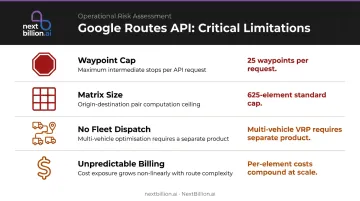
For teams that assumed Google Maps would handle their routing end-to-end, discovering this product split mid-implementation is a costly surprise.
The Pricing Problem
Google's Route Matrix billing is element-based: one element equals one origin-destination pair, meaning a 50×50 matrix generates 2,500 billable elements. Current pricing runs $5.00 per 1,000 Essentials elements, $10.00 per 1,000 Pro elements, and $15.00 per 1,000 Enterprise elements.
For high-volume operations running thousands of matrix calculations daily, those per-element charges compound quickly and are difficult to forecast. The Google Route Optimization API adds another billing layer: per shipment, with separate SKUs for single-vehicle and fleet routing. There is no free tier for the Route Optimization API itself, which is part of why teams asking whether a free route API exists end up looking at alternatives with flat per-vehicle or per-order pricing instead.
Operational Gaps
Even with the separate Route Optimization API, logistics teams routinely run into:
- No driver skill matching (only route certain jobs to qualified drivers)
- No truck-specific road restrictions by vehicle dimensions or hazmat class
- No on-demand re-routing that incorporates live driver location
- No multi-depot dispatch logic
- No custom road attribute overrides for facility-specific routing rules
Each gap typically gets patched with a manual workaround. At scale, those patches become a dispatch team's full-time job.
Best Google Maps Route Optimization API Alternatives
These alternatives were selected based on route optimization depth, constraint richness, enterprise-readiness, pricing structure, and real-world logistics applicability — not just mapping capabilities.
NextBillion.ai
NextBillion.ai is an API-first route optimization and location intelligence platform built by the former Grab Geo team engineers who co-founded the company in 2020. The platform serves 150+ businesses globally — including DoorDash and AB InBev — and has optimized over 10.9 million deliveries across 557+ million miles.
Where most mapping APIs require significant custom development to approach logistics-grade functionality, NextBillion.ai was designed specifically for fleet operations, last-mile delivery, field service, and on-demand dispatch from the start.
Key differentiators:
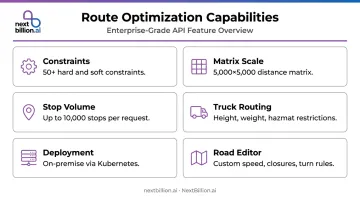
- 50+ hard and soft constraints — time windows, vehicle load capacity, driver skill matching, priority stops, shift hours, multi-depot support, order incompatibility rules, and more
- Distance matrix up to 5,000 × 5,000 elements (25 million distance/ETA pairs per call) vs. Google's 625-element standard cap — critical for high-volume dispatch planning
- Up to 10,000 stops in a single optimization request
- Truck-compliant routing with vehicle height, weight, hazmat, and dimensional restrictions
- On-premise deployment via Kubernetes (AWS EKS, GCP GKE, Azure AKS, or self-managed)
- SOC 2 Type II and ISO/IEC 27001 certifications
- Custom Road Editor for modifying speed limits, closures, turn restrictions, and no-parking zones without engineering changes
One customer, James Nebeker from TruckIT, put it directly: "NextBillion solves the problem of providing a high-performance mapping platform at scale. We use them to generate large distance matrices that we use to solve unique geospatial routing problems that arise in the short-haul trucking industry."
Pricing: Per-vehicle or per-order monthly plans with annual commitment options — no per-API-call billing. This directly addresses the unpredictability of Google's per-element model. For teams searching for a free route API or a lower-cost path off Google Maps, this pricing structure gives a predictable monthly cost instead of one that scales with every matrix call.
The cost difference is measurable: GOIN reduced API costs by 40% after switching, while an on-demand transportation platform cut costs by 82% without sacrificing ETA accuracy.
Integrations: Native plug-and-play connectors with Samsara, Geotab, Motive, Netradyne, and Verizon Connect; API-level integrations with Salesforce, SAP, and Microsoft Dynamics 365.
| Category | Details |
|---|---|
| Key Features | 50+ routing constraints, 5,000×5,000 distance matrix, truck routing, on-premise deployment, real-time re-routing, AI-powered ETAs, custom Road Editor |
| Best For | Last-mile delivery, field service, fleet operators, logistics SaaS companies, NEMT, paratransit, on-demand delivery |
| Pricing Model | Per-vehicle or per-order monthly plans; no per-API-call billing; free trial available on request |
HERE Maps
HERE Technologies brings decades of routing data and is widely deployed in automotive, logistics, and urban planning. Its dedicated fleet routing products — including HERE Tour Planning — go well beyond point-to-point navigation.
HERE's waypoint sequencing supports up to 150 waypoints, and HERE Tour Planning is positioned for many-to-many fleet planning with thousands of deliveries per request. Truck routing covers size, gross weight, height restrictions, and hazardous cargo classifications including explosives, flammables, and radioactive materials.
Differentiators:
- Strong offline map capabilities across 190+ countries via the HERE SDK
- Multimodal routing: truck, car, EV, bicycle, pedestrian, motorcycle, public transit
- Enterprise SLA options with carrier-grade reliability
- Automotive-grade navigation (BMW Group is a cited HERE SDK customer)
Pricing starts with a free tier and scales via pay-as-you-grow with volume discounts and enterprise contract options.
| Category | Details |
|---|---|
| Key Features | Truck-compliant routing, offline maps, real-time traffic, geocoding, fleet management APIs, multimodal routing |
| Best For | Large-scale logistics, automotive navigation, enterprises needing offline or carrier-grade reliability |
| Pricing Model | Freemium tier available; pay-as-you-grow with enterprise plans via sales |
Mapbox
Mapbox is a developer-first mapping and navigation platform built around highly customizable routing APIs and branded map experiences. It's widely used in mobility apps and on-demand platforms where visual presentation matters as much as routing logic.
Mapbox Optimization API v2 solves VRP problems for fleets and supports up to 1,000 locations, with constraints including vehicle capacities, service and shipment time windows, mandated breaks, and vehicle capabilities like refrigeration. The older v1 API is limited to 12 coordinates and single-route TSP optimization.
Differentiators:
- Deep map styling customization for consumer-facing or branded experiences
- Navigation SDK for iOS, Android, and web with turn-by-turn guidance
- Real-time traffic integration via the
mapbox/driving-trafficprofile - Generous free tier: 100,000 free monthly Directions API and Optimization API requests
Pricing scales with usage — $2.00 per 1,000 requests after the free tier, with Navigation SDK pricing based on monthly active users and trips.
| Category | Details |
|---|---|
| Key Features | Custom map styles, Navigation SDK, Optimization API v2 (VRP), geocoding, real-time traffic, data visualization |
| Best For | Developer teams building mobility apps, consumer-facing navigation, or branded location experiences |
| Pricing Model | Pay-as-you-go with free tier; costs scale with API call volume |
TomTom
TomTom has been in location technology long enough to earn trust from partners like Microsoft and Uber — both of which run on TomTom's routing infrastructure. Their developer platform covers directions, matrix routing, waypoint optimization, and logistics-specific road attributes.
TomTom's Routing API supports up to 150 intermediate waypoints with optimized TSP-style route calculation. The Matrix Routing v2 API handles synchronous matrices up to 2,500 cells and asynchronous matrices up to 100 million cells — a meaningful advantage for high-volume dispatch planning.
Differentiators:
- Real-time and predictive traffic using IQ Routes and TomTom Traffic
- Detailed truck attributes: weight, height, width, axle count, US Hazmat classes 1–9, ADR tunnel codes
- Renewed Uber partnership (January 2026) integrating TomTom across routing, fare calculation, and pickup/drop-off accuracy
- Long-term Microsoft agreement powering Azure Maps, Bing, and Microsoft 365
Freemium tier includes 2,500 free non-tile requests daily. Pay As You Grow: $0.75 per 1,000 routing requests, $2.50 per 1,000 matrix requests.
| Category | Details |
|---|---|
| Key Features | Real-time and predictive traffic, truck routing, route matrix (up to 100M async cells), geocoding, offline routing |
| Best For | Fleet management software, logistics platforms needing accurate ETAs, automotive navigation |
| Pricing Model | Freemium with pay-as-you-go; enterprise plans via sales |
GraphHopper
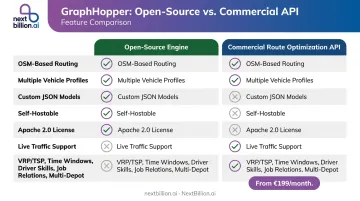
GraphHopper is an open-source routing engine (Apache License 2.0) built on OpenStreetMap data. It's the go-to choice for developer teams and startups that need a transparent, self-hostable routing backend without per-call licensing fees.
The open-source engine supports profiles from bicycle to heavy truck, with custom models via JSON rules. The commercial Route Optimization API adds full VRP/TSP support — multiple vehicles, capacities, time windows, required skills, and job relations like in_same_route and in_direct_sequence. The jsprit toolkit (also Apache License v2) handles multiple-depot VRP and time-dependent VRP formulations.
Limitations to know:
- OSM routing does not currently support live traffic data —
consider_traffichas no effect in the open-source version - Advanced constraints and job relations require the commercial API or substantial custom development
Commercial pricing starts at €199/month for the Standard plan (15,000 credits/day). Credits are calculated as vehicles × locations, with a minimum of 10 per request.
| Category | Details |
|---|---|
| Key Features | Open-source routing engine, VRP/TSP optimization, multiple vehicle profiles, OSM data, self-hosting |
| Best For | Developer teams, startups, or companies needing cost-efficient self-hosted routing |
| Pricing Model | Free open-source; commercial API from €199/month for 15,000 credits/day |
How to Choose the Right Route Optimization API Alternative
Start With These Four Questions
Before comparing feature lists, get specific about your operational requirements:
- How many stops per route? Under 25 and Google may suffice. Dozens to hundreds per vehicle requires a VRP-capable API.
- How many vehicles? Single-vehicle routing and fleet dispatch are fundamentally different problems.
- Do you need real-time re-routing? Not all APIs handle mid-route re-optimization with live traffic.
- Do you have compliance constraints? Truck restrictions, hazmat routing, time windows, and driver hours require explicit constraint support.
Key Evaluation Criteria
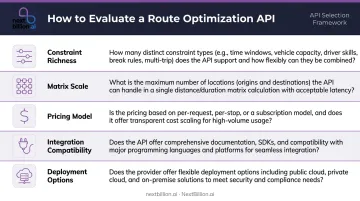
| Criterion | What to Check |
|---|---|
| Constraint richness | Time windows, vehicle capacity, driver skills, priority stops, truck road restrictions |
| Matrix scale | Google caps at 625 elements; alternatives range from 2,500 to 100M+ |
| Pricing model | Per-call vs. per-vehicle vs. per-order — per-call models spike unpredictably at scale |
| Integration compatibility | Native connectors vs. custom API work for TMS/fleet systems |
| Deployment options | Cloud-only vs. on-premise for data residency or latency requirements |
Total Cost of Ownership
This is where the per-call vs. per-vehicle pricing difference hits hardest. McKinsey analysis found that inefficient mid- and last-mile handovers account for 13–19% of logistics costs — up to $95 billion annually in the US. Meanwhile, Deloitte estimates last-mile delivery alone represents 30–35% of total delivery cost.
A route optimization API that costs more per month than a basic mapping API can still reduce total operational costs substantially if it eliminates manual dispatching, reduces missed time windows, and handles re-routing automatically. The documented 30–40% cost reductions seen by NextBillion.ai customers across NEMT, delivery, and logistics verticals reflect this dynamic.
Evaluate total cost at your actual operating volume — not just the monthly API bill. The API with the lower sticker price often generates higher costs through manual dispatching overhead, missed SLAs, and re-routing gaps that a more capable solution would handle automatically.
Conclusion
Google Maps Routes API works well for what it was built to do: individual point-to-point navigation. For businesses running multi-vehicle fleets, enforcing delivery time windows, or dispatching at scale, it creates real operational ceilings — both in capability and cost predictability.
The alternatives covered here each address specific gaps. HERE and TomTom bring enterprise routing depth with strong offline and automotive-grade capabilities. Mapbox excels for developer teams building custom branded navigation experiences. GraphHopper offers cost-efficient self-hosted routing for teams with the engineering capacity to build around it.
For logistics and fleet operations that need the full stack — large matrix computation, 50+ constraints, fleet integrations, and predictable per-vehicle pricing — NextBillion.ai is worth evaluating directly. The platform supports unlimited API calls during the trial period and includes 24/7 engineer-backed support from day one.
Request a demo or free trial to test it against your specific routing requirements.
Frequently Asked Questions
What is the difference between Google Maps routing and a route optimization API?
Google Maps routing solves point-to-point navigation for individual trips. Route optimization APIs solve the Vehicle Routing Problem (VRP) — automatically sequencing multi-stop routes across entire fleets while respecting constraints like time windows, vehicle capacity, and driver schedules. They're fundamentally different problem classes. For US fleets, this also means factoring in FMCSA hours-of-service limits and DOT-regulated driver break requirements, which point-to-point navigation tools have no mechanism to account for.
What are the biggest limitations of Google Routes API for last-mile logistics?
The main limits: 25-waypoint cap per request, a 625-element standard matrix cap, and no native multi-vehicle dispatch in the Routes API itself. Multi-vehicle VRP capabilities require Google's separate Route Optimization API, and both products use per-element/per-shipment billing that scales unpredictably at high volume.
How does route optimization API pricing typically work?
Two main models: per-call/per-element (Google's approach, which can spike unpredictably at scale) and per-vehicle or per-order monthly plans (used by platforms like NextBillion.ai). For high-volume logistics operations, per-vehicle or per-order pricing offers significantly better cost predictability and typically lower total cost.
Can a route optimization API integrate with my existing fleet management system?
Yes — most enterprise-grade platforms support fleet management integrations, though depth varies significantly by provider. NextBillion.ai, for example, offers native integrations with Samsara, Geotab, Motive, Netradyne, and Verizon Connect, plus API-level connections to SAP, Salesforce, and Microsoft Dynamics 365. Other providers typically require custom API work.
What routing constraints should a route optimization API support for delivery operations?
At minimum, look for: time windows, vehicle load capacity, driver hours and breaks, priority stops, truck road restrictions (height, weight, hazmat), multi-depot support, and dynamic re-routing. Google Maps natively handles very few of these — that gap is the core reason logistics teams seek alternatives.
Is there a free or open-source alternative to Google Maps for route optimization?
GraphHopper is the primary open-source option: self-hostable, Apache License 2.0, built on OpenStreetMap data. Advanced constraints and live traffic require the commercial API (from €199/month). It works best for teams with engineering resources willing to build around those gaps. Free tiers generally lack US-specific truck attributes like height and weight restrictions, hazmat routing, and IFTA-relevant mileage tracking, which fleet operators typically need to add or verify separately.
Is there a free route API available?
Some providers offer limited free tiers or trial credits for route APIs, typically capped by request volume or feature set. These usually cover basic point-to-point routing rather than multi-vehicle optimization with constraints like time windows or driver hours. For US commercial fleets needing hazmat routing, truck restrictions, or IFTA-relevant data, free tiers are rarely sufficient for production use.