The best HVAC technician apps with GPS and routing combine live GPS tracking with routing logic built for real-world field operations, not just demo-day scenarios. Rather than treating routing as a static map feature, these platforms adapt routes to fleet size and service demands in real time, which is what reduces drive time, improves technician utilization, and speeds up emergency response — especially during high-volume seasonal spikes.
This guide evaluates the top HVAC dispatch software in 2026 with GPS routing capabilities — covering what makes each one the right fit, from 2-truck residential shops to multi-vehicle commercial fleets.
Key Takeaways
- GPS dispatch software reduces drive time, improves technician utilization, and speeds up emergency response
- Platform fit depends on fleet size, service type (residential vs. commercial), and whether you need a full FSM suite or a dedicated routing engine
- ServiceTitan leads for enterprise operations; Housecall Pro fits residential SMBs; FieldEdge suits QuickBooks-centric shops; Jobber works for growing mid-market teams
- NextBillion.ai delivers enterprise-grade route optimization — 50+ constraints, per-vehicle pricing, and API-first flexibility — for large fleets and FSM software teams that need more than standard dispatch tools offer
- When evaluating options, weigh dispatch board capability, GPS routing depth, emergency re-routing speed, and total cost of ownership
Why GPS Routing Is Critical for HVAC Dispatch
HVAC dispatching has a complexity problem that most scheduling tools underestimate. Residential technicians handle multiple stops per day across geographically scattered service areas.
An emergency call mid-morning doesn't just add one stop. It reshuffles every stop that follows, recalculates drive sequences, and triggers customer notifications — all while the dispatcher is already managing the rest of the day. Without automated route optimization, that work falls entirely on one person making judgment calls under pressure.
Salesforce's field service research confirms that route optimization software helps field service organizations reduce travel time and costs — though the magnitude depends on your fleet size and current routing practices. Every unnecessary mile driven is time a technician isn't on-site and billable.
The Revenue Math
Consider a simple illustration. If route optimization recovers 30 minutes of daily drive time per technician:
- 30 minutes saved × your billing rate × number of techs × working days per year
For a 10-technician fleet billing at $120/hour, that's $300,000+ in recovered billable capacity annually — without hiring a single additional tech. The exact savings vary by operation, but the direction is consistent: less windshield time means more wrench time.
Two Outcomes Simultaneously
GPS routing in HVAC dispatch does two things at once:
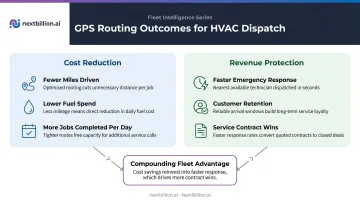
- Cost reduction — fewer miles, less fuel, more jobs completed per day
- Revenue protection — faster emergency response keeps high-value customers from calling a competitor
Both outcomes compound over time. A fleet that responds faster and completes more jobs per day doesn't just save money — it builds the kind of reliability that wins service contracts.
Top HVAC Dispatch Software with GPS Routing in 2026
These platforms were evaluated across six factors: dispatch board depth, GPS routing quality, emergency call handling, technician tracking, integration breadth, and total cost of ownership. The right tool depends entirely on your operation type and fleet scale.
ServiceTitan
ServiceTitan is the enterprise standard for HVAC dispatch. Its platform is purpose-built for larger operations running multiple technicians, with a dispatch board that surfaces real-time GPS locations, skill-matched assignments, and capacity-aware scheduling in a single view.
The Dispatch Pro AI add-on, powered by what ServiceTitan calls Titan Intelligence, continuously re-evaluates job assignments during business hours based on technician location, skill stack, and predicted job revenue. For operations running a busy dispatch floor, that continuous optimization replaces hours of manual decision-making.
Key differentiators:
- Equipment serial tracking, refrigerant logbooks, and maintenance agreement automation built into a single HVAC workflow
- Integrated marketing attribution connecting dispatched jobs to revenue sources
- AI-powered dispatch re-assignment through Dispatch Pro
ServiceTitan uses per-technician monthly pricing across Starter, Essentials, and The Works tiers, with significant implementation investment. Verify current pricing directly with ServiceTitan before committing.
| Attribute | Detail |
|---|---|
| Key Features | Dispatch Pro AI re-assignment, skill-matched GPS dispatch, HVAC-specific workflows, maintenance agreement automation, refrigerant tracking |
| Pricing | Per-technician monthly pricing; quote-based; verify current costs directly with ServiceTitan |
| Best For | Enterprise HVAC operations with dedicated dispatchers and complex multi-technician scheduling needs |
Housecall Pro
Housecall Pro is the leading residential HVAC SMB option. It combines a clean drag-and-drop dispatch board, GPS technician tracking, and automated "On My Way" customer texts. Flat monthly pricing starts at $59/month with a 14-day free trial and no contracts.
It earned placement on both the 2026 Capterra HVAC Shortlist and the 2026 Service Dispatch Shortlist, with a 4.7/5 rating from over 2,700 reviews. For small residential shops, that level of verified adoption across both categories is a meaningful signal.
Where it stands out for residential HVAC:
- Built-in consumer financing options for high-ticket install jobs
- Intuitive mobile UX that technicians actually adopt
- No per-technician billing — flat tiers scale predictably
- Self-booking and automated customer notifications reduce dispatcher call volume
Limitations to know: Route optimization is shallower than purpose-built routing tools, and advanced features like the CSR AI and marketing suite require paid add-ons.
| Attribute | Detail |
|---|---|
| Key Features | Drag-and-drop dispatch board, GPS tech tracking, automated On My Way texts, customer self-booking, online payments |
| Pricing | Flat monthly tiers from $59/month; no per-tech billing; 14-day free trial; verify current plans at housecallpro.com/pricing |
| Best For | Residential HVAC shops with 1–10 technicians prioritizing clean mobile UX and integrated customer communication |
FieldEdge
FieldEdge is the HVAC/plumbing trade-specific platform with the deepest QuickBooks integration in the FSM category: both Desktop and Online, with real-time sync. For shops where flat-rate pricing books and accounting continuity are central to operations, that integration removes a significant friction point.
Its dispatch board supports skill-set matching for HVAC specialties, making assignment decisions smarter than generalist platforms. A technician certified on mini-splits doesn't get dispatched to a job requiring heat pump expertise.
GPS note: FieldEdge provides GPS and asset tracking through its FleetSharp partner integration rather than a natively bundled module. For shops that already run separate telematics hardware, that approach works cleanly. Operations that want GPS fully embedded in the FSM interface should clarify the setup requirements before committing.
Limitations: Per-user pricing scales quickly on growing teams, and there's no self-serve free trial — guided onboarding is mandatory.
| Attribute | Detail |
|---|---|
| Key Features | Real-time QuickBooks Desktop and Online sync, skill-matched dispatch board, flat-rate HVAC pricing book, GPS via FleetSharp partner, service agreement management |
| Pricing | Quote-based per-user monthly pricing; no free trial; verify current pricing directly with FieldEdge |
| Best For | HVAC/plumbing shops where QuickBooks is the financial system of record and flat-rate pricing is central to service delivery |
Jobber
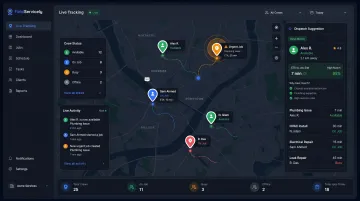
Jobber is a clean, intuitive FSM platform built for growing mid-market teams that need professional scheduling, client management, GPS-linked dispatching, and invoicing in one package, without enterprise complexity.
Pricing is transparent: Core, Connect, Grow, and Plus tiers run from $29/month to $529/month annually, with route optimization available on Connect, Grow, and Plus plans. A 14-day free trial is available on the Grow plan without a credit card.
Why it works for HVAC teams in the 2–15 technician range:
- Easy onboarding — most teams are operational within days
- Built-in quote-to-invoice workflow reduces admin overhead
- Route optimization on higher tiers provides real GPS routing, not just pin-drop mapping
- Transparent per-user pricing with no hidden implementation fees
HVAC workflow depth: Capterra's 2026 HVAC Shortlist gives Jobber a category-features score of 4/14, compared to Housecall Pro's 7/14 and ServiceTitan's 8/14. Trade-specific workflows like equipment history tracking are less developed than in purpose-built HVAC platforms.
| Attribute | Detail |
|---|---|
| Key Features | Scheduling and GPS dispatch, client hub with service history, route optimization (Connect+ plans), automated follow-ups, quote-to-invoice workflow |
| Pricing | Transparent per-user monthly tiers from $29/month; 14-day free trial; verify current pricing at getjobber.com/pricing |
| Best For | Growing mid-market HVAC teams (2–15 techs) wanting structured FSM with GPS dispatch and straightforward pricing |
NextBillion.ai
NextBillion.ai sits in a different category from the platforms above. It's a dedicated GPS routing engine — not a full HVAC FSM suite — built for businesses and software teams that have outgrown the route optimization capabilities of standard field service platforms.
The platform powers GPS tracking, route optimization, and field service intelligence for 150+ businesses globally and integrates with fleet management systems including Samsara, Geotab, Motive, Netradyne, and Verizon Connect.
What sets it apart for high-volume HVAC dispatch:
- 50+ hard and soft constraints — including technician skill matching, time windows, vehicle type, traffic conditions, and job priority (urgent repairs vs. routine maintenance)
- Distance matrix up to 5,000×5,000 elements — versus the standard 25×25 limit of most mapping APIs, enabling efficient planning at real fleet scale
- Re-optimization of planned routes — handles emergency call-ins mid-day by evaluating task urgency and technician availability within existing routes without rebuilding from scratch
- No-code Route Planner App — HVAC dispatchers who aren't building custom software can access the full 50+ constraint optimization engine through a browser-based interface, with no per-seat fees
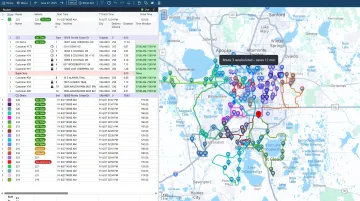
Per-vehicle or per-order pricing keeps costs predictable as dispatch volume scales — a meaningful difference from per-API-call models that penalize growth.
| Attribute | Detail |
|---|---|
| Key Features | 50+ constraint route optimization, real-time GPS tracking, 5,000×5,000 distance matrix, fleet management integrations (Samsara, Geotab, Motive, Netradyne), on-premise deployment option, no-code Route Planner App |
| Pricing | Per-vehicle or per-order pricing; fixed monthly options available; contact NextBillion.ai for current pricing |
| Best For | HVAC fleets with high stop volumes or multi-region dispatch, and FSM software companies embedding enterprise-grade GPS routing into HVAC scheduling products |
How We Chose the Best HVAC Dispatch Software
Most "best of" software lists prioritize affiliate relationships over operational fit. This evaluation used six factors tied directly to HVAC dispatch outcomes:
- Dispatch board sophistication — can a dispatcher manage emergency reshuffling without leaving the board?
- GPS route optimization depth — is routing truly optimized, or just mapped?
- Emergency call handling — how does the platform respond when a new job lands mid-route?
- Customer-facing visibility — ETA notifications, on-my-way texts, and self-service portals
- HVAC-specific workflow depth — equipment tracking, refrigerant logs, maintenance agreements
- Total cost of ownership — subscription + implementation + per-user fees across 12–24 months
The Most Common Buying Mistake
Buyers often evaluate dispatch software based on feature count or brand recognition. A mid-market residential shop and a 20-truck commercial mechanical contractor have very different dispatching requirements. The wrong choice creates bloat and cost rather than efficiency.
The gap plays out in both directions:
- A 3-technician residential shop doesn't need AI-powered dispatch re-assignment
- A 25-truck commercial fleet can't run on a platform that treats route optimization as a checkbox
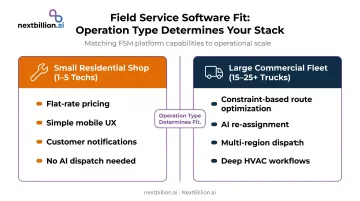
Operation type is the deciding variable — not review count or feature totals.
One more factor: pricing transparency. Platforms with unclear per-tech pricing or undisclosed implementation fees are flagged throughout. Verify current pricing directly with any vendor before committing.
Conclusion
The right HVAC dispatch software for 2026 depends on your fleet size, service type, and how much routing capability you actually need.
Quick-fit recap:
- ServiceTitan — enterprise operations needing AI-assisted dispatch and deep HVAC workflows
- Housecall Pro — residential SMBs wanting flat pricing, clean UX, and strong customer notifications
- FieldEdge — QuickBooks-first shops where accounting sync drives operational decisions
- Jobber — growing teams needing structured FSM with transparent pricing and solid routing on higher tiers
- NextBillion.ai — large fleets or software builders needing routing depth that FSM platforms can't match
Before committing, run each shortlisted platform against these questions:
- Does the GPS routing engine scale with your fleet as it grows?
- Does the total cost of ownership fit your revenue base?
- Does it actually reduce dispatcher workload during a live emergency, not just on a demo call?
If you're running a large fleet where route optimization quality matters more than FSM bundling, or building HVAC dispatch software and need a reliable routing backbone, explore NextBillion.ai's route optimization and GPS tracking capabilities.
Frequently Asked Questions
What is the best HVAC technician app with GPS routing and dispatching in 2026?
It depends on operation type. ServiceTitan leads for enterprise-scale HVAC operations; Housecall Pro is the strongest fit for residential SMBs; Jobber suits growing mid-market teams. For fleets requiring advanced GPS route optimization beyond what standard FSM apps offer, NextBillion.ai provides the underlying routing engine.
What software do HVAC companies use for scheduling and dispatching?
The most widely used platforms are ServiceTitan, Housecall Pro, Jobber, and FieldEdge. Larger fleet operators increasingly use dedicated route optimization engines like NextBillion.ai to supplement their dispatch routing once FSM-native tools hit their ceiling.
What features should HVAC dispatch software with GPS routing include?
Must-haves include real-time technician GPS tracking, route optimization that minimizes cumulative drive time, skill-matched job assignment, emergency call re-routing, customer-facing ETA notifications, and a mobile app for field technicians. Enterprise operations should also look for constraint-based optimization and re-routing on live routes. For fleets crossing state lines, confirm the platform can support FMCSA hours-of-service awareness so routing does not push technicians past legal drive-time limits.
How does GPS route optimization reduce drive time for HVAC technicians?
Route optimization sequences daily stops to minimize total drive distance and clusters geographically adjacent jobs. It also enables real-time re-routing when emergency calls are inserted mid-day — directly recovering billable time that would otherwise be lost in transit.
Can small HVAC companies afford GPS dispatch software?
Flat-rate platforms like Housecall Pro (from $59/month) and Jobber (from $29/month) make GPS dispatch accessible at SMB price points. Enterprise tools like ServiceTitan carry per-technician costs better suited to larger operations. NextBillion.ai's per-vehicle pricing can be cost-effective for mid-sized fleets once stop volume justifies advanced optimization. Companies weighing the switch should factor in the operational cost of manual dispatching, missed windows and unbilled drive time, not just the software's sticker price.
What is the difference between HVAC dispatch software and a route optimization API?
HVAC dispatch software like ServiceTitan or Housecall Pro is a complete FSM suite with scheduling, invoicing, and customer management built in. A route optimization API like NextBillion.ai is the underlying routing engine — it can be embedded into existing dispatch tools or used to power custom HVAC scheduling applications.
What is the best dispatch app for HVAC fleets managing multiple technicians?
For multi-technician HVAC fleets, the choice depends on scale. ServiceTitan and FieldEdge handle scheduling, invoicing and dispatch in one suite for larger operations. Smaller crews often do fine with Housecall Pro or Jobber. When dispatch decisions require optimizing across many vehicles and constraints simultaneously, a dedicated routing engine like NextBillion.ai can be layered in to handle the underlying route logic that FSM tools alone do not solve.