Massachusetts truck traffic relies on a network of interstates and state-designated truck routes, including I-90 (Mass Pike), I-95, I-93, and Route 128, which forms the through-transport bypass around Downtown Boston. Local truck routes are set by individual municipalities and may differ from state or federal designations. For hazmat carriers, the relevant network is narrower: only routes not restricted by MassDOT or local ordinance qualify, and dispatchers should verify both state and municipal designations before routing.
Introduction
The Boston hazmat route runs on a three-tier system: all downtown tunnels are permanently restricted, daytime through-routing is banned between 6 a.m. and 8 p.m., and nighttime NRHM transit is limited to prescribed surface corridors between 8 p.m. and 6 a.m. Hazmat transport compliance failures are more common than most carriers realize. CVSA's 2025 HM/DG Road Blitz inspected more than 4,600 hazmat vehicles over five days — and placed 1,000 of them out of service, a 21.7% out-of-service rate with 1,800 violations recorded. For fleet operators running through urban corridors, those numbers translate directly into enforcement delays, fines, and liability exposure.
Boston's complexity starts with its infrastructure. The Big Dig moved I-93 underground, creating a tunnel-heavy downtown core that is off-limits for hazmat vehicles — then layers federal preemption rulings, daytime/nighttime restrictions, and a two-tier permit system on top. Miss any one of those requirements and you're looking at out-of-service orders or route deviation penalties.
This guide covers Boston's complete hazmat route framework: which tunnels are restricted, which surface corridors are prescribed for nighttime NRHM transit, how daytime rules work, what permits are required, and where carriers consistently go wrong.
Key Takeaways
- All Boston tunnels are restricted for all hazmat vehicles with no exceptions and no time-of-day workarounds.
- Daytime through-routing (6 a.m. – 8 p.m.) is prohibited, requiring through-carriers to divert via I-95/Route 128.
- Nighttime NRHM transit (8 p.m. – 6 a.m.) is permitted on specific prescribed surface corridors, with separate corridors designated for northbound and southbound travel.
- Two separate permits exist: one for carriers with a Boston origin/destination, another for through-carriers with no Boston stop.
- Boston's routing designations fall under federal law (49 CFR Part 397), which preempts any local rules that conflict with FMCSA requirements.
Understanding Boston's HazMat Route Framework
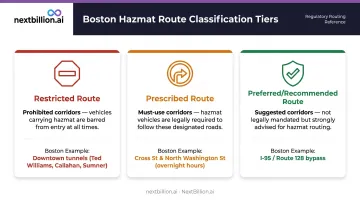
Boston's hazmat routing system uses three classification tiers. Knowing which tier applies to your cargo determines everything about how you plan a trip. These distinctions matter for dispatch planning: a restricted route is a hard no regardless of time of day, a prescribed route is mandatory once you're operating within its window, and a preferred route is a bypass suggestion carriers can deviate from if operationally necessary.
| Route Type | Meaning | Boston Example |
|---|---|---|
| Restricted Route | Prohibited for specified cargo — do not use | All downtown tunnels |
| Prescribed Route | Mandatory corridor — must use | Cross St, North Washington St, Albany St at night |
| Preferred/Recommended Route | Advisory corridor — suggested, not legally required | I-95/Route 128 bypass during daytime |
All Hazmat vs. NRHM: Know the Difference
Two cargo designations drive Boston's rules, and carriers must determine which applies before planning any route.
- All Hazmat (All HC): Covers every hazmat classification, including radioactive materials — Boston's tunnel ban applies here without exception, regardless of cargo type.
- All NRHM: Covers non-radioactive hazardous materials requiring placards under 49 CFR 172.504 Tables 1 and 2 — the nighttime prescribed surface corridors operate under this designation.
Misclassifying cargo between these two designations can result in using a surface corridor that doesn't apply to your load — or missing a tunnel restriction that does. Confirm your designation against 49 CFR 172.504 before routing.
How Boston's Framework Was Built — and Challenged
The current route structure traces directly to the Big Dig. When the Central Artery/Tunnel project moved I-93 underground, Boston changed its hazmat route from Commercial Street to Cross Street. The city did not follow the federal process for that route change, which triggered FMCSA proceedings.
In 2009, FMCSA issued a preemption determination finding that Boston's Article VII routing designation and its de facto permit ban on through-transport both violated 49 U.S.C. 5125(c)(1). The city had not complied with 49 CFR Part 397, Subpart C — the federal NRHM routing standards.
The current Metro-Boston NRHM designation was developed through the compliant federal process. Carriers must verify they are operating under MassDOT's officially published routing, not outdated city ordinances that have since been preempted.
The Permit System
Two distinct permits apply, depending on your trip profile:
- Local permit: Applies when your origin or destination is within Boston — required for any delivery operation to or from a Boston address.
- Through-permit: Applies when you have no Boston origin or destination but need to transit the city. The 1980 Boston Regulations set a "compelling need" and "public interest" standard; permits are issued annually.
Restricted Routes: Tunnels and Prohibited Corridors
All hazardous cargo and cargo tankers are prohibited from Boston's underground tunnel infrastructure, regardless of cargo class or time of day. This includes the I-93 tunnel system built during the Big Dig, which moved the highway underground through downtown Boston and remains fully finished and open to general traffic — but closed to hazmat vehicles under the current routing framework.
The Restricted Tunnel List
Per MassDOT and the FMCSA Massachusetts route registry:
- Callahan Tunnel — Route 1A Northbound under Boston Inner Harbor
- Sumner Tunnel — Route 1A Southbound under Boston Inner Harbor
- I-90 Ted Williams Tunnel — under Boston Harbor to Logan Airport
- I-90 Prudential Tunnel — Dalton St. to Clarendon St. / Logan Airport to Massachusetts Ave
- I-93 Thomas P. O'Neill Tunnel — Leverett Connector to Kneeland Street (includes the Dewey Square segment)
- Charlestown/City Square Tunnel — I-93 to Charlestown
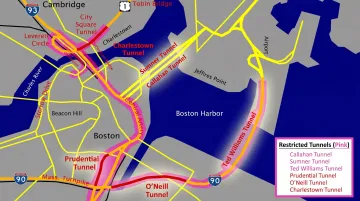
Because I-93 runs through the O'Neill Tunnel in downtown Boston, hazmat vehicles cannot remain on the highway mainline and must exit to designated surface corridors before reaching the tunnel system.
Critical Exit Points
MassDOT posts hazmat warning signs at key decision points:
- Southbound on I-93: Exit 18 is the last available exit before the tunnel system. Signs alert drivers that Exit 18 (Leverett Circle/Storrow Drive) is the final exit before the restriction begins.
- Northbound on I-93: Hazmat vehicles may travel no further north than Exit 15B before they must divert.
Dispatchers should confirm drivers have noted both exit points before entering the Boston metro — once past them, there is no compliant re-entry route back onto the mainline.
Daytime Restrictions (6 a.m. – 8 p.m.)
During daytime hours, through-routing of all hazardous cargo in Downtown Boston is completely prohibited — not just tunnel use, but any surface-road transit through the downtown area by through-carriers.
Required diversions:
- Northbound (approaching from south): Exit I-93 at Exit 28B in Woburn → I-95/Route 128 southbound toward Waltham → continue to points south, east, and west of Boston.
- Southbound (approaching from north): At the I-93/I-95 junction in Canton, follow I-95 northbound → continue to points north, east, and west.
These diversions apply to through-carriers only. Local deliveries with a valid permit to a Boston destination are still permitted during daytime hours — but carriers without a Boston stop must bypass the city entirely via I-95.
Prescribed Nighttime Corridors for NRHM (8 p.m. – 6 a.m.)
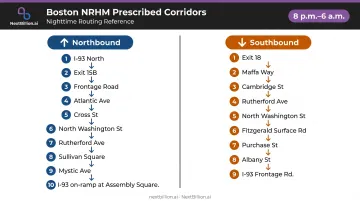
Between 8 p.m. and 6 a.m., Non-Radioactive Hazardous Materials (NRHM) vehicles may transit Downtown Boston, but only on specific surface corridors. Northbound and southbound trips use entirely different streets — taking the wrong direction's route is a compliance violation, even if you're on a designated hazmat street.
Northbound Prescribed Route (From South of Boston)
- I-93 North → Exit 15B (Mass Ave/Frontage Road)
- Frontage Road north → South Station/Downtown on-ramp
- Atlantic Ave northbound
- Cross Street north
- North Washington Street north
- Rutherford Avenue toward Sullivan Square
- Sullivan Square Rotary → follow signs to Mystic Avenue
- Mystic Avenue north → I-93 North on-ramp at Assembly Square
Southbound Prescribed Route (From North of Boston)
- I-93 South → Exit 18 (Route 38, Sullivan Square/Charlestown)
- Route 38 south → Maffa Way
- Maffa Way south → Cambridge Street
- Right onto Rutherford Avenue south
- Straight onto North Washington Street
- Southwest onto John F. Fitzgerald Surface Road
- South to Purchase Street → rejoins Surface Road south
- Continue south to Albany Street
- I-93 Frontage Road south → enter I-93 southbound
Recovery Route: Missed Exit 18
If a southbound driver misses Exit 18 and continues past it toward Leverett Circle/Storrow Drive:
- Right on Nashua Street → Left on Lomasney Way → Left on Causeway Street (past TD Garden) → Sharp right on North Washington Street → reconnect to the prescribed corridor at John F. Fitzgerald Surface Road.
Segment Classifications
These segments carry mandatory prescribed route status for all NRHM vehicles — compliance applies in both directions unless otherwise noted:
- Albany St — Surface Rd to I-93 South
- Cross St — Atlantic Ave to North Washington St
- North Washington St — Cross St to New Rutherford Ave (both directions)
Federal and State Compliance Requirements
Boston's routing designations operate within a strict federal framework. Under 49 U.S.C. 5125 and 49 CFR 397.71, any NRHM routing designation established or modified after November 14, 1994 must meet federal standards — or face preemption.
What a compliant routing designation requires under 49 CFR 397.71:
- Safety enhancement finding
- Public notice with a 30-day comment period
- Consultation with affected jurisdictions
- Continuity of through-highway routing
- Risk analysis
- No unreasonable burden on commerce
- Interstate agreement or FMCSA dispute resolution
Boston's 2009 preemption occurred because the city modified its route without following this process. The current MassDOT-published Metro-Boston NRHM designation was developed through the compliant federal process.
Carriers should verify their route against MassDOT's official hazardous material route designation page. Legacy city ordinances do not supersede the federally compliant designation.
Common HazMat Routing Mistakes to Avoid
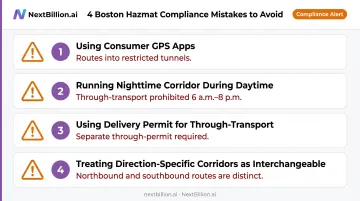
Four errors account for most Boston hazmat compliance failures:
1. Relying on consumer GPS apps for hazmat routing Consumer navigation tools have no knowledge of hazmat restrictions and will route vehicles directly onto the I-93 mainline and into restricted tunnels without warning. Only hazmat-aware routing platforms should be used in the metro area.
2. Running the nighttime surface corridor during daytime hours The surface road NRHM corridor (Cross St, North Washington St, Albany St) does not become compliant just because a driver uses it. Through-transport is prohibited during daytime regardless of which surface streets are used.
3. Treating a delivery permit as authorization for through-transport A permit issued for a Boston origin or destination does not authorize through-transport. Through-carriers need a separate through-permit. Notably, the 2009 FMCSA ruling found Boston's historical practice of denying all through-permits non-compliant with federal law.
4. Treating direction-specific corridors as interchangeable Boston's prescribed nighttime corridors are direction-specific. The northbound corridor runs via Atlantic Ave → Cross St; the southbound corridor runs via Maffa Way → Rutherford Ave → North Washington St. A driver following the northbound path while traveling southbound is out of compliance.
How Technology Supports Boston HazMat Route Compliance
Manual route planning for Boston hazmat transport is high-risk. The combination of tunnel restrictions, direction-specific corridors, time-of-day windows, and cargo-type distinctions creates too many variables for a driver or dispatcher to manage reliably without purpose-built tools.
NextBillion.ai's truck-compliant routing engine is built specifically to address this complexity. The platform supports:
- Blocks restricted tunnel routes at the engine level, so prohibited paths are never generated in the first place
- Enforces daytime prohibition windows and restricts NRHM corridor access to approved nighttime hours only
- Factors in vehicle dimensions, cargo type, and hazmat classification when generating each route
- The Road Editor App, a no-code interface that lets operations teams encode custom restrictions — including Boston tunnel prohibitions — at the road-segment level, scoped by vehicle type, time of day, and day of week
Route restrictions configured in the Road Editor feed directly into the Directions, Distance Matrix, Route Optimization, and Navigation APIs with no lag. For fleets that need dispatcher visibility, the platform also supports geofence-based alerts for deviations from compliance-required route segments.
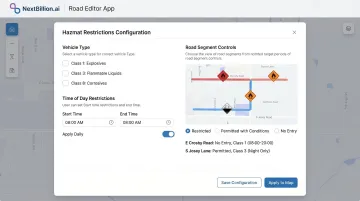
For carriers moving hazmat through Boston, the practical difference is this: constraints encoded into the routing engine cannot be overlooked, miscommunicated, or forgotten the way a driver briefing can. Compliance becomes a system property, not a human one.
Conclusion
Safe hazmat transport through Boston requires two things working together: accurate knowledge of the physical route network (which tunnels are off-limits, which surface corridors are mandatory, which direction each corridor applies to) and a firm grasp of the regulatory framework governing permits, time windows, and federal preemption standards.
Neither element is static. Routes get updated, permit requirements shift, and enforcement priorities change without much notice. Fleet operators and dispatchers should treat Boston hazmat routing as an ongoing operational discipline — one that gets reviewed on a regular cadence, not buried in onboarding materials and revisited only after a violation.
That kind of disciplined, constraint-aware routing is where software infrastructure earns its keep. Platforms like NextBillion.ai support truck-aware routing with custom road attribute controls, making it easier to encode hazmat restrictions, corridor requirements, and time-window rules directly into your dispatch logic — rather than relying on drivers to remember them.
Frequently Asked Questions
Are all Boston tunnels restricted for hazmat vehicles?
Yes. All major Boston tunnels are restricted for all hazmat classifications, including the Callahan, Sumner, Ted Williams, I-90 Prudential, I-93 O'Neill (Thomas P. O'Neill), and Charlestown tunnels. This restriction applies 24 hours a day, regardless of cargo class or time of day.
What is the difference between a restricted, prescribed, and preferred hazmat route in Boston?
Restricted routes prohibit hazmat transport entirely: Boston's tunnels are the clearest example. Prescribed routes are mandatory corridors; Cross St and North Washington St are prescribed for nighttime NRHM transit. Preferred routes are advisory corridors suggested by MassDOT but not legally required.
Does Boston apply different hazmat routing rules during the day vs. night?
Yes. Through-transport of all hazmat is prohibited in Downtown Boston during daytime hours (6 a.m. – 8 p.m.); through-carriers must divert via I-95/Route 128. Between 8 p.m. and 6 a.m., NRHM vehicles may use the prescribed surface road corridor, with separate northbound and southbound routes.
What permits are required for hazmat transport through Boston?
Carriers with a Boston origin or destination need a city permit for local delivery operations. Carriers transiting Boston with no local stop require a separate through-permit demonstrating compelling need and public interest. Dispatchers should confirm permit status before assigning a route, since a valid load-specific permit does not override tunnel restrictions or daytime through-transport bans. Route planning software that flags hazmat restrictions can help catch conflicts before a driver is dispatched.
What federal regulations govern Boston's hazmat routing designations?
Boston's routing designations fall under 49 U.S.C. 5125 and 49 CFR Part 397 Subpart C. Routing changes made without following the federal NRHM standards — public notice, risk analysis, inter-jurisdictional consultation — are subject to FMCSA preemption, as occurred in 2009.
What are the consequences of violating Boston's hazmat routing requirements?
Violations trigger enforcement from Boston, state, and federal regulators — including out-of-service orders and fines. Under 49 CFR 107.329, federal civil penalties reach $102,348 per violation, rising to $238,809 when a violation causes death, serious injury, or major property destruction — and carriers face additional liability exposure for any incident on a non-compliant route.
What are the hazardous materials route restrictions in Boston?
Boston restricts hazmat transport primarily through tunnel bans and time-of-day rules. All major tunnels are closed to hazmat vehicles at all times. Downtown Boston prohibits daytime through-transport of hazmat, forcing carriers onto I-95/Route 128. At night, a prescribed surface corridor on Cross St and North Washington St handles non-radioactive hazmat traffic. Local delivery and through-transit each require separate permits, and routing decisions must account for both city and federal rules.