The software you choose to manage that final leg isn't a minor tooling decision. According to the World Economic Forum, last mile costs accounted for 53% of total shipping costs in 2023 — and in Indonesia, where logistics inefficiencies compound across geographies, the wrong platform actively costs money through failed deliveries, poor routing, and unmanageable COD workflows.
With Indonesia's e-commerce logistics market projected to reach USD 8.71 billion by 2031, the pressure on last mile operations is only increasing. This guide covers what to look for, what to avoid, and how to evaluate platforms against Indonesia's specific operational realities.
Key Takeaways
- Last mile delivery software automates route planning, dispatch, tracking, and proof of delivery to cut costs and improve delivery success rates.
- Indonesia's archipelago geography, inconsistent address data, COD prevalence, and rapid e-commerce expansion expose gaps that most generic global platforms can't fill.
- Key evaluation factors: route optimization quality, local map accuracy, integration flexibility, COD management, and pricing model structure.
- Per-vehicle or per-order pricing outperforms per-API-call billing during Indonesian peak seasons like Harbolnas 11.11.
- NextBillion.ai delivers AI-powered route optimization with 50+ constraints, custom map layers, and per-vehicle pricing, built by founders who engineered location infrastructure for Grab.
What Is Last Mile Delivery Software?
Last mile delivery software manages and automates the final leg of the supply chain — from a distribution hub or warehouse to the customer's doorstep. It replaces manual dispatch, paper-based routing, and ad hoc driver communication with a coordinated digital system. The best software for last mile delivery management is the one that matches the operating environment it runs in — for Indonesia, that means a platform built to handle archipelago routing, COD reconciliation, and non-Java map gaps, not just generic dispatch features.
The core functional modules in most platforms include:
- Route optimization engine — plans multi-stop routes across a fleet
- Driver/rider management app — pushes routes, captures status updates, and logs stops
- Customer communication layer — sends tracking links, ETA updates, and delay alerts
- Proof of delivery (PoD) capture — photo, digital signature, or OTP confirmation
- Analytics dashboard — tracks delivery performance, exceptions, and costs
Key Benefits for Indonesian Logistics Operations
For Indonesian operators, the metrics that define profitability — deliveries per rider per day, fuel cost per shipment, first-attempt delivery success rate, and return-to-origin (RTO) rate — each have a direct software lever. The right platform doesn't just track these numbers; it changes them.
That translates into concrete day-to-day gains:
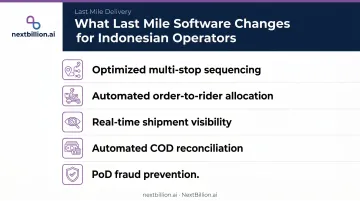
- Reduced empty miles through optimized multi-stop route sequencing
- Automated rider-to-order allocation, replacing manual dispatch
- Real-time shipment visibility for both operations managers and customers
- Automated COD cash reconciliation at shift end
- PoD fraud prevention through photo and OTP verification
Why Last Mile Delivery Is Especially Complex in Indonesia
Most last mile platforms assume flat, well-mapped urban geography. Indonesia breaks nearly every one of those assumptions.
Geographic and Infrastructure Challenges
The country spans over 17,000 islands with widely varying road quality across regions. BPS Statistics Indonesia's 2024 Land Transportation data shows that while 66.77% of roads are rated "good," 8.11% are heavily damaged — and that damage is concentrated outside Java. Standard map data frequently contains inaccuracies or outright gaps for non-urban areas, meaning routing engines built on generic global providers can generate technically valid routes that are practically unnavigable.
Shipping costs reflect this reality. A 2023 report by Kredivo and Katadata found that shipping from Jakarta to West Papua reached IDR 128,608 per kg — roughly five times the cost of shipping to East Java. Without software that accounts for these geographic realities, route planning defaults to assumptions that don't hold outside Tier 1 cities.
E-Commerce Demand and Scale Pressure
That infrastructure gap is widening precisely where order volumes are growing fastest. Indonesia's e-commerce GMV reached USD 65 billion in 2024, projected to grow to approximately USD 150 billion by 2030. The country accounts for 46.9% of total Southeast Asian e-commerce GMV. Tier 2 and Tier 3 cities now generate 43% of transaction value — up from 33% in 2020 — meaning delivery volumes are expanding fastest in the regions with the least reliable roads.
Social commerce is adding further pressure. Indonesia's social commerce market is expected to reach USD 22 billion GMV by 2028, driven by platforms like TikTok Shop (now merged with Tokopedia). These channels generate order volumes that are difficult to predict and hard to batch without intelligent software.
COD Complexity
Cash-on-delivery remains the payment reality for large portions of the country. The same Kredivo/Katadata report found 61.4% COD usage in Indonesian e-commerce in 2023. Outside Tier 1 cities, that figure is higher.
COD creates operational problems that most globally-built platforms handle poorly: cash must be tracked per rider, discrepancies create reconciliation delays, failed deliveries require empty-mile returns to the warehouse, and fraud risk accumulates without digital confirmation. This is a distinct problem from cross-border shipping into Indonesia, where international carriers and customs clearance — not COD reconciliation — determine delivery success.

Software that treats COD as an edge case — rather than a core workflow — pushes these problems onto operations teams. That's the first signal to look for when evaluating any platform for the Indonesian market.
Key Factors to Consider When Choosing Last Mile Delivery Software in Indonesia
Many platforms offer "last mile capabilities." What separates effective solutions from costly mistakes is how well each one addresses Indonesia's specific constraints — rather than checking generic feature boxes.
Route Optimization Quality and Constraint Handling
Basic A-to-B routing isn't sufficient here. Riders handle multi-stop routes across congested urban zones and poorly mapped rural roads, with vehicle load capacity, time windows, delivery priority, and road restrictions all needing to be honored simultaneously.
When evaluating route optimization, ask specifically:
- How many hard and soft constraints does the engine support?
- Can it handle mixed fleets — motorbikes, vans, and trucks — with vehicle-specific routing?
- Does it reoptimize dynamically when a stop fails or a new order comes in mid-shift?
- What's the maximum number of stops per optimization request?
Key KPIs affected include deliveries per vehicle per day, distance per shipment, fuel cost, and on-time delivery rate. A platform that handles only simple constraints will produce routes that look good on paper but break down in the field.
Map Accuracy and Local Geo-Intelligence
Route optimization is only as reliable as the underlying map data. In Indonesia, address standardization is inconsistent outside Java — the AIP Conference Proceedings published research as far back as 2016 identifying standardized address formats as a core geocoding challenge across the country.
Platforms built entirely on generic global map providers will generate routes to addresses that don't cleanly geocode, through roads that don't reflect current conditions, or via paths that aren't accessible to motorbikes. The practical result is increased failed deliveries and rider downtime.
Evaluation checkpoints:
- Does the platform allow custom map layers or road attribute edits?
- Can operators mark road closures, add missing roads, or restrict routing for specific vehicle types?
- Is map data calibrated for non-urban Indonesian geographies, beyond Java?
Integration with Existing Tech Stack and Local Systems
Last mile software doesn't operate in isolation. It must connect with order management systems, warehouse management platforms, marketplace integrations (Tokopedia, Shopee, Lazada), and COD management or payment tools.
Manual integration workarounds slow dispatch times and introduce errors at the point where speed matters most — order release to first route generation. Key checkpoints:
- Is the platform API-first, with well-documented endpoints for OMS/WMS connection?
- Are there pre-built connectors for regional e-commerce platforms or logistics operators?
- Does the integration layer support real-time data flow, or is it batch-based?
COD Management and Cash Reconciliation
In Indonesia, COD is a core operational workflow — not a secondary feature. Platforms without native COD support create compounding problems:
- Riders accumulate cash with no system-enforced limits
- End-of-shift reconciliation is manual and error-prone
- Failed COD deliveries generate empty miles with no automated return-to-warehouse workflow
- Settlement disputes take days to resolve
Software built for Indonesian operations should include per-rider cash limits, digital COD confirmation (OTP or photo), automated settlement reporting at shift close, and exception flagging for cash discrepancies. Each of these directly affects COD settlement time, cash discrepancy rates, and empty mile percentages.
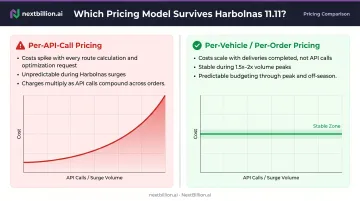
Scalability and Pricing Model
The difference between per-API-call and per-vehicle/per-order pricing matters enormously during Indonesian peak seasons. During Harbolnas 11.11, J&T Express alone processed 16.5 million packages in a single day, with Kredivo/Katadata data showing that shopping events like 11.11 and 12.12 increase daily transaction volumes by 1.5x to 2x.
Per-API-call pricing punishes exactly this kind of volume surge. Every route calculation, distance matrix query, and optimization request counts separately — costs spike precisely when you're already under operational pressure.
Per-vehicle or per-order pricing aligns software costs with actual operational scale. You're paying for the deliveries you complete, not the API calls your infrastructure generates to optimize them. For platforms handling seasonal swings, this distinction directly affects cost predictability.
Real-Time Visibility and Customer Communication
Customer expectations in Jakarta, Surabaya, and Bandung are rising. Shoppers expect live tracking, ETA updates, and proactive delay alerts — and they expect them through channels they actually use. In Indonesia, that means WhatsApp. WhatsApp reaches approximately 92% of Indonesian internet users, making it the dominant customer communication channel.
Software that can only send email notifications will miss most customers entirely. Evaluation checklist:
- Does the platform support WhatsApp notifications natively or via integration?
- Can customers track delivery progress in real time, rather than receiving only static status updates?
- Does ETA calculation update dynamically with traffic conditions?
The KPIs this drives: first-attempt delivery success rate (customers who know when a rider is arriving are more likely to be available), and reduction in "Where Is My Order" support inquiries.
How NextBillion.ai Can Help
NextBillion.ai was built by founders who previously engineered location infrastructure for Grab's Geo team — one of Southeast Asia's largest logistics and mobility platforms. That background translates directly to Indonesia: the team has seen firsthand how generic mapping infrastructure breaks down in complex, high-density markets with inconsistent road data.
The platform addresses the specific challenges Indonesian operators face:
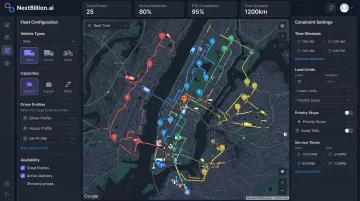
- Route optimization at scale — 50+ hard and soft constraints, including time windows, vehicle load capacity, motorbike-specific routing, restricted roads, driver shift limits, and mixed-fleet configurations. The Route Optimization API generates dispatch-ready routes in seconds, handling thousands of stops per request.
- Map accuracy for non-urban geographies — The Road Editor App lets operators edit road attributes directly: close roads, adjust speed limits, restrict routing by vehicle type or time of day, and add routes where base map data is absent. Mapfusion fuses OpenStreetMap, TomTom, proprietary operator data, and local edits into a single routing layer calibrated per geography.
- Predictable pricing during peak seasons — Per-vehicle and per-order pricing keeps costs stable during Harbolnas surges. Unlike per-API-call billing (where optimization requests multiply with every dispatch decision), per-order pricing tracks deliveries completed — not the infrastructure used to plan them.
- Proof of delivery — Photo capture, digital signatures, and OTP validation provide a verifiable delivery record for both PoD confirmation and driver accountability.
- Regional deployment — Route optimization infrastructure is hosted in Singapore for lower latency across Southeast Asian operations. On-premise and private cloud options are available for operators with data sovereignty requirements.
The platform has helped optimize over 10.9 million deliveries globally and delivered $11M+ in documented cost savings to customers including Gojek, one of Southeast Asia's largest logistics and mobility operators.
Ready to optimize your Indonesia delivery operations? Request a demo to see the platform in action.
Conclusion
Choosing last mile delivery software in Indonesia is a geography-specific, operationally complex decision. The wrong platform costs money in ways that aren't always obvious upfront — through poor routes in outer-island geographies, unmanageable COD workflows, API billing spikes during peak seasons, and failed integrations with the local tech stack.
The right software is an ongoing operational partner, not a one-time purchase. As delivery volumes grow, route data improves through operator edits, and customer expectations shift. The platform needs to keep pace. Flexibility, integration depth, map customizability, and support quality determine whether it does — and those factors are harder to evaluate on a feature checklist than on a live route. Platforms like NextBillion.ai are built specifically for this: custom road-attribute editing, predictable per-vehicle pricing, and deep API integration designed for the operational realities of markets like Indonesia.
Frequently Asked Questions
What is last-mile delivery software?
Last mile delivery software automates the final leg of the supply chain — managing route planning, driver dispatch, real-time tracking, proof of delivery, and customer communication. The software increases delivery success rates, reduces cost per shipment, and gives operations managers real-time visibility into fleet performance. Most platforms are built on APIs, so dispatch, routing, and tracking logic can be embedded into an existing transportation management system rather than run as a standalone app, which matters for fleets already using WMS or ERP tools.
How much does last-mile delivery cost in Indonesia?
Indonesia's logistics costs run 14–26% of GDP — well above the 8–10% typical of advanced economies. Last mile accounts for 41–53% of total shipping costs by global benchmarks, making route optimization the most direct lever for reducing per-delivery spend.
What are the recent trends in last-mile delivery services in Indonesia?
Key trends shaping Indonesia's last-mile market:
- Social and video commerce pushing delivery volumes into Tier 2 and Tier 3 cities
- AI-based route optimization becoming standard for mid-to-large fleets
- Same-day delivery growing at a 9.12% CAGR through 2031
- Electric two-wheelers gaining traction for urban delivery
- Real-time tracking integrated directly with WhatsApp for customer notifications
What features should last-mile delivery software have for Indonesia's archipelago geography?
Look for customizable or locally editable map layers, vehicle-specific routing (especially motorbike profiles), robust offline functionality for low-connectivity areas, and the ability to handle irregular address formats common outside Java. Off-road route planning capability is an advantage for remote delivery zones. The same requirements apply to any fleet operating across mixed terrain or spotty connectivity, so evaluate whether the routing engine lets you edit map data directly rather than waiting on a vendor's update cycle.
How does route optimization software reduce last-mile delivery costs in Indonesia?
Route optimization reduces costs across three areas:
- Fuel: Shorter, smarter routes cut total distance traveled
- Throughput: Intelligent stop batching increases deliveries per rider per shift
- Failed deliveries: Time-window management and proactive notifications lower return-to-origin rates
Each improvement reduces cost per delivery, and the impact scales with volume.
Can last-mile delivery software handle cash-on-delivery (COD) reconciliation in Indonesia?
Purpose-built platforms handle COD through per-rider cash limits, OTP or photo confirmation at the doorstep, automated settlement reports at shift end, and exception flagging for discrepancies. This reduces fraud risk and eliminates manual cash runs back to the warehouse. The same controls apply to any market where COD or cash-heavy delivery persists, including parts of the US, such as appliance and furniture delivery, so the reconciliation logic is not region-specific to Indonesia.
What is the best software for last mile delivery management?
There is no single best platform — the right choice depends on fleet size, vehicle mix, and whether you need a full dispatch app or an API layer to embed into existing tools. Evaluate any option against route optimization accuracy, real-time tracking, proof-of-delivery capture, offline handling, and how easily it integrates with your current TMS or order management system. Fleets with in-house engineering teams often prefer API-first platforms over closed, all-in-one apps for flexibility.
How do US regulations affect last-mile delivery software requirements?
Last-mile delivery software used by US fleets often needs to account for FMCSA hours-of-service limits for drivers operating commercial vehicles, DOT vehicle and driver record requirements, and ADA-compliant delivery practices for accessibility. Route and dispatch planning should avoid scheduling that pushes drivers past legal drive-time limits, and reporting features should support the recordkeeping fleets need for compliance audits, even though the software itself is not a compliance certification tool.