Introduction
A retail shopper walks past a storefront and gets a flash-sale text within seconds. A logistics dispatcher receives an automated alert the moment a delivery driver pulls into a depot. Neither of these required a human to watch a screen and hit send.
That's SMS geofencing — and according to Grand View Research, the global geofencing market was valued at $2.37 billion in 2023 and is projected to reach $9.36 billion by 2030, a trajectory driven by adoption in logistics, retail, and field operations alike.
Most explanations treat SMS geofencing as a retail marketing gimmick. That framing leaves operations teams, logistics engineers, and field service managers without a clear picture of how the underlying technology works or where it genuinely fits into a real workflow.
This guide covers the mechanics.
Key Takeaways
- SMS geofencing sends a text automatically when a consented mobile device enters, exits, or lingers inside a virtual geographic boundary.
- GPS, Wi-Fi positioning, or cell tower data continuously compares device location against stored boundary coordinates.
- Only opted-in subscribers receive messages — the technology cannot broadcast to unknown devices nearby.
- Use cases span retail promotions, event reminders, delivery ETAs, fleet compliance, and field technician check-ins.
- Consent requirements, battery drain, and detection accuracy are real constraints worth addressing before you build.
What Is SMS Geofencing?
SMS geofencing is a location-triggered messaging technique. It uses a virtual perimeter — defined by geographic coordinates — to automatically send a pre-written SMS the moment a consented mobile device crosses or dwells within that boundary.
The operational problem it solves is straightforward: businesses needed contextual communication tied to physical location without someone manually watching a map and sending messages. SMS geofencing removes that human dependency entirely, creating event-driven messaging that fires the moment a location condition is met.
What It Is Not
Two common misconceptions are worth clearing up:
- It is not carrier broadcasting. SMS geofencing cannot mass-text every device physically near a location. That's a government emergency alert system (WEA), not commercial messaging.
- It is not the same as a push notification. Push notifications require an installed app. SMS geofencing works through a phone number and prior consent — no app required.
Boundary Shapes
Geofences fall into two configurations, and choosing the wrong one causes misfires:
- Circular (radius-based): A center point plus a distance — for example, a 500-meter radius around a warehouse entrance. Simple to configure, reliable for single-location triggers.
- Polygon-based: Custom-shaped boundaries that follow a road corridor, property line, or irregular delivery zone. More complex to define, but far more precise for non-circular areas.
A circular fence works well around a large distribution center. Try to use one on a single arm of a highway interchange, and it will trigger on the wrong road constantly.
Why SMS Over Push Notifications?
CTIA reports that text messages have a 98% open rate — and unlike app push notifications, SMS reaches users without requiring them to have installed anything. For time-sensitive location triggers — a delivery arriving in 10 minutes, a technician at the gate — that no-install, near-universal reach is the deciding factor.
How Does SMS Geofencing Work?
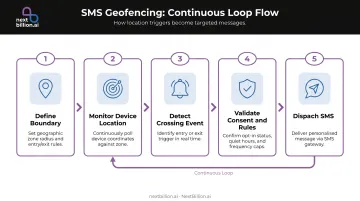
The system operates as a continuous loop: define boundary → monitor device location → detect crossing event → validate consent and rules → dispatch SMS. Each stage has its own technical dependencies.
Boundary Definition and Setup
Setting up a geofence means specifying:
- Location — latitude/longitude coordinates or a drawn map boundary
- Shape and size — circle with radius, or a custom polygon
- Trigger condition — entry, exit, dwell time, or a combination
- Message content — the pre-written SMS (up to 160 characters in standard 7-bit encoding)
The most common setup error is sizing. Android's developer documentation recommends a minimum geofence radius of 100–150 meters for reliable detection — anything smaller risks missed or false triggers, especially indoors. Oversized fences create the opposite problem: messages fire too early, when the recipient is still blocks away.
Location Monitoring and Event Detection
Once the boundary is live, the system continuously compares the device's reported position against the stored coordinates. The moment the device's location intersects the geofence perimeter, a detection event fires.
Dwell-time logic adds a useful second layer of control. Rather than triggering the instant a device enters a zone (which catches people walking past, not stopping), operators set a minimum time-in-zone — say, 3 minutes — before the message fires. This cuts false positives for store entrances, job sites, or any context where actual presence matters more than proximity.
Message Trigger and Delivery
Once dwell-time conditions are met, the detection event passes through a validation layer before any message goes out. That layer checks:
- Is this device's number on the opted-in subscriber list?
- Have frequency caps been met (preventing the same person from receiving multiple messages per day)?
- Do time-of-day rules allow sending right now?
Only when all conditions clear does the SMS dispatch — typically within seconds of the trigger. Campaign platforms log each send event with timestamp and location data, giving operators a full audit trail for delivery timing, frequency, and zone-level performance.
The Technology Stack Behind SMS Geofencing
SMS geofencing depends on two distinct layers: the location detection layer and the software orchestration layer above it.
Location Detection Methods
| Method | Accuracy | Best For | Limitation |
|---|---|---|---|
| GPS | ~4.9 m outdoors | Outdoor, open-sky environments | Battery-intensive; degrades near buildings |
| Wi-Fi positioning | 20–50 m typical | Indoor environments | Requires nearby network SSIDs |
| Cell tower triangulation | Hundreds of meters | Rural areas, wide-zone coverage | Low precision for tight geofences |
| RFID/BLE beacons | Very short range (<10 m) | Precise indoor detection | Requires hardware at location |
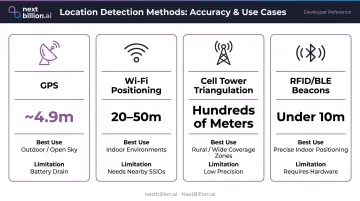
GPS-enabled smartphones are typically accurate within 4.9 meters under open sky, but that figure erodes fast near tall buildings. Signal multipath in dense urban environments can introduce errors of tens of meters.
That gap is why Android recommends 100–150 m as a minimum geofence radius — not the 5–10 m that raw GPS accuracy might suggest is achievable.
The Software Orchestration Layer
Above the location signal sits the geofencing platform, which handles:
- Boundary intersection — checks incoming device coordinates against stored fence definitions in real time
- Subscriber matching — maps detected devices to opted-in phone numbers before any send
- Compliance enforcement — blocks sends that would violate TCPA, GDPR, or internal frequency caps
- Gateway dispatch — routes the triggered message and logs the delivery event
For logistics and field operations, NextBillion.ai's Geofencing API sits at this layer. It supports polygons, circles, corridors, and custom shapes, and fires boundary-crossing events via webhooks in real time. Time-of-day and day-of-week scheduling filters are built in — so a vehicle crossing a depot boundary at 2 a.m. doesn't trigger an SMS meant for a daytime delivery window.
Consent and the Data Pipeline
The system requires two separate permissions before it can function:
- OS-level location permission — the user must grant the app (or web flow) access to their device's location on iOS or Android
- SMS opt-in consent — explicit written consent to receive commercial text messages, required under TCPA in the US
Without both, the trigger chain is legally and technically broken. The FCC confirms that autodialed texts to mobile devices require prior consent, with marketing texts requiring written consent specifically.
Where SMS Geofencing Is Used
Marketing and Consumer-Facing Applications
These represent the most common adoption patterns:
- Retail — proximity promotions triggered as customers approach a store location
- Food and beverage — lunch specials sent to nearby office workers during peak hours
- Events and entertainment — schedule reminders for attendees who've entered a venue's geofence
- Real estate — open house alerts for people passing a listed property
These use cases work well because foot traffic is concentrated, dwell times are predictable, and the message-to-context fit is obvious.
Operational and Logistics Applications
For B2B teams, these use cases often deliver more measurable ROI:
- Delivery ETA notifications — fires when a driver enters the recipient's neighborhood geofence, cutting missed deliveries without dispatcher involvement
- Field technician arrival alerts — customers receive a text when the technician crosses the job-site boundary, eliminating "where are they?" calls
- Fleet compliance monitoring — alerts trigger when vehicles enter or exit permitted operating zones, supporting both safety compliance and asset tracking
- Depot check-in automation — driver arrival at a distribution center is logged and acknowledged without manual sign-in
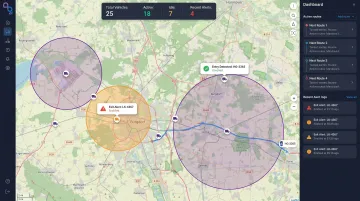
NextBillion.ai's Geofencing API handles this operational layer directly: real-time boundary detection for last-mile delivery, field service, and fleet workflows, with webhook-based event output that connects to downstream SMS and notification systems.
Where It Performs Best vs. Struggles
Best fit:
- Physical locations with concentrated, predictable movement (retail corridors, warehouses, job sites, event venues)
- Workflows where timing matters — delivery windows, technician schedules, depot operations
Poor fit:
- Diffuse, high-mobility environments with short dwell times (highways, transit hubs)
- Indoor locations without Wi-Fi or beacon infrastructure, where GPS accuracy is unreliable below 100-meter radius
SMS Geofencing: Key Benefits and Real Limitations
Core Benefits
- Contextual relevance: Location-triggered messages match timing to physical proximity, which reduces irrelevance and opt-out rates compared to scheduled broadcast campaigns
- Fully automated — no one needs to monitor a map or manually send messages at trigger moments
- With a 98% SMS open rate, time-sensitive operational communications (delivery alerts, technician arrivals) get seen fast
Real Limitations
Most coverage of geofencing glosses over the friction points. They're worth naming directly:
- Dual consent friction: Obtaining both location permission and SMS opt-in creates a two-step onboarding process that shrinks the addressable audience before any message is sent
- Continuous location polling can drain batteries, prompting users to disable location services entirely — silently breaking the trigger chain
- Message volumes scale with subscriber counts; large-scale geofencing campaigns require real budget planning, not an afterthought
- A geofence that's too small for the available GPS accuracy will produce false triggers or missed events entirely
Privacy and Compliance
Shortcuts here create real liability. GDPR, TCPA, and CCPA all apply, and the California AG specifically classifies precise geolocation as sensitive personal information under CCPA/CPRA.
Two practical rules:
- Never send geofence-triggered messages without verifiable dual consent
- Write message copy that references the general area ("near our store"), not the user's exact coordinates — precise location references in SMS copy erode trust and can cross regulatory lines
NextBillion.ai's platform collects location data only when users explicitly grant permission and never sells or shares it with third parties. The platform holds SOC 2 Type II, GDPR, CCPA, and ISO/IEC 27001:2013 certifications — relevant checkboxes when evaluating any location intelligence layer in a geofence-triggered messaging workflow.
Frequently Asked Questions
What is SMS geofencing?
SMS geofencing is a location-triggered messaging technique that uses virtual geographic boundaries to automatically send a pre-configured text when a consented mobile device enters, exits, or dwells within a defined zone. It requires both a stored boundary and an opted-in subscriber list — it cannot broadcast to unknown nearby devices.
What technology does geofencing use?
The four main methods are:
- GPS — accurate to ~5 meters outdoors
- Wi-Fi positioning — 20–50 meters, useful indoors
- Cell tower triangulation — lower precision, wide coverage
- RFID or Bluetooth beacons — short-range, hardware-dependent
The method chosen affects both accuracy and device battery consumption.
Do users need to download an app for SMS geofencing to work?
Not always — location permission can be granted via a mobile browser or through an existing app, and the phone number can be collected via an SMS opt-in flow. However, background location access on iOS and Android typically requires an app, which affects dwell-time and exit-trigger reliability.
Is SMS geofencing compliant with privacy regulations?
Compliance requires dual consent: OS-level location permission and explicit SMS opt-in. US operations must follow TCPA rules; EU-facing businesses must meet GDPR standards; California adds CCPA requirements on top. All jurisdictions require a clear opt-out mechanism in every message.
How accurate is SMS geofencing?
Accuracy varies by method. GPS is typically within 4.9 meters under open sky but degrades near tall buildings or indoors. Cell tower triangulation can have errors of several hundred meters. Geofence radius should always be sized to match the expected accuracy of the available signal — Android's minimum recommended radius is 100–150 meters.
Can SMS geofencing be used for logistics and fleet management?
Yes, and it's one of the more reliable operational use cases. Common applications include automated delivery-approach notifications, technician arrival alerts, permitted-zone compliance monitoring, and depot check-in logging — all of which are easier to measure than consumer marketing campaigns.