Introduction
Ride-hailing software for the Middle East needs to handle multi-country licensing, cash and wallet payments, and Arabic-first driver and rider apps out of the box — not as a later add-on. The Middle East's ride-hailing market is growing faster than most entrants expect. Rapid urbanization, 88% smartphone adoption in GCC states (per GSMA's 2024 MENA Mobile Economy report), and a young population dependent on on-demand transport have created real, exploitable demand.
What's accelerating interest: Careem's narrowed footprint in smaller markets, government-backed smart mobility programs, and steady commuter demand across cities like Riyadh, Dubai, and Amman. Those gaps represent concrete entry points for operators who move early.
This interest comes from different starting points — local entrepreneurs, fleet owners going digital, tech founders, regional investors. Each arrives with different capital, connections, and expectations.
What all of them need is the same: a clear picture of what this market actually requires. This guide covers the realities — market structure, early decisions, regulatory requirements, and the practical steps from incorporation to operational launch.
Key Takeaways
- A ride-hailing business earns revenue by connecting passengers with drivers through a mobile app, taking commissions (typically 15–25%), subscription fees, or corporate billing
- Structural demand is strong across the region — urbanization is high, public transport is thin, and expatriate populations are large — but regulatory requirements vary sharply by country
- Key early decisions: launch market, white-label vs. custom tech, and local licensing pathway (TGA in Saudi Arabia, RTA in Dubai, Ministry of Transport in Jordan)
- Plan 6–12 months from incorporation to public launch — the first 3–6 months after go-live are about stabilizing driver supply, not scaling
- Success depends on local trust, driver density, pricing discipline, and a defensible niche — not app features
What Is a Ride-Hailing Business?
A ride-hailing business operates a platform — typically a mobile app — that connects passengers with nearby drivers on demand. The platform handles matching, pricing, payment, and reviews. The business earns from each transaction rather than owning a fleet or employing drivers directly. This is the same model behind apps riders already search for by name, including Careem in Dubai and Riyadh, Yango and inDrive across the Gulf, and Gett in Israel — the closest local equivalent to Uber there.
Three common structures in the Middle East:
| Model | How it works | Trade-offs |
|---|---|---|
| Owner-operated fleet | Operator owns vehicles, hires drivers | High cost, full quality control |
| Aggregator | Platform connects independent drivers with riders | Lower cost, harder to control quality |
| Hybrid | Base fleet + third-party drivers | Balances both; most common at mid-scale |
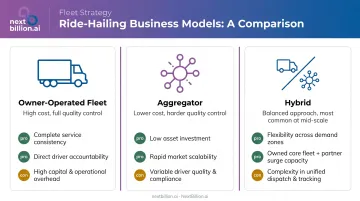
Each model shapes your licensing requirements, driver relationships, and growth ceiling differently. The sections ahead break down what those differences mean for specific Middle East markets.
What to Know Before You Start
Most entrepreneurs underestimate what the first 12 months actually look like. Driver acquisition is often harder and slower than rider acquisition. The majority of early effort goes into operations and compliance, not growth.
Set these expectations before starting:
- Expect to personally manage driver onboarding, dispute handling, and regulatory inspections until proper systems exist — this can't be delegated early
- Plan for losses through month 6–12 while building driver supply density and rider trust within a specific zone
- Building or licensing an app is the easy part; local relationships, driver network development, and regulatory navigation are the real obstacles
- Competing with Careem, Yango, and inDrive means finding a niche — women-only rides, corporate accounts, airport transfers, or underserved geography — not matching their features
When Careem exited Oman in February 2020, OTaxi — a local operator that started with just 30 cars — became the country's primary app-based ride-hailing service. It had built its position on national identity and local values, not technology. By the time Careem left, OTaxi was already handling over 90,000 lifts per month.
Why Start a Ride-Hailing Business in the Middle East?
Not every operator will succeed here. But the market structure actively favors entrants who pick a focused geography and a defensible niche over those trying to compete at scale from day one.
The Market Opportunity Is Real
Statista projects MENA ride-hailing revenue to grow from USD 10.26B to USD 26.94B across the forecast period, with Saudi Arabia as the region's largest market. Saudi Arabia alone had 48.1 million cellular connections at 140% population equivalent in early 2025. The UAE reached 195% population-equivalent mobile connections.
These aren't vanity numbers. They indicate a population that is already using smartphones for daily transactions — including transport.
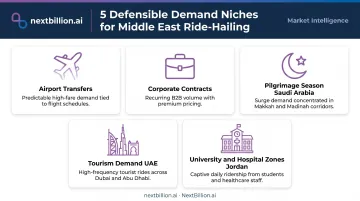
Specific Demand Channels Offer Defensible Beachheads
Rather than competing head-on with super-apps, new entrants can target recurring, predictable demand:
- Airport transfers — high-value, repeat corporate and tourist customers
- Corporate contracts — reliability and invoicing matter more than brand
- Pilgrimage season in Saudi Arabia — concentrated, predictable transport surge
- Tourism demand in UAE — international visitors without local options
- University and hospital zones in Jordan — daily commuters with consistent patterns
Local Operators Can Win Where Multinationals Won't Go
Multinationals chase volume in tier-one cities. That leaves mid-size GCC cities, specific demographics, and cultural niches underserved.
OTaxi's trajectory in Oman makes this concrete: a local brand starting with 30 cars outlasted Careem by delivering faster on-the-ground response, local accountability, and cultural alignment that a global platform operating from a regional HQ simply couldn't replicate.
How to Start a Ride-Hailing Business in the Middle East — Step by Step
Four mistakes kill most early-stage ride-hailing operators before they reach profitability: rushing to launch before driver supply is stable, skipping regulatory setup, scaling to a second city before the first breaks even, and underestimating how much local context shapes every decision.
The steps below address each of these in sequence.
Step 1 — Identify Your Market, Niche, and Customer
Define the specific city and zone (not just the country). Then identify the primary customer segment: airport users, corporate employees, female riders, tourists, or daily commuters.
Ask what problem is underserved in that specific context:
- Safety for women riders?
- Reliability for airport transfers?
- Price for daily commuters in Amman?
The answer shapes every downstream decision — app features, driver briefing, pricing, and marketing.
Step 2 — Validate Demand and Economics Before Anything Else
Talk to at least 20–30 potential riders and 10–15 potential drivers in your target geography before writing code or filing paperwork. Test willingness to pay, not just stated interest.
Then sanity-check the unit economics:
- Average fare
- Commission earned per ride
- Driver payout per ride
- Daily rides needed per driver to break even
If the numbers don't work at current local pricing, the model needs adjustment before launch (not after).
Step 3 — Define the Business Model and Pricing Structure
Core revenue model options:
- Per-ride commission (industry standard: 15–25%; for context, Arab News reported incumbents charge 25–40% in driver fees)
- Flat weekly driver subscription
- Corporate contract billing
- Dynamic/surge pricing
Factor in local expectations. Jordan and Egypt have high price sensitivity and significant cash payment usage. GCC markets are increasingly card and wallet-first — Moyasar covers Mada, Apple Pay, and STC Pay in Saudi Arabia; Tap Payments supports 20+ methods across MENA including KNET and OmanNet. Software built for a single home market rarely handles this split cleanly, so confirm your platform can run cash reconciliation and wallet payouts side by side before you commit to a launch city.
Build a simple financial model before launch: fixed monthly costs, variable costs, expected daily rides, and the revenue needed to break even.
Step 4 — Set Up the Legal and Regulatory Foundation
Requirements differ across markets. Research the full compliance cost per target market before committing capital.
| Market | Key requirements | Timeline estimate |
|---|---|---|
| Saudi Arabia | TGA transport license (via Logisti platform) + MOCI commercial registration + Nitaqat compliance | 2–4 months |
| Dubai (UAE) | RTA authorization (Admin Resolution No. 516 of 2022) + feasibility study + RTA platform integration | 2–4 months |
| Abu Dhabi | ADTA licensing through Abu Dhabi Mobility | 2–4 months |
| Jordan | Ministry of Transport smart-application approval | Lower barrier, lower price tolerance |
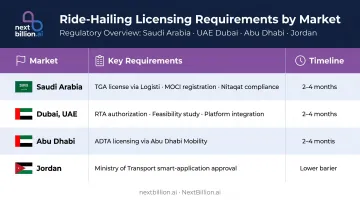
In all GCC markets, commercial insurance covering passengers, drivers, and third parties is mandatory. Driver documents — license, medical check, criminal clearance — must be verified before any driver goes live.
Step 5 — Build the Platform and Operating Infrastructure
Build custom vs. white-label:
- Custom builds offer full differentiation but require 6–12 months and significant development cost
- White-label platforms (such as Onde) get you to market faster with limited customization; most early-stage Middle East operators start here and migrate later
Critical regional requirements for the tech stack:
- Arabic RTL UI
- Local payment gateway integration (Moyasar for Saudi Arabia, Tap Payments for GCC-wide)
- Cash ride support alongside digital payments
- Phone number masking for rider/driver privacy
- Reliable GPS dispatch across dense urban infrastructure
The routing layer deserves specific attention. Per-call billing from generic mapping providers becomes uneconomical at volume; alternatives like NextBillion.ai use per-vehicle pricing and offer a Driver Assignment API with sub-second matching latency, which is relevant once your dispatch volume makes call-based costs a line-item problem.
Step 6 — Build Driver Supply Before Rider Demand
Driver network density determines whether the app is usable. A rider who waits 15 minutes will not return. Plan driver acquisition before any rider-facing marketing.
Target minimum 20–30 active drivers in a tight geographic zone before opening to public riders.
Driver model decisions:
- Independent contractors (own vehicles) reduce upfront cost but make quality harder to control
- Company-owned fleets give full quality control at higher capital expense
- A hybrid model is most practical at early stage in GCC markets
GCC regulations typically require vehicles to meet specific standards and insurance levels regardless of ownership model.
Step 7 — Launch and Build Local Trust
Go to market with a local credibility strategy, not general app advertising. Effective early-stage tactics:
- Referral programs with initial incentives
- Partnerships with hotels, corporate employers, or universities
- Airport booth presence for transfer-focused launches
- Driver-referred riders (word-of-mouth within driver networks)
Focus the first 90 days on getting 100–200 riders who complete at least 3 rides each (not total downloads). These core users provide the ratings, feedback, and word-of-mouth needed to fix the product before scaling.
Step 8 — Monitor, Stabilize, and Prepare to Scale
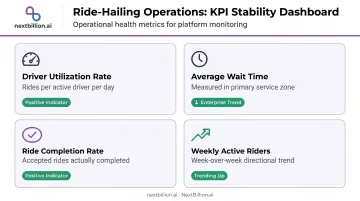
Track metrics that indicate operational stability before any expansion:
- Driver utilization rate — rides per active driver per day
- Average wait time — measured in your primary operating zone
- Ride completion rate — accepted rides that are actually completed
- Weekly active riders — directional trend week over week
Fix driver retention and service consistency before entering a second city. The OTaxi experience is instructive here too: when COVID-19 hit, OTaxi's operations dropped by 60%. The operators who survived that period had built financial reserves and operational discipline before the crisis (not during it).
Conclusion
Starting a ride-hailing business in the Middle East is primarily an operations, compliance, and trust-building challenge. Technology is achievable. The hard work is regulatory navigation, driver network development, and earning rider trust in a market where Careem, Yango, and inDrive already occupy space.
The operators who survive past year one share a pattern: they chose their geography carefully, built driver supply before chasing riders, and resisted scaling until the core operation was stable and the unit economics were proven.
The opportunity is real — ride-hailing penetration in several Middle Eastern cities remains well below mature markets, and local operators willing to build deliberately have room to compete. That advantage goes to those who treat this as a local operations business first, with technology in service of it.
Frequently Asked Questions
How much does it cost to start a ride-hailing business in the Middle East?
GCC markets (Saudi Arabia, UAE) carry higher upfront costs — licensing fees, mandatory insurance, and compliance requirements can push pre-launch spend into the tens of thousands of dollars. Levant markets like Jordan have lower regulatory barriers and correspondingly lower startup costs. Beyond licensing, budget for the routing, mapping, and dispatch engine that powers ETAs, fare calculation, and driver-rider matching — building this in-house adds significant time and cost compared to integrating an existing mapping and routing API.
Do I need a separate transport license to operate a ride-hailing app in Saudi Arabia or the UAE?
Yes. Saudi Arabia requires a TGA transport license issued through the Logisti platform, separate from commercial registration. Dubai requires RTA authorization under Administrative Resolution No. 516 of 2022, which includes submitting a feasibility study and integrating with RTA's electronic platform. Operating without these approvals carries significant legal and financial risk.
Can a local startup compete with Careem and Uber in the Middle East?
Direct competition with Careem and Uber in tier-one cities is a losing strategy for most local startups. Those that have succeeded targeted underserved geographies, specific demographics (women-only rides, corporate accounts), or niches where local trust outweighs brand recognition. OTaxi in Oman is the clearest example — a local operator that outlasted a multinational by staying focused on exactly that.
What payment methods should a ride-hailing app support in the Middle East?
Cash remains significant in Jordan and Egypt, while GCC markets are increasingly card and wallet-first. A functional GCC platform needs to support Mada, Apple Pay, and STC Pay alongside broader MENA methods via Tap Payments — plus cash for markets where digital adoption is still growing. Payment flexibility only matters if the underlying dispatch and routing layer can calculate accurate fares in real time, since fare estimates, surge logic, and driver payouts all depend on live ETA and distance data.
How long does it typically take to launch a ride-hailing business in the Middle East?
Budget 6–12 months from decision to public launch: GCC licensing takes 2–4 months, platform setup takes 4–8 weeks (white-label) or up to 12 months (custom build), and driver onboarding adds another 1–2 months. Rushing regulatory setup or driver supply creates problems that are expensive to fix post-launch.
Which city is the best starting point for a ride-hailing startup in the Middle East?
There is no universal answer. Amman offers lower barriers, lower costs, and faster regulatory approval. Riyadh and Dubai offer larger addressable markets but higher regulatory complexity and stronger incumbent competition. Mid-size GCC cities with limited public transport — where multinationals have thin coverage — often offer the clearest path to early traction. Whichever city you pick, verify that your mapping and routing provider has solid road coverage and address data there, since map quality in secondary cities varies more than in Dubai or Riyadh. The right choice depends on your capital, local connections, and the specific niche you're targeting.
What is the Dubai version of Uber?
Careem is the platform most associated with the Dubai version of Uber. Founded in Dubai before being acquired by Uber, it operates under RTA regulation and offers ride-hailing alongside delivery and other services. Uber itself also operates directly in Dubai. Both platforms rely on routing and mapping infrastructure to handle dense urban traffic, address ambiguity, and real-time ETA accuracy, which is core to any ride-hailing operation in the city.
What is the best ride-hailing app in Saudi Arabia?
Uber and Careem are the two dominant platforms in Saudi Arabia, both operating under TGA licensing requirements. Which is "best" depends on city coverage, wait times, and pricing, which vary by region and time of day. For any operator — global or local — the underlying experience depends heavily on routing accuracy and dispatch efficiency, since Saudi cities include a mix of dense urban cores and sprawling low-density areas that stress mapping systems differently.