Introduction
Asset tracking integration with fleet management software works by feeding trailer, container, and equipment data from GPS trackers directly into the same platform that manages vehicles and drivers, so dispatchers see one operational picture instead of two disconnected systems. Fleet management software tracks vehicles. Asset tracking monitors trailers, containers, and equipment. Most fleets run both — but separately. That separation is where visibility breaks down — and costs climb.
Without integration, a dispatcher can see where the truck is but has no idea where the trailer is sitting, whether it's available, or when it was last serviced.
The downstream problems compound fast. Equipment gets stranded on job sites. Maintenance windows get missed because no one tracked how many hours a generator actually ran. Billing disputes go unresolved because there's no timestamp for when an asset arrived or left a customer location.
This guide is for fleet managers, logistics operations teams, and transportation technology buyers running mixed fleets — powered vehicles alongside trailers, containers, and non-powered equipment. It covers how the integration works, what makes it hold up at scale, and where implementations most commonly break down.
Key Takeaways
- Asset tracking integration connects location and status data from physical assets directly into a fleet management platform, creating a single operational view.
- Without it, vehicle and asset data live in separate systems, which leads to missed maintenance, poor utilization visibility, and inefficient dispatch.
- Integration works through GPS/telematics hardware feeding data via APIs into a central fleet or route optimization platform.
- Integration quality depends on four factors: hardware compatibility, API openness, data update frequency, and how much the platform can be configured to fit your operation.
- Asset tracking and fleet tracking serve different purposes — understanding the distinction helps small and mid-size fleets prioritize which integration they actually need.
What Is Asset Tracking Integration with Fleet Management?
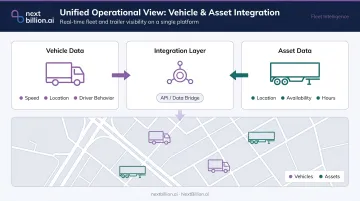
Asset tracking integration feeds asset-level data — GPS position, engine hours, door sensor events, load status, idle time — from tracking hardware directly into a fleet management system. The outcome: powered vehicles and non-powered assets managed within the same platform, visible on the same map, subject to the same alerting rules. This is also the distinction behind two of the most common search questions on this topic: the best fleet tracking software manages vehicles and drivers, while the best asset tracking software extends that same visibility to trailers, containers, and equipment that don't move under their own power.
How It Differs from Standalone Tracking
The terms get conflated often, but the distinction matters operationally:
- Standalone asset tracking records location only — you can see where a trailer is, but that data sits in its own silo
- Standalone fleet management manages vehicles and drivers but typically lacks trailer or equipment-level data
- Integration connects both into a closed-loop visibility layer that spans the entire operational footprint
What It Looks Like in Practice
When integration is working correctly:
- A dispatcher sees both the truck's live position and the status of the trailer it's pulling
- A fleet manager receives a maintenance alert triggered by actual hours logged across equipment — not a calendar reminder
- A route planner knows which trailers are available, where they're staged, and which ones are already committed before generating stop assignments
The route planning scenario is where integration pays off most clearly. An optimizer that only knows vehicle positions is working with an incomplete picture. When it also knows asset positions and availability, it can factor in trailer pickup, repositioning, and drop-off — cutting deadhead miles and sharpening load planning before a single route is assigned.
Why Fleet Operations Need Asset Tracking Integration
The Non-Powered Asset Blind Spot
Fleet management software was built around powered vehicles. But modern fleets operate with a substantial volume of non-powered assets — trailers, containers, generators, portable equipment — that move between job sites, yards, and customer locations independently of trucks. Once a driver drops a trailer at a customer dock, it disappears from most fleet management platforms entirely.
What happens operationally when those assets fall off the visibility grid:
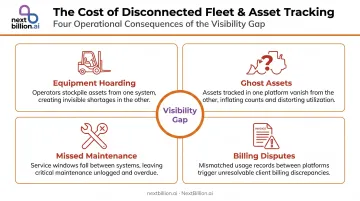
- Equipment hoarding — job sites hold onto equipment longer than needed because there's no visibility into utilization
- Ghost assets — equipment appears as "available" in the system but is physically located at a site no one has checked recently
- Missed maintenance — service intervals tied to actual usage hours (not calendar dates) get skipped because hour data never reaches the maintenance system
- Billing disputes — customers challenge time-on-site charges when there's no verifiable record of asset arrival and departure
The Utilization Cost Is Measurable
Idle time on non-powered and powered assets is a direct, measurable cost driver. Research from the Association of Equipment Manufacturers found that nonproductive idling consumes an estimated 10% to 30% of construction equipment fuel, and that telematics can reduce nonproductive idling by 10% to 15% on average. One large fleet saved approximately 6,000 gallons of fuel per week — about a 20% reduction — by using telematics data to manage idle time.
That kind of result requires status and runtime data, not just location dots on a map. Integration is what makes that data accessible across systems. It also touches on what some call the core pillars of fleet management — vehicle utilization, maintenance, compliance, driver and asset coordination, and cost control — since asset-level data feeds directly into most of those functions rather than sitting apart from them.
Running Parallel Systems Doesn't Scale
Some teams accept the fragmentation and build manual workflows to bridge the gap — dispatchers toggle between fleet and asset platforms to reconcile data before making load assignments. At 15 trucks and 30 trailers, that's manageable. At 150 trucks and 400 trailers across multiple depots, the manual layer collapses under its own weight.
The errors compound: stale data leads to wrong assignments, wrong assignments cause missed pickups, and reporting gaps make it impossible to audit where things went wrong. At that scale, integration isn't a convenience — it's the only way to maintain operational accuracy.
Compliance in Regulated Industries
For fleets operating under food safety (FSMA), pharmaceutical traceability (DSCSA), or hazardous waste (EPA e-Manifest) requirements, integrated asset tracking supports the documentation layer those frameworks expect. Location history, condition data, and maintenance records (accessible from a single system) provide the audit-ready records that standalone fleet management software cannot generate without asset-level data feeding into it.
How Asset Tracking Integration Works
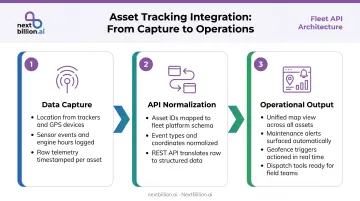
Asset tracking integration is essentially a data pipeline with three stages: capture, normalization, and operational output.
Step 1: Data Capture and Transmission
Trackers attached to trailers, containers, and equipment continuously capture location pings and sensor events — door open/close, temperature, load weight, idle state, engine hours for powered equipment. That data gets timestamped and transmitted over cellular or satellite networks to a cloud telematics platform.
Update frequency depends on asset type and power source:
- Powered assets support higher-frequency reporting — continuous or near-continuous updates
- Battery-operated non-powered trackers require a tradeoff between data freshness and battery life. Samsara's unpowered asset gateway defaults to 12-hour reporting intervals, with configurable schedules ranging from 30 minutes to 72 hours, and a typical battery life of 3–5 years at two check-ins per day
The right ping cadence depends on use case, not default settings. Active dispatch typically needs more frequent updates than yard management or long-haul trailer monitoring.
Step 2: API-Based Data Normalization and Routing
The integration layer (typically a REST API or a telematics standard connector such as NMFTA or AEMP) receives raw asset data and normalizes it into a schema the fleet management platform can interpret. This means mapping asset IDs, event types, and coordinates to the platform's data model.
A few technical reference points worth knowing:
- NMFTA's Open Telematics API was specifically designed to reduce vendor lock-in and let fleets avoid rebuilding integrations when switching providers
- ISO 15143-3 (the AEMP mixed-fleet telematics standard) provides a communication schema for mobile machinery status data from telematics servers to third-party applications
- COVESA VSS offers an open data model for normalizing vehicle data across vendors
Platforms like NextBillion.ai expose REST APIs and native connectors for major fleet management systems, including Geotab and Samsara, enabling bidirectional data flow that pulls vehicle and order data automatically and pushes optimized routes back into the same environment.
Step 3: Operational Output and Actionability
Once normalized, that data reaches the fleet management platform in forms dispatchers and operations teams can act on directly:
- Unified dashboards showing vehicle and asset positions on the same map
- Automated maintenance triggers based on actual equipment usage hours, not fixed calendar intervals
- Geofence alerts that fire arrival and departure notifications for billing, compliance, and customer updates
- Dispatch tools that check real-time asset availability before assigning loads
Location data becomes operationally useful when it's tied to configured business rules and a connected optimization layer. That combination is what converts a position ping into a dispatch decision, a maintenance alert, or a customer ETA — and ultimately what moves the needle on idle time and on-time delivery rates.
Key Factors That Affect Asset Tracking Integration Quality
Hardware Compatibility and Tracker Type
Not all tracking technology serves the same purpose. Match tracker type to asset mobility patterns:
| Technology | Best For | Limitation |
|---|---|---|
| GPS (cellular/satellite) | Mobile assets moving between sites | Battery tradeoff at high frequency |
| BLE | Yard and facility-level tracking | Requires local infrastructure; no wide-area coverage |
| RFID | Dock, gate, inventory checkpoint events | No continuous outdoor tracking |
Defaulting to a single technology across all asset types is a common mistake. A construction fleet tracking both long-haul trailers and yard equipment needs different solutions for each. The hardware layer sets the foundation — but whether that data actually reaches your fleet system depends on how the integration is built.
API Flexibility and Data Standards
Proprietary or closed APIs create vendor lock-in. When either the asset tracking platform or the fleet management system upgrades its API, a closed integration breaks — and rebuilding it is expensive.
When evaluating integration compatibility, look for:
- Published API documentation with stable versioning
- Support for open standards (NMFTA Open Telematics API, ISO 15143-3)
- Export capabilities that don't depend on a single vendor's ecosystem
- A sandbox or trial environment for pre-production testing
Update Frequency and Data Latency
Stale data costs you. Location data that's 15–30 minutes old during active dispatch operations can lead to incorrect load assignments and missed pickups. Not every use case requires near-real-time updates — hourly pings are often sufficient for yard management or long-haul trailer monitoring.
Configure update intervals by operational use case. Keep in mind that data volume requirements compound quickly as fleet size grows, which makes platform performance a separate evaluation criterion from update frequency alone.
Scale and Fleet Composition
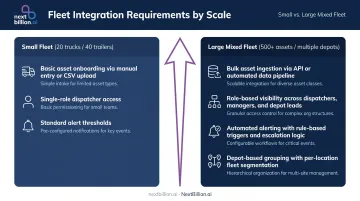
Integration complexity grows with fleet size and asset diversity. A 20-truck, 40-trailer fleet has straightforward needs. A 500-asset mixed fleet across multiple depots needs:
- Bulk asset ingestion capabilities
- Role-based visibility (regional managers see only their assets)
- Automated alerting that doesn't require constant manual monitoring
- Zone or depot-based asset grouping to prevent data overload at the dashboard level
Common Issues and Misconceptions
"We Have Vehicle GPS, So Assets Are Covered"
They're not. Vehicle GPS tracks the truck. The moment a trailer is dropped at a customer site or equipment is left at a job location, the truck drives away and the asset disappears from the system. CargoNet recorded 3,625 reported cargo theft incidents in the U.S. and Canada in 2024 — a 27% increase from 2023, with an average estimated value of $202,364 per incident. Many of those assets had no independent tracking.
Teams that conflate vehicle tracking with asset tracking discover the gap only when something goes missing or a maintenance window is missed at scale.
"Integration Is a One-Time Configuration"
It isn't. Tracker firmware updates, API version changes from either platform, and fleet composition changes — new asset categories, new depot locations — all require integration adjustments over time. Platforms like Geotab publish regular release notes documenting changes that can affect existing integrations.
Teams that don't plan for ongoing maintenance see data drift and accuracy degradation within months. Build a maintenance process for the integration layer from day one — it's not optional.
"Integration Automatically Produces Operational Intelligence"
Integration delivers location and sensor data. Turning that data into actionable decisions requires an additional configuration layer. Before any of the following work, someone has to set them up:
- Geofences — define the zones that trigger alerts and status changes
- Business rules — specify what conditions trigger maintenance flags, exceptions, or reassignments
- Optimization engine connections — link asset availability data to a routing or planning system that can actually use it as a constraint
Teams that skip that configuration layer end up with a sophisticated data feed they're barely using.
Frequently Asked Questions
What is the difference between asset tracking and fleet tracking?
Fleet tracking monitors powered vehicles and drivers — speed, location, fuel, driver behavior. Asset tracking covers non-powered assets like trailers, containers, and equipment that move independently of vehicles. Integration combines both into a unified visibility layer so operations teams don't have to reconcile two separate systems.
Can asset tracking systems integrate with existing fleet management software?
Most modern asset tracking platforms expose REST APIs or native connectors for major fleet management systems including Samsara, Geotab, and Motive — with API-first platforms enabling bidirectional data flow without custom middleware. NextBillion.ai, for example, offers native integrations with both Geotab and Samsara.
What data is shared between asset tracking and fleet management systems through integration?
The primary data types exchanged are GPS coordinates, sensor events (door open/close, temperature, load status), engine hours, idle time, and geofence entry/exit events. Load weight and battery status are also available depending on hardware and platform capabilities. This shared data also supports compliance recordkeeping tied to DOT and FMCSA hours-of-service requirements, since asset location and status logs can corroborate driver and vehicle records during audits or inspections.
How does asset tracking integration improve route optimization?
When a route optimizer knows the real-time location and availability of all trailers and equipment — not just trucks — it can factor in asset pickup, drop-off, and repositioning when generating routes. The result: fewer deadhead miles, better load planning, and no more dispatching trucks to trailers that aren't actually there.
What are the most common challenges when integrating asset tracking with fleet management?
Three issues come up consistently:
- Hardware-software compatibility: Not all trackers work cleanly with every fleet platform
- Data latency mismatches: Update frequency from the asset tracker often doesn't match what operations need
- Ongoing maintenance: Fleet composition and software versions change, and integrations require upkeep
A fourth challenge worth planning for is data ownership and access control across systems, especially when third-party carriers or leased equipment are involved, since unclear permissions can slow down troubleshooting and create gaps in the audit trail during a DOT review.
What is the best fleet tracking software?
There is no single best option since the right fit depends on fleet size, asset mix, and existing systems. Look for platforms with open APIs, native integrations with major telematics providers like Geotab and Samsara, and support for both powered and non-powered asset tracking. Evaluate based on how well it fits your route optimization, compliance reporting, and maintenance workflows rather than feature lists alone.
What are the 5 pillars of fleet management?
Fleet management generally rests on five areas: vehicle and asset tracking, driver management and compliance (including FMCSA hours-of-service and CDL requirements), maintenance scheduling, fuel and cost management, and route and dispatch optimization. Integrating asset tracking with fleet management software strengthens the first and last pillars directly, since it gives dispatch and route planning visibility into trailers and equipment, not just powered vehicles.