Introduction
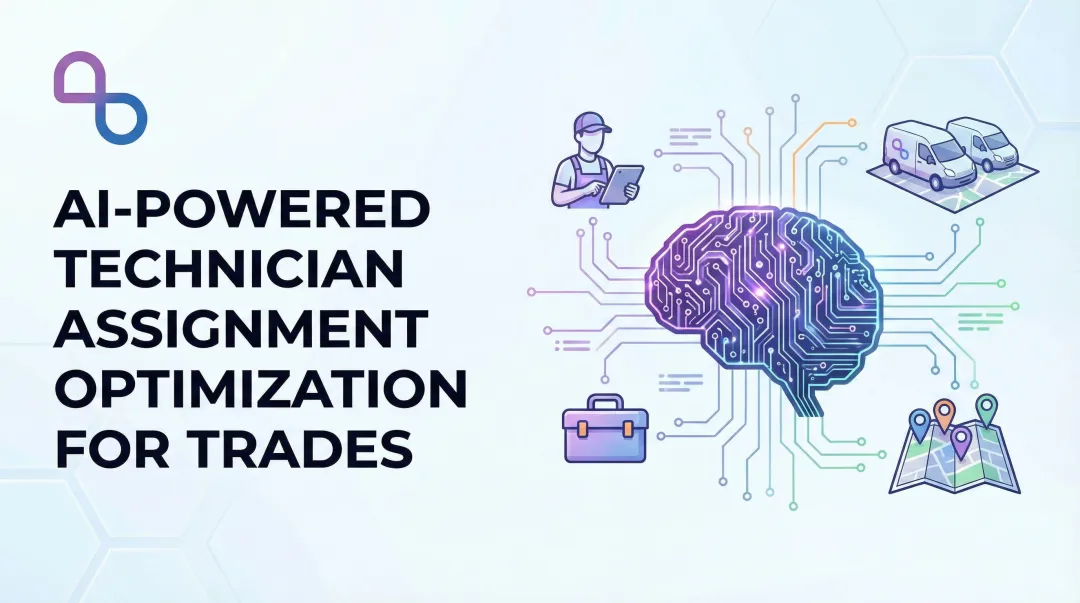
A field service marketplace on-demand technician dispatch platform matches incoming job requests to the best available technician in real time, weighing skills, certifications, performance history, and live location instead of relying on a dispatcher working a phone list. Picture this: a home warranty company receives a midnight HVAC emergency. Within seconds, an AI system has identified the nearest certified technician, verified their active refrigerant handling license, checked their first-time fix rate for similar jobs, and sent the customer a precise ETA — all without a human dispatcher touching the request.
Five years ago, that same scenario meant phone trees, spreadsheets, and a dispatcher manually calling down a rotation list hoping someone would pick up.
That gap reflects how dramatically field service marketplaces have changed. The global FSM software market is valued at $5.10 billion in 2025 and projected to reach $9.17 billion by 2030 — a 12.5% CAGR.
Much of that growth is driven by marketplace platforms connecting businesses to broader networks of employed and contracted technicians.
What follows is a breakdown of how AI is reshaping technician dispatch inside those marketplaces — from multi-variable smart matching to the location intelligence infrastructure that makes real-time routing work at scale.
Key Takeaways
- Field service marketplaces demand dynamic dispatch: variable technician pools, shifting certifications, and unpredictable demand make manual assignment unscalable
- AI replaces proximity-only matching with simultaneous optimization across skills, performance history, availability, and location
- Purpose-built routing APIs handle 50+ constraints, large-scale distance matrices, and real-time reoptimization — consumer mapping tools aren't built for this
- Documented outcomes include 38% more jobs per day, 15% travel time reductions, and a 27% NPS increase after AI dispatch adoption
- Integration complexity is the top adoption barrier: 42% of field service buyers cite system compatibility as their primary purchasing concern
What Makes Field Service Marketplace Dispatch Uniquely Complex
Traditional FSM software manages a fixed, employed workforce. A field service marketplace is different: it's a two-sided network connecting service companies (or end customers) with pools of qualified technicians who may be employed, contracted, or freelance. This is also why buyers researching "is Field Nation worth it" or comparing the best field service scheduling software tend to focus less on scheduling calendars and more on how well a platform matches jobs to technicians across a mixed workforce.
Home warranty networks, telecom installation platforms, and appliance repair marketplaces all operate on this model. What makes dispatch in these environments harder than standard FSM isn't just scale — it's the blended workforce structure underneath it.
The blended workforce reality:
- Core employed technicians handle baseline demand
- Contracted specialists handle demand spikes without adding permanent staff
- Availability, certifications, and performance scores vary across the entire pool
- Geographic coverage spans far wider than a traditional service area
That variability creates a dispatch problem that manual systems can't solve at volume. As the technician pool grows from 10 to 50 to 500 workers, the number of possible assignment combinations grows exponentially. Each combination must be evaluated against skills requirements, time windows, live location, and customer history simultaneously.
Tight labor markets compound the problem directly. The U.S. Bureau of Labor Statistics projects 608,100 annual openings in installation, maintenance, and repair occupations through 2034, with HVAC alone projected to generate 40,100 openings per year. When qualified employees are hard to find, marketplace operators lean harder on contractor networks — which means dynamic, multi-source dispatch stops being a feature request and becomes a core operational requirement.
How AI Is Transforming Technician Dispatch
Smart Technician-Job Matching
The first place AI changes dispatch is in the matching decision itself. Traditional systems use "nearest available" logic — whoever is closest gets the job. That works when your technician pool is small and jobs are interchangeable. It breaks down fast in a marketplace with diverse skill requirements and variable performance histories.
AI replaces that single-variable lookup with simultaneous multi-criteria optimization:
- Skills and certifications — does this technician hold the required license for this specific job type?
- Performance history — what's their first-time fix rate for this equipment category?
- Customer preferences — has this customer requested or flagged specific technicians?
- Current workload — how many jobs are already on their schedule today?
- Live proximity — where are they right now, not just at the start of their shift?
Each factor carries a weight, and the AI balances all of them in a single assignment decision. That's categorically different from a routing lookup : it's a constrained optimization problem solved in real time.
Machine learning improves match quality over time. Algorithms train on historical outcomes (first-time fix rates, customer satisfaction scores, job completion time by technician-job type pair), so each dispatch decision builds on what previous decisions revealed.
The results are measurable. According to Aquant's 2025 Field Service Benchmark Report, which analyzed 157 service organizations and 21 million service events, the median first-time fix rate is 75%, with top performers reaching 87%. That 12-point gap is exactly what intelligent matching addresses. The same report found top-performing organizations achieve 39% faster resolution times when using AI for service work.
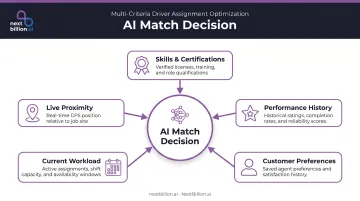
Platforms like NextBillion.ai extend this matching logic through a Driver Assignment API that evaluates technician skills, certifications, shift timings, location familiarity, performance history, and customer preferences simultaneously — with sub-second latency even across large technician pools.
Predictive Demand Forecasting and Real-Time Reoptimization
Reactive dispatch is expensive. AI-powered platforms forecast demand surges before they hit, shifting scheduling from reactive to proactive.
An HVAC platform, for example, can analyze historical service request volumes, weather forecast data, and regional patterns to pre-position contractor coverage two weeks before a forecasted heat wave rather than scrambling to find available technicians at peak.
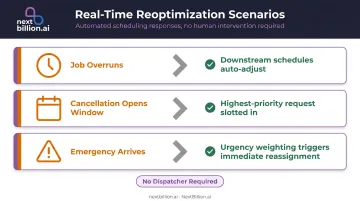
Real-time reoptimization handles the inevitable disruptions that forecasting can't prevent:
- A job overruns by 90 minutes → all downstream schedules automatically adjust
- A cancellation opens a window → the system slots in the highest-priority pending request
- An emergency comes in → urgency weighting triggers immediate reassignment without dispatcher involvement
What was once a manual fire drill (a dispatcher noticing a late job and spending 20 minutes rearranging three other technicians' schedules) becomes a background process.
Salesforce field service optimization examples document a 95% auto-scheduling rate for one roadside-assistance provider and a 38% increase in jobs per day for a utility provider using this approach (vendor-reported figures).
Automated Quality Control and Performance Feedback
Better scheduling and matching solve the assignment problem. What they don't solve is ongoing accountability — and that's where AI quality monitoring picks up.
Continuous tracking covers KPIs that manual oversight can't maintain at marketplace scale.
The system tracks first-time fix rates, job duration vs. estimated, SLA compliance, and customer satisfaction in real time. It also applies natural language processing to customer reviews to generate technician-specific performance insights rather than just aggregate scores.
Two often-overlooked AI functions in marketplace contexts:
- Automated credential verification — matching technician certifications against regulatory databases before dispatch, not just at onboarding
- Fraud and anomaly detection — identifying unusual booking patterns, duplicate claims, or inconsistent job completion data that signal integrity issues at scale
For large contractor networks where direct supervision is impossible, these automated checks substitute for the oversight a traditional employment relationship would provide. This same accountability layer is part of why field technician work is considered demanding rather than easy: technicians are measured continuously against fix rates, SLA windows, and customer feedback, and top performers with strong track records and specialized certifications are typically the ones who command the highest pay in the field.
Location Intelligence: The Infrastructure Behind AI Dispatch
Route Optimization for Distributed Technician Networks
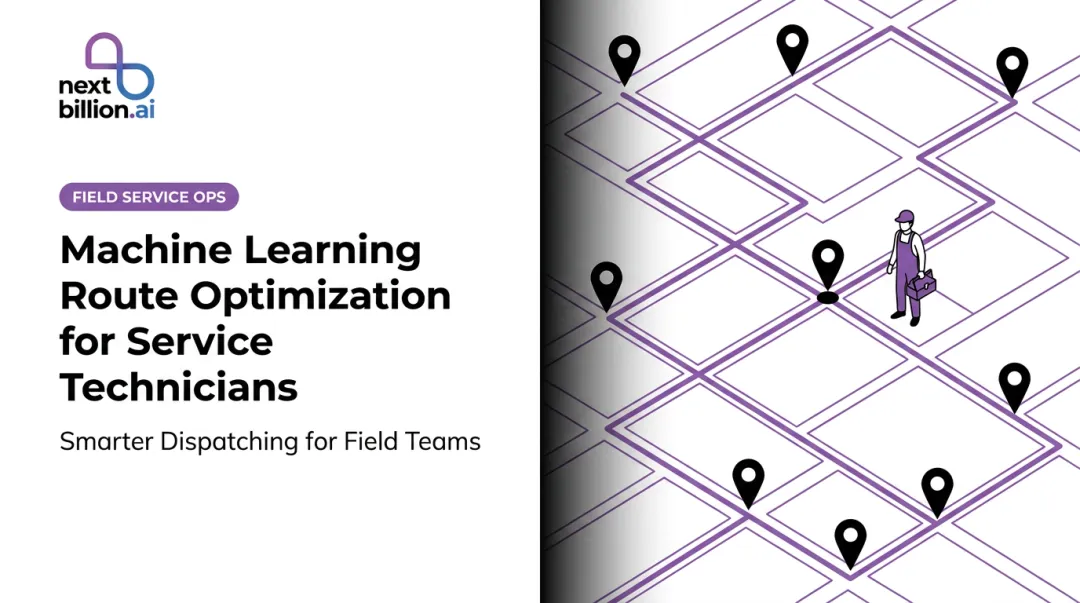
Smart matching identifies the right technician. Route optimization determines how efficiently they reach the job, and across a live marketplace with dozens of concurrent dispatches, that calculation has to complete in seconds. A perfect skill match loses its value if the technician arrives 90 minutes late because their route wasn't optimized.
Marketplace routing is substantially more complex than consumer navigation:
- Technicians start from variable locations, not a central depot
- Multi-stop job sequences have hard time windows
- Territory and zip-code coverage rules constrain assignments
- Traffic conditions change continuously throughout the day
- Some vehicles carry specialized equipment with road restrictions
Standard consumer mapping APIs aren't designed for this constraint density. They handle navigation well; they don't handle operational optimization at commercial scale.
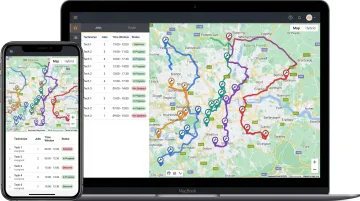
Purpose-built routing APIs address this differently. NextBillion.ai's Route Optimization API handles 50+ hard and soft constraints simultaneously — including skills-based task assignment, time windows, priority parameters, territory rules, and maximum task loads per technician.
The Distance Matrix API supports matrices up to 5,000×5,000 elements, compared to the far lower limits of consumer-grade APIs. That enables large-scale proximity calculations across entire technician networks in a single API call.
Hawx Smart Pest Control, one of the largest pest control service providers in the US with hundreds of technicians across 16 states, uses NextBillion.ai's Route Optimization and Distance Matrix APIs for technician dispatch — reporting substantially reduced drive times, higher NPS scores, and the ability to update job schedules multiple times per day to incorporate same-day bookings and cancellations.
Pricing structure matters as much as capability for marketplace operators. Per-API-call billing becomes unpredictable at scale: as dispatch volume fluctuates seasonally, API costs fluctuate with it. NextBillion.ai's per-vehicle pricing model charges based on the number of technicians dispatched in a 24-hour window rather than API request volume, producing predictable monthly fees that absorb routing call fluctuations.
Real-Time Tracking, ETA Accuracy, and Dynamic Rerouting
Routing decisions made at dispatch degrade the moment field conditions shift. Continuous technician location updates feed back into the optimization layer in real time, refreshing availability windows and recalculating ETAs as the day evolves.
When a technician is running 45 minutes behind schedule, the system doesn't wait for a dispatcher to notice. It recalculates downstream ETAs automatically and triggers reassignment logic if the delay breaches a threshold.
Customer experience is directly tied to this accuracy. A Trimble-commissioned survey of 2,000 UK adults found that 40% identified long appointment slots as their single greatest frustration with service providers, and only half considered a 1–3 hour window acceptable (vendor-commissioned; expectations have since tightened further).
Customers now expect the same real-time tracking visibility from field service that they get from food delivery: a live map with an accurate arrival time, not a 4-hour window.
LG Electronics USA reported a 27% increase in NPS after implementing dispatch optimization through ServicePower (vendor-reported figure, methodology not stated) — a result that reflects the downstream satisfaction impact of better matching and more accurate arrival windows.
Business Impact of AI-Powered Marketplace Dispatch
The operational and financial case for AI dispatch adoption is well-documented.
Efficiency gains (per Salesforce field service data):
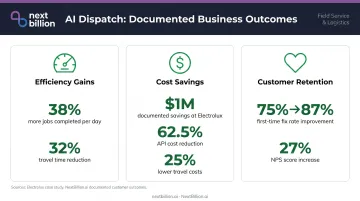
- 38% increase in jobs completed per day
- 32% reduction in travel time
- 15% reduction in technician travel time at Electrolux after implementing ServicePower scheduling optimization
Cost impact:
- Electrolux reported $1 million in year-over-year savings from scheduling optimization alone
- EasyHealth achieved 62.5% reduction in API costs switching to NextBillion.ai, alongside a 40% reduction in scheduling time
- A health-tech logistics company using NextBillion.ai achieved 35% more visits per rider and 25% lower travel costs
Customer retention:
- Industry-wide first-visit resolution sits at 75% — AI-matched dispatch pushes that number higher, cutting return visit costs directly
- Faster response times and accurate ETAs lift NPS scores and reduce customer churn
- Better technician-job fit means fewer escalations and shorter calls
Key Challenges in AI Marketplace Dispatch
AI dispatch adoption isn't frictionless. Three challenges consistently surface in real deployments.
Quality Consistency at Scale
Managing contractor performance across a dispersed network — without direct employment relationships — is an ongoing challenge. AI credential verification and continuous KPI monitoring reduce the risk, but they don't fully replace the oversight a direct employment relationship provides. Performance outliers still require human review. AI surfaces them faster; it doesn't resolve them autonomously.
Dynamic Pricing and Technician Economics
Balancing competitive service pricing with fair contractor compensation requires real-time pricing models that respond to supply and demand signals. The tension is genuine. Under-compensating contractors erodes the talent pool over time; over-pricing loses customers to competitors. AI-driven pricing helps optimize this balance, but introduces its own complexity in how technicians perceive compensation fairness.
Integration Complexity
This is the most commonly cited barrier to adoption. According to Software Advice's 2026 field service buying trends survey — based on a 2025 survey of over 3,000 software decision-makers — 42% of field service buyers prioritize compatibility with existing systems as their top purchasing concern.
Marketplace dispatch platforms must connect AI engines across multiple systems simultaneously:
- CRM and customer data platforms
- Contractor compliance and credentialing tools
- Scheduling and work order software
- Payment processing systems
- Routing and mapping APIs
Each integration point is a potential failure mode. Platforms with native connections across major enterprise stacks — Salesforce, SAP, Microsoft Dynamics, Geotab, Samsara — reduce that friction significantly, but integration complexity remains the primary reason AI dispatch projects stall before going live.
Frequently Asked Questions
What is a field service management platform?
FSM platforms are software systems that coordinate on-site service delivery from work order creation through scheduling, dispatch, real-time tracking, and performance reporting. They're used by any organization that sends technicians to customer locations — utilities, HVAC companies, appliance repair networks, and property managers are common examples. In the US, these platforms also need to account for driver hours-of-service limits, vehicle inspection requirements, and territory-specific licensing rules that affect who can be dispatched where.
What does a field service technician do?
Field service technicians are skilled professionals dispatched to customer sites to install, repair, maintain, and troubleshoot equipment or systems. They work across industries including HVAC, telecom, appliances, utilities, and property management, typically using mobile tools that connect directly to central dispatch systems.
How does AI improve technician dispatch in field service marketplaces?
AI replaces proximity-only assignment with simultaneous optimization across skills, certifications, performance history, availability, and location. It also enables predictive scheduling before demand surges occur and real-time reoptimization when jobs run over, cancel, or escalate, which removes most manual dispatcher intervention from routine decisions.
What is the difference between a field service marketplace and traditional FSM software?
Traditional FSM manages a fixed employed workforce. Field service marketplaces connect businesses to broader networks of employed and contracted technicians, requiring more dynamic matching, credential management, and performance scoring across a variable talent pool that changes day to day. This distinction matters for compliance too: contracted technicians raise different considerations around classification, insurance verification, and licensing checks than a directly employed workforce does, which marketplace platforms must track continuously rather than once at onboarding.
How does route optimization work in AI-powered dispatch systems?
Routing APIs calculate efficient technician paths using real-time traffic, job locations, current technician positions, and operational constraints: time windows, vehicle types, territory rules, and skill requirements. The best implementations update dynamically throughout the day as conditions in the field change, not just at the start of the morning shift. For fleets subject to DOT rules, routing logic also needs to respect driving-time limits so dispatchers aren't assigning jobs that push technicians past legal hours on the road.
What is the best field service scheduling software?
There's no single best option — it depends on workforce model, job complexity, and fleet size. Businesses with a fixed employed workforce and simple routes may do fine with basic scheduling tools. Those dispatching across large contractor networks, multiple skill sets, or wide territories typically need platforms with AI-driven matching and real-time route optimization to keep up with cancellations, delays, and shifting demand throughout the day.
Is field technician a hard job?
Field technician work is physically demanding and unpredictable — it involves travel between sites, variable working conditions, tight time windows, and troubleshooting under pressure, often with limited access to a supervisor. The difficulty also depends on dispatch quality: poorly optimized routes and unrealistic scheduling windows add unnecessary stress, while accurate job matching and realistic time allocation make the work more manageable day to day.