The stakes are real. Deployment model directly affects API latency, data residency compliance, cost predictability, and your ability to meet industry regulations — whether that's HIPAA for healthcare transport, FedRAMP for government fleets, or GDPR for cross-border logistics. Choosing the wrong model doesn't just create IT headaches; it creates operational and legal exposure.
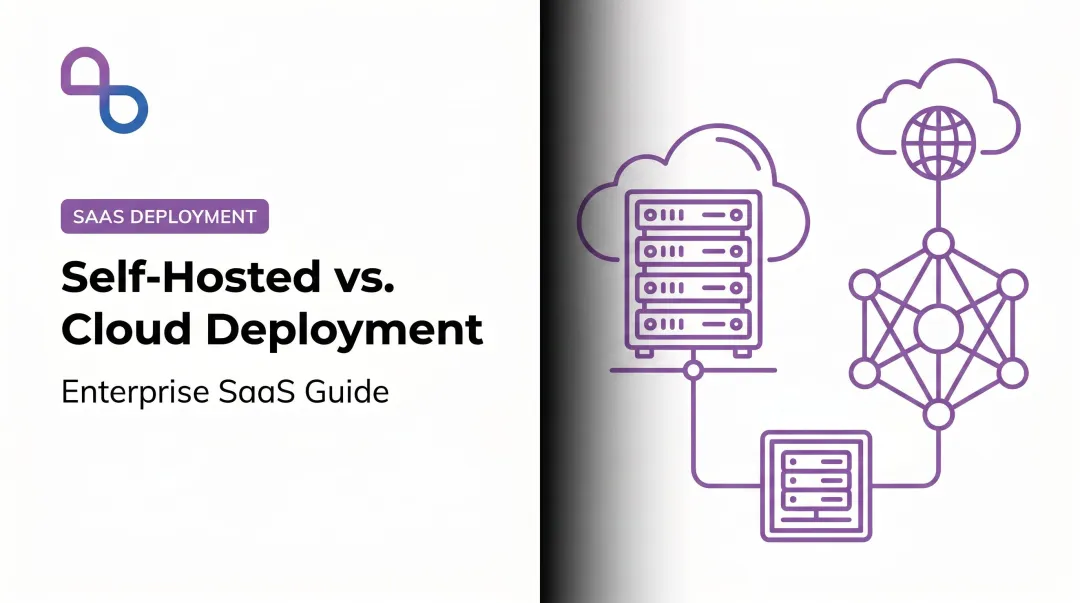
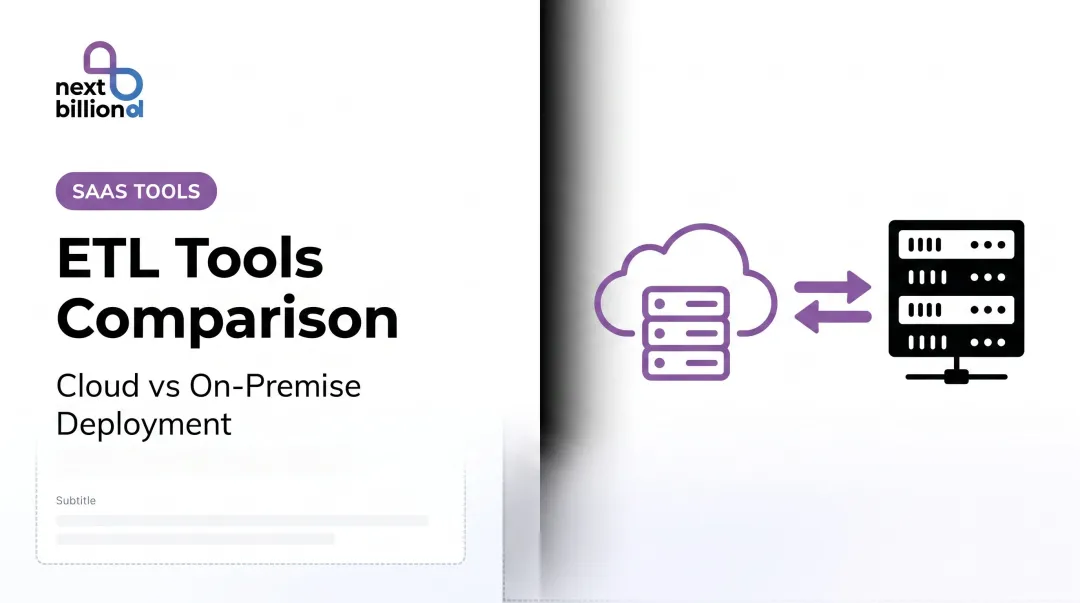
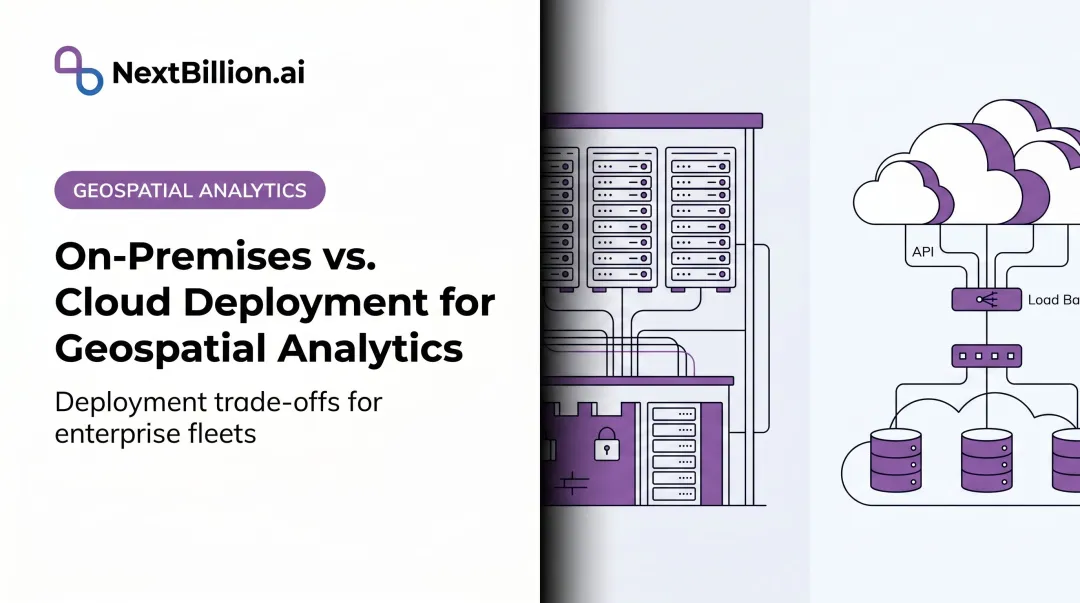
This article breaks down the three primary deployment models — cloud, on-premise, and hybrid — covering how each works, where each fits, and how to choose based on your actual operational and compliance profile.
Key Takeaways
- Cloud APIs offer fast deployment and elastic scaling, but per-call pricing can spike unpredictably as usage grows.
- On-premise APIs give organizations full data control and compliance enforcement, at the cost of higher infrastructure overhead.
- Hybrid deployment keeps sensitive workloads on-premise while burst or dynamic workloads run in the cloud.
- Choosing a model comes down to data sensitivity, compliance requirements, IT capacity, and cost predictability.
Understanding API Deployment Options: Cloud, On-Premise, and Hybrid
The Three Core Models
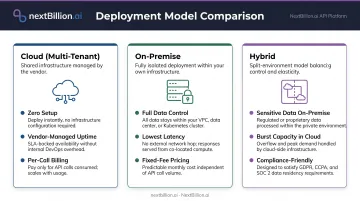
NIST defines cloud computing as on-demand network access to shared configurable resources that can be provisioned with minimal management effort. In practice, this breaks into three deployment models relevant to logistics and location APIs:
- Cloud (multi-tenant): The API vendor hosts everything on shared infrastructure, accessed over the internet. Zero setup, immediate availability, vendor-managed uptime. This is what most people mean when they refer to a cloud-based API — a service consumed over the internet without owning or managing the underlying servers.
- On-premise (private deployment): Your organization runs the API within its own infrastructure — data center, private cloud, or Kubernetes cluster. You control the data boundary entirely.
- Hybrid: A combination — typically, sensitive data processing happens on-premise while cloud infrastructure handles management, analytics, or elastic workloads.
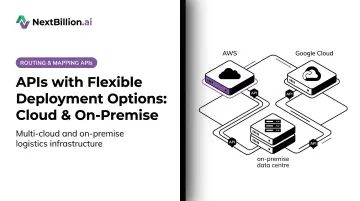
A fourth model, multi-cloud, distributes workloads across multiple public cloud providers (AWS, Azure, GCP) to avoid vendor lock-in. Unlike hybrid deployments — which mix public cloud with private/on-premise infrastructure — multi-cloud stays entirely within public providers.
Why Deployment Model Matters More for Location APIs
Unlike a generic SaaS tool, location and routing APIs process operationally sensitive data: vehicle positions, customer addresses, driver routes, and fleet telemetry. Where that data lives — and who has access to it — carries direct compliance implications under regulations including:
- GDPR — governing personal data for EU residents
- HIPAA — covering protected health information in healthcare logistics and NEMT
- FedRAMP — required for US federal or government-adjacent deployments
On-premise doesn't mean legacy or slow. Modern on-premise deployments run on containerized infrastructure via Kubernetes. The Cloud Native Computing Foundation notes that cloud-native technologies support scalable applications across public, private, and hybrid clouds.
That means the developer experience of an on-premise Kubernetes deployment can match a fully managed cloud environment — while keeping data entirely within your control boundary.
NextBillion.ai, for instance, supports on-premise deployment on any Kubernetes cluster — AWS EKS, GCP GKE, Azure AKS, or self-managed environments — using an open-source utility called k10s to streamline setup.
Cloud API Deployment: Benefits and Limitations for Location-Driven Operations
The Core Appeal
Cloud-hosted APIs eliminate upfront infrastructure investment. For logistics and field service teams, this matters:
- No hardware provisioning — spin up immediately, pay for what you use
- Automatic scaling — cloud APIs absorb unpredictable call volumes without manual intervention
- Vendor-managed maintenance — patching, uptime, and redundancy are the vendor's responsibility
- Predictable SLAs — Google Maps Platform and Mapbox both publish 99.9% monthly uptime targets with service credits
MHI and Deloitte's 2025 supply chain report found that 91% of supply chain leaders planned to invest in cloud computing and storage — the highest of any technology category surveyed.
The Cost Problem at Scale
Per-API-call billing is standard across cloud location platforms. The model works well at low volumes, but breaks down quickly as operations grow.
A fleet routing 500 vehicles daily generates geocode requests, distance matrix computations, and route optimization calls — all billed separately. As call volume scales, so does the bill, often without a predictable ceiling. Flexera's 2025 cloud spending report found 84% of organizations struggle to manage cloud spend, with cloud budgets exceeding limits by an average of 17%.
For location-API-heavy operations specifically, this unpredictability compounds: a busy delivery season can double API call volume without any change in fleet size.
One structural fix is moving to fixed-fee or per-vehicle pricing, where a monthly cost covers unlimited API calls regardless of volume. NextBillion.ai offers this model as an explicit alternative to per-call billing, and customers have documented up to 82% reductions in API costs after switching.
Data Residency Limitations
Cloud APIs in multi-tenant environments may not satisfy regulations where data must stay within specific geographic boundaries. Specific scenarios:
- HIPAA: A cloud provider handling ePHI for a covered entity qualifies as a HIPAA Business Associate under HHS guidance, even for no-view services
- FedRAMP: Federal agencies must obtain and maintain FedRAMP authorization for in-scope cloud services
- GDPR: The EDPB restricts transfers of personal data — including location data — outside the EEA without adequate safeguards
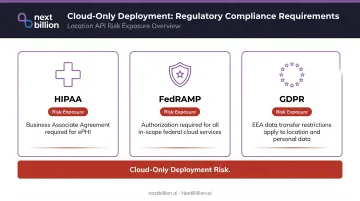
For operations subject to these regulations, cloud-only deployment carries real compliance exposure, not just operational inconvenience.
On-Premise API Deployment: When Data Control Is Non-Negotiable
Compliance and Data Sovereignty
Regulated industries — healthcare transport, government fleet operations, cross-border logistics — often cannot allow operational data to leave their own infrastructure. On-premise deployment enforces data residency by design: no external transmission, no multi-tenant risk, no shared cloud boundary. The key difference from cloud deployment is control: on-premise keeps data, access policies, and audit trails inside the organization's own network, while cloud deployment shifts that control to the vendor in exchange for less operational overhead.
GDPR explicitly classifies location data as personal data. The EDPB requires that any transfer outside the EEA either fall under an adequacy decision or use approved safeguards. For organizations that process EU customer or driver data, on-premise deployment in their own EU data center removes the cross-border transfer question entirely.
Performance Advantages
On-premise routing APIs eliminate network round-trips to external cloud endpoints. NextBillion.ai documents 20x higher throughput and 3x lower latency for on-premise deployments compared to typical cloud equivalents. For real-time dispatch, fleet tracking, or sub-second routing decisions, this difference is operationally meaningful — not just a benchmark number.
Infrastructure Control
Organizations running on-premise can:
- Configure custom security policies and patch on their own timeline
- Integrate with internal authentication systems (JWT, API keys, with enterprise identity frameworks)
- Apply data encryption standards specific to their compliance environment
- Maintain complete audit logs entirely within their own infrastructure
NextBillion.ai's on-premise deployment supports Kubernetes-based autoscaling with Horizontal Pod Autoscaler (HPA) and multi-replica configurations — meaning performance scales without requiring a cloud dependency.
Honest Trade-offs
On-premise requires your team to manage infrastructure: hardware provisioning, load balancers, Kubernetes cluster maintenance, and software upgrades. NextBillion.ai provides Helm chart templates and technical support for initial setup, but ongoing operations do require Kubernetes competency and internal ownership.
The verticals most likely to choose on-premise at NextBillion.ai are government and public sector, healthcare and pharmaceuticals, and financial services. In each case, regulatory mandates make infrastructure control a hard requirement rather than an architectural preference.
Hybrid API Deployment: Bridging Flexibility and Control
How Hybrid Works
Hybrid deployment splits workloads between cloud and on-premise: sensitive data processing (API gateway, routing computations, fleet telemetry) runs on-premise, while cloud infrastructure handles management, analytics, or developer tooling. According to Flexera's State of the Cloud research, 73% of organizations now operate hybrid estates, reflecting how standard this split has become in enterprise IT.
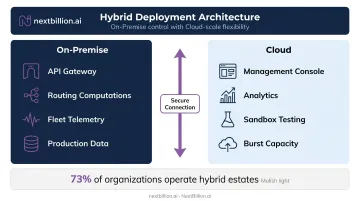
For logistics operations, the use case is concrete: a large carrier might process production routing data on-premise to satisfy data residency requirements, while using cloud infrastructure for sandbox testing, seasonal burst capacity, or a developer portal.
Key Benefits
- Elastic burst capacity — cloud handles demand spikes (peak delivery seasons, new market launches) without permanent on-premise over-provisioning
- Local data residency — sensitive fleet data stays within the organization's infrastructure boundary
- Compliance-friendly scalability — multi-region operators can maintain on-premise stacks in regulated markets while using cloud infrastructure elsewhere
The Complexity Trade-off
Hybrid requires maintaining two environments: firewall rules between cloud and on-premise components, synchronized update schedules, and teams capable of managing both. That operational overhead is real, and organizations should carefully assess whether their IT team has the capacity to own it — or whether a vendor offering managed hybrid support makes more sense.
NextBillion.ai's cloud-agnostic architecture is deployable on AWS, GCP, or Azure and on-premise using the same Kubernetes-based stack. Running a single platform across both environments simplifies synchronization considerably compared to managing two separate technology stacks.
How to Choose the Right Deployment Model for Your API Needs
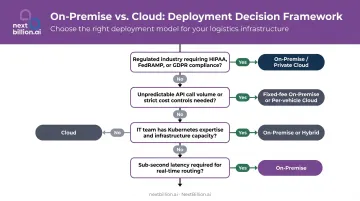
Four Questions That Drive the Decision
| Question | Points Toward |
|---|---|
| Does your industry require specific data residency or compliance certifications (HIPAA, FedRAMP, GDPR)? | On-premise or private cloud |
| Is your API call volume unpredictable, or do you need strict cost controls on usage? | Fixed-fee on-premise or per-vehicle/per-order cloud pricing |
| Does your IT team have Kubernetes expertise and capacity to manage infrastructure? | Cloud (low capacity) or on-premise/hybrid (sufficient capacity) |
| Do your real-time routing or tracking use cases require sub-second response times? | On-premise (lowest latency) |
Deployment Model by Scenario
- Startup last-mile delivery company, small IT team: Cloud deployment with per-vehicle or per-order pricing. Fast to deploy, no infrastructure overhead.
- Healthcare transportation network (NEMT, PHI data): On-premise or private cloud. Data stays behind the firewall; SOC 2 Type II and ISO/IEC 27001 certifications apply.
- Large enterprise fleet with seasonal volume spikes and regulated data: Hybrid. Production data processing on-premise; cloud handles burst routing during peak seasons.
- Multi-region logistics operator with varying local regulations: Hybrid with regional on-premise stacks in regulated markets and cloud infrastructure elsewhere.
What to Look For in an API Vendor
Cloud-first platforms often add on-premise as an afterthought: limited documentation, no Kubernetes support, and compliance coverage that doesn't extend to self-hosted deployments.
Key signals of genuine deployment flexibility:
- Kubernetes-native on-premise support (not just a downloadable binary)
- Cloud-agnostic architecture across AWS, GCP, and Azure
- Pricing that doesn't punish scale — fixed-fee or per-vehicle models rather than per-call
- Compliance certifications (SOC 2 Type II, ISO/IEC 27001) that apply across deployment environments
- Documented SLA with uptime guarantees regardless of deployment model
NextBillion.ai meets all five criteria. The platform supports cloud, private cloud, and on-premise deployment on Kubernetes — with SOC 2 Type II and ISO/IEC 27001:2013 certifications that apply across all environments, fixed-fee pricing at unlimited API call volumes, and a 99.9% uptime SLA.
Frequently Asked Questions
Which deployment model uses both on-premises and cloud-based resources?
Hybrid deployment combines both environments. Typically, sensitive components like API gateways or data processing run on-premise, while management infrastructure, analytics, or scaling capacity run in the cloud. Organizations use this split to satisfy data residency requirements without sacrificing elastic scalability. For US fleets, this often means routing and mapping logic stays on-premise near dispatch systems while reporting dashboards run in the cloud, keeping FMCSA-relevant trip data local while still allowing remote access to performance metrics.
What are the 4 types of cloud models?
The four models are:
- Public cloud: shared, third-party managed infrastructure
- Private cloud: dedicated single-tenant infrastructure
- Hybrid cloud: mix of public and private environments
- Multi-cloud: workloads spread across multiple public providers
For location APIs, private cloud and hybrid are most relevant when data sovereignty or compliance drives the architecture.
What is the difference between a cloud API and an on-premise API?
A cloud API runs on vendor-managed servers accessed over the internet. An on-premise API runs within your own infrastructure. The key differences:
- Data control: on-premise keeps data behind your firewall
- Latency: on-premise eliminates external round-trips
- Compliance: on-premise enforces data residency by design
- Cost structure: cloud bills per call; on-premise runs fixed-fee
For most US operations, cloud deployment is simpler to start with and scale, while on-premise suits fleets handling regulated freight, driver PII, or internal systems that cannot route data externally.
What are the benefits of on-premise API deployment for logistics companies?
On-premise deployment gives logistics operations:
- Full data residency control with no data leaving your infrastructure
- Consistent low-latency performance for real-time routing decisions
- Built-in compliance with regulated industry requirements (HIPAA, FedRAMP, GDPR)
- Predictable fixed-fee pricing — no per-call cost exposure at high volumes
Can I switch from cloud to on-premise API deployment later?
Yes, but it requires planning. You'll need to provision Kubernetes infrastructure, handle environment configuration, and connect to internal systems. Choosing a vendor that supports both models from the start — with consistent APIs across deployment modes — cuts migration effort and the risk of API contract changes.
What security certifications should I look for in an on-premise API provider?
SOC 2 Type II and ISO/IEC 27001 are the baseline enterprise standards. For healthcare transport, confirm whether the vendor supports HIPAA-compliant workflows. For government fleet operations, FedRAMP authorization matters. Verify that certifications apply across deployment environments — not just to the vendor's cloud-hosted offering.
What are cloud-based APIs?
Cloud-based APIs are interfaces hosted and managed by a vendor on remote servers, accessed over the internet rather than run on your own hardware. The vendor handles scaling, uptime, and updates, and you pay based on usage or subscription. For routing and mapping, this means your team calls the API endpoint directly instead of maintaining servers, which speeds up integration but keeps data flowing through the vendor's infrastructure.
What are the key differences between cloud and on-premises deployments?
Cloud deployment runs on vendor-managed infrastructure, scales automatically, and bills on usage, making it faster to set up. On-premises deployment runs inside your own network, giving you direct control over data location, latency, and compliance posture but requiring your team to manage servers and updates. US logistics operations handling regulated freight or driver data often weigh compliance and latency needs against setup speed when choosing between the two.