Introduction
Traffic aware routing is the method routing engines use to select paths based on current road conditions instead of fixed distances. Most routing systems know the distance between two points. Fewer know what the road actually looks like right now.
Traffic aware routing is a dynamic approach to path selection that factors real-time road conditions — congestion, incidents, speed changes — into every routing decision. The goal is the fastest viable route given what's actually happening on the road, not just the shortest one on paper.
This guide is written for logistics managers, fleet operators, last-mile delivery teams, and transportation technology builders who depend on accurate ETAs and efficient dispatch. If late deliveries cost you customers, if fuel waste is eating your margins, or if missed SLAs are a recurring conversation with your clients, the way your routing system handles traffic is operationally critical.
That operational gap is where things break down. The term "traffic aware routing" appears across GPS apps, fleet platforms, and API documentation — but what it actually does under the hood, and how to implement it correctly, rarely gets a thorough explanation. This guide covers the mechanics, the implementation decisions, and what separates systems that handle traffic well from those that merely claim to.
Key Takeaways
- Traffic aware routing dynamically adjusts routes using real-time traffic data, unlike static routing that relies on fixed distances or time estimates.
- For logistics and fleet operations, it directly affects on-time delivery, fuel costs, and driver productivity.
- The system ingests live traffic feeds, re-weights road segment costs, and pushes recalculated routes to drivers or dispatch systems.
- Data freshness, geographic coverage, vehicle constraints, and recalculation frequency all affect system performance.
- Watch for route oscillation from over-frequent rerouting, poor fit in low-congestion areas, and the gap between consumer navigation APIs and enterprise routing needs.
What Is Traffic Aware Routing?
Traffic aware routing combines static network parameters — road distance, speed limits, road classification — with real-time inputs: live congestion, accident reports, and current travel speeds. The result is a time-efficient path computed for actual conditions at any given moment — not idealized ones from a static map.
A static map knows a road exists. A traffic aware system knows that road is backed up three miles because of a fender bender at the on-ramp — and reroutes before the driver ever gets there. That gap between "road exists" and "road is usable right now" is where delivery schedules get broken.
How It Differs From Related Concepts
These three terms often get used interchangeably, but they describe different things:
| Concept | What It Does | Key Limitation |
|---|---|---|
| Standard route optimization | Sequences stops to minimize distance or time | May use fixed travel time estimates |
| Turn-by-turn GPS navigation | Reroutes a single driver reactively | Single-vehicle, no multi-stop planning |
| Traffic aware routing | Integrates real-time intelligence with multi-stop planning | Requires live data feeds and enterprise infrastructure |
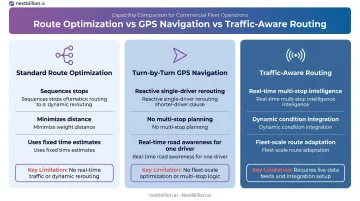
Standard optimization and GPS navigation each solve half the equation. Traffic aware routing handles both simultaneously — adjusting stop sequences, departure times, and paths based on what's actually happening on the road.
Why Traffic Aware Routing Matters for Fleet Operations
Fleet operations live and die by ETA accuracy. The financial stakes are direct: according to Capgemini's research, last-mile delivery accounts for 41% of total supply-chain costs, and close to three-fourths of consumers will reward a superior last-mile experience with increased spend and loyalty.
Failed deliveries compound the damage. When a vehicle arrives outside the delivery window or misses a stop entirely, the redelivery cost and customer friction pile up quickly. In regulated segments like NEMT or hazmat transport, missed windows also create compliance exposure on top of the direct cost, since appointment and delivery timing are often tied to contractual or DOT-adjacent obligations.
What Goes Wrong Without It
Picture a food delivery fleet that builds routes the night before. By 8 AM, three arterial corridors are congested, and every vehicle is queued on the same road. ETAs slip 25 minutes. Customers who expected a 9 AM arrival are calling at 9:30, while dispatchers have no visibility and no way to respond.
That's not a hypothetical — it's the default state for operations running static routing.
The Fuel and Cost Equation
Congestion doesn't just delay vehicles. It burns fuel. According to ATRI's 2024 analysis, traffic congestion cost the U.S. trucking industry $108.8 billion annually and caused 1.3 billion hours of lost productivity. A heavy-duty truck idling in traffic burns roughly 0.8 gallons of fuel per hour — and fuel represents 28% of total marginal trucking costs.
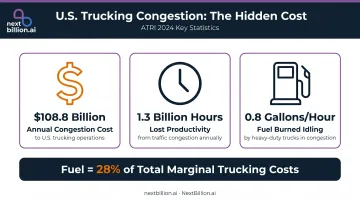
Traffic aware routing reduces unnecessary idling by routing around congestion before vehicles enter it, not after they're already stuck.
Who Needs It
The dependency on condition-aware routing spans a wide range of operations:
- Last-mile and e-commerce delivery
- Long-haul fleet management
- Field service scheduling (HVAC, pest control, utilities)
- Non-emergency medical transportation (NEMT)
- Ride-hailing and on-demand mobility
- Same-day and on-demand delivery with tight time windows
What these verticals have in common is exposure to the same failure mode: a route planned at 6 PM is often wrong by 8 AM, and without live traffic data feeding into dispatch, there's no way to catch it before it costs you.
How Traffic Aware Routing Works
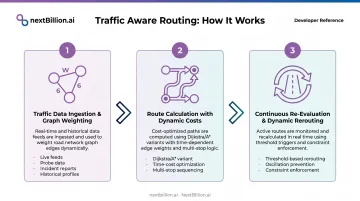
The system continuously ingests real-time traffic signals, weights road segments by current travel cost, and selects the minimum-cost path — delivering updated routing instructions either at dispatch or dynamically mid-route. Here's how that process breaks down across three operational steps.
Step 1: Traffic Data Ingestion and Road Graph Weighting
The routing engine maintains a road network graph where each edge (road segment) carries a cost value. Traffic aware routing dynamically updates these cost values based on current travel speeds, queue lengths, and incident flags.
A normally fast arterial road during rush hour becomes "expensive" in the graph even if the physical distance is short. The system treats time cost, not miles, as the primary routing variable.
Data inputs typically include:
- Real-time traffic feeds from providers like HERE or TomTom, both of which update traffic flow and incident data every minute with coverage across 70+ countries
- Probe data aggregated from GPS-equipped vehicles and connected devices — TomTom's network draws from 650M+ GPS-enabled devices
- Incident and closure reports covering accidents, construction, and road closures
- Historical speed profiles by road segment, time of day, and day of week
Step 2: Route Calculation Using Dynamic Costs
The routing algorithm — typically a variant of Dijkstra's or A* adapted for dynamic graphs — computes the optimal path using updated cost weights rather than fixed values. The "shortest" route is the fastest given current conditions, not just the fewest miles.
For multi-stop routes, the calculation extends to sequencing stops in the order that minimizes total travel cost under current conditions. NextBillion.ai's Route Optimization API handles this using a traffic timestamp attribute — optimizing stop sequence and arrival estimates based on conditions at planned execution time.
Step 3: Continuous Re-Evaluation and Dynamic Rerouting
For vehicles already on route, the system periodically re-evaluates whether the original path is still optimal. When a new incident reduces travel speed, the engine compares rerouting cost — additional mileage, stop sequencing disruption — against staying on course, and only reroutes if the benefit exceeds a configurable threshold. That threshold prevents oscillation: constant path-switching that confuses drivers and can increase total journey time.
Enterprise platforms like NextBillion.ai enable teams to configure dynamic rerouting triggers alongside 50+ hard and soft constraints — time windows, driver hours, vehicle weight limits, hazmat rules — so traffic aware routing works within the same operational limits that govern the fleet, rather than as a separate layer bolted on top. Driver hours constraints, for instance, can be aligned with FMCSA hours-of-service rules so rerouting decisions never push a driver past legal drive time.fic awareness operates within the full business logic of the operation, not as a standalone navigation function.
Key Factors That Affect Traffic Aware Routing Performance
Five implementation factors determine whether traffic aware routing actually performs in production — or just looks good on a demo.
Data Freshness and Source Quality
A system refreshing traffic speeds every 15 minutes performs materially differently from one updating every 60 seconds. Both HERE and TomTom update traffic flow and incident data every minute, but coverage quality varies by region and road type. Probe-data-based feeds cover roads without agency-owned sensors, making them more comprehensive for suburban and secondary road networks — but accuracy depends on connected vehicle density in that corridor.
Geographic Coverage Gaps
Traffic data density varies significantly by region. Dense urban cores have strong coverage, but suburban, rural, and emerging-market corridors often carry sparse or stale data. Teams must understand where their operations run and whether their routing provider covers those areas — or whether the system will default to static speed estimates without surfacing a warning.
NextBillion.ai's Road Editor App gives operations teams direct control over road attributes — custom speed limits, restrictions, closures — to supplement coverage in underserved corridors where traffic feed data is thin.
Vehicle Type and Constraint Specificity
Traffic aware routing for a standard delivery van is different from routing for a refrigerated semi-truck or a hazmat vehicle. Road segments open to passenger vehicles may be restricted by:
- Bridge weight limits (federal law limits gross vehicle weight to 80,000 lb on the Interstate System)
- Tunnel height and width clearances
- Hazmat routing regulations under eCFR Part 397, which require avoiding heavily populated areas and tunnels unless no practicable alternative exists
NextBillion.ai's platform handles weight restrictions, height clearances, width restrictions, hazmat routing rules, and axle load limits as part of its vehicle-specific constraint set — ensuring routes are not just fast, but operationally and legally valid.
Update Frequency vs. Route Stability
Systems that re-evaluate too frequently generate route changes faster than drivers can safely respond. The right recalculation interval depends on fleet type and journey length:
- A long-haul driver on a 4-hour run doesn't need rerouting every 2 minutes
- An urban courier on a 20-minute delivery benefits from near-real-time adjustments
The right interval needs to be configured explicitly for each fleet profile — it won't emerge from a default.
Integration With Dispatch and Fleet Management Systems
Traffic aware routing only delivers value if its outputs reach dispatchers and drivers in real time. NextBillion.ai integrates natively with Samsara, Geotab, Motive, Netradyne, Verizon, and Azuga — enabling one-click dispatch that pushes optimized routes directly to driver apps, with no manual re-entry required.
Routing computation that runs in isolation from the operational workflow creates a dead end: the optimal route exists in the system but never reaches the driver.
Common Challenges, Limitations, and Misconceptions
"Real-Time Always Means Better"
Historical traffic patterns — time-of-day, day-of-week speed profiles — are often more reliable predictors of conditions than a single noisy live data point. A mature traffic aware routing implementation blends both, using historical baselines to smooth out anomalous live readings. Teams that rely on live data alone often get inconsistent performance during unusual events or data dropouts.
When Traffic Aware Routing Adds Limited Value
Not every operation benefits equally. Three scenarios where it may add limited value:
- Rural operations with sparse road networks and no viable route alternatives
- Fixed industrial routes where there's only one viable path regardless of conditions
- Regions with poor traffic data coverage where the system falls back to static estimates anyway
In these contexts, static or historically optimized routing can be more appropriate. The overhead of real-time routing infrastructure should be evaluated against the actual coverage and congestion profile of the operation.
Consumer APIs Are Not Enterprise Routing
Many teams assume that integrating a consumer navigation API is equivalent to implementing traffic aware routing for fleet operations. It isn't — and the gap shows up fast at fleet scale.
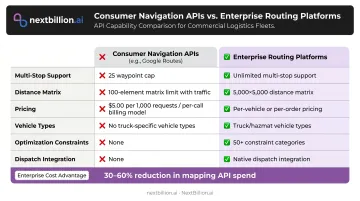
The Google Routes API caps requests at 25 intermediate waypoints and limits Route Matrix computations to 100 elements when using TRAFFIC_AWARE_OPTIMAL. Pricing starts at $5.00 per 1,000 requests, a model that compounds quickly across high-volume operations. No truck-specific vehicle type exists in the documented vehicle types, so truck routing constraints can't be applied at all.
Enterprise routing platforms are built around what fleet operations actually need. NextBillion.ai, for example, uses per-vehicle or per-order pricing rather than per-call billing, supports distance matrices up to 5,000×5,000, covers 50+ constraint categories, and includes native dispatch integration. For high-volume fleet operators, that typically translates to a 30–60% reduction in total mapping API spend compared to consumer-grade alternatives.
Frequently Asked Questions
What is traffic aware routing?
Traffic aware routing is a method of computing vehicle routes that incorporates real-time and historical traffic conditions (congestion, incidents, current travel speeds) to identify the fastest path at any given moment. It differs from static routing by treating current road conditions, not just distance, as the primary routing variable.
What is traffic routing?
Traffic routing refers to directing vehicles along road networks to reach destinations efficiently. Modern systems layer live congestion data on top of map geometry so routing decisions reflect actual on-road conditions rather than idealized map distances. In practice, this means the routing engine recalculates recommended paths as speeds change, rather than relying on a single precomputed route for the entire trip, which matters for dispatchers managing time-sensitive deliveries or service calls across a metro area.
How does traffic aware routing differ from standard route optimization?
Standard route optimization focuses on stop sequencing and distance minimization using fixed travel time estimates. Traffic aware routing continuously updates those travel time values based on live conditions. The two are complementary; most enterprise fleet solutions combine both for dispatch-ready, condition-aware multi-stop routes.
What data sources does traffic aware routing use?
Common inputs include:
- Commercial traffic feeds from providers like HERE or TomTom, updating every minute
- Probe data aggregated from GPS-equipped vehicles
- Incident and closure reports
- Historical speed profiles by road segment and time of day
Can traffic aware routing handle multi-stop delivery routes?
Yes. Enterprise-grade systems apply dynamic traffic costs across multi-stop route optimization, computing not just the path between two points but the optimal stop sequence considering current conditions throughout the full delivery run. As conditions shift mid-route, the engine can re-rank remaining stops so drivers avoid newly congested segments, which is useful for last-mile delivery and field service fleets working against delivery windows or driver hours-of-service limits.
Is traffic aware routing suitable for trucks and specialized vehicles?
Only when the routing engine applies vehicle-specific constraints alongside traffic data: weight limits, height and width clearances, and hazmat restrictions. Without these constraints, the system may produce a technically faster but operationally invalid route for heavy or specialized vehicles.
Does traffic aware routing help with FMCSA hours-of-service compliance?
Traffic aware routing does not manage hours-of-service compliance directly, but more accurate, condition-based travel time estimates give dispatchers a clearer picture of how much drive time a route will actually consume. This helps fleet managers sequence stops and plan breaks so drivers are less likely to run into HOS limits mid-route due to unexpected congestion, though HOS tracking itself remains the job of an ELD or compliance system.
How is traffic aware routing typically integrated into existing fleet software?
Most fleet management platforms integrate traffic aware routing through a routing API rather than replacing their existing dispatch or telematics stack. The API receives stop locations and vehicle constraints, returns traffic-adjusted routes and ETAs, and the fleet software handles dispatch, driver communication, and tracking. This keeps the traffic and optimization logic separate from the operational systems teams already use daily.