Introduction
Most fleet managers already have telematics hardware installed. GPS pings live in one system, engine diagnostics in another, and maintenance records in a spreadsheet no one updates consistently. The result is a fleet that generates enormous amounts of data but makes decisions based on fragments of it.
The cost of this fragmentation is real. ATRI's 2024 operational cost analysis found total marginal trucking costs reached $2.270 per mile in 2023, with repair and maintenance alone at $0.202 per mile — up 3.1% year-over-year. Deadhead mileage averaged 16.3% across non-tank operations. These aren't abstract numbers; they're what disconnected data costs in practice.
Fleet telematics integration is the discipline of connecting hardware data streams — GPS units, OBD sensors, ELDs, and platforms like Fleetmatics, Geotab, or Samsara — to the software platforms that act on them: fleet management systems, maintenance schedulers, dispatch tools, and route optimization engines. Rather than leaving each device or vendor feed as its own silo, integration unifies these fragmented data streams into one system that supports actionable, real-time decisions.
This guide covers:
- What telematics integration actually means and which data elements matter most
- Five proven integration strategies and best practices for execution
- The three most common failure points teams encounter
Key Takeaways
- Telematics integration connects GPS, diagnostics, driver behavior, and fuel data into one unified operational system.
- Full integration links telematics hardware to FMS, dispatch, maintenance platforms, and route optimization engines.
- The biggest wins come from API-based connections, centralized dashboards, and condition-based maintenance scheduling.
- Data silos, driver resistance, and cybersecurity gaps are solvable with the right architecture and change management approach.
- Pairing telematics data with intelligent routing is what converts visibility into lower fuel costs and faster delivery cycles.
What Fleet Telematics Integration Actually Means
Telematics collects raw vehicle data. Fleet management software interprets it. Integration is what makes these two layers function as one coherent system rather than two separate tools that require manual reconciliation.
Without integration, GPS pings and engine diagnostics sit in one platform while dispatch decisions happen in another. Operators end up manually exporting CSVs, reconciling timestamps, and patching together context that a connected system would surface automatically.
Why the Urgency Has Increased
The scale of telematics adoption makes integration a pressing operational requirement. Berg Insight reported 19.2 million active fleet management systems in North American commercial vehicle fleets as of Q4 2024, projected to grow at 11.6% CAGR to 33.2 million units by 2029. More hardware in more vehicles means more data — but also more integration surface area to manage.
Fleets today are contending with FMCSA compliance requirements, tighter delivery windows, and expanding vehicle counts — often at the same time. When telematics data stays siloed, compliance reporting becomes manual work and real-time dispatch decisions get made on stale location data.
Three Hardware Types That Shape Your Integration Approach
| Type | Examples | Integration Implication |
|---|---|---|
| OEM embedded | Ford Pro, GM OnStar API | Factory data access via OEM API; no added hardware |
| Aftermarket | Geotab, Samsara, Motive | Broadest data coverage; open APIs for custom integration |
| Temporary/trial | Short-term OBD-II plug-ins | Limited to pilot phases; not suitable for production workflows |
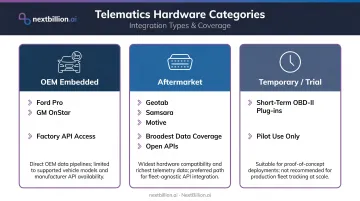
Aftermarket devices like Geotab and Samsara offer the broadest integration paths. Motive alone reports over 200 telematics signals — including GPS, fuel consumption, engine hours, hard braking, and idle time — giving fleet software platforms far more operational context to work with.
Key Data Elements Your Integration Must Cover
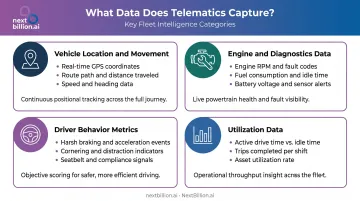
Four data categories form the backbone of any telematics integration. Leaving any one of them siloed reduces the value of the others.
1. Vehicle Location and Movement GPS position, geofencing events, trip history, and route deviation data. Without this layer feeding your dispatch system, real-time rerouting and after-the-fact compliance audits both fall apart.
2. Engine and Diagnostics Data Fault codes, battery status, fuel consumption, and OBD-II readings. When this feeds a maintenance platform, it enables condition-based servicing instead of fixed maintenance schedules.
3. Driver Behavior Metrics Speed, harsh braking, rapid acceleration, idle time, and seatbelt use. Per FMCSA guidance, ELDs are not required to collect braking or steering data — so behavioral data from aftermarket devices fills a compliance gap that ELDs alone can't address.
4. Utilization Data Engine hours, days in service, miles traveled per vehicle. Essential for right-sizing fleets and identifying underused assets before they quietly drain budget.
The Compliance-Critical Data Layer
On top of these four categories sits a mandatory compliance layer. FMCSA requires ELDs to automatically record date, time, location, engine hours, vehicle miles, and driver/carrier IDs. Location is captured at 60-minute intervals during motion, plus at engine power-up, shutdown, and duty-status changes. This data must integrate with both fleet management and HR systems for accurate HOS compliance — manual workarounds create audit exposure.
Core Integration Strategies for Maximum Fleet Visibility
Telematics data alone is just noise. These five integration strategies turn raw signal into decisions that actually move operations forward.
Aligning Telematics with Fleet Management Software
Connecting telematics to your FMS creates a single source of truth: route plans, vehicle locations, driver assignments, and maintenance histories in one place. Practically, this means:
- Comparing planned vs. actual routes automatically
- Automating compliance documentation (HOS records, DVIRs)
- Flagging exception events — speeding, unauthorized stops, geofence exits — against pre-defined thresholds
Integrating Telematics with Maintenance Scheduling
The shift from calendar-based to condition-based maintenance is one of the highest-ROI integration moves available. When telematics feeds actual engine hours, mileage, and diagnostic fault codes into maintenance platforms, service reminders trigger automatically before breakdowns occur.
The average $0.202 per mile repair and maintenance cost compounds quickly at scale. Reactive repairs cost more than scheduled ones in both parts and downtime — the math favors prevention.
Geotab's fleet maintenance tools include remote diagnostics, active fault monitoring, and work order management. Samsara's DVIR API allows programmatic resolution of inspection reports for preventive maintenance workflows.
Building Centralized Dashboards for Cross-Functional Visibility
Fragmented dashboards create fragmented decisions. Operations, safety, maintenance, and dispatch teams each need different data — but they also need visibility into each other's KPIs to coordinate effectively.
Effective centralized dashboards surface:
- Real-time vehicle status and GPS positions
- Driver safety scores and behavioral alerts
- Fuel efficiency trends by vehicle and route
- Maintenance queues and upcoming service windows
- Compliance flags and HOS status
Role-based access controls let each team see what's relevant without cluttering views with data from other departments. Getting that visibility layer right is what makes the underlying technical integration worth building.
Leveraging APIs and Middleware for Direct Data Exchange
Modern fleets don't replace existing systems to integrate telematics — they connect them via open APIs and middleware. This approach handles growing integration volume without rearchitecting, and it's how NextBillion.ai approaches the problem.
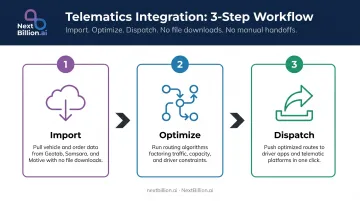
NextBillion.ai's platform has native, pre-built integrations with Geotab, Samsara, and Motive, plus enterprise connectors for Salesforce, SAP, and Microsoft Dynamics 365. The workflow is straightforward:
- Import — pull vehicle and order data from telematics platforms in a few clicks, no file downloads required
- Optimize — run advanced routing algorithms factoring in traffic, capacity, schedules, and driver constraints
- Dispatch — push optimized routes back to driver apps and telematics platforms with one click, eliminating manual re-entry
That workflow is backed by a pricing model designed for integration at scale: per-vehicle, per-order, or per-API-call options instead of the standard pay-per-call model, so costs stay predictable even as volume grows.
Connecting Telematics to Route Optimization
This is the integration layer most fleet operations underinvest in. Real-time GPS positions, vehicle capacity data, and driver availability from telematics should dynamically influence dispatch decisions, stop sequencing, and ETAs rather than just feeding a tracking dashboard.
The fuel case alone justifies it. The DOE's Alternative Fuels Data Center reports a typical long-haul truck idles approximately 1,800 hours per year, consuming around 1,500 gallons of diesel. Route optimization informed by real-time telematics data directly attacks that idle time by routing around delays rather than sitting in them.
When Xpress Global Systems implemented route optimization integrated with live traffic data through NextBillion.ai, they achieved a 13% reduction in miles driven per month and a 35% reduction in operating costs , with driver satisfaction rising as an added outcome.
Best Practices for Telematics Integration Success
Set KPIs Before Integration Begins
Define measurable success criteria before a single API call is written. Without pre-defined KPIs, integration investments produce dashboards, not accountability.
Relevant benchmarks to establish upfront:
- Fuel cost per mile (ATRI baseline: $0.553 per mile in 2023)
- Idle time per driver per week
- Mean time between maintenance events
- Accident rate per million miles
- Deadhead mileage as a percentage of total
Get Cross-Department Buy-In Early
Telematics integration fails when it's treated as an IT project. Operations, safety, maintenance, dispatch, and HR all have distinct data needs that should shape the integration architecture before build begins.
A maintenance team that learns about the integration after go-live will have missed their chance to specify the fault-code thresholds that trigger service alerts. That gap won't be cheap to fix post-deployment.
Build for Scalability, Not Just Today's Fleet
Select platforms that support modular expansion, remote updates, and future integrations, including EV fleet data. DOE FEMP confirms that telematics-equipped EVs can track charging sessions, and as fleet electrification accelerates, integration architectures built on rigid, vendor-locked infrastructure will require costly rebuilds.
NextBillion.ai's on-premise and cloud-agnostic deployment options (AWS, GCP, Azure, or private data center via Kubernetes) address this: fleets with data residency requirements or evolving compliance mandates aren't locked into a single hosting model.
Use a Phased Rollout
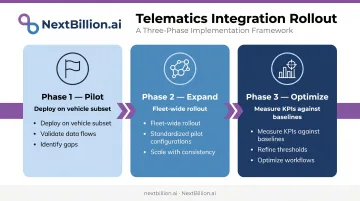
A three-phase approach reduces organizational disruption:
- Pilot: Deploy on a vehicle subset, validate data flows, and surface integration gaps before they affect the full fleet
- Expand — Roll out with standardized configurations based on pilot learnings
- Optimize: Measure KPIs against baselines, then adjust thresholds and workflows based on real-world results
NextBillion.ai provides a sandbox environment with real-world traffic data and historical routing insights specifically for this purpose, so that pilot testing reflects actual operating conditions.
Establish Data Governance and Security Protocols
Define data ownership, access tiers, retention periods, and encryption standards before integration goes live. Key requirements:
- Encryption in transit (HTTPS/TLS) and at rest (disk encryption)
- Role-based access controls with multi-factor authentication
- Audit trails for data access and modification
- SOC 2 Type II and ISO/IEC 27001 certification from integration partners
NextBillion.ai holds both SOC 2 Type II and ISO/IEC 27001 certifications, undergoes regular third-party audits and penetration testing, and supports RBAC with MFA across its platform.
Common Challenges and How to Overcome Them
Data Silos and Incompatible Platforms
Legacy FMS platforms and newer telematics hardware often don't share data formats, which forces duplicate entry and creates blind spots. Platform replacement is rarely the answer. Select integration partners with open APIs, documented data schemas, and pre-built connectors to common FMS tools.
Samsara, Geotab, and Motive all publish developer APIs for GPS, diagnostics, route plans, ETAs, DVIRs, and geofence data. Verify these endpoints are supported before committing to a vendor.
Driver Resistance and Change Management
Driver pushback is one of the most consistent integration failure points. An OOIDA Foundation survey of over 3,700 members after the ELD mandate found 78% felt more pressure to speed and 71% felt more fatigued — outcomes directly tied to poor change management, not the technology itself.
An effective approach:
- Communicate data use policies transparently and early
- Involve drivers in pilot programs before fleet-wide rollout
- Frame training around safety benefits, not surveillance
- Tie telematics data to positive performance incentives
At Xpress Global Systems, drivers went from resisting the routing system to trusting it — specifically because the new routes were demonstrably better than what the old system produced. That trust came from results, not mandates.
Cybersecurity and Data Privacy Risks
Telematics systems are cybersecurity targets. A 2023 ransomware attack on ORBCOMM's FleetManager platform left trucking fleets unable to track inventory or use electronic logging for days, illustrating exactly what inadequate security controls cost operationally.
DOE guidance also confirms that aftermarket telematics devices can create entry points for unauthorized access via vehicle CAN bus networks. Minimum requirements for any integration partner:
- Encryption in transit and at rest
- Role-based access with audit trails
- SOC 2 Type II and ISO/IEC 27001 compliance
- On-premise or cloud-agnostic deployment options for sensitive data environments
Frequently Asked Questions
What is telematics in fleet management?
Fleet telematics uses GPS, onboard sensors, and wireless communication to collect and transmit real-time vehicle data — including location, engine diagnostics, driver behavior, and fuel consumption. Fleet managers use this data to monitor and optimize operations remotely without relying on driver self-reporting. Its value depends on integration: raw telematics feeds only improve outcomes when connected into routing, dispatch, and maintenance systems that act on the data rather than just displaying it.
What are the four pillars of fleet success?
The four pillars are:
- Safety — driver behavior monitoring and incident prevention
- Efficiency — route optimization and fuel management
- Compliance — ELD hours-of-service and regulatory reporting
- Maintenance — proactive vehicle health management
Integrated telematics supports all four simultaneously by feeding shared data to each operational layer.
What systems should fleet telematics integrate with?
Core integration targets include:
- Fleet management software
- Maintenance scheduling platforms
- Dispatch and TMS tools
- Route optimization engines
- ELD systems
- HR platforms for driver performance management
The more of these connections are live, the less manual data reconciliation operations teams have to handle. Most existing telematics hardware exposes data through APIs, so fleet automation platforms can typically connect without replacing installed devices, provided the vendor supports standard data feeds.
How does telematics integration improve route optimization?
When real-time vehicle locations, fuel consumption, and driver availability feed directly into a route optimization engine, dispatch teams can make smarter stop-sequencing decisions, reduce deadhead miles, and respond dynamically to delays. Static routing decisions made without live telematics data consistently underperform against real operating conditions.
What data does a fleet telematics system collect?
Primary data categories include:
- GPS location and trip history
- Engine diagnostics and fault codes
- Driver behavior metrics (speed, braking, idling)
- Fuel and energy consumption
- Utilization data (engine hours, days in service)
ELDs specifically record date, time, location, engine hours, vehicle miles, and driver/carrier IDs per FMCSA requirements.
How do you overcome driver resistance to telematics?
Transparency matters more than policy. Communicate data use clearly before rollout, involve drivers in pilot programs, and frame telematics around safety improvements rather than surveillance. Tying data to positive performance incentives — rather than purely punitive applications — converts the most skeptical drivers over time. Resistance also drops when integration is seamless: if automation systems plug into telematics drivers already use, there is no added hardware or workflow disruption to justify pushback.
What is the role of telematics in fleet management?
Telematics acts as the data layer underneath fleet management. It supplies location, diagnostics, and driver behavior data that other systems consume to make decisions. On its own, telematics only reports what happened. Its role becomes operational when fleet automation systems integrate with existing telematics to trigger routing changes, maintenance alerts, or compliance flags automatically instead of requiring manual review of dashboards.
How do fleet automation systems integrate with existing telematics providers?
Integration typically happens through APIs that telematics providers expose for location, diagnostic, and driver-behavior data. Rather than replacing installed hardware or ELDs, automation platforms connect to these feeds to power routing, dispatch, and maintenance workflows. Compatibility depends on the specific provider's API support and data format, so fleets should confirm integration options with both their telematics vendor and the automation platform before rollout.