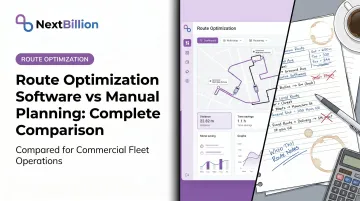
This comparison breaks down exactly where manual planning holds up, where it fails, and how route optimization software changes the math — with data to back it up.
Key Takeaways
- Manual planning works for small, predictable operations (under 5 vehicles, fixed routes) but degrades quickly as complexity grows.
- Route optimization software generates multi-stop, multi-vehicle routes in seconds using algorithms and real-time data.
- Key differences: planning speed, constraint handling, real-time adaptability, scalability, and cost efficiency.
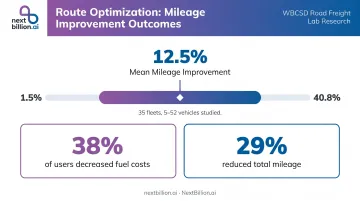
- WBCSD's Road Freight Lab research found a 12.5% mean mileage improvement across 35 fleets after route optimization adoption.
- If you run more than 5 vehicles or handle variable daily orders, software pays for itself through fuel and labor savings alone.
Route Optimization Software vs. Manual Planning: Quick Comparison
| Factor | Manual Planning | Route Optimization Software |
|---|---|---|
| Planning Speed | Hours per dispatcher, per day | Seconds for an entire fleet |
| Constraint Handling | Limited to a few variables at once | 50+ hard and soft constraints simultaneously |
| Real-Time Adaptability | Requires dispatcher intervention | Auto-recalculates on traffic, closures, new orders |
| Scalability | Adds headcount as fleet grows | Scales from 10 to 10,000+ vehicles without proportional labor |
| Cost Impact | Hidden costs accumulate untracked | Documented reductions in fuel, miles, and labor |
Cost Impact: What the Data Shows
The WBCSD Road Freight Lab modeled 35 fleets ranging from 5 to 52 vehicles and found a mean mileage improvement of 12.5%, with results ranging from 1.5% to 40.8% depending on prior route quality and operational complexity. A UK Freight Transport Association member survey cited in the same report found that 38% of computerized routing users decreased fuel costs and 29% reduced total mileage.
The figures come from industry-led research with documented methodology, not vendor marketing sheets. The wide outcome range — 1.5% to 40.8% — means the baseline matters: a fleet already running tight manual processes will see modest gains, while one relying on experience-based routing stands to recover the most ground.
What Is Manual Route Planning?
Manual route planning means sequencing delivery stops and assigning drivers using human judgment, experience, spreadsheets, or general-purpose tools like Google Maps. No optimization engine. No constraint processing. Just a dispatcher making their best call given the information in front of them.
Why Businesses Still Use It
The appeal is straightforward:
- No upfront cost — spreadsheets and Google Maps are free
- Familiarity — experienced dispatchers know their territories
- Sufficient for simple operations — fixed routes with predictable stops rarely expose the limitations
For an independent courier running five regular stops or a small trade service business with repeat weekly appointments, manual planning is adequate.
When Manual Planning Fails
The cracks appear when any of these triggers hit:
- Fleet grows beyond 5–10 vehicles
- Order volumes vary significantly day-to-day
- Customer-facing time windows become contractual commitments
- Multi-depot operations require coordinated routing
- Driver turnover means institutional route knowledge walks out the door
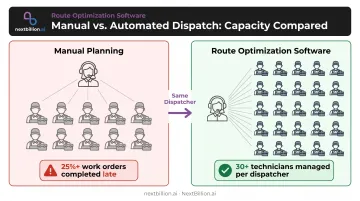
The workload problem is well-documented. Research from Aberdeen Group found that manual dispatching processes often limit a single dispatcher to managing 10 or fewer technicians. In one communications company case, automation allowed that same dispatcher to scale from 7 to 30+ technicians — a structural shift in planning capacity, not a marginal tweak.
The same research found that companies using manual or semi-manual scheduling completed more than 25% of work orders late. For operations where delivery windows are customer commitments, that rate translates directly into churn.
What Is Route Optimization Software?
Route optimization software is a technology platform that uses algorithms and machine learning to automatically generate the most efficient stop sequences for one or many vehicles simultaneously, factoring in a configurable set of operational constraints.
This is fundamentally different from Google Maps. A navigation app sequences stops for a single vehicle with no awareness of your business rules. Optimization software solves a multi-variable planning problem across an entire fleet at once — accounting for vehicle capacity, driver schedules, customer time windows, road restrictions, and dozens of other constraints in a single processing cycle. Google Maps can help a single driver find the fastest path between points, but it cannot balance capacity, time windows, and driver hours across a fleet, which is why businesses researching route optimization software quickly hit its limits and look for a dedicated platform instead.
Key Capabilities
The four core capabilities that separate optimization platforms from basic navigation tools are constraint handling, real-time replanning, telematics integration, and ML-driven improvement.
Constraint handling at scale
Enterprise-grade platforms handle complexity that no dispatcher can reliably manage manually. NextBillion.ai supports 50+ configurable hard and soft constraints, including:
- Vehicle weight and dimension limits
- Truck-specific road restrictions
- Driver hours-of-service rules
- Customer time windows (hard and soft)
- Priority order flags
- Multi-depot assignments
- Hazmat compliance requirements
Across a 50-vehicle fleet, that combination of variables exceeds what any dispatcher can balance simultaneously.
Real-time dynamic routing
When a road closes or a new order arrives mid-morning, the software recalculates affected routes automatically and pushes updated instructions to drivers — without dispatcher involvement. NextBillion.ai's dynamic replanning handles mid-day and mid-week route changes, adapting to traffic shifts, order modifications, and on-road disruptions as they happen.
Fleet and telematics integration
Route optimization platforms connect with GPS trackers and fleet management systems to create a unified dispatch-to-delivery workflow. NextBillion.ai has pre-built integrations with Samsara, Geotab, and Motive that sync data in both directions — eliminating manual CSV imports and exports entirely.
ML-driven continuous improvement
NextBillion.ai's ML routing trains on each customer's historical fleet data — actual driver completion times, observed traffic patterns on regular corridors, and historical deviation patterns — so routes improve over time rather than staying static.
Which Approach Is Right for Your Operation?
Neither approach is universally superior. The right choice depends on four factors: fleet size, operational complexity, order volume variability, and cost sensitivity.
Decision Framework
Choose manual planning if:
- You operate fewer than 5 vehicles
- Routes are fixed and change infrequently
- Dispatcher time is not a constraint
- Delivery windows are flexible, not customer commitments
Choose route optimization software if:
- Your fleet is growing or already past 5–10 vehicles
- Order volumes vary day-to-day
- Customers expect time window adherence
- Fuel and labor costs are under scrutiny
- You operate across multiple depots or service territories
- You want AI-driven route optimization that adapts to real-time conditions and improves accuracy over time as it learns from your fleet's actual performance data, rather than relying on static, one-time route plans
The Scalability Ceiling
Even operations that currently manage "fine" with manual planning will hit a ceiling. The cost isn't always visible upfront: it accumulates through excess fuel, dispatcher overtime, failed deliveries, and planning hours that grow directly with order volume.
Software breaks that linear relationship. NextBillion.ai's platform handles thousands of stops across hundreds of vehicles in a single processing cycle — the same algorithm that plans 20 routes plans 2,000, without adding headcount.
For cost-benefit framing: a Forrester Consulting TEI study of field service modernization found that routing algorithms and traffic-based optimization produced $2.1M in avoided travel time savings over three years, alongside a 40% improvement in dispatcher productivity. Those figures reflect what happens when planning hours stop scaling with headcount — and start scaling with software.
Real-World Results: The Business Case for Switching
The pattern leading to a switch looks similar across industries: a dispatching bottleneck caused by fleet expansion, rising fuel costs compressing margins, or an escalation in missed time windows that manual planning can no longer absorb.
What Switching Produces
Across NextBillion.ai's customer base — over 10.9 million deliveries and field tasks optimized and $11+ million in verified cost savings delivered — the measurable outcomes after switching from manual to software-driven planning break down consistently:
- Reduced planning time: EasyHealth reduced scheduling time by 40%, enabling schedulers to identify suitable providers and plan routes significantly faster
- Lower API and operational costs: Hawx Pest Control substantially reduced developer hours spent on scheduling within one month of implementation, improving operational efficiency and cost savings
- Faster deployment than expected: EasyHealth completed testing, integration, and production deployment within 10 days; one on-demand transportation software company achieved full integration within 72 hours
- Improved delivery performance: A leading TMS provider saw 30% improvement in ETA and ETD accuracy after switching to NextBillion.ai's optimization engine
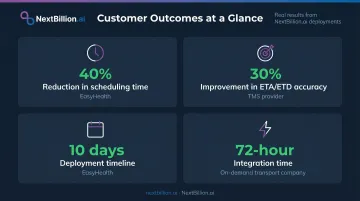
These results translate directly to fuel spend, dispatcher headcount, and delivery volume — the three levers where manual planning bleeds money fastest.
NextBillion.ai's route optimization platform uses per-vehicle and per-order pricing instead of per-API-call billing, so costs stay predictable as order volumes grow rather than spiking every time the algorithm runs. Deployment typically takes days to a few weeks, with 24x7 hands-on support from solution engineers throughout integration and production.
Request a demo to see how the platform handles your specific constraints and fleet size.
Conclusion
Manual route planning and route optimization software are not competing on equal terms for most modern logistics operations. Manual works for simple, stable environments — but it stops being viable the moment complexity and volume outpace what a dispatcher can reasonably balance at once.
The metrics that matter — fuel spend, dispatcher productivity, on-time delivery rate, customer satisfaction — all point in the same direction. A 12.5% mean mileage improvement compounds across an entire fleet. A 40% gain in dispatcher productivity frees capacity for higher-value work. That 30% improvement in ETA accuracy? It's often the difference between retaining a customer and losing one.
If you're managing more than a handful of routes and already feeling the operational friction, the ROI case for optimization software isn't a future consideration. The savings are happening now — at competitors who've already made the switch. Tools like NextBillion.ai's Route Optimization API are built specifically for this transition, handling 50+ constraints across real-world fleet conditions without the per-call pricing that makes scaling painful.
Frequently Asked Questions
What is the main difference between manual route planning and route optimization software?
Manual planning relies on human judgment and general tools like Google Maps to sequence stops one vehicle at a time. Route optimization software processes an entire fleet simultaneously, balancing constraints like time windows, vehicle capacity, and live traffic in seconds — a problem no dispatcher can solve manually at the same speed or accuracy.
How much can route optimization software reduce fuel costs?
The WBCSD Road Freight Lab found a 12.5% mean mileage improvement across 35 fleets, with 38% of computerized routing users reporting decreased fuel costs. In a specific named case, Grupo Petropolis achieved a 5% reduction in fuel consumption after route optimization across nearly 3,000 vehicles.
Is route optimization software worth it for small fleets?
For fleets under 5 vehicles with fixed, predictable routes, manual planning is often sufficient. Once order volumes vary or fleet size grows, the ROI typically becomes positive quickly — fuel and labor savings alone usually cover the software cost, and the productivity gain from reducing dispatcher hours compounds from there. Small US fleets should also weigh FMCSA hours-of-service compliance and IFTA mileage tracking, since manual logs make both harder to maintain accurately as stop counts rise.
Can route optimization software handle last-minute order changes or traffic disruptions?
Yes. Modern platforms support dynamic re-routing — when a new order arrives or a road closes, the software recalculates affected routes automatically and pushes updates to drivers. Manual planning cannot match this at speed or scale; a dispatcher handling 30 vehicles cannot re-sequence mid-day without significant delay. This matters most in US urban corridors with recurring congestion or DOT-mandated detours, where static manual plans become outdated within the first hour of a shift.
What constraints can route optimization software handle that manual planning cannot?
Enterprise platforms like NextBillion.ai handle 50+ simultaneous constraints including vehicle weight and size limits, driver hours-of-service rules, customer time windows, priority order flags, truck-specific road restrictions, and multi-depot assignments. A dispatcher can partially account for a few of these — not all of them, not simultaneously, not across a full fleet.
How long does it take to implement route optimization software?
It varies by integration complexity, but most businesses can go live within days to a few weeks. API-first platforms like NextBillion.ai are built for fast deployment: EasyHealth completed full integration within 10 days, and one customer went live within 72 hours. Pre-built integrations with Samsara, Geotab, and Motive accelerate the timeline further.
Can Google Maps do route optimization?
Google Maps can sequence a handful of stops for a single driver, but it does not solve multi-vehicle optimization. It has no concept of vehicle capacity, driver hours-of-service limits, delivery time windows, or truck-specific restrictions like weight or height limits. For a single-stop errand it works fine; for a fleet of delivery vehicles it leaves significant efficiency on the table compared to purpose-built routing software.
Which route planner is most accurate?
Accuracy depends on how well a platform models real-world constraints, not just distance and traffic. The most accurate systems account for live traffic, historical speed patterns, vehicle-specific road restrictions, and driver hours-of-service rules simultaneously, then recompute as conditions change. Manual planning and single-vehicle consumer apps cannot factor in all of these at once, which is why fleet-grade optimization software consistently outperforms them on total route efficiency.