Introduction
The waste collection vehicle routing problem with time windows is the task of sequencing truck routes so every stop, disposal trip, and depot return happens within its allowed start and end times, while keeping the route feasible within a driver's shift. Time windows in waste collection routing are the earliest and latest allowable times a vehicle can service a stop, visit a disposal facility, or return to the depot. These aren't scheduling preferences — they're hard constraints that determine whether a route is operationally feasible at all.
When time windows are misconfigured, the consequences compound quickly:
- Missed pickups create overflow bins and customer complaints
- Vehicles arriving at landfills outside operating hours idle or get turned away
- Drivers push past shift limits on routes that were never realistically achievable
- Fuel costs from inefficient stop sequencing add up across every truck in the fleet
This article walks through how time windows actually work in waste collection routing, what types must be managed simultaneously, how to configure them correctly by collection scenario, and where rigid constraints undermine route performance.
Key Takeaways
- Time windows apply to customer stops, disposal facilities, vehicle depots, and driver shifts — all four must align
- Hard time windows are required for regulated or access-restricted sites; soft windows work for general residential routes
- Misapplying residential window logic to commercial stops is one of the most common causes of inflated route counts
- Food waste and hazardous waste carry regulatory collection deadlines that override cost-efficiency considerations
- Manual planning cannot handle multi-constraint time window problems at scale; purpose-built route optimization software is required
Why Time Windows Drive Waste Collection Routing Efficiency
Time windows directly control stop sequence, disposal trip timing, and whether a driver can finish a route within their shift. Get them wrong and the schedule becomes infeasible before the first truck leaves the yard.
The Cost of Getting It Wrong
A 2020 peer-reviewed study by Hannan et al. found that variable route optimization for solid waste collection improved collection efficiency by 26.08% at a 70% bin-fill threshold, with modeled cost savings of 44.44% and a 17.60% reduction in carbon emissions. The same research noted that solid waste management can account for 40–80% of local authority expenditure — which means routing inefficiency is a direct budget problem.
Contract exposure is real too. Hernando County's service documentation lists liquidated damages of $250 per missed residential collection and $500 per missed commercial collection. Those penalties apply regardless of why the window was missed.
Compliance and Service Quality
Certain stops carry legal or contractual time restrictions. School zones, healthcare facilities, and regulated commercial zones often have ordinance-level access windows. Two city-level examples illustrate how specific these restrictions get:
- Baltimore City prohibits solid waste collection between 11:00 p.m. and 7:00 a.m. within 300 feet of a residential structure
- NYC requires businesses placing bags on the curb to wait until 8:00 p.m.; those using secure-lid containers can set out waste one hour before closing
These aren't guidelines; they're enforceable rules.
Inconsistent collection times erode customer trust just as quickly. Residents and businesses calibrate their day around expected pickup windows. Unpredictable scheduling generates complaints and, over time, puts contract renewals at risk — which connects directly to the operational side: disposal facility timing.
The Disposal Facility Ripple Effect
When vehicles arrive at a transfer station or landfill outside its operating window, the entire day's routing plan unravels. Seattle's transfer stations operate 8:00 a.m.–5:30 p.m. on most days, with commercial truck traffic peaking between 3:00 p.m. and 5:00 p.m. on weekdays. A vehicle arriving at 5:15 p.m. with a full load has nowhere to go — and every stop scheduled after that disposal trip doesn't get served.
The Key Types of Time Windows in Waste Collection Routing
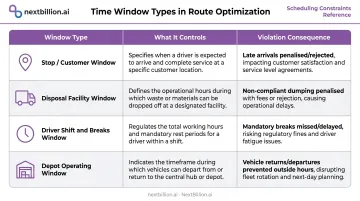
Waste collection planners must manage four distinct window types simultaneously. Each behaves differently and carries different consequences when violated.
The Four Window Categories
| Window Type | What It Controls | Violation Consequence |
|---|---|---|
| Stop/Customer | Earliest and latest service start at each collection point | Missed pickup, penalty, or contract violation |
| Disposal Facility | Transfer station, landfill, or processing center hours | Vehicle trapped full, forced to idle or return to depot |
| Driver Shift & Breaks | Maximum on-duty time, driving limits, mandatory rest | Regulatory violation, driver fatigue, HOS noncompliance |
| Depot Operating | When vehicles can depart and must return | Routes that can't start or finish within facility hours |
Hard vs. Soft Time Windows
This distinction determines how the optimization solver treats violations:
- Hard time windows make a route infeasible if violated. Used for regulated sites, access-restricted locations, and any stop where service cannot happen outside the window.
- Soft time windows add a penalty cost when violated, letting the solver arrive late if it improves the overall solution. Typical for residential and general municipal collection stops.
Getting the classification wrong in either direction is costly. Over-classifying stops as hard forces the solver to generate more routes than necessary; under-classifying means regulated windows go unprotected when they shouldn't. Solving the waste collection vehicle routing problem with time windows well means applying hard constraints only where a violation is truly unacceptable, and letting soft constraints absorb the rest as penalty costs the solver can trade off against total route efficiency.
Driver shift windows sit in their own category — they're not a planning preference, they're a federal compliance requirement.
Driver Shift Windows Are Regulatory, Not Preferences
FMCSA Hours of Service rules apply to commercial motor vehicles weighing 10,001 lbs or more. For property-carrying drivers, the key limits are:
- 11-hour driving limit after 10 consecutive hours off duty
- 14-hour on-duty window from shift start
- 30-minute break required after 8 cumulative driving hours
- 60/70-hour weekly limits depending on operating schedule
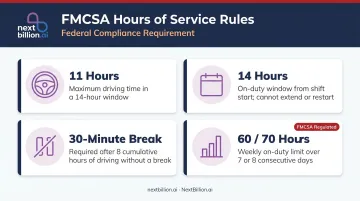
These are legal constraints. The routing system must enforce them with the same rigor as any hard customer time window.
How to Optimize Time Windows by Operational Scenario
The right time window configuration depends on collection type, waste type, and site-specific access rules.
By Collection Type: Residential vs. Commercial
Residential curbside routes typically don't need customer-level time windows. The binding constraints are the driver's shift window and disposal facility hours. Forcing narrow windows onto residential stops reduces route density artificially and requires more trucks to cover the same geography.
Commercial routes work differently. Business hours, loading dock availability, and local ordinances create genuine stop-level access windows that must be respected. Configure these stops as hard constraints and group them geographically with other stops that share compatible windows.
Assigning commercial stops with incompatible windows to the same route forces backtracking and waiting — both reduce the number of stops completed per shift. This is where the waste collection vehicle routing problem with time windows becomes a true multi-constraint optimization: the solver has to balance stop windows, disposal facility hours, and driver shift limits at once, which is why manual dispatch spreadsheets break down once a fleet mixes residential and commercial service on the same day.
By Waste Type: Food, Hazardous, and Medical
Food waste and biological waste carry time pressure from public health and odor risk. Douglas County, Kansas requires that garbage and putrescible materials be removed at least weekly, or more frequently if necessary to prevent nuisance conditions. Schedule these stops early in the shift — before ambient temperatures peak — and treat them as high-priority hard windows.
Hazardous and medical waste involve regulatory deadlines that override cost optimization entirely:
- EPA large quantity generators may accumulate hazardous waste on-site for 90 days or less without a permit
- Small quantity generators get 180 days (or 270 days when disposal requires transport of 200+ miles)
- Virginia regulations require generators producing under 250 gallons per month to have regulated medical waste removed at least monthly, with storage capped at 45 calendar days; higher-volume generators face 10-day limits
- Unrefrigerated regulated medical waste at transfer stations cannot exceed 7 calendar days
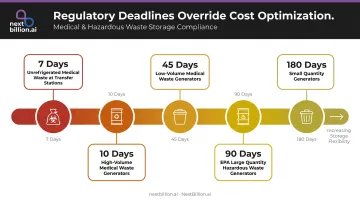
Your routing system must validate these regulatory clocks before any other optimization logic runs — soft windows have no place in hazardous or medical waste scheduling.
When Rigid Time Windows Hurt Routing Performance
Tight constraints don't always produce better routes. Over-constraining them creates its own category of failures.
The Over-Constraint Problem
Assigning narrow hard time windows to every stop — including low-priority residential locations — forces the solver into one of two bad outcomes:
- It creates more routes than necessary to find feasible solutions
- It declares the problem infeasible and fails to produce any usable schedule
Neither is acceptable at scale. Route optimization research distinguishes hard windows (which restrict the feasible solution set) from soft windows (which keep solutions feasible but penalize violations) specifically because this trade-off matters.
Window Clustering and Backtracking
When stops with incompatible windows end up on the same route, the vehicle either waits at an early stop until the next window opens or backtracks across service geography. Both patterns burn fuel and reduce the number of stops completed per shift.
A 2024 peer-reviewed study on municipal solid waste transport optimization reported a 4,835.2 km monthly travel-distance reduction after route optimization across 230,000 tonnes of MSW. Much of that distance had been lost to inefficient sequencing of this type.
Seasonal and Event-Driven Disruptions
Time windows configured months in advance often don't reflect current conditions. Post-holiday waste volumes are higher; cities like Philadelphia and Los Angeles document formal one-day collection delays following observed holidays.
Large events, weather disruptions, or new commercial developments can all invalidate previously workable windows. Treating time window configuration as a one-time design decision — rather than an ongoing operational input — is where many municipal and commercial fleets quietly accumulate avoidable inefficiency.
Best Practices for Time Window Optimization in Waste Collection Routing
Segment Stops Before Building Routes
Classify all stops as hard-window or soft-window before the optimizer runs:
- Hard-window stops: Regulated commercial sites, hazardous/medical waste pickups, access-restricted locations, time-sensitive waste streams
- Soft-window stops: Residential curbside, general municipal, non-time-critical commercial
Route these at different constraint levels within the same optimization pass. This prevents hard-window compliance requirements from bleeding into residential sequences and inflating the overall route count.
Align Disposal Trips with Fill Rate and Facility Windows
Plan routes so vehicles approach capacity near a disposal facility — not halfway across the service area. This requires the routing system to model vehicle capacity, disposal trip timing, and facility operating hours together.
NextBillion.ai's Route Optimization API handles this through return-to-dump logic that automatically triggers disposal trips when vehicles reach capacity thresholds, coordinating unload timing with facility windows. The platform's 50+ configurable constraints can be modeled simultaneously in a single optimization pass, including:
NextBillion.ai's Route Optimization API handles this through return-to-dump logic that automatically triggers disposal trips when vehicles reach capacity thresholds, coordinating unload timing with facility windows. The platform's 50+ configurable constraints can all be modeled in a single optimization pass, including:
- Disposal facility operating hours
- Stop-level time windows
- Driver break scheduling
- Vehicle capacity limits
No spreadsheet juggling required.
Build Buffer Time into High-Variability Stops
Commercial stops near loading docks or shared access roads near schools consistently run over service time estimates. Padding time windows at these locations prevents cascading delays that push later stops outside their windows. A 5–10 minute buffer per high-variability stop is far less costly than the downstream disruption of a missed window at stop 14 because stop 6 ran long.

Monitor Adherence and Recalibrate
Track which stops are consistently served early or late. That pattern tells you exactly which time window configurations are off. Static windows set at initial route design drift from reality over time as business hours change, traffic patterns shift, and service density evolves.
Use field adherence data to update window configurations in the routing model regularly — at minimum, each quarter.
Modern route optimization platforms, including NextBillion.ai's API, support dynamic re-optimization that re-sequences remaining stops in real time when a driver misses a window or a facility closes early, removing the guesswork from mid-route decisions.
Frequently Asked Questions
What is a time window in waste collection vehicle routing?
A time window defines the earliest and latest allowable times a vehicle can begin service at a stop, visit a disposal facility, or return to the depot. Route planning software models these constraints to keep schedules feasible and compliant with access restrictions, regulations, and driver shift limits.
What is the difference between a hard and soft time window in waste collection routing?
Hard time windows make a route infeasible if violated — the vehicle must arrive within the window or the stop cannot be served. Soft time windows allow violations but add a penalty cost to the route objective. The choice depends on the stop type and the real-world consequence of arriving outside the window. Disposal facilities and gated commercial accounts typically warrant hard windows, while residential curbside pickups with flexible household routines are often better modeled as soft, letting the solver trade minor lateness for a shorter overall route.
How do disposal facility time windows affect route planning?
Disposal facilities have fixed operating hours and cannot accept waste outside those times. Routes must be planned so vehicles reach capacity and arrive at facilities within their open window. Misalignment forces vehicles to idle, detour, or return to the depot still loaded — disrupting all remaining stops.
When should food waste or biological waste be prioritized in time window scheduling?
Food and biological waste carry elevated health and odor risks that increase with time and temperature. These pickups should be scheduled with early-shift hard windows before ambient temperatures peak. Regulatory rules (for example, requirements to collect putrescible waste at least weekly) set the outer boundary.
Can time windows be adjusted dynamically during operations?
Yes. Route optimization platforms can ingest real-time inputs such as traffic delays, missed stops, or facility closures and re-sequence remaining stops while respecting existing time window constraints. This requires a routing engine that can re-solve quickly, not just re-order stops manually. Static schedules built once each morning become outdated as soon as field conditions diverge from the plan, leaving dispatchers to manage exceptions by phone.
What happens when a waste collection vehicle misses a customer time window?
Hard window misses typically mean the stop cannot be served that day and requires a return trip; soft window misses incur a penalty cost. Either way, downstream stops on the route are at risk. In regulated commercial contexts, operators may also face formal service level violations with liquidated damages — Hernando County's contract specifies $250 per missed residential pickup and $500 per missed commercial pickup.
How do FMCSA hours-of-service rules interact with waste collection time windows?
Driver hours-of-service limits cap how long a route can run before a mandatory rest break, independent of customer or facility time windows. A route optimizer must treat remaining drive and duty time as a constraint alongside delivery windows, since a route that is time-window feasible can still be illegal if it pushes a driver past allowable hours. Ignoring this creates compliance risk even when every stop is technically on schedule.