When it breaks down, the symptoms are familiar: excess mileage, inaccurate ETAs, half-empty vehicles, overtime, missed time windows, constant manual replanning, and failed delivery attempts. This article covers 10 levers across planning, execution, and continuous improvement that address those problems.
Key Takeaways
- Better routing starts with clean order, address, service-time, vehicle, and driver data.
- Plan time windows, capacity, road restrictions, driver hours, and live conditions together.
- Manage efficiency through KPIs and small, tested changes, not a one-time redesign.
What Does Routing Efficiency Mean?
Routing efficiency means completing the required work with the least practical combination of distance, travel time, fuel, idle time, labor, and service failures. It applies to trucking, fleet operations, last-mile delivery, and field service alike.
Planning, Optimization, and Efficiency Are Different Things
- Route planning sets a stop sequence and assigns it to a vehicle or driver.
- Route optimization searches for a better sequence or assignment under modeled constraints.
- Routing efficiency judges the broader operational result: cost, service, and driver workload.
Why the Shortest Route Often Loses
Picture a driver with ten stops. The distance-minimizing sequence puts a customer with a 9:00 to 10:00 a.m. window third, so the truck arrives at 8:15 and waits. Another stop needs a liftgate truck, and a return pickup must happen before 2:00 p.m.
Google's OR-Tools documentation on time-window routing notes that visits must fall within allowed windows, waiting is permitted, and the objective is total travel time rather than geographic distance. A feasible plan beats a short one.
10 Practical Levers to Improve Routing Efficiency
Levers 1–4: Improve the Plan Before Vehicles Leave
1. Audit current performance first. Build a baseline before changing anything:
- Cost per delivery and distance per order
- On-time performance and first-attempt delivery rate
- Idle time, route adherence, and vehicle utilization
- Planner hours spent per day
Segment it by depot, territory, vehicle type, driver shift, customer type, and day of week. Averages hide the real causes. A single bad territory or one overloaded Monday can drag down the whole network.
2. Clean and validate location and job data. Bad inputs create avoidable mileage and failed stops. A Loqate and Censuswide survey from 2021 found inaccurate addresses were a primary cause of failed delivery for 71% of surveyed businesses (a mixed US, UK, and Germany sample). Check these before every plan:
- Addresses geocoded and validated
- No duplicate orders
- Service-time estimates based on actual history, not guesses
- Delivery windows and customer availability captured
- Order priority and special handling flagged
- Correct depot and vehicle assignments
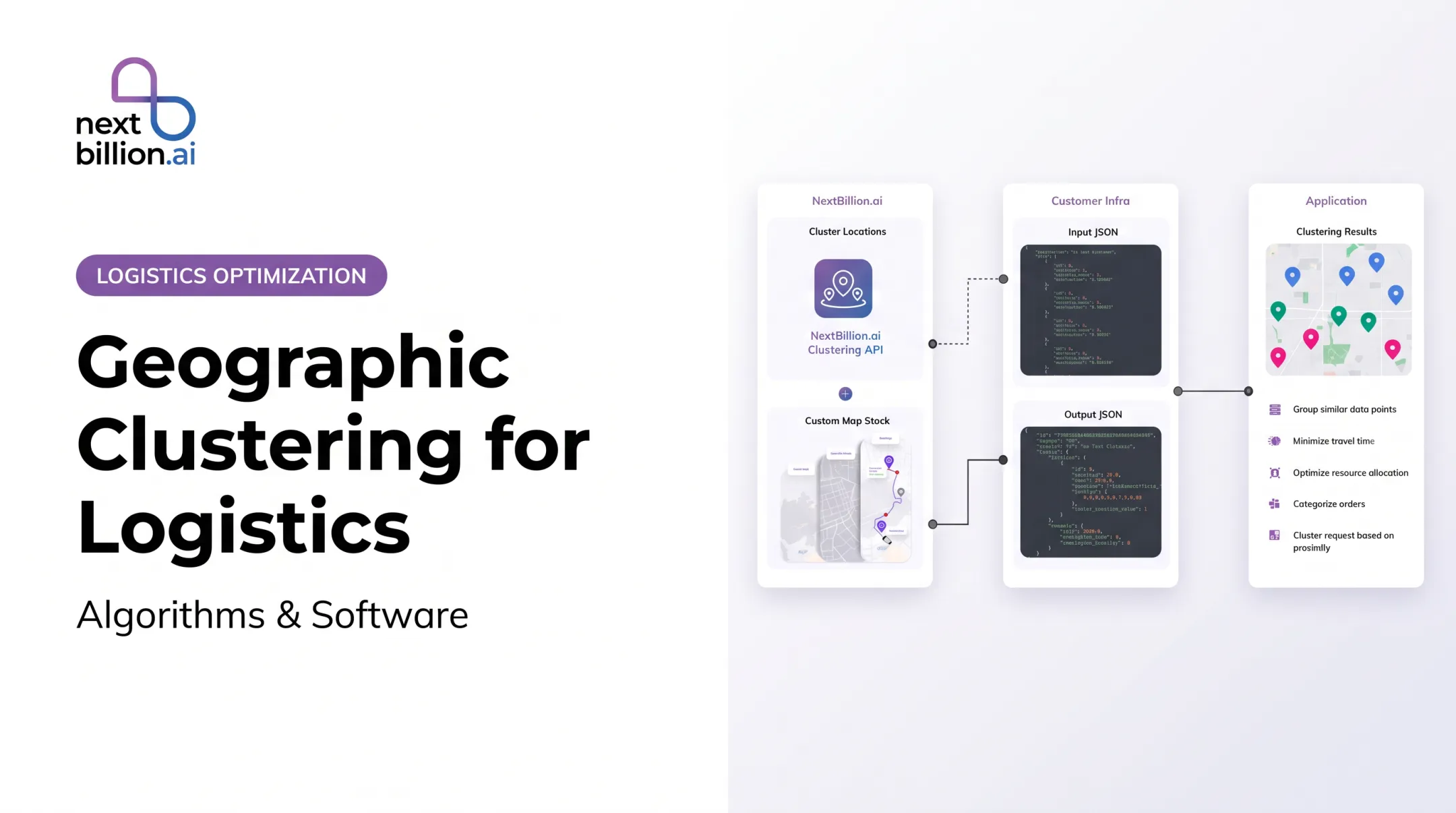
3. Cluster stops by geography, density, and requirements. Grouping nearby stops cuts backtracking. But rigid territories ignore capacity and windows.
Simple clustering puts every stop in one neighborhood on one truck, even when six of them need morning delivery and the truck can't carry the load. Constraint-aware clustering splits the neighborhood by window, weight, and workload. Research on spatiotemporal partitioning makes this same contrast with conventional spatial clustering.
4. Sequence stops around business constraints. A good sequence accounts for windows, appointment length, priority, traffic patterns, loading order, customer availability, and the return to the depot. A distance-minimizing sequence can still produce late arrivals or long waits, because it doesn't know a customer closes at noon.

Levers 5–7: Optimize Assignments and Route Execution
5. Match each route to the right vehicle and driver. Account for:
- Vehicle dimensions, capacity, and cargo type
- Road restrictions such as weight, height, and hazmat routes
- Driver skills, shift length, and breaks
- Federal hours-of-service limits
The FMCSA's hours-of-service summary allows 11 driving hours after 10 hours off, no driving past the 14th consecutive hour on duty, and a 30-minute break after 8 cumulative driving hours. Poor matching causes reassignments, partial loads, overtime, and routes that are impractical or noncompliant.
6. Consolidate compatible orders and plan backhauls. Look at outbound and inbound work together. Scheduled return pickups, reverse logistics, and multi-stop designs reduce empty miles. ATRI's 2025 report put empty mileage at 16.7% for non-tank trucking operations in 2024.
Consolidation has limits. Never let it break time windows, load limits, product handling rules, or service-level commitments.
7. Use dynamic routing with controlled replanning. Road closures, weather, cancellations, failed stops, new orders, and breakdowns make static plans obsolete. But constant changes confuse drivers. Define the rules up front:
- Which events trigger a replan
- How often routes may change
- Who approves exceptions
- How new instructions reach drivers
Research on real-time rerouting after breakdowns explicitly prices route disruption alongside operating cost, because recovery and stability pull against each other. Fewer, smaller changes usually win.
Levers 8–10: Improve Network Balance and Continuous Performance
8. Balance territories, workloads, and depots. Equal stop counts don't mean equal work. Distribute by service duration, capacity, driver hours, and depot proximity. Review overloaded and underloaded territories, multi-depot overlap, and peak-day capacity.
Be careful: workload-equity research by Matl, Hartl and Vidal shows some balancing measures produce longer tours. Equal-looking routes aren't automatically efficient. Weigh density against coverage deliberately.
9. Improve ETA accuracy and exception communication. Visibility cuts second attempts and dispatcher phone time. Cover accurate ETAs, proactive delay notices, proof of delivery, failed-stop workflows, and clear escalation rules.
Customers care. Pitney Bowes' 2022 BOXpoll found 77% want time-of-day tracking. Failed first attempts are costly too: the Loqate survey put the US rate at 8%, at an average of $17.20 each.
10. Build a recurring KPI and feedback loop. After each operating period, compare:
- Planned versus actual arrival times
- Stop duration and distance
- Idle time and route deviations
- Failed delivery reasons
- Fuel or energy use
Test one change at a time where possible, document the result, then update service times, constraints, territories, or dispatch rules. UPS learned this the hard way: per INFORMS, early ORION algorithms didn't work well in the field until the team redesigned around driver practice.

How to Measure Routing Efficiency
Build a scorecard that pairs cost measures with service measures. Declare the cost scope and denominator for each.
| KPI | Formula |
|---|---|
| On-time delivery | Deliveries within window ÷ total deliveries × 100 |
| First-attempt rate | First-attempt completions ÷ deliveries attempted × 100 |
| Empty-mile % | Empty miles ÷ total miles × 100 |
| Vehicle deployment utilization | Vehicles used ÷ vehicles available × 100 |
| Cost per delivery | Delivery operating costs ÷ completed deliveries |
| Cost per mile | Operating costs ÷ total miles |
Also track:
- Distance per order
- Idle time
- Planner hours
- Route adherence
- ETA accuracy
- Customer escalations
Compare Like With Like
Separate urban, rural, long-haul, field service, time-critical, and high-density routes. One universal target will punish rural routes and flatter dense ones.
Set a Review Cadence
- Daily: monitor exceptions
- Weekly: operational review of KPIs and root causes
- Periodically: redesign territories, constraints, and route policies
Skip made-up targets. No single authoritative US benchmark covers trucking, last-mile, and field service together. Check APQC's delivery measures and ATRI's segmented fleet tables for your own segment.
How to Choose and Implement Routing Technology
Evaluate Against Real Constraints
Use this checklist when comparing tools:
- Constraint-based optimization and time-window handling
- Service durations and multi-depot planning
- Truck-compliant, vehicle-specific routing
- Large distance matrices (Google's Routes API caps at 625 elements per request, or 100 with traffic-aware routing)
- Custom maps and road attribute editing
- Live traffic and dynamic replanning
- Reverse logistics and analytics
- Driver communication and API integrations
Implement in Stages
Connect routing to order management, geocoding, telematics, fleet management, dispatch, and customer notifications first. Then stage the rollout:
- Pick a defined pilot territory so results stay measurable
- Document the current baseline for miles, on-time rate, and cost
- Train planners and drivers on the new workflow
- Create a fallback process before expanding beyond the pilot
Where NextBillion.ai Fits
NextBillion.ai is an API-first routing platform for logistics, fleet, and field service operations. Its Route Optimization API supports 50+ hard and soft constraints and up to 10,000 stops in one request. That maps to levers 2 through 7: time windows, service times, capacity, driver skills, depots, and breaks.
Other relevant capabilities:
- Truck-compliant, vehicle-specific routing
- Custom maps and road edits through its Road Editor App
- Large distance matrix computation without a 25x25 limit
- Per-vehicle or per-order pricing instead of per-call billing
- Integrations with Geotab and Samsara
- Deployment on customer infrastructure, including on-premise
Its Clustering API supports territory design (lever 8), and its Geofencing API and Navigation SDK help with route adherence (lever 10).

In one case, Xpress Global Systems compared identical problems on NextBillion.ai and its existing TMS, and reported a 13% drop in average monthly miles while maintaining service levels. Test any vendor against your own data in a pilot.
Frequently Asked Questions
What is the best algorithm for routing?
No single algorithm fits every operation. Vehicle routing problem variants, constraint solvers, heuristics, metaheuristics, and AI-assisted methods each have a place. The right choice depends on fleet size, time windows, vehicle restrictions, response-time needs, and whether routes update in real time.
What does routing optimization mean?
It's the process of selecting routes, stop sequences, vehicle assignments, and timing that best meet operational objectives and constraints. It involves far more than choosing the shortest distance between stops.
What is the difference between route planning and route optimization?
Route planning creates a route or stop sequence. Route optimization evaluates alternatives to reduce cost, time, distance, or service failures under real-world constraints.
How do you measure routing efficiency?
Track cost per delivery, distance per order, on-time delivery, first-attempt delivery, vehicle utilization, route adherence, empty miles, idle time, and ETA accuracy. Segment them by route type.
Can route optimization account for traffic, vehicle limits, and delivery windows?
Yes. Capable systems model live traffic, vehicle dimensions and capacity, road restrictions, driver schedules, service durations, and customer windows, then replan when conditions change.