



- BLOG
Offline Routing & Navigation for Fleets: How to Operate Without Connectivity
Published: June 8, 2026
Route Optimization API
Optimize routing, task allocation and dispatch
Distance Matrix API
Calculate accurate ETAs, distances and directions
Directions API
Compute routes between two locations
Navigation API & SDK
Turn by Turn Instructions for Drivers & Technicians
Route Optimization Software
Plan optimized routes with 50+ Constraints
Product Demos
See NextBillion.ai APIs & SDKs In action
AI Route Optimization
Learns from Your Fleet’s Past Performance
Platform Overview
Learn about how Nextbillion.ai's platform is designed
Road Editor App
Private Routing Preferences For Custom Routing
On-Premise Deployments
Take Full Control of Your Maps and Routing
Table of Contents
The offline routing and navigation facility is a boon for the long-haul truckers, delivery carriers, and local transporters.
Fleet operators leveraging modern technological solutions assume constant connectivity throughout the delivery vehicle’s journey. But reality strikes hard when, while moving in rural areas, construction zones, or cross-border regions, the drivers observe network lag or zero connectivity.
While there are multiple reasons for connectivity breakout in the GPS systems, some logistics firms still rely on real-time connectivity for routing and navigation. The task assessment repeatedly reports missed stops, inefficient re-routing, delayed deliveries, and frustrated drivers.
Even after being the world’s most advanced nation both scientifically and technologically, the United States still struggles to serve consistent internet from end to end. The rural routes in the Midwest, interstate corridors, and mining regions are some of the most portions experiencing non-existent connectivity in worst-case scenarios.
It is 100% true that navigational disturbances incur major impact on the delivery assignments, and routing tools that serve in offline mode give an edge to the situation.
The article uncovers the facts about how connectivity issues trouble route optimization for delivery vehicles. And can platforms like Nextbillion.ai provide a robust and reliable solution to handle offline routing and navigation for enterprise-scale operations?
Gone are the days of delivery drivers keeping a large road map to analyze their position on the geography and figuring out the correct route to the destination. Technology has erased the past, and now the vehicles or drivers have embedded devices for live navigation through digital maps.
Vehicle tracking and route navigation are essential technologies for logistics and transportation businesses. But the interdependence on internet services makes them vulnerable to generating consistent output.
The logistics landscape is expanding globally to diminish international boundaries. Transportation is penetrating unprecedentedly into the rural zones and outskirts that are routed through long and vacant transit roads.
The vast and complex directions on the digital map create confusion in choosing the right path to the destination. A route planner does the job of generating the efficient, safe, and compliant path. But the real test of these tools begins when the vehicle enters an outer area or places that have serious internet network issues. Because the real-time data eventually pauses, that halts the navigation and routing instructions.
Ideal conditions may not persist throughout the journey. Routing solutions should be reliable enough to anticipate availability of resources, like connectivity loss, and serve alternatives to surpass the problem.
Modern platforms like NextBillion understand the vulnerability of internet networks and how essential it is to ensure a backup solution in case of network failure during adverse conditions. Offline routing capability adds a fail-safe layer to the route planner by facilitating the dispatchers to add necessary data, such as delivery locations, fuel stations, etc., on the map.
Most critical issues that offline routing resolves;
Quick tips to hire delivery drivers.
Causes of Network Interference that Trigger Offline Routing and Navigation | |
Jamming | Deliberate tools to regulate satellite signals |
Infrastructure | Building materials and constructions that disrupt network |
Spoofing | False signals that show incorrect signals |
Weather | Severe rainfall, and snowfall impact signal strength |
Physical Blockage | Natural terrain that prevent signal reception |
Outdated System | Damaged cables, fiber-optics, hardware failure, power supply issues |
Developed nations like America face connectivity issues due to the environmental and infrastructural challenges. It is often the feasibility and lower resource utilization that deter the policymakers from strengthening the networks in less demanding regions.
Network-affected areas or potential causes for connectivity troubles can be based on the physical characteristics of the location, geographically dead zones, and artificial signal interference.
The United States is a vast nation with varied environmental conditions, infrastructural differences in rural/urban establishments, and strictly regulated zones.
Here is a brief description of some areas across the country where logistics drivers and commoners have experienced the worst as no internet connectivity for a notable duration. The purpose is to highlight the necessity of an offline routing and navigation facility for transporters.

Popular connectivity risk areas in the USA | ||
Location type | Route | Issue |
High plains | I-80, Wyoming | Vast distance between towers |
Northern Border | US-2, Montana | Remote terrain, no signal for 70 hours |
Dense Metro | Manhattan, NYC | Signal blockage from skyscrapers |
Dessert Corridor | I-40, Arizona | Canyon walls blocking GPS |
Offline navigation systems are now a critical component of the supply chain system. Companies from different segments understand the feasibility of the tool and aptly integrate the appropriate tool with the telematics. There’s a growing need for navigation systems that don’t rely on the internet, especially in industries and regions where connectivity is unreliable.
Logistics Management
Logistics support is required for all sorts of goods and services. Trucks moving across the American continent have to serve every corner and move through different regions. In such cases, it becomes essential for the drivers to have an offline route navigation facility. This ensures service continuity and accurate movement of delivery vehicles even during connectivity loss in some areas.
Oil, Gas, and Renewables (Energy Belts)
The oil wells and pipelines are usually located in remote areas like the Eagle Ford Shale or Permian Basin. Such places have weak cellular networks and therefore require offline navigation to assist field crew, asset inspections, and emergency response.
Mining and Natural Resources
Mining regions in Nevada, Alaska, or Appalachia are privately owned remote lands with unmapped roads and harsh environmental conditions. Offline maps are necessary for heavy vehicle navigation, workers’ safety, and area exploration.
Rural Areas & Last-Mile Delivery
The Midwest region (Kansas, Nebraska,) mountain states, or southern parts have fewer signal towers, causing low connectivity. E-commerce giants like Amazon and Walmart are expanding towards these places and find it difficult to locate their customers in completing last-mile deliveries. Preloaded maps ensure consistent task completion.
Agriculture & Agri-Logistics
Farmlands have critical requirements for offline route mapping to manage crop transportation, tractors, harvesters, etc. Connectivity is usually low in such wide regions.
Forestry & Environmental Services
Dense forest regions in Washington, Idaho, and other places are hard to stabilize signal connectivity in. Along with logistics vehicles, it also troubles timber transport, fire management, and land survey.
Emergency Services
FEMA and state emergency services have faced network vulnerabilities in California, Florida, and other wildfire or hurricane-prone regions. Evacuation, logistics distribution, and field coordination are highly dependent on offline routing and navigation.
Industrial Expansion of Logistics Operations | ||
Sector | Expansion | Requirements |
Retail/E-commerce | Last-mile, returns, micro-fulfilment centers | Same-day/quick delivery |
Healthcare | Cold-chain logistics, home healthcare, medical demands | Temperature-controlled transport, time-critical |
Manufacturing | Machinery, chemicals, heavy industry | Just-in-time inventory, raw & finished goods |
Food & beverage, FMCG | Online grocery, meal delivery | High frequency & volume, perishables, same day |
Automotive | EVs, batteries, and parts logistics (tier 1, 2, 3 suppliers) | Multi-tier supply chains, specialized handling |
Energy | Oil & gas field operations, renewable energy projects | Remote low-connectivity regions |
Technology | Semiconductors, consumer electronics, components | Safety, air freight logistics, high-value transport |
Defence | Domestic manufacturing | Secure supply chain |
Construction | Federal infrastructure, real estate, industrial development | Heavy equipment transit, bulk (steel, cement, etc.) |
3PLs | Fast-growing service layer | Efficiency, scalability |
Technology is not just about development and innovation; it is deeply integrated with all sorts of service industries. Internet connectivity is among the core components of every business segment that keeps the system active and deliverable.
Organizations in the logistics and transport segment understand the need for live tracking, real-time updates, constant navigation, and communication.
While network signals can deceive in critical situations, a reliable offline routing and navigation tool, like NextBillion, can ensure the transit mission stays on its track.
It is essential to understand the consequences of network failure on transportation, where offline route navigation can reduce the adversity of the scenario.
Navigation troubles: Low connectivity can pause map navigation, and drivers can miss the turns or stoppages or unknowingly take the non-compliant road.
Driver’s stress: Straining the memory and roadside signage to stay on the designated route can frustrate the drivers, raising safety concerns. The driver’s shift timings may overshoot with unsuccessful task completion
Disrupting delivery sequence: Courier, grocery, or pharma delivery generates profit margin through cost-efficient delivery sequences and route planning. Connectivity failure with no offline map support will ruin the route plan, and delivery agents may select any drop point randomly.
Fleet tracking issues: The dispatch managers lose control of the vehicles and the delivery progress. Offline navigation increases the probability of task execution according to the plan with minor alterations.
Inaccurate ETAs: Network failure does not update the ETAs, and deliveries can get delayed unexpectedly. But offline maps can at least keep the vehicle on the track to reach the location almost according to the pre-estimated time.
Unsatisfied customers: Missed or untimed delivery schedules and wrong ETAs can irritate the customer and shift their trust towards the competitor.
Enhanced fuel charges: Vehicles detouring from the planned path may make the drivers move extra mile, and with chunks of orders,
Routing is generating the most suitable/efficient path from the origin to the endpoint and covering essential stoppages in proper sequence. Navigation is the directional guidance on the route plan.
Consistent internet connection is imperative for activating route plans and navigation. But to deal with the adverse situation of faulty networks, advanced technology systems have introduced offline routing and navigation. It works even when there is no signal in an area and drives you through the pre-decided path with synced-in delivery locations.
Here the offline routing and navigation must not be confused with “just offline maps” that add vector map data locally to review roads and GPS position. Nor is it “just cached directions” with a pre-computed route with instructions.
A well-suited tool allows re-routing for the drivers using local data and logic in the offline mode, and once the network resumes, the cloud server can reconcile the plan.
Read why holiday calendars matter in multi-region route planning.
There are some critical components of the offline routing and navigation system. Proper consideration of these factors ensures successful results of the tool.
We’ll discuss them in detail to understand the ability of NextBillion APIs in delivering route navigation without connectivity.
Nextbillion Route Optimization API for Offline Routing and Navigation | |
Components | Products and usage logic |
Offline Maps/ Tile caching | Vector tile API, Basemap, App Storage |
On-device Routing Engine | Directions API, Navigation API |
Turn-by-Turn Navigation | Navigation API & SDK |
Route Deviation | Route plans, Snap-to-Roads API, Route Report |
Data Synchronization | Navigation output, Rerouting |
Offline maps serve the purpose of guiding the drivers on the designated route even when they lose network connectivity. The specific route maps are pre-downloaded on the local device and contain all the essential details, such as, roads, labels, images, etc.
Tile Caching: The tile-caching procedure plays an important role in keeping the maps informative and purpose-driven. It stores the image tiles in two common formats, and caching keeps them in the memory to avoid repetitive downloads.
Tile caching is predesigned in one of the two typical patterns.
Difference Between Active & Passive Tile Caching | ||
Parameters | Active | Passive |
Objective | Pre-caching | Automatic caching |
Downloads | All the tiles in a bounded region | Tiles zoomed-in by users |
Storage | SQLite/MBTiles (tile pack) | Local cache (memory) |
Tiles or imagery is synced with the offline maps in a sequence of steps. It begins with task assessment, which is followed by route optimization and journey planning.
With offline maps and a tile caching mechanism, the driver’s app uploads faster with a smoother experience when zooming an area because tiles do not buffer.
Navigation instructions are important for the logistics and transportation industries, as the organization cannot rely solely on the driver’s interpretation of the route plans. Consistent route guidance ensures that the drivers won’t get stuck in no-network zones.
The advanced routing tools like NextBillion are empowered with a device-based compact navigation engine that provides turn-by-turn guidance when internet connectivity is unreliable. Here the GPS quickly restores the driver’s position on the offline map and keeps them on track. Although the live traffic feed is bound to get compromised in offline mode.
There are four main components that work behind the navigation engine when there is low or zero connectivity.
4 Main Components of Offline Navigation Engine |
|
|
|
|
Read how routing algorithms actually decide.
While it appears to be a direct and instant transformation from online to offline mode and vice versa. But the process is quite complex and requires addressing multiple constraints that may disturb the instruction or accuracy levels.
The offline navigation system creates turn-by-turn instructions for the delivery drivers. But the tool’s potential is far more than just computing navigation to the endpoint.
Not just the long-haul trucks transporting cross-border logistics that face connectivity issues at various regions. Even the multi-stop delivery services, such as food delivery, online grocery stores, or e-commerce B2C orders, had to deal with network troubles. The delivery locations are usually at the residential complexes or corporate zones that deal with network issues due to the common urban canyon or huge buildings and metal structures.
Also read about freight forwarding and logistics software and the best tools in 2026.
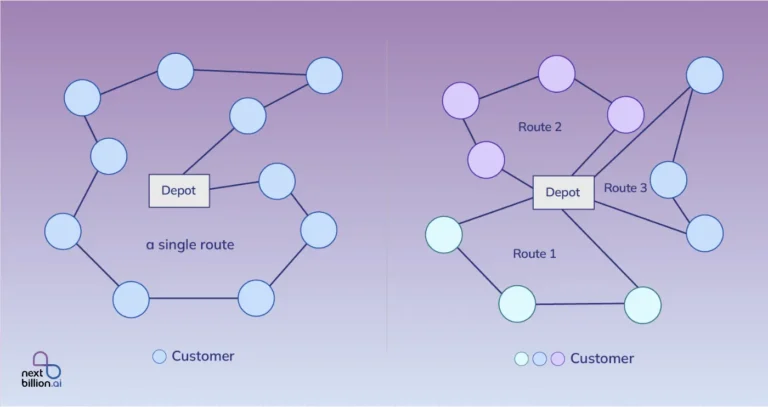
Offline routing is conceptually an integral component of multi-stop delivery services. The transportation tasks are computed through automated routing tools that configure the route plans to efficiently serve maximum orders in a feasible cluster of delivery locations.
With a consistent network during the journey, the drivers get the live feed on the traffic incident and can re-route at any moment to avoid the crowd. They can add stoppages for pickup, change priorities, update order completion, etc., and based on the information, the route plans can be edited.
The offline routing serves the same critical function to the application. Here the entire route plan with time windows, order sequence, priorities, etc. is stored on the device. The driver navigates on the preset path, which stays active even in the offline mode.
But as soon as they need to change the route, for any reason, and reach an out-of-network coverage area, the offline routing mode gets activated. The drivers can still optimize their route to get the direction for their next delivery location and capture progress about arrival and delivery on their device. These details quickly sync with the cloud data as soon as the network gets connected.
If low or zero connectivity switches route navigation to an offline mode, then what would happen when the driver reaches a proper network connectivity zone after some time? Do the live updates and task progress confuse the system? Or does the data overlap from the cloud server and direct the driver to finish the deliveries that were already completed via offline navigation?
Well, neither of these happens! Instead, when the app starts receiving a signal and connects with the cloud, it quickly shares the work progress and current position of the delivery agent. The system adapts to the offline updates and carefully uploads the live traffic, data, and routes. A routing tool with a proper synchronization strategy can seamlessly merge the offline data to the server, keeping the navigation consistent and accurate.
There is a sequence of automated steps performed by the system once it starts receiving a signal.
Types of Offline Data Sync in Routing Tools | |
Attended orders | Completed, failed, rescheduled, timestamps, PODs |
Route deviations | Time of change, distance covered, road details, reason for alteration, impact on fuel, travel time |
Driver behavior | Speed, harsh turns, brakes, crash events, eco-driving, etc. |
Location traces | Coordinates of critical events |
Sync strategy by the routing tool can deeply impact the delivery task and overall business performance. A compromised or low-quality data sync can affect the profit, parcel security, and trust between the parties involved.
Drawbacks of incomplete data sync after offline navigation and routing.
Benefits of accurate sync strategy in offline routing and navigation.
Delivery drivers of logistics or other transport segments always have the liberty to deviate from the planned route whenever they detect an issue moving on the same route. There is a consistent process of rerouting in real-time, which either suggests or adapts deviations in the route plan taken for any particular reason.
But what happens when the connectivity is lost? Can the local routing engine work in offline mode to handle route deviations?
Yes, of course! Advanced routing tools like NextBillion provide SDK files to manage route deviation on local maps whenever the device encounters low or zero connectivity.
When a delivery van deviates from the set path and is out of the network coverage area, the tool fetches its GPS coordinates and navigates the driver through the next possible direction to reach the destination.
NextBillion supports real-time deviation alerts, which strengthens the routing compliance. Read what they are and why every fleet needs them.
Route deviation has multiple consequences on the delivery task. It may increase the total travel distance, time, ETA & ETD, or fuel costs or get charged for regulatory fines or tolls in case there are restrictions. Such details get recorded on local storage and synced once connectivity is regained.
The driver needs a robust app to detect and handle the route deviations once the network resumes. It is a continuous process throughout the journey because the probability of losing connectivity is high in any region, whether it is long-haul trucking or local food and grocery delivery.
The route plan is saved locally on the driver’s app, which keeps monitoring the GPS updates to ensure the position, whether it is within the path or deviated from it. While it ignores the short detours, longer ones are tagged with timestamps and distance. The tool computes a connecting path to the planned stoppage sequence, and if not possible, it finds an alternate route to attend to the delivery tasks in a new feasible sequence.
NextBillion is a core technology company offering an AI-powered route optimization solution with a full stack of routing and navigation tools for enterprises. These are specifically designed for large and complex use cases such as high-volume dispatch, last-mile deliveries, or B2B routing.
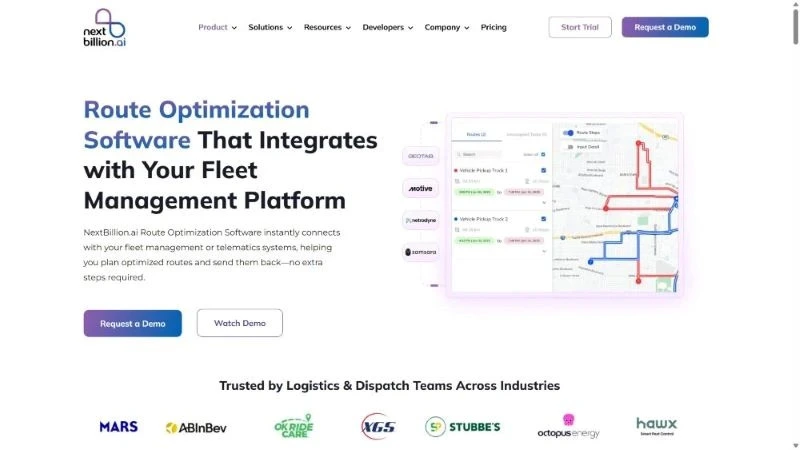
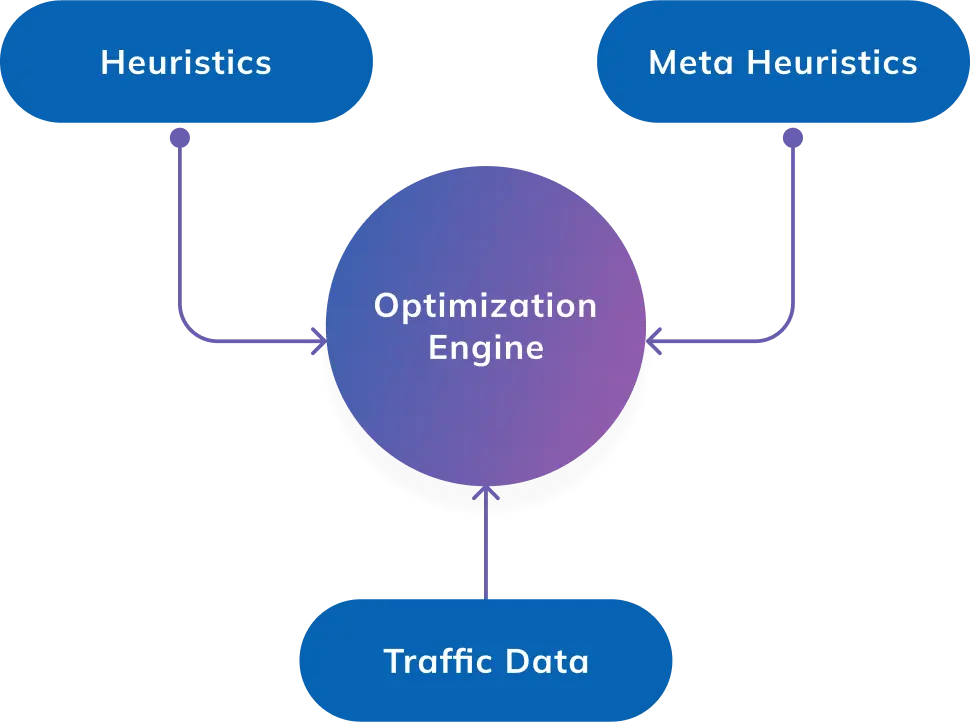
The optimization engine is backed by advanced algorithms that utilize AI with heuristics, metaheuristics, and traffic data to quickly analyze the route possibilities. With the capacity to handle 50+ constraints, NextBillion’s AI route optimization ensures the highest accuracy levels in analyzing the transit requirements, strategically deploying the API resources, and efficiently designing the plan.
Here is a precise list of NextBillion’s routing support tools and their feasibility in generating optimized navigation in offline mode or when connectivity is fluctuating.
Route Optimization API: It has a powerful algorithm to make deep analyses and is backed by AI technology to make quick decisions, specifically in multi-stop deliveries where drivers get confused in choosing delivery sequences and considering different constraints. If the driver loses connection and takes a wrong turn, once they get reconnected, the rerouting process takes seconds to suggest the best possible direction for completing all the orders.
Clustering API: With the clustering API, you can make small groups of delivery locations that are closer to each other, for example, in a closed society or area. Drivers alloted to each cluster can have the delivery plan downloaded on their device, and if the network goes off, they can still navigate on the preset route. Small clusters make small route plans, which are easier to store
Directions API: Considering live traffic and other conditions, the directions API provides the best route between two places on the map. These planned polylines can help you find a suitable path between stoppages via a local engine.
Distance Matrix API: It fetches ETA on the many to many basis and thus computes the most accurate route of the task. To avoid offline stuck, the dispatchers can generate different route options as alternate plans, and drivers can utilize those in downloaded form to know the feasible sequence of order fulfilment.
Snap to Road API: It keeps track of all the past journeys and provides a data-backed comparison of different journeys, while also uses them to create an efficient route. Dispatchers share detailed analysis of different road segments to help drivers make better decisions
Isochrone API: It computes the delivery points that are at equal distance from a particular location and can be helpful in designing route plans for known low-network regions.
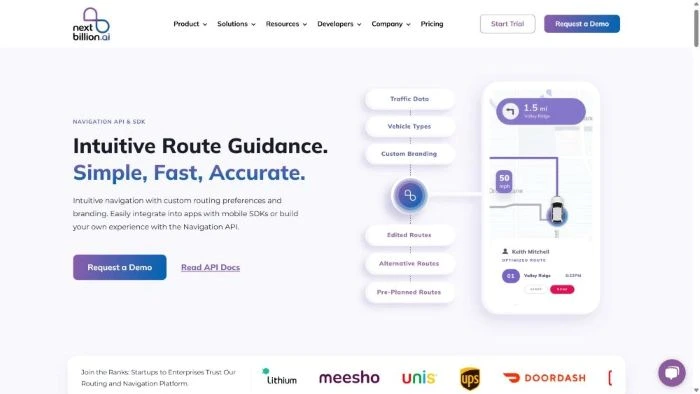
Navigation API & SDK: It serves multiple purposes, like turn-by-turn navigation, rerouting, off-route detection, route guidance, etc. The API designs the route navigation on the map, and the SDK file renders them from cache memory during low or zero networks. While the live traffic conditions cannot be optimized without a server connection, this tool still serves sufficiently via precomputed directions.
Route Report API: It provides a precise report of the completed tasks and contains information about the distance traveled, turns, duration, speed, road segments, etc. You can compare the routes taken during offline mode or generate offline route plans for areas with network issues and where drivers may get misguided without a proper plan.
Geofence API: It can create a virtual boundary on the digital map to control the movement of the vehicles in a known region. With critical route reports about specific regions with network issues, you can create a virtual fence for the drivers to alert them if they tend to deflect from the route at these points.
Route Reconstruction API: It can recreate the actual route taken by the vehicle and calculate the total distance and time taken between specific points. Dispatchers can use it to fetch the details about the portion traveled by the vehicle during the offline mode.
Documents API: You can attach critical documents, like proof of delivery, permits, or design form templates for the drivers. These can be pre-downloaded on the device and can be shown even without network.
Maps API: You can use the vector tiles, raster tiles, and static images to enhance the digital map interface for the users. Add essential details like road names, places, etc. with location-based images that are arranged in tile sets to form a grid structure. These embedded static maps appear without connectivity issues, and you can add images of U-turns, bridges, or name the landmarks, restricted zones, etc. It is quite a suitable solution for offline routing and navigation.
Road Segment API: It can extract important details about the roads, highways, or expressways. You can check for speed limits, weight restrictions, and other information to mark them in the offline map.
Road Editor API: You can add specific instructions, like “Speed below 20 m/hr,” “Gas station ahead,” etc., on each road network. Offline maps become more interactive and useful.
Weather API: It is an additional constraint for routing solutions to generate more feasible routes, specifically for trucks on long-haul deliveries. Extreme weather conditions can ruin the network signals. Forecasting rainstorms or other natural calamities keeps you aware and storing offline navigation maps for the weather-affected regions.
Places API: It is capable of extracting the exact location on the map from an incomplete address. The dispatch managers can look up places around a specific point, find coordinates, get postal codes, search for POIs, and also get auto-suggestions that complete the semi-known locations. This makes it essential in preparing for offline routing and navigation because when the server connection is unstable, the drivers would not be able to look for places in detail.
An offline routing and navigation facility is essential for delivery services. The road network is jumbled; flyovers and tunnels make it difficult for transporters to move without guidance. A drowning network loses live updates and makes the task tougher. But route management through offline maps, GPS positioning, and point-to-point navigation ensures safe, compliant, and successful deliveries with satisfied customers.
We at NextBillion.ai consistently analyze the use cases in different segments of global/domestic logistics and transport businesses. Our developers create powerful and in-depth technology solutions that deliver reliable results. The tool ensures that the delivery vehicles travel no extra miles, finish the trip in a calculated timeframe, and avoid traffic congestion.
Whether it is America or any other part of the world, signals have dead zones or struggle to connect around rural highways, tunnels, ports, industrial yards, and other network-hampering regions. Offline maps with route navigation facilities ensure business continuity in network-affected areas and minimize delays, unnecessary traveling, and broken SLAs.
No, offline maps are a structured combination of imagery or tiles that can display the GPS position of the vehicle on the map and follow the movement. But offline navigation is the route guidance of the vehicle on the map, which is usually optimized and planned or directed through the server and stored for implementation through the local device engine during zero or low connectivity.
Routing tools, like NextBillion, work through cloud connectivity for route planning and optimization where the delivery locations, time windows, and other constraints are analyzed. Dispatch managers share the route plan with the driver through online mode, and the driver can download the same using the driver’s app. They get the complete stoppage list with optimized route geometry.
ETA is estimated time of arrival, which is computed from multiple factors. But live traffic updates are crucial for generating accurate ETAs. It’s impossible to get live traffic updates without connectivity. So in offline mode, the ETAs are based on static and historical data, such as speed profiles in specific road segments, route geometry, road conditions, regular traffic conditions, etc.
The navigation API works around factors like vehicle data, which includes category, load type, fuel, etc. Then there are pre-planned routes and ERP data for orders and delivery points. In offline mode the navigation app collects all the events in the local memory, and once the network is resumed, the progress or buffered data gets synced to the telematics. So the dashboard, KPIs, and schedules are regularly maintained.
Nitesh Malviya is a research-oriented professional with a background in Computer Science & Engineering. He served for 7 years as a software consultant and wrote passively in the tech niche before becoming a full-time technical writer.