
Distance Matrix API
NextBillion.ai vs. Google Maps

Save up to 60%, achieve on-par ETA accuracy and compute large matrices in seconds with NextBillion.ai's API.

Request a Demo

Top 3 Reasons Why Businesses Switch to NextBillion.ai
tick

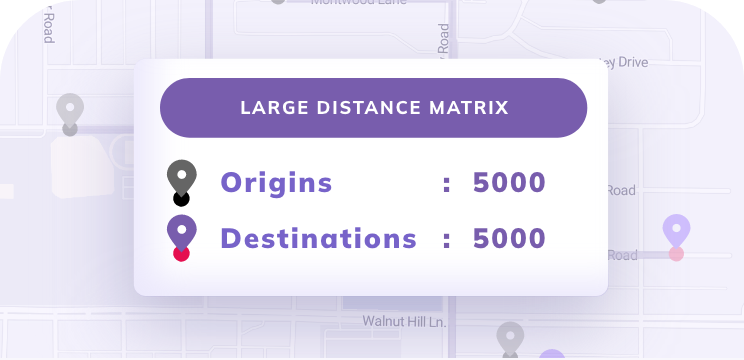
5000 x 5000 matrix size support with low latency

Unlike Google's standard 25 x 25 matrix, NextBillion.ai’s API offers matrix sizes of up to 5000 x 5000 elements. Our API's performance is optimized to generate accurate ETAs and handle large matrices at very low latencies.
tick

Flexible pricing for predictable costs

NextBillion.ai offers custom pricing based on the number of orders, assets or API calls, ensuring predictable costs. In contrast, Google's per API call fixed cost and feature-based pricing may not align with heavy distance matrix usage.
tick

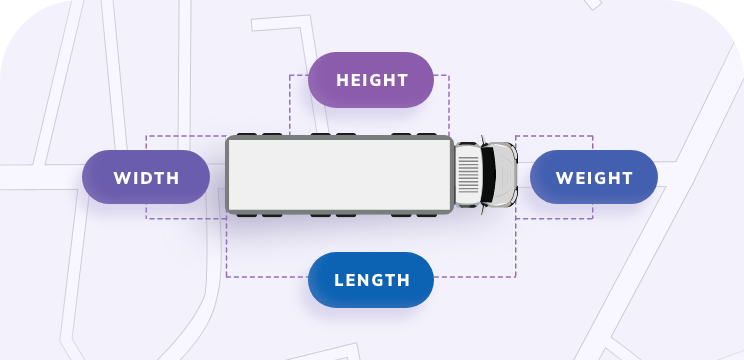
Truck-specific optimal routes

NextBillion.ai offers out-of-the-box support for truck routing, a feature missing in Google Distance Matrix API. Our system takes into account truck dimensions and type of goods for more efficient and regulation-compliant routing and navigation.

Join the Ranks: Startups to Enterprises Trust Our Routing and Navigation Platform.

Logo wrap
Logo wrap
Logo wrap
Logo wrap
Logo wrap
Logo wrap
Logo wrap
Logo wrap
Logo wrap
Logo wrap
Logo wrap
webb
Logo wrap
Logo wrap
Logo wrap
Logo wrap
Logo wrap
Logo wrap
Logo wrap
Logo wrap
Logo wrap
Logo wrap
Logo wrap
webb

Engineers and Developers’ Take on Us

G2 Badge G2 Badge G2 Badge G2 Badge G2 Badge
NextBillion.ai Google Maps
Ease of setup
9.4/10
8.5/10
Ease of admin
9.4/10
8.4/10
Quality of support
9.6/10
8.8/10
Has the product been a
good partner in doing business?
9.6/10
8.6/10
Product Direction(% positive)
9.7/10
9.1/10

How much
could you save?

NextBillion.ai has a standardized pricing structure for all its features — no unexpected cost spikes. In contrast, Google’s standard version lacks features like departure time-based routes, requiring an upgrade to the ‘Advanced’ version that costs double.

Save up to

40%

compared to
Google
Distance Matrix
Standard API

Save up to

60%

compared to
Google
Distance Matrix
Advanced API

FEATURE COMPARISON

NextBillion.ai Distance Matrix API vs
Google Distance Matrix API

Features NextBillion.ai Distance Matrix API Google Distance Matrix API
Historical and real-time traffic tick Yes tick Yes
Global map data coverage tick Yes tick Yes
Matrix size supported 5000 x 5000 25 x 25
Latency and throughput 2X-3X lower latency
10X-20X higher throughput
Average
Support for truck-specific routes tick Strong
Flexible pricing options, including unlimited simulations/dry runs
tick No
Avoid options Provides flexibility to avoid service roads, u-turns and sharp turns. Lacks options to avoid service roads, u-turns and sharp turns.
Routing and map customizations tick Advanced tick No
Complementary APIs & map tools Available for end-to-end workflows Limited options
Custom pricing tick Yes
Flexible pricing options.
tick No
Fixed and restrictive pricing
Customer support tick Superior product support Standard
Support for on-prem deployment tick Yes tick No

Customers Who Switched
From Google Maps to NextBillion.ai

A great product that fills a distinct hole in the market.

NextBillion solves the problem of providing a high-performance mapping platform at scale. We use them to generate large distance matrices that we use to solve unique geospatial routing problems that arise in the short-haul trucking industry. We generate efficient delivery schedules in real time for hundreds of vehicles, so distance calculations need to be fast and reliable.

James Nebeker,
Machine Learning Engineer, TruckIT

NexBillion.ai Routing API
fast and easy to use

Switching from the Google to Nextbillion.ai routing was easy and has made our app faster and more robust. In addition, the number of calls to the API to get the same result set has decreased dramatically… Nextbillion.ai takes fewer API calls than Google for the same result sets and is more responsive.

Allan Wallace
Prostock Livestock

Support very good
and friendly

Nextbillion provide the maps distance calculation with the low price but high value service to us. Nextbilions has help us reduce the cost and provide the same service as google!

Chi Hwe Teo,
Technical Lead, ZUS Coffee

NextBillion.ai reduced Printo spends
on distance matrix API by almost 58%!

The integration process is quick and the nextbillion's team responds quickly for any queries we have. It reduced our spends on distance matrix API by 50% as we used to use Google Maps API before.
Sai Ram Teja,
Program Manager, Printo

Frequently asked questions

NextBillion.ai is a strong alternative to Google Distance Matrix API for businesses that require large-scale, customizable and cost-effective distance and travel-time calculations. It supports matrices of up to 5,000 × 5,000 elements, traffic-aware ETAs, truck-specific routing, custom maps and advanced route-avoidance preferences. Its flexible pricing and complementary routing, optimization and navigation APIs also make it suitable for high-volume, end-to-end logistics workflows.

For large-scale calculations, NextBillion.ai can process matrices of up to 5,000 × 5,000 elements, allowing businesses to calculate distances and travel times across thousands of origins and destinations with fewer requests. Google Distance Matrix API is limited to 25 origins or 25 destinations per request, requiring large datasets to be divided into multiple batches. Even Google’s newer Compute Route Matrix supports up to 625 elements, or 100 with traffic-aware optimal routing. NextBillion.ai is therefore better suited to high-volume logistics and fleet-planning workloads.

NextBillion.ai can process distance matrices of up to 5,000 × 5,000 elements, making it suitable for large fleets and high-volume routing workloads. In comparison, Google Distance Matrix API allows a maximum of 25 origins or 25 destinations and up to 100 elements per request. NextBillion.ai therefore enables businesses to process significantly larger origin-destination datasets with fewer API calls and less request batching. Read more here.

NextBillion.ai is designed for high-volume distance and travel-time calculations, with support for matrices of up to 5,000 × 5,000 elements. Larger matrices reduce the need for request batching and repeated API calls, helping improve overall processing efficiency. According to NextBillion.ai’s published comparison, its API can deliver 2–3 times lower latency and 10–20 times higher throughput than Google Distance Matrix API. Actual performance may vary by matrix size, traffic settings, geography and workload, so businesses should validate results using their own operational data. Read the guide here.

Yes. Both NextBillion.ai and Google Distance Matrix API use historical and real-time traffic data to calculate traffic-aware ETAs. NextBillion.ai can generate distance and ETA matrices using current traffic conditions or typical traffic patterns for a specified departure time. Google returns its duration_in_traffic estimate when a valid departure time is included in a driving request, combining historical traffic patterns with live conditions. However, Google traffic-enabled requests are billed at a higher rate and are limited to 100 elements per request.

Yes. NextBillion.ai’s Distance Matrix Flexible API can calculate truck-specific distances and travel times using parameters such as vehicle height, width, length, total weight, axle load, hazardous cargo type and emission classification. It uses these details to identify roads suitable for the configured truck and avoid incompatible or restricted routes. Businesses can also apply departure times, traffic conditions and preferences such as avoiding tolls to generate more operationally accurate distance and ETA matrices.

Yes. NextBillion.ai supports custom maps and private road edits through its Map Editor. Businesses can define road-access permissions, closures, custom speed limits, turn restrictions and truck-specific limits based on vehicle dimensions or weight. The Distance Matrix API also supports preferences for avoiding or excluding toll roads, highways, service roads, U-turns and selected turn types. These controls help ensure that calculated distances and ETAs reflect the roads a fleet can or is permitted to use.

NextBillion.ai offers flexible pricing based on orders, assets or API calls, allowing businesses to choose a billing unit that aligns with their operational model and expected volume. Google Distance Matrix API charges per matrix element, the number of origins multiplied by the number of destinations with separate pricing for standard and advanced traffic-enabled requests. Since element-based costs can increase rapidly with matrix size and repeated calculations, NextBillion.ai can provide greater cost predictability for high-volume workloads. Final costs should be compared using actual matrix sizes, traffic requirements and monthly usage.

Yes. NextBillion.ai Distance Matrix API can be integrated with Route Optimization API to support task assignment, vehicle allocation and route sequencing. Optimized routes can then connect with Directions API, Navigation API and SDKs for turn-by-turn driver guidance. Businesses can also combine it with live tracking, geofencing and driver-assignment tools or integrate it into their existing TMS, ERP, dispatch and fleet-management systems.

Migration can be completed in phases. Developers can map existing origins, destinations, travel modes, departure times and avoidance settings to NextBillion.ai’s Distance Matrix API, then run both APIs in parallel to compare distances, ETAs, latency and costs. NextBillion.ai offers a free evaluation in which its solutions team helps businesses test the API with their technology stack, operational data and routing requirements. The exact migration effort depends on how deeply Google-specific request formats and responses are embedded in the existing application. To know more in details, feel free to get in touch with our tech team.

Maximize cost-effectiveness with a feature-rich API.
Switch to NextBillion.ai

Request a Demo