


Table of Contents
Traffic does more than slow vehicles down. Left unmanaged, it becomes a critical operational bottleneck for the logistics industry, leading to unexpected stoppages, delayed deliveries, missed SLAs, and frustrated customers. What starts as a minor road incident can quickly escalate into a costly disruption, impacting planning accuracy, on-time performance, and customer trust across the delivery network.
Traditional traffic data only tells part of the story. By focusing on congestion levels and average speeds, it leaves operations teams blind to the real causes of disruption such as accidents, road closures, construction zones, and temporary restrictions.
This is where the Traffic Incidents API comes in. In this blog, we break down the Traffic Incidents API,what it is, why it matters, and when to use it.
What is Traffic Incidents API by NextBillion.ai?
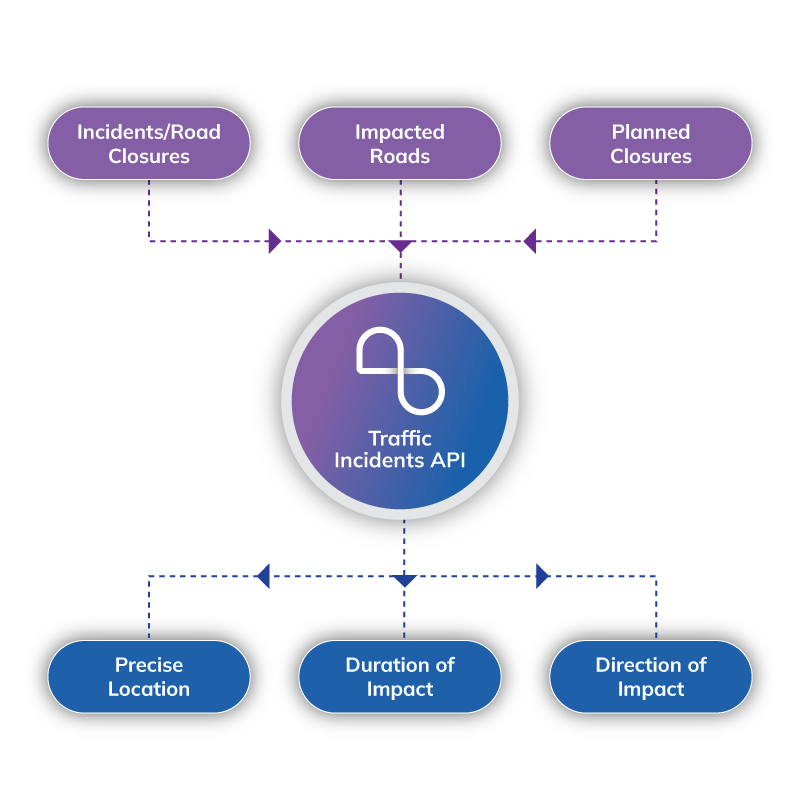
The NextBillion.ai Traffic Incidents API provides real-time, incident-level intelligence about road events that disrupt logistics and fleet operations. It captures critical disruptions such as accidents, road closures, construction zones, lane blockages, and temporary restrictions that directly impact route feasibility and delivery timelines.
Unlike basic traffic feeds that focus on congestion or speed, NextBillion.ai delivers context-rich incident data, including precise location, incident type, severity, direction of impact, and duration.
This depth of detail enables routing and dispatch systems to understand not just that traffic is slow, but why it’s happening, so they can respond proactively.
Incident Types Supported by the Traffic Incidents API
- Accident – Traffic collisions that partially or fully block roads or lanes, often causing sudden delays and safety risks.
- Fog – Low-visibility conditions that reduce safe driving speeds and impact long-haul and highway routing.
- Dangerous Conditions – Road hazards such as debris, fallen objects, or unsafe surfaces that affect route safety and vehicle handling.
- Rain – Heavy rainfall events that slow traffic flow, increase braking distance, and raise the risk of secondary incidents.
- Ice – Icy road surfaces that significantly increase accident risk and may require rerouting or speed adjustments.
- Jam – Severe congestion caused by incidents or disruptions, distinct from normal peak-hour traffic.
- Lane Closed – Partial road restrictions where one or more lanes are unavailable, reducing road capacity and increasing travel time.
- Road Closed – Complete road shutdowns due to accidents, emergencies, flooding, or planned works, requiring immediate rerouting.
- Road Works – Construction or maintenance activity that introduces lane reductions, detours, or temporary speed limits.
- Wind – Strong wind conditions that affect high-profile vehicles, bridges, and exposed road segments.
- Flooding – Water-covered or submerged roads that may be unsafe or impassable for vehicles.
- Broken Down Vehicle – Disabled vehicles obstructing lanes or shoulders, often causing localized slowdowns or sudden bottlenecks.
Read the technical documentation to understand how to integrate the NextBillion.ai Traffic Incidents API.
Why NextBillion.ai Takes an Incident-First Approach to Routing
For logistics and fleet operations, delays rarely come from traffic alone, they come from unexpected road events. A single unaccounted accident or closure can break carefully planned routes, cause missed SLAs, and trigger costly downstream delays.
NextBillion.ai embeds traffic incident intelligence directly into routing, navigation, and ETA workflows. This enables operations teams to detect disruptions early, replan routes dynamically, update ETAs in real time, and maintain service reliability, without relying on manual intervention or reactive firefighting.
Why Incident-Level Traffic Intelligence Matters
Traffic congestion alone doesn’t explain delivery risk. What really disrupts logistics operations are unexpected road events, accidents, road closures, construction work, and temporary restrictions that can change routes in real time. Without visibility into these incidents, routing systems rely on assumptions and often react only after delays have already affected operations.
Incident-level traffic intelligence provides the missing context. By understanding what is happening on the road, where it’s occurring, and how long it’s likely to last, operations teams can make informed decisions before disruptions escalate. This enables proactive rerouting, more accurate ETAs, improved SLA adherence, and greater operational resilience, turning traffic from an unpredictable variable into a manageable part of fleet operations.
When Should You Use the NextBillion.ai Traffic Incidents API?
The Traffic Incidents API is designed for use cases where precision, reliability, and time-bound execution matter most. This includes long-haul trucking, high-volume last-mile delivery, field service operations, and urban mobility platforms operating in dynamic road environments.
It becomes especially valuable during peak traffic hours, in dense urban areas, and across regions with frequent construction or temporary restrictions where static routing and speed-based traffic data fail to reflect real-world conditions.
How the Traffic Incidents API Can Integrate Into Your Workflows
The Traffic Incidents API integrates seamlessly with NextBillion.ai’s routing, navigation, and ETA services to fit directly into your existing planning and execution workflows. When an incident occurs, impacted routes are automatically identified, alternative paths are recalculated, and ETAs are updated in real time before disruptions spread across operations.
By combining live incident data with operational routing constraints such as vehicle type, road eligibility, permits, and compliance rules, NextBillion.ai enables truly incident-aware routing that mirrors real-world fleet operations. Teams can respond faster to on-ground disruptions, maintain accurate delivery timelines, and ensure routing decisions remain compliant and operationally feasible.
To learn how the Traffic Incidents API can be embedded into your current systems and workflows, get in touch with our technical team for a tailored integration walkthrough.
When Should You Use a Traffic Incidents API?
A Traffic Incidents API is most valuable in operations where timing, reliability, and real-time decision-making are critical. It is especially useful for logistics teams managing high delivery volumes, strict SLAs, and constantly changing road conditions where even a minor accident or closure can quickly cascade into missed deliveries and network-wide delays.
Beyond knowing that an incident exists, teams need to know whether it impacts their operations. By retrieving traffic and weather incidents within a defined bounding box, radius, or along a planned route, operations teams can focus only on disruptions that matter to them. This allows systems to surface timely, relevant, and actionable alerts instead of overwhelming drivers and dispatchers with unnecessary information.
Using bounding box–based or route-aware incident queries, teams can deliver real-time incident notifications directly to driver apps or operations dashboards. Incidents can be detected near a driver’s current location or ahead on their route, enabling proactive rerouting, accurate ETA updates, and faster decision-making. This level of targeted visibility helps maintain service reliability even in dense urban areas, peak traffic hours, or regions prone to frequent accidents, construction, or temporary road restrictions.
Wrapping Up
Traffic disruptions are no longer occasional exceptions, they are a constant operational challenge for logistics and fleet teams. Relying only on congestion or speed-based traffic data leaves critical gaps, forcing teams to react after delays have already occurred.
By using the NextBillion.ai Traffic Incidents API, organizations gain real-time, incident-level visibility into road disruptions that directly impact routing and delivery performance. This enables proactive rerouting, more accurate ETAs, stronger SLA adherence, and more predictable operations at scale.
With incident-aware intelligence built into routing and dispatch workflows, traffic becomes a manageable variable rather than an unpredictable risk, helping teams deliver with confidence, even in the most dynamic road conditions.
Looking for a customized solution to your routing needs? Get in touch with our tech team.
Ready to get started?
Request a DemoTable of Contents
Subscribe to our Newsletters
Get the best practices for route planning & optimization, delivered to your inbox.
Subscribe