


what avoid toll means

What ‘Avoid Tolls’ Really Means in Navigation Apps (And When It Fails)

Published: March 6, 2026

Most navigation apps include an “Avoid Tolls” setting that promises to help drivers save money. At first glance, it seems simple – turn it on, and the app will steer you away from toll roads.

In reality, the feature works as a routing preference, not a guarantee. Whether you’re using apps like Google Maps or Waze, the system relies on map data, traffic conditions, and available road networks to calculate alternatives. In some cases, toll roads still appear in the suggested route.

This guide explains what “Avoid Tolls” actually does, why it sometimes fails, and when you should or should not rely on it.

What ‘Avoid Tolls’ Really Means in Navigation Apps

“Avoid Tolls” is a routing preference in navigation apps that instructs the routing engine to exclude roads marked as toll segments when calculating directions. The system attempts to generate an alternative path that minimizes or removes toll charges.

However, the feature depends on map data accuracy, regional coverage, and routing constraints. In some cases, toll roads may still appear in the suggested route.

What Does “Avoid Tolls” Actually Do in Navigation Apps?

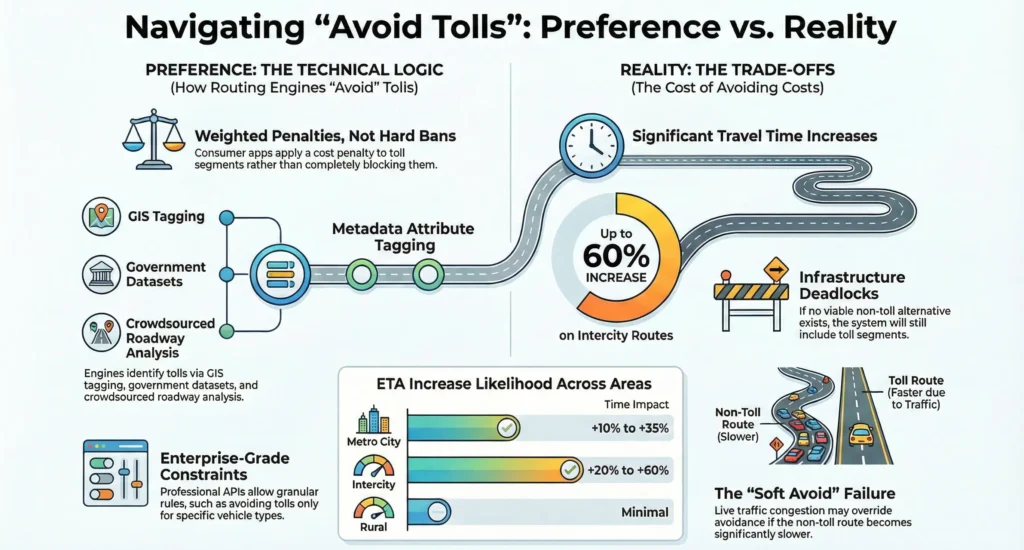
When you enable “Avoid Tolls,” the navigation engine adjusts its routing logic to deprioritize roads marked as toll segments. Instead of selecting the fastest or shortest path by default, the system recalculates the route to reduce or eliminate toll road usage, where alternatives exist.

In most consumer apps, this is not a strict ban. It is a weighted preference within the routing algorithm.

How It Works at a Technical Level

Navigation systems such as Google Maps, Apple Maps, and Waze rely on graph-based routing engines. Roads are modeled as connected segments (edges), each with attributes such as speed limit, traffic data, turn restrictions, and toll status.

Here’s what happens behind the scenes:

1. Uses Map Metadata That Labels Toll Segments

Each road segment in the digital map contains metadata. If a segment requires payment, such as a toll highway, bridge, or tunnel, it is tagged accordingly by the map provider.

The routing engine reads this attribute before calculating the path.

2. Applies Route Penalties Instead of Hard Exclusions

Most consumer apps do not completely block toll roads. Instead, they assign a cost penalty to those segments.

This means:

  • Toll roads are treated as “expensive” in the routing calculation.

  • The algorithm attempts to minimize total route cost (distance + time + penalties).

  • If avoiding tolls creates an extremely long or impractical route, the engine may still include a toll segment.

This approach ensures the app can always return a viable route even when non-toll alternatives are limited.

3. Re-Optimizes Based on Distance, ETA, and Traffic

After applying toll penalties, the system recalculates the best available path. It balances:

  • Estimated travel time (ETA)

  • Distance

  • Live traffic conditions

  • Road classifications (highway vs local roads)

  • Turn restrictions

If traffic congestion makes a non-toll route significantly slower, the app may weigh whether the time impact justifies strict avoidance.

Comparison Table: Hard Avoid vs Soft Avoid

Criteria

Hard Avoid

Soft Avoid (Most Common)

Toll road usage

Completely excluded

Penalized but not fully excluded

Route availability

May return no route

Always returns a route

ETA impact

Often higher

Optimized balance

Real-world usage

Enterprise APIs

Consumer navigation apps

“Avoid Tolls” is a routing preference, not a guarantee. Its effectiveness depends on:

  • Map data accuracy

  • Road network density

  • Real-time traffic conditions

  • Algorithm design

Understanding this helps explain why toll roads sometimes still appear, even when the setting is enabled.

modes

How Do Navigation Apps Identify Toll Roads?

Navigation apps identify toll roads through map data that labels specific road segments with toll attributes. These tags signal that a driver must pay to use that portion of the road, whether it’s a highway, bridge, tunnel, or managed lane.

When you request directions, the routing engine reads these attributes before calculating the optimal path.

Data Sources Used by Major Apps

Most navigation platforms do not build every map layer from scratch. They rely on a mix of proprietary data, licensed datasets, and third-party providers.

  • Google Maps – Uses Google’s mapping ecosystem, which combines proprietary mapping, public datasets, and user contributions.

  • Apple Maps – Builds on Apple’s in-house mapping infrastructure and curated regional data sources.

  • TomTom – Supplies global digital map data to consumer and enterprise platforms.

  • HERE Technologies – Provides enterprise-grade map layers, including detailed road attributes and regulatory information.

These providers maintain structured road graphs where each segment contains metadata such as:

  • Road classification

  • Speed limits

  • Turn restrictions

  • Access controls

  • Toll status

The “toll” attribute is one of many properties used during route calculation.

Common Toll Identification Methods

Toll data accuracy depends on how the information is collected and updated. Providers typically combine several methods.

1. Manual GIS Tagging

Geographic Information System (GIS) specialists manually review and tag road segments that require payment. This method ensures structured and verified classification, especially for major highways.

2. Government Road Authority Datasets

Public agencies often publish official records of toll roads, pricing zones, and electronic toll systems. Map providers ingest and standardize these datasets into their routing models.

3. Crowdsourced Updates

Drivers may report newly introduced tolls, removed toll booths, or incorrect classifications. Platforms that support user contributions can use this input to refine their maps more quickly.

4. Satellite and Roadway Analysis

High-resolution satellite imagery and roadway surveys help identify infrastructure patterns such as toll plazas, gantries, or controlled-access lanes. These observations are validated before being applied to the map.

Why Identification Can Still Be Imperfect

Even with multiple data sources, toll identification may lag behind real-world changes. Dynamic toll lanes, congestion pricing zones, and newly built expressways can introduce inconsistencies until map updates propagate.

As a result, the accuracy of “Avoid Tolls” depends heavily on how current and complete the underlying toll metadata is in a given region.

avoid tolls

Why Does “Avoid Tolls” Sometimes Fail?

“Avoid Tolls” can fail when the routing engine cannot calculate a practical path without using toll roads or when the toll data behind the route is incomplete, outdated, or incorrectly classified. In most consumer apps, toll avoidance is treated as a preference, not an absolute restriction.

As a result, the app may still include toll segments under certain conditions.

Common Failure Scenarios

1. No Non-Toll Alternative Exists

In some regions, especially around major metro areas, toll highways are the only high-capacity routes connecting key corridors. If every viable path includes a toll segment, the routing engine has two options:

  • Return no route at all (rare in consumer apps)

  • Include the toll road despite the preference

Most navigation platforms choose the second option to ensure usability.

2. Map Data Incorrectly Tags Toll Segments


Routing accuracy depends on how toll attributes are labeled in the map database. If a segment is:

  • Missing a toll tag

  • Incorrectly classified as non-toll

  • Recently converted to a toll road

The system cannot avoid it because the metadata does not reflect reality. Apps like Google Maps and Apple Maps update map layers regularly, but regional changes can create temporary gaps.

3. Partial Toll Roads Are Unavoidable

Some highways include short toll sections within otherwise free corridors. For example:

  • Toll bridges along free highways

  • Managed express lanes

  • Urban bypass segments

If avoiding a small toll section would require a long detour, the algorithm may still include it to prevent excessive travel time or distance.

4. Traffic Conditions Override Avoidance Preference

Routing engines optimize across multiple variables like distance, ETA, congestion, and road hierarchy.

If live traffic makes the non-toll route significantly slower, the algorithm may prioritize arrival time over toll avoidance. In such cases, the app balances:

  • Time cost

  • Fuel impact

  • Route complexity

  • User preference weight

Because “Avoid Tolls” often applies a penalty rather than a hard exclusion, traffic-heavy conditions can override it.

5. Regional Toll Rules Differ (Time-Based or Dynamic Tolls)

Not all toll systems are static. Some regions use:

  • Time-of-day congestion pricing

  • Variable toll rates

  • High-occupancy toll (HOT) lanes

If the toll applies only during certain hours or depends on vehicle type, the routing engine must interpret complex rules. If that logic is incomplete or simplified, the route may not align with user expectations.

The Core Reason Behind Most Failures

“Avoid Tolls” operates within a broader optimization framework. It does not remove toll roads from the map. It adjusts their weight in the routing calculation.

When infrastructure, data quality, or traffic conditions limit viable alternatives, the system may still choose a toll segment to preserve route feasibility.

Comparison Table: Failure Causes vs Impact

Failure Cause

What Happens

User Impact

No alternate road

Toll road included

Higher cost

Outdated map data

Toll not avoided

Unexpected charge

Traffic override

Faster toll route suggested

Confusion

Complex toll zones

Partial toll usage

Inconsistent behavior


When Should You Use “Avoid Tolls”?

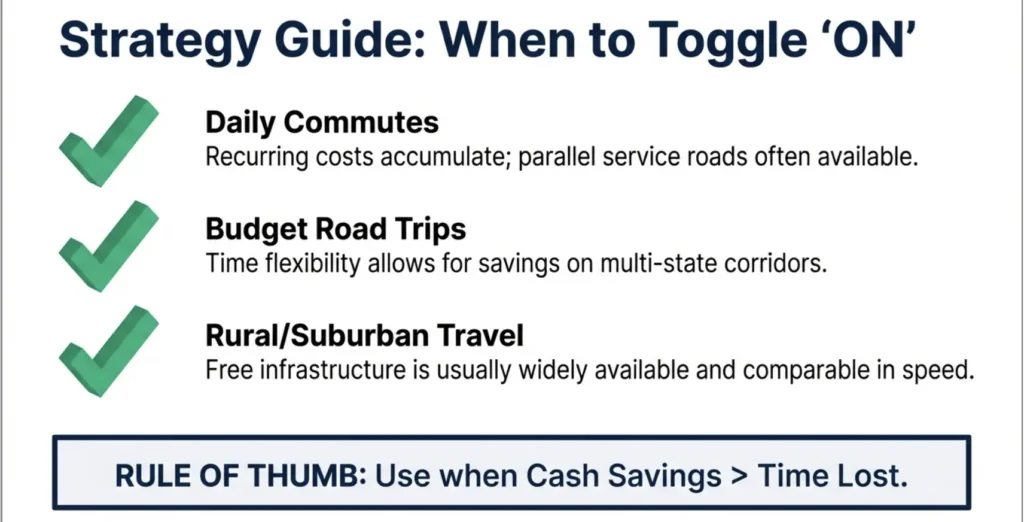
You should use “Avoid Tolls” when reducing out-of-pocket costs is more important than minimizing travel time and when a practical non-toll alternative exists. The setting works best in regions with dense road networks where free highways or arterial roads can serve as substitutes.
strategy guide
In these situations, the time trade-off is predictable and manageable.

Ideal Use Cases


1. Daily Commuters Avoiding Recurring Toll Fees

For drivers who travel the same route every day, toll charges can accumulate quickly. Even small per-trip fees add up over weeks and months.

If the non-toll route increases travel time by only a few minutes, the cost savings may outweigh the delay. This is especially relevant in cities where parallel service roads run alongside toll highways.

2. Delivery Fleets Optimizing Cost per Route

Fleet operators often measure performance using cost-per-mile or cost-per-stop metrics. Avoiding tolls can reduce variable expenses across high-volume operations.

However, fleet managers must balance toll savings against:

  • Driver labor costs

  • Fuel consumption

  • SLA commitment

In cost-sensitive deliveries where timing is flexible, enabling toll avoidance can improve margin control.

3. Budget Road Trips

Long-distance travelers looking to reduce overall trip expenses may prefer toll-free routes. While the journey may take longer, the savings can be significant across multi-state travel corridors.

This approach works best when:

  • The alternative route does not dramatically increase fuel use

  • Traffic congestion is moderate

  • Travel deadlines are flexible

4. Rural or Suburban Travel

In many rural and suburban areas, toll roads are limited or optional. Enabling “Avoid Tolls” in these regions typically results in minimal travel disruption because free road infrastructure is widely available.

In such environments, the setting functions predictably and rarely forces major detours.

When It Makes Strategic Sense

Use “Avoid Tolls” when:

  • You have time flexibility

  • Route alternatives are well-developed

  • Cost savings are measurable

  • Minor ETA increases are acceptable

If time sensitivity is high such as airport transfers, emergency trips, or tight delivery windows the trade-off may not justify enabling the setting.

Comparison Table: Cost vs Time Trade-Off

Scenario

Toll Route

Avoid Toll Route

Distance

Shorter

Longer

Travel time

Faster

Slower

Fuel usage

Lower

Higher

Monetary cost

Higher

Lower

When Should You NOT Rely on “Avoid Tolls”?

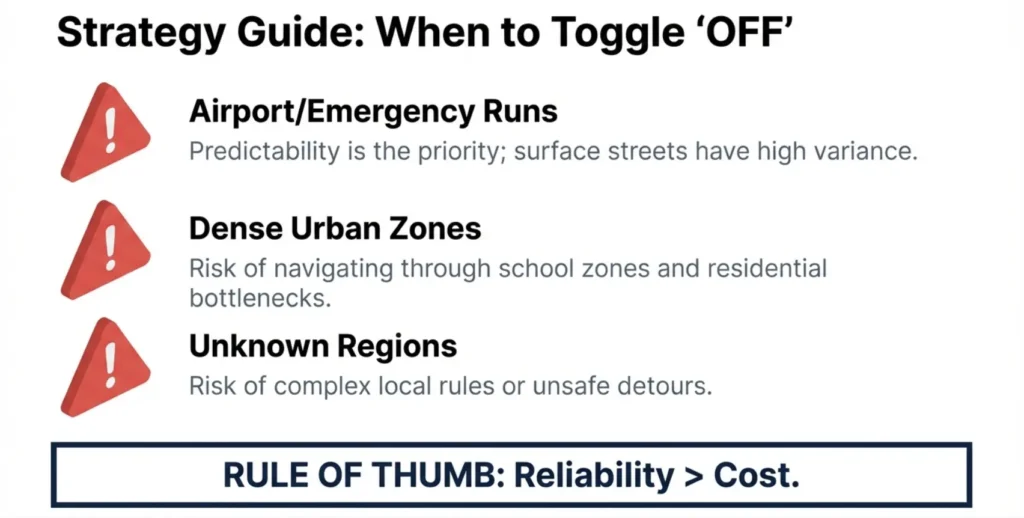
You should not rely solely on “Avoid Tolls” when arrival time, regulatory compliance, or infrastructure constraints matter more than cost savings. In these cases, the trade-off between toll avoidance and route efficiency can introduce delays, uncertainty, or operational risk.
strategy guide
The feature is a preference, not a guaranteed routing rule.

Risk Scenarios

1. Urban Congestion Zones

In dense metro areas, toll highways often function as primary traffic relievers. Avoiding them may redirect you to:

  • Surface streets with frequent signals

  • School and residential zones

  • Roads with unpredictable congestion

In peak hours, the non-toll alternative can significantly increase travel time. For city driving where predictability matters, toll corridors may provide more consistent ETAs.

2. International Travel with Dynamic Toll Pricing

Some regions use congestion pricing or time-based toll systems. Charges may vary by:

  • Time of day

  • Vehicle class

  • Traffic demand

Navigation apps such as Google Maps and Apple Maps may simplify these complex pricing models. If the toll only applies during certain hours, the system might either avoid it unnecessarily or fail to account for temporary charges.

When traveling across countries or unfamiliar jurisdictions, toll logic can differ widely.

3. Emergency or Time-Critical Trips

If you are heading to an airport, hospital, or scheduled appointment, travel time reliability should take priority over small toll savings.

Avoiding toll highways may introduce:

  • Longer routes

  • Increased exposure to traffic lights

  • Higher variability in arrival time

In time-sensitive situations, the fastest predictable route—toll or not—is usually the safer option.

4. Regions with Limited Non-Toll Highways

In some areas, toll roads are the main long-distance connectors. Alternatives may involve:

  • Indirect detours

  • Poorly maintained roads

  • Lower-speed rural corridors

In these environments, enabling “Avoid Tolls” can produce routes that are technically valid but operationally inefficient.

The Practical Takeaway

Do not depend on “Avoid Tolls” when:

  • Arrival deadlines are strict

  • Route predictability is critical

  • Regional toll systems are complex

  • Road alternatives are sparse

In such cases, review the full route preview and estimated time impact before committing to the setting.

Comparison Table: Consumer Use vs Commercial Use

Criteria

Consumer Navigation

Fleet Operations

Tolerance for delay

Moderate

Low

Cost sensitivity

Personal preference

Operational KPI

Routing customization

Limited

Configurable via APIs

Compliance control

Minimal

Required

How Do Enterprise Routing APIs Handle Toll Avoidance Differently?

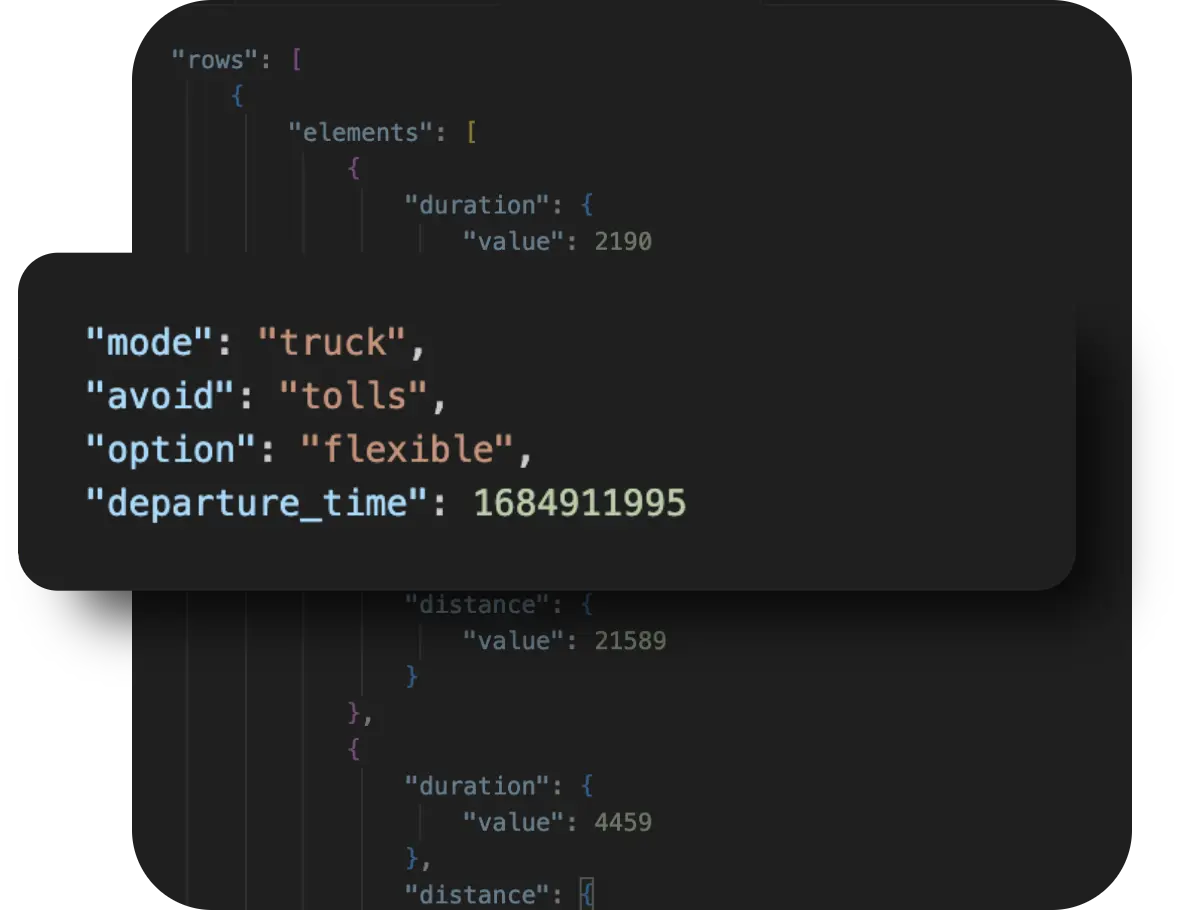
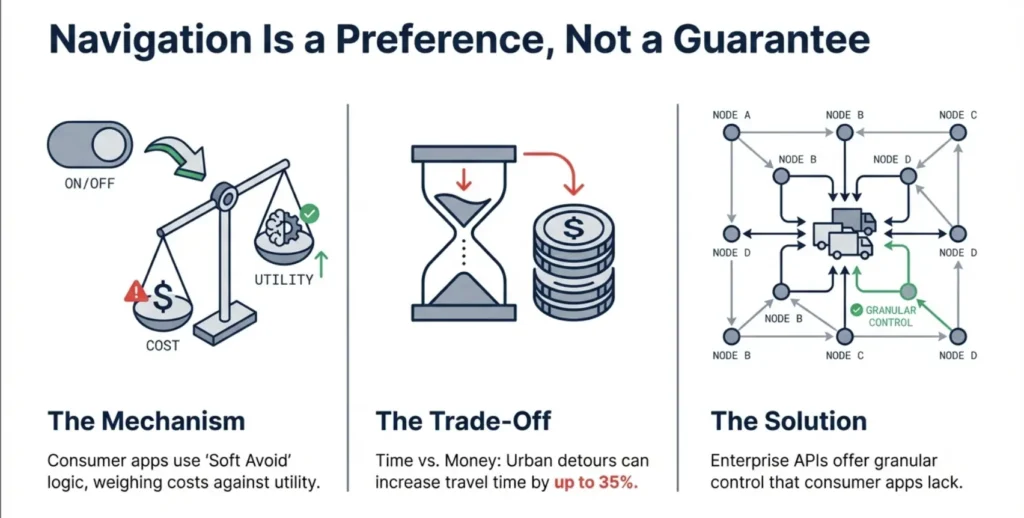
Enterprise routing engines treat toll avoidance as a configurable routing constraint within a broader optimization framework. Unlike consumer navigation apps, where “Avoid Tolls” is a simple toggle, enterprise APIs let developers and operations teams define how toll avoidance interacts with other variables, such as vehicle type, cost models, multiple stops, and business rules.
navigation
This configurability helps fleets and logistics platforms balance cost, compliance, and performance based on real-world operational needs.

Key Differences in Enterprise Routing

Multi-Vehicle Optimization

Enterprise APIs can optimize routes for multiple vehicles at once, considering toll preferences across an entire fleet rather than just a single trip. This means the system can decide that certain vehicles should use toll roads when it benefits overall performance, while others avoid them to reduce costs—based on constraints you set.

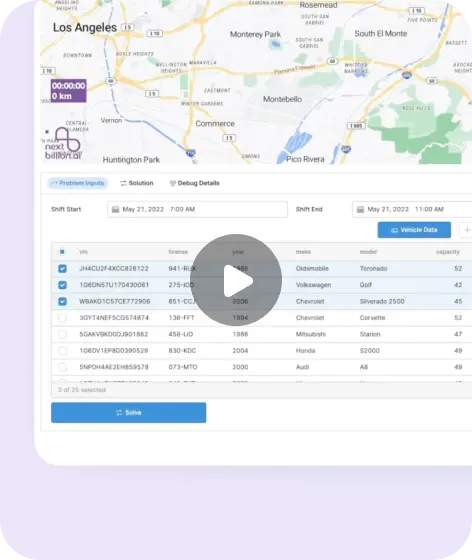
NextBillion.ai’s Route Optimization API supports large multi-vehicle routing problems with configurable constraints such as toll avoidance for specific vehicle groups or regions. Planners can define different avoidance preferences per routing profile in the same optimization request.

Cost-Based Modeling (Fuel + Toll + Driver Time)

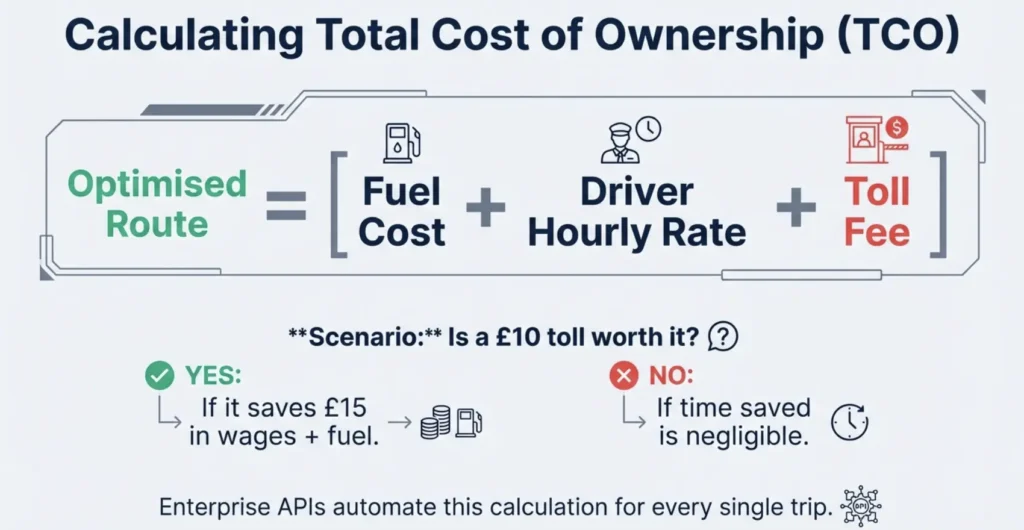
Rather than treating toll avoidance in isolation, enterprise solutions incorporate cost modeling that includes multiple expense types, such as fuel, tolls, driver hours, and more, to compute the best overall solution.

With NextBillion.ai, you can define custom cost matrices or objectives to weigh tolls against other cost factors. This lets the optimizer choose routes that align with your business’s total cost priorities, not just the lowest toll spend.

Regional Rule Enforcement

Toll systems vary by jurisdiction; some use dynamic pricing, time-based charges, or exemptions for vehicle classes. Enterprise APIs allow you to enforce region-specific rules within the routing logic.

NextBillion.ai’s platform includes advanced constraint handling that lets you apply toll avoidance selectively based on region, vehicle type, or time window, ensuring compliance with local toll systems and business policies.

Custom Avoidance Parameters

Beyond a simple “yes/no” for tolls, enterprise APIs let you customize how toll avoidance should behave:

  • Apply avoidance only on certain routes

  • Allow tolls for specific vehicle types

  • Mix avoidance with other constraints, like avoiding highways or U-turns

NextBillion.ai’s suite supports more than 50 constraints, enabling granular routing preferences such as “avoid tolls for heavy trucks but not for light vans” or “avoid tolls only outside peak hours.” This spreads decision logic across the entire optimization, giving developers fine-grained control.

Why This Matters

For businesses that depend on predictable costs, regulatory compliance, and scalable operations, treating toll avoidance as part of a wider constraint set ensures routing decisions align with both economic and operational goals. Enterprise routing APIs like NextBillion.ai’s Route Optimization API enable this level of flexibility and control, making them suitable for logistics, field services, and delivery fleet use cases.

Does “Avoid Tolls” Increase Travel Time Significantly?

In many cases, yes. Avoiding toll highways often redirects traffic to local roads, arterial streets, or secondary highways. These routes typically have lower speed limits, more intersections, and higher congestion exposure, leading to longer travel times.

Toll roads are usually designed for faster, uninterrupted movement. When you opt out of them, you trade cost savings for reduced speed and predictability.
avoid tolls

Why Travel Time Increases

When “Avoid Tolls” is enabled, the routing engine may:

  • Replace controlled-access highways with signalized roads

  • Route through residential or commercial zones

  • Add additional turns and merge points

  • Increase exposure to traffic bottlenecks

Even if the distance difference is small, stop-and-go conditions can significantly extend the arrival time.

Typical Impact Ranges

The time increase varies depending on geography and road infrastructure.

Urban Areas: +10% to +35% Travel Time

In cities, toll expressways often bypass dense traffic corridors. Avoiding them typically means:

  • More traffic lights

  • Frequent lane changes

  • Higher congestion variability

The impact may be moderate during off-peak hours but more pronounced during rush hour.

Intercity Highways: +20% to +60% Travel Time

On long-distance routes, toll highways are often the primary high-speed connectors. Avoiding them may require:

  • Indirect state or regional roads

  • Reduced speed limits

  • Additional fuel consumption due to variable driving patterns

Over longer distances, even small speed reductions compound into significant time increases.

Sparse Infrastructure: No Viable Alternative

In some regions, toll highways are the only practical connectors between major destinations. In such cases:

  • The app may still include toll segments

  • Or the alternative route may be excessively long and impractical

Here, the time impact can exceed reasonable thresholds, making toll avoidance operationally inefficient.

The Trade-Off in Practical Terms

Avoiding tolls is fundamentally a cost-versus-time decision:

  • Lower direct monetary cost

  • Potentially higher fuel usage

  • Longer driver hours

  • Increased ETA variability

For casual travel with flexible schedules, the increase may be acceptable. For time-sensitive trips or commercial operations, the delay can outweigh the toll savings.

Comparison Table: Travel Impact by Area Type

Area Type

ETA Increase Likelihood

Metro city

High

Suburban

Moderate

Rural

Low (limited tolls)

“Avoid Tolls” is a useful setting, but it is not a guarantee. It works by adjusting how routing engines prioritize road segments, not by completely eliminating toll roads from consideration.

In regions with strong alternative infrastructure, the feature can help reduce recurring costs. In dense cities, time-sensitive trips, or areas with limited road options, it may increase travel time or still include toll segments.

Understanding how toll metadata, traffic conditions, and routing algorithms interact allows you to make better decisions. Whether you are a daily commuter or managing fleet operations, the key is to weigh cost savings against reliability, ETA impact, and operational goals before relying on the setting.

About Author

Shivangi Singh

Shivangi is a seasoned Technical Writer with a passion for simplifying technical concepts. With over 5 years of experience, she specializes in crafting clear and concise documentation for various technical products and platforms.

Ready to get started?

Table of Contents