


Table of Contents
California is one of the most operationally complex trucking markets in the United States. Fleets must manage dense urban traffic, long distances between delivery regions, mountainous terrain, truck-access restrictions, customer time windows, and limited parking, all while ensuring drivers remain within applicable Hours of Service requirements.
For carriers operating in California, Hours of Service(HOS) compliance begins with an important distinction: Is the driver engaged in interstate commerce or operating entirely within California? The answer determines whether federal or California intrastate HOS rules apply.
This guide explains the principal HOS requirements affecting property-carrying fleets. It also explores how route planning software can help operators integrate applicable driving limits, mandatory breaks, rest periods, and shift restrictions into their existing fleet plans, making routes more compliant, realistic, and executable.
What Are Hours of Service Regulations?
Hours of Service regulations establish how long commercial drivers may drive and remain on duty before taking required rest.
These rules are intended to reduce fatigue-related risk by controlling:
- Maximum driving time
- Maximum duty windows
- Required off-duty periods
- Mandatory driving breaks
- Cumulative weekly or multi-day work limits
- Record-of-duty-status requirements
HOS compliance affects far more than driver logs. It determines whether a planned route can actually be completed, whether a customer time window is realistic, and whether the driver has sufficient time to reach a suitable rest location.
Federal or California HOS Rules: Which Apply?
Interstate operations
Federal HOS regulations generally apply when cargo or passengers move as part of interstate commerce. A driver does not necessarily need to cross the California border for an operation to be classified as interstate.
For example, federal rules may still apply when a driver transports cargo entirely within California if that cargo originated outside the state or is continuing to another state as part of an interstate movement.
Intrastate operations
California intrastate rules generally apply when the entire commercial movement takes place within California and is not part of interstate commerce.
Carriers should not determine applicability based only on the day’s route or whether the driver crosses a state line. The shipment’s origin, destination, and overall commercial intent must also be considered.
Federal HOS Limits for Property-Carrying Drivers
When federal HOS rules apply, the main limits for property-carrying commercial vehicle drivers include:
11-hour driving limit
A driver may drive for a maximum of 11 hours after completing at least 10 consecutive hours off duty.
14-hour driving window
A driver generally cannot drive beyond the 14th consecutive hour after coming on duty. Off-duty periods taken during the workday usually do not pause or extend this 14-hour window.
30-minute break
A driver must take a break of at least 30 consecutive minutes after eight cumulative hours of driving without a qualifying interruption.
The break can generally be satisfied by off-duty time, sleeper-berth time, on-duty-not-driving time, or a qualifying combination of non-driving statuses.
60/70-hour limit
A driver may not drive after accumulating:
- 60 on-duty hours in seven consecutive days if the carrier does not operate every day of the week; or
- 70 on-duty hours in eight consecutive days if the carrier operates every day of the week.
A driver may restart the seven- or eight-day calculation after taking at least 34 consecutive hours off duty.
These are the principal federal limits, but exceptions and special provisions may apply to short-haul drivers, sleeper-berth operations, adverse driving conditions and certain industries. The FMCSA HOS summary provides additional guidance.
California Intrastate HOS Limits
California provides different HOS limits for qualifying intrastate property-carrying drivers.
Under the general California intrastate framework, a truck driver may not drive:
- More than 12 cumulative hours following at least 10 consecutive hours off duty
- After the end of the 16th hour after coming on duty following at least 10 consecutive hours off duty
- After reaching the applicable cumulative on-duty limit over consecutive days
This creates a broader daily operating window than the federal 11-hour driving and 14-hour duty-window limits. However, a carrier cannot use California’s intrastate limits simply because a particular route remains within the state. The underlying movement must qualify as intrastate commerce.
The applicable provisions are contained principally in Title 13 of the California Code of Regulations, Sections 1212 and 1212.5.
Electronic Logging Device Requirements in California
Since January 1, 2024, motor carriers and drivers operating in California intrastate commerce have generally been required to use electronic logging devices to record their duty status unless an exemption applies.
Importantly, using an ELD does not automatically place an intrastate driver under federal HOS limits. The California Highway Patrol states that intrastate drivers using ELDs may comply with the applicable California or federal HOS requirements permitted under Title 13 CCR.
California identifies several ELD exceptions, including certain situations where:
- A driver must complete a record of duty status on no more than eight days during a 30-day period
- The driver participates in a qualifying driveaway-towaway operation
- The vehicle was manufactured before model year 2000
- An applicable FMCSA waiver, exemption, or regulatory guidance excludes the operation from the ELD requirement
An ELD exemption does not always eliminate the obligation to maintain duty-status records. Drivers may still need paper logs, electronic records, time records, or other supporting documentation.
The California Highway Patrol’s intrastate ELD guidance explains the current requirements and exceptions.
California’s 100 Air-Mile Record-Keeping Exception
California maintains a 100 air-mile provision for qualifying intrastate drivers. A qualifying driver may be exempt from maintaining a standard record of duty status when conditions are satisfied, including:
- Operating within a 100 air-mile radius of the normal work-reporting location
- Returning to and being released from the reporting location within the prescribed period
- Receiving the required consecutive off-duty time
- Having the carrier maintain accurate reporting, release and total-duty-time records
This is primarily a record-keeping exception. It should not be interpreted as permission to disregard applicable driving or on-duty limits.
California also distinguishes its 100 air-mile RODS provision from the federal 150 air-mile short-haul exception. Fleets should ensure their systems apply the correct radius, return-to-base requirement, duty window and record-keeping logic.
Adverse Driving Conditions
California regulations allow limited additional driving time when a driver encounters qualifying adverse driving conditions and cannot safely complete the run within the normal limit.
The extension may permit up to two additional driving hours to complete the run or reach a safe location. However, it remains subject to applicable outer limits, and the condition generally must have been unexpected rather than a delay that should reasonably have been known during dispatch.
Regular congestion in Los Angeles, scheduled roadworks or a routinely congested port terminal should not automatically be treated as unforeseen adverse conditions.
Route planning should therefore use realistic travel times instead of relying on exceptions to rescue an already unworkable schedule.
Why California HOS Compliance Is Difficult in Practice
A route can appear compliant in a spreadsheet and still fail during execution. Common causes include:
Congestion and variable travel times
Traffic around Los Angeles, the Inland Empire, the Bay Area, San Diego, and major port corridors can significantly alter drive-time consumption.
Loading and unloading delays
Time spent waiting at distribution centers, ports, warehouses, customer facilities, and loading docks may count toward on-duty time even when the vehicle is stationary.
Limited truck parking
A driver approaching an HOS limit may not have an appropriate parking or rest location nearby. Planning a break without checking whether the location can accommodate the vehicle creates operational and safety risks.
Truck-specific road constraints
Vehicle height, weight, length, axle count, hazardous-material restrictions and road accessibility can force trucks onto longer routes than a standard consumer navigation system predicts.
Interstate and intrastate fleet overlap
The same carrier may operate drivers under different HOS frameworks. Applying a single generic rule template across every driver can create compliance gaps or unnecessarily reduce available capacity.
Delivery time windows
A route may meet the driving-hour limit while still being impossible to execute once service time, mandatory rest, facility appointments and customer time windows are included.
Why HOS Must Be Considered Before Dispatch
Many routing systems calculate the fastest sequence of stops first and leave the dispatcher to add breaks later. This creates a route that is mathematically efficient but operationally infeasible.
HOS-aware planning should consider all these parameters, from the beginning:
- The driver’s remaining driving and duty time
- Previous on-duty hours
- Required breaks and daily rest
- Interstate or intrastate rule applicability
- Stop service durations
- Customer and facility time windows
- Truck-appropriate roads
- Traffic conditions
- Suitable break and rest locations
- Multi-day route requirements
If a break is inserted after the route has already been optimized, every downstream arrival time can change. That may cause missed appointments, detention costs, overtime, or an additional vehicle requirement.
How NextBillion.ai Supports HOS-Aware Route Planning
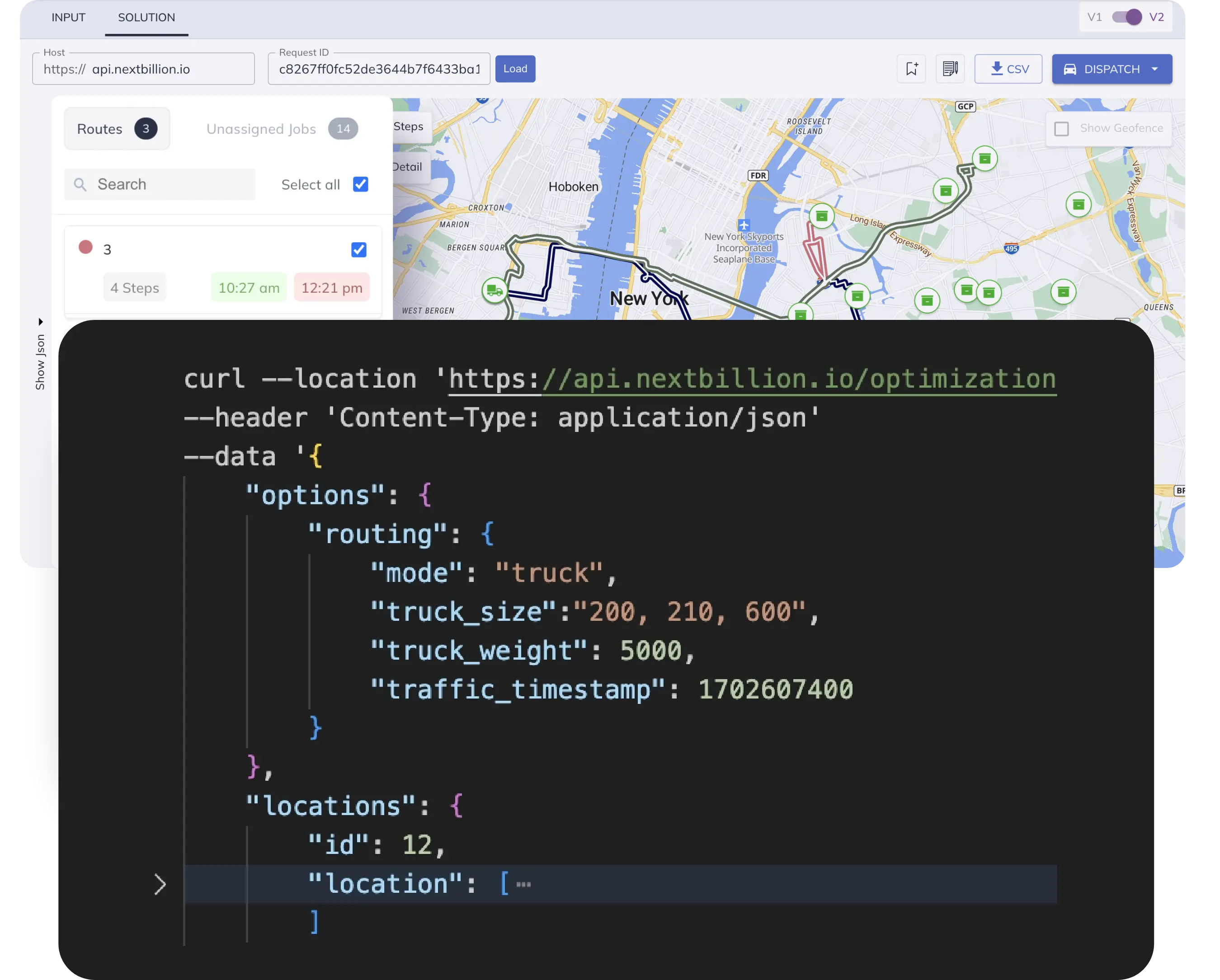
NextBillion.ai helps logistics teams configure route-planning workflows around their applicable driver-hour and operating requirements.
Fleet operators can use NextBillion.ai to:
- Define maximum continuous driving time
- Configure required break durations
- Incorporate driver shifts and maximum route durations
- Add daily driving, on-duty and off-duty requirements
- Plan multi-day routes with rest or layover periods
- Include stop-level service time and delivery windows
- Generate truck-appropriate routes based on vehicle characteristics
- Evaluate whether assignments can be completed within the available driver hours
- Re-optimize routes when delays or operational changes affect the original plan
This makes it possible to build California-specific or federal HOS logic into the planning workflow instead of treating compliance as a manual check after dispatch.
Best Practices for California Fleet Operators
Classify each movement correctly
Determine whether the shipment is interstate or intrastate before selecting an HOS rule set.
Maintain separate rule profiles
Create different planning profiles for federal operations, California intrastate operations and any specialized vehicle or cargo categories.
Use actual driver availability
Plan against the driver’s remaining hours, not a standard shift that assumes every driver starts with a fresh clock.
Plan rest locations in advance
A compliant break is only useful when the driver can safely and legally stop at an appropriate location.
Use realistic service and traffic data
Historical travel times, expected facility delays and stop-level service durations should be included when calculating route feasibility.
Recalculate after disruption
A late departure, extended detention period or road closure can invalidate the original schedule. Re-optimization should reassess both arrival times and HOS feasibility.
Preserve an audit trail
Maintain the logs, supporting documents and planning data needed to explain driver assignments, route changes and duty-status decisions.
Building More Executable Routes in California
California HOS compliance is not simply an ELD or record-keeping problem. It is a planning challenge involving driver availability, traffic, customer commitments, truck restrictions and safe rest opportunities.
The most efficient-looking route is not necessarily the best operational route. A successful plan must be both cost-effective and realistically executable within the correct federal or California HOS framework.
NextBillion.ai enables fleets to incorporate driving limits, shift windows, required breaks, service durations and truck-specific routing constraints directly into route optimization. This can help dispatchers identify infeasible assignments earlier, improve ETA reliability and build safer, more practical route plans.
Looking to build California-specific HOS requirements into your route-planning workflow? Talk to the NextBillion.ai team to explore configurable HOS-aware routing for your fleet.
Ready to get started?
Request a DemoTable of Contents
Subscribe to our Newsletters
Get the best practices for route planning & optimization, delivered to your inbox.
Subscribe