


hos-constraints-in-route-optimization

Why Route Optimization Should Consider HOS Constraints?

Published: August 29, 2026

Logistics companies often overlook the importance of service hours or shifts of the drivers. Many route optimization tools put the drivers on continuous travelling mode for quick task completion without inserting the necessary break or time windows. While HOS, or Hours of Service, relates indirectly to the movement procedures but has a direct impact on the serviceability, regulations, safety, and cost factors.

Route optimization is a unified concept for logistics and transportation management. Being a critical layer in the entire delivery business, it has to strategically integrate all the possible constraints that can impact the movement of delivery vehicles. HOS primarily ensures the convenience of drivers to take timely rest on the journey, as stressful rides adversely impact the performance and may also have repercussions in generating regulatory issues.

The HOS constraints govern how long commercial drivers can drive, when they must take breaks, and how much rest they need before returning to the road. Ignoring these constraints during route planning can lead to compliance violations, delivery delays, costly last-minute rerouting, and increased operational risk.
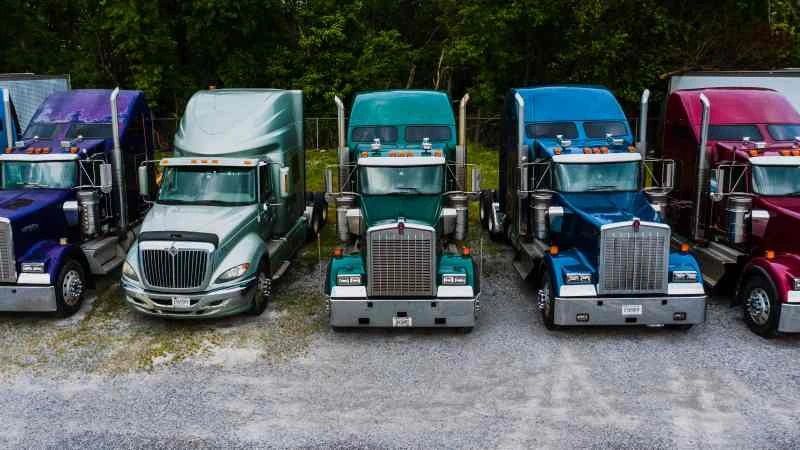
trucks at hos compliant parking

We’ll explore why HOS-aware route optimization has become a necessity for logistics and transportation businesses. You will also learn the challenges of planning routes without these constraints and how customizable routing solutions like NextBillion’s Route optimization API  are successfully helping organizations in building compliant, efficient, and scalable route planning workflows.

But let us first understand the complexity of the HOS constraint in the route optimization system.

route optimization

What are Hours of Service for Transportation Businesses? 

HOS, or Hours of Service, is simply the evaluation of total driving time served by a delivery agent/driver on the field. These are typical regulations enforced by the regional government to ensure that no individual drives the vehicle excessively without breaks. 

These strategic time windows on the route help in reducing the stress and fatigue of the drivers and give them a moment of short nap or rejuvenation. It also improves road safety and prevents accidents caused by tired driving.

HOS can be defined as the legal rules that govern how long commercial drivers (trucks, buses, delivery vehicles, etc.) can drive, work, and rest within a specific period. These regulations establish maximum driving and on-duty hours while mandating rest breaks and off-duty periods to address the drivers’ tiredness.

Also Read: Quick tips to hire delivery drivers.

Logistics companies, fleet operators, and carriers are legally advised to follow the compliances related to hours of service. Thus, it can be said that HOS directly impacts route planning, delivery schedules, and operational efficiency, although the exact requirements vary by country.

Importance of Hours of Service (HOS) in Logistics and Transportation

Aspects

Relevance

Driver Safety 

Reduces fatigue and lowers accidental risks due to drowsiness and impaired judgment. 

Road Safety 

Minimizes fatigue-related crashes involving commercial vehicles. 

Compliances 

Following government regulations, avoiding penalties, fines, and legal issues. 

Operational Efficiency 

Proper routing and scheduling and resource allocation while maintaining legal driving limits. 

Employee Well-being 

Promotes adequate rest and work-life balance and improves the driver’s health, morale, and job satisfaction. 

Productivity 

Effective scheduling helps maintain consistent and sustainable productivity. 

Risk Management 

Reduces the likelihood of accidents, cargo damage, insurance claims, and liability costs. 

Customer Satisfaction 

Improves delivery reliability through better trip planning and compliance, enhancing customer trust. 

Fleet Management 

Helps in monitoring driver hours using Electronic Logging Devices (ELDs), ensuring efficient dispatch and compliance. 

Cost Control 

Prevents costs associated with accidents, legal penalties, vehicle damage, and driver turnover. 

Environmental Impact 

Optimized schedules and reduced unnecessary idling contribute to lower fuel consumption and reduced emissions. 

Business Reputation 

Demonstrates a commitment to safety, legal compliance, and responsible transportation practices. 

Are HOS regulations adopted globally?

HOS is a prominently embraced concept by worldwide regions, and especially countries like the USA, Canada, and the EU have proposed stringent regulations on the logistics and transportation companies. While the core objective remains the same globally, HOS rules vary across regions.

United States (FMCSA)

The Federal Motor Carrier Safety Administration (FMCSA) has responsibly introduced the rules of Hours of Service for the truckers and other commercial motor vehicle drivers. These rules involve interstate transportation and are closely monitored through Electronic Logging Devices (ELDs).

Canada

Canada’s HOS regulations slightly differ from the USA’s. Its federal Commercial Vehicle Drivers Hours of Service Regulations are similar to U.S. requirements but additionally include important differences in daily and cycle limits. Hence, the fleets operating across the U.S.-Canada border must account for both regulatory frameworks.

European Union

The European Union calls it Driving Time Regulations. These are similar to the standard HOS system with specific limits on driving hours, mandatory breaks, and rest periods for commercial drivers across all the member states. These rules are designed to create consistent safety standards throughout the EU while supporting cross-border freight movement. 

Common Elements of HOS Regulations

Parameters

Why it Matters

Maximum driving time

Limits the number of hours a driver can steer the wheel before taking a break.

Mandatory rest breaks

Requires drivers to take breaks with maximum driving limits after a specified period.

Daily duty limits

Restricts the total number of hours a driver’s shift in a day, which may include other work too along with driving.

Weekly limits

Caps the total hours worked or driven over a week to prevent cumulative fatigue.

Recordkeeping

Drivers need to maintain records of their driving and rest periods. ELDs or electronic logging devices are popular as digital logbooks for these data sheets.

Why Are Traditional Route Optimization Systems Losing Trust?

Route optimization is often misunderstood for a tool that can fetch the fastest or shortest path between multiple stops. But the concept of routing is wide, and advanced tools like NextBillion.ai have already induced a broad scope of applications.  

The fact is that the fastest, shortest, or cost-effective path finders are not working sufficiently in the logistics and transportation operations. Such route optimization APIs are only delivering a part of the solution, which often results in penalties and unexpected outcomes. A route that appears optimal on paper can quickly become impractical if it requires drivers to exceed their legally permitted working hours.

Logistics providers are now expected to balance delivery speed with regulatory compliance. It is because driver safety, customer expectations, and operational efficiency are nevertheless equally important to ensure legal and ethical aspects of the transportation business.

Delivery structure of legacy routing engines

Route optimization tools are expected to have deep insights about the geographic and environmental conditions. These tools fetch regular updates about the movement of traffic and make analytical decisions about any specific route plan and desired goals.

  • Shortest distance: Finding the absolute fewest miles between stops to reduce total travelling distance.

  • Fastest ETA: Routing around bottlenecks or clusters of stoppages to minimize travel time.

  • Fuel efficiency: Eliminating excessive idling, unnecessary movement, or traffic congestion to save fuel consumption

  • Traffic conditions: Ingesting live road updates of the area road network to avoid active congestion.

Constraints your routing engines might ignore

Factors like shortest driving distance, quickest arrival time, fuel-efficient path, or dealing with traffic are conceptually the desirable output from a routing engine. These are quite successful for a car navigation system but not completely suitable for commercial purposes or fleets carrying loads. It is because the constraints lack human-centric impact, as they completely ignore the internal operations data.

Also Read: How routing algorithms actually decide.

  • Driver work hours: Not evaluating a driver’s work stress as a person driving for 13 hours cannot perform the same way as another driver who just started their shift.

  • Break requirements: Routing engines are not sequencing suitable resting points on the journey, as they are not programmed to manage a mandatory 30-minute rest break, which is legally required.

  • Shift schedules: Continuous allotment of drivers’ shifts on new tasks and not registering the structured daily layovers.

  • Remaining legal driving time: Ignoring the rolling weekly clocks (60/70-hour rules) tracked by the driver’s Electronic Logging Device (ELD)

Logistics Companies Transitioning Towards Modern-Day Route Optimization

Modern route optimization spreads for more than traffic conditions, travel time, and vehicle capacity. It incorporates real-world driver availability and regulatory requirements to produce routes that are not only efficient but also executable. 

By embedding HOS constraints into route planning, businesses can improve on-time deliveries, maximize fleet utilization, reduce compliance risks, and create more predictable operations. The US government enforces HOS into the route optimization algorithm, as these are not mere post-planning guidelines but strict constraints of delivery operations.

At a certain level, the traditional routing engines appear to have been designed with a major flaw, where the programming structure seems to ignore the difference between a mechanical device and a human. They treat the vehicle and the driver as a single, unfatiguable machine. 

These legacy systems excel at solving the classic Traveling Salesperson Problem (TSP) by evaluating external, physical road factors. However, they completely ignore the human and legal realities occurring inside the driver’s cab.

Also read: What it takes to create an in-house delivery system?

Why HOS Matters for Route Optimization

Constraints

What the optimizer should consider 

Remaining driving hours 

The driver must complete each delivery within the legal time limit and with essential breaks. 

On-duty window 

Driving, service time, fueling, inspections, and waiting must fit within the available duty period. 

Mandatory breaks 

Legal break schedules at safe locations

Weekly hours 

Managing driver’s cumulative hours for daily assignments and future commitments 

Sleeper berth and rest rules 

Overnight or split-rest plans to make the routes feasible 

Stop service time 

Loading, unloading, customer dwell, inspections, and paperwork that consume duty time 

Parking availability 

Legal resting place with sufficient space and easy-to-reach directions

Live disruptions 

Traffic, weather, route deviations, and appointment changes must not invalidate the plan 

Consequences of avoiding HOS constraints in route optimization

A route plan goes in vain when an optimization engine builds the route based solely on external road conditions. Missing constraints not just results in penalties but also affects the entire transit operation cycle.

  1. In a typical scenario for a routing engine generating a 600-mile operation with three delivery windows. Now, if the selected driver has already covered five driving hours of the day. They only manage to cover 450 miles in the available hours with two pending deliveries. In such cases, the entire route plan is a waste because the person cannot legally complete the journey.  

  2. If the tool doesn’t sequence a breakpoint for rest, the driver has to manually search for parking, etc. This exercise ruins the scheduled movements and overall route optimization.

  3. Delayed movement results in missing delivery slots, which turns the drivers into waiting for the next 24 to 48 hours, which is quite inefficient fleet utilization.

  4. On the other side, if the driver violates HOS regulations to meet the optimized ETAs. While it is unsafe transportation, the act gets caught on their ELDs and pushes into severe fines.

  5. Later the fleet managers have to bear the driver detention fees, trucks are barred, and with pending orders the operations costs for fees and truck extra expenditure on rerouting would also impact further assignments.

The Business Impact of Ignoring HOS Constraints in Route Plans

Let us start with an example of regular tasks assigned to a delivery truck at a logistics company.

Suppose a beverage distributor shares a route plan with the truck driver. The route optimization tool assumes that the driver can drive 14 hours continuously. But as per the FMCSA regulations, a driver is only allowed 11 hours of driving within a 14-hour on-duty window before required rest. It means legally the routing must include breaks at resting points after certain hours of driving.
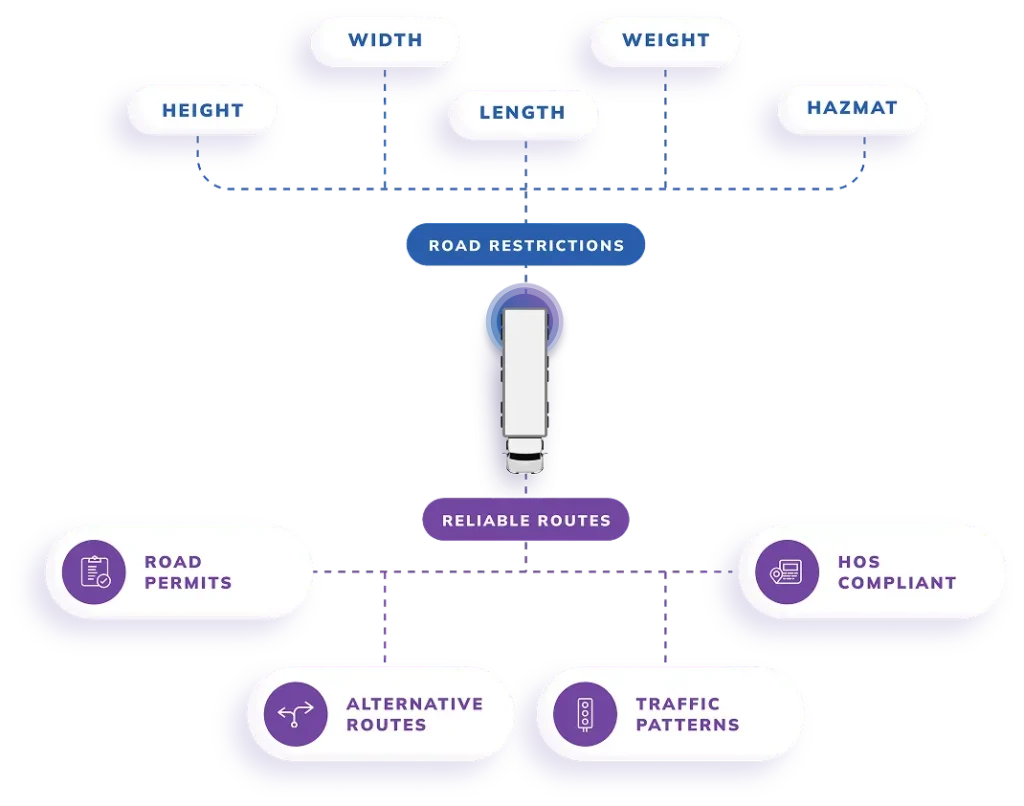
region specific route plans for hos complaince

Now when the route optimization software generates: 

  • 25 deliveries for a truck in a beverage distribution day’s assignment

  • 95% vehicle utilization

  • Low transportation cost

Then during execution, what happens when:

  • The driver reaches the legal driving limits before completing the route.

  • Several delivery orders get postponed.

  • The dispatchers then manually reassign loads.

  • Sometimes additional drivers and vehicles are also required.

  • And in the worst case, the customers receive late shipments.

The actual operating cost becomes significantly higher than the planned cost because the optimization ignored a critical operational constraint.

Also read: How Do Beverage Distributors Optimize Delivery Routes to Reduce Fuel Costs and Missed Deliveries? 

Hence, ignoring Hours of Service (HOS) constraints in route optimization causes multiple drawbacks for the logistics and transportation companies. A cascade of financial, legal, and operational damage is observed. 

Impact of Ignoring HOS Constraint in Routing Over Business Outcomes

Business Impact

Brief Description

Regulatory penalties and legal risk

Non-compliance with HOS regulations can result in fines, legal liabilities, and lower safety ratings.

Increased accident risk

Driver fatigue raises the likelihood of accidents, leading to higher insurance, repair, and litigation costs.

Unrealistic delivery schedules

Routes become impractical, causing delays, missed delivery windows, and frequent manual replanning.

Higher operating costs

Emergency driver replacements, overtime, and route adjustments increase overall expenses.

Reduced fleet utilization

Vehicles may remain idle when drivers reach legal limits, lowering fleet productivity.

Driver dissatisfaction and turnover

Excessive workloads increase stress, reduce morale, and contribute to higher driver attrition.

Customer service impacts

Delivery delays and unreliable schedules reduce customer satisfaction and may result in lost business.

Poor optimization decisions

Ignoring HOS produces unrealistic route plans, leading to inaccurate cost estimates and resource planning.

The fleet managers must take a holistic approach while planning delivery routes. They must include HOS as a hard constraint, not a flexible guideline.

Here is a breakdown of the real business impacts when HOS rules are ignored.

Compliance Risks & Financial Penalties

  • Fines: Regulatory agencies issue severe monetary penalties per violation to both drivers and carriers.

  • Out-of-Service Orders: Inspectors place non-compliant drivers out of service immediately, halting the truck on the spot.

  • Safety Scores: HOS violations degrade Carrier Safety Ratings, triggering frequent roadside inspections and audits.

  • Legal Liability: In accidents involving fatigued drivers, courts award massive punitive damages for negligent dispatch.

  • Insurance Spikes: A history of non-compliance drives commercial insurance premiums up significantly. 

Operational Inefficiencies & Chaos

  • Forced Rest Breaks: Drivers must stop to rest mid-route, stranding the vehicle miles away from the destination.

  • Emergency Replanning: Dispatchers must manually reroute other assets to recover the delayed freight.

  • Driver Idle Time: Crew members sit unproductive at truck stops waiting for their regulatory clocks to reset.

  • Fleet Underutilization: Unplanned stops trap active trucks, leaving subsequent scheduled load sitting on docks.

  • Driver Turnover: Burnout from illegal scheduling pushes drivers to quit, skyrocketing recruitment costs.

Customer Experience Breakdown

  • Missed ETAs: Shipments arrive hours or days late because the optimization software assumed a human could drive indefinitely.

  • Broken Delivery Windows: Tight retail appointment windows are missed, resulting in expensive chargebacks and penalties.

  • Reduced Reliability: Shippers lose trust in the carrier’s capability, shifting their volume to compliant competitors.

  • Customer Service Strain: Support teams face a surge of tracking inquiries, tracking down delayed trucks manually

The Factual Benefits of Integrating HOS Constraints Into Route Optimization API

Prominent routing solutions like NextBillion are now considering HOS constraints as an essential factor in route planning and optimization. The system ensures to generate a compliant, efficient, and more feasible route for the assigned drivers. When algorithms ignore human limits, the resulting routes look perfect on paper but disintegrate in reality.

Instead of simply minimizing distance or travel time, the optimizer accounts for driver work-hour limits, mandatory breaks, and rest requirements, ensuring that planned routes can be executed in real-world conditions.

HOS Complaiant Vs Non-HOS Compliant Route Optimization

Parameters

With HOS

Without HOS

Impact of HOS

Driver Assignment

Truck allotment with adequate duty hours.

Selects the nearest truck to the load.

No mid-route driver switching.

Route Duration

Total distance includes legal breaks and rest.

Calculation through distance and speed.

Avoids missing any delivery windows.

Stop Sequencing

Combines geography with driving hours.

Fastest or shortest physical path.

Prevents drivers from running out of legal time miles from a safe stop.

Multi-Day Continuity

Factors in cumulative weekly recap hours.

Assumes identical productivity every day.

Allows dispatchers to commit to long-haul freight confidently.

Disruption Handling

Recalculates the HOS impact of traffic delays immediately.

Ignores traffic delays until the driver is late.

Triggers early alerts to reassign loads before violations occur.

There are some credible advantages for logistics companies when they switch toward routing tools with HOS inclusion.

  • Dynamic Driver Selection: The routing tools have the capacity to fetch real-time updates about the past trip. These are important for analyzing real-time electronic logging device (ELD) data, which gives details about the completed work hours on a daily and weekly basis. The purpose is to select drivers with adequate remaining work hours for specific trips.

  • Predictive Break Scheduling: Credible routing solutions mandatorily insert the compulsory 30-minute breaks and 10-hour rest periods automatically based on travel duration, rather than taking chances.

  • Feasible Multi-Day Planning: Long-haul routes may take many days in completion and account for cumulative weekly limits (e.g., the 60/70-hour rule), ensuring multi-day transit times are accurate.

  • Proactive Violation Prevention: The system flags potential duty-hour breaches during route planning. It reassigns stoppages to the best available drivers before final dispatch.

  • Dynamic ETA Accuracy: The arrival windows include the necessary driver rest points, and provides customers accurate  ETAs  with unalterable delivery timelines.

Route optimization tools with HOS integration ensure that every transit plan is legal and viable. Being a logical and compliant solution, it also reasons out the conflict between the driver and the dispatcher. There is higher understanding of real-world constraints to ensure sustainable efficiency.

HOS-Aware Route Optimization Platform

HOS-aware routing platforms are resourceful, reliable, and responsible solutions that put up a humanistic approach in generating delivery route plans. It automatically suggests a delivery path with significant stoppages at specific break intervals. These time windows are conveniently included on the navigation, and the entire delivery operation is developed while managing the working hours of the driver.

Taking a realistic example: If a driver has three hours of legal driving time remaining for the day, then in such a case the HOS-aware route optimization tool won’t choose this person for a delivery order that may take four hours to reach from the pickup point. The tool would either suggest the delivery when an adequate driver is available or would plan a legal stop after three hours near a rest area, schedule an overnight stay, and then continue on the path to stay compliant.

Above was the simplistic explanation of a routing solution that considers HOS as a hard constraint and understands the potential obstructions on any typical route.
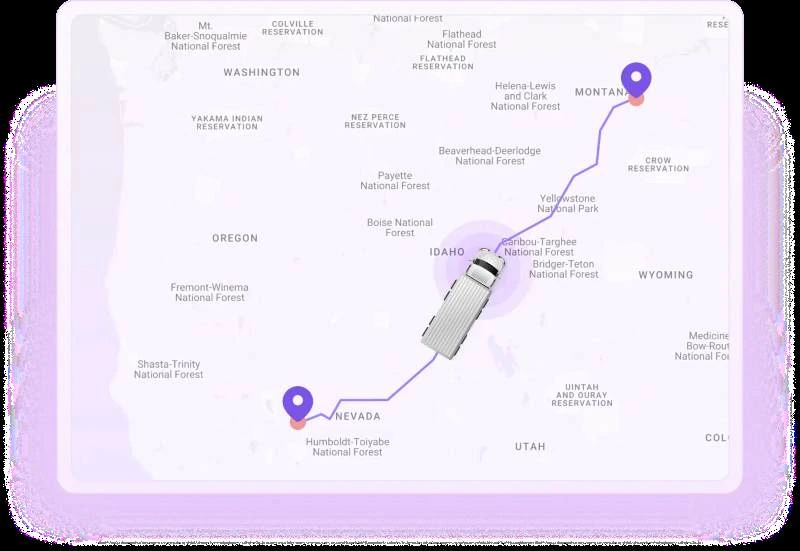
hos aware route optimization

An HOS-aware route optimization platform must bridge the gap between compliance software (ELDs) and core routing engines. 

Features of HOS-Aware Route Optimization

HOS is not just about recording the driver’s working time or managing the shifts. It holds multiple features that enhance the overall operational efficiency of the route optimization system.

Driver-Specific Constraints: Considers each driver’s remaining driving hours from ELD data, shift start and end times with a weekly recap management, and automatically inserts the mandatory break periods in the delivery sequence. 

Vehicle Assignment & Fleet Logistics: Matches vehicle class, capacity, and other factors with the order details. It also essentially accounts for driver domiciles and return-to-base requirements within the legal daily duty window. 

Delivery Time Windows: It is an important feature that aligns customer delivery hours with the driver’s available duty hours to avoid missed appointments. At the same time, it also records wait times at loading docks, automatically deducting it from the driver’s total working hours available. 

Multi-Stop Optimization: Determines the most efficient sequence of multiple stops while respecting HOS regulations, delivery priorities, and vehicle constraints. 

Dynamic Rerouting: Continuously adjusts routes in response to traffic, delays, cancellations, adverse weather conditions, or unexpected events. It alerts the dispatchers and maintains HOS compliance. 

Real-Time Adaptability: Incorporates live traffic conditions and travel-time updates to improve ETA accuracy and reduce delays. It also identifies nearby compliant drivers to intercept and recover a load if the original driver runs out of hours. 

Fleet-Wide Optimization: Evaluates the entire fleet simultaneously, balancing workloads, maximizing vehicle utilization, and minimizing total operating costs. 

API-First Architecture: Exposes robust endpoints to seamlessly sync data between the Telematics/ELD platform, GPS, TMS, and the optimization engine.

External Data & System Integration: Uses live and historical traffic patterns to calculate highly precise travel times, preventing unexpected HOS drain.

What are ELDs, and Why are They Important for Routing?

ELD is an abbreviation for electronic logging device. As the name suggests, they can mechanically register the active/inactive status of a machine. In case of commercial vehicles, these devices can automatically record a driver’s Hours of Service (HOS) information. 

ELDs are installed in the vehicles such that they can fetch the real-time driving or halting status and keep track of this information. They replace traditional paper logbooks in many jurisdictions and establish a transparency of work standard between the field staff and administration. Since it connects with the vehicle’s engine, the drivers and fleet operators can easily comply with HOS regulations.

A typical ELD machine can record:

  • Driving time (when the vehicle is moving)

  • Engine hours

  • Vehicle mileage

  • Vehicle location (using GPS)

  • Date and time

  • Driver identification

  • Duty status

HOS-aware route optimization systems often integrate with ELDs to access real-time driver availability. For example, if an ELD reports that a driver has only 2 hours of driving time remaining, the routing software can:

  • Assign a closer delivery

  • Schedule a required rest break

  • Reassign a longer trip to another driver

  • Plan a stop at an appropriate rest location.

This helps create routes that are feasible and legally compliant.

Prominent Use Cases of HOS-Compliant Route Optimization

HOS regulations are being made compulsive by the majority of nations. The US government has made strict laws to penalize the concerned parties in the delivery process or other transport-related commercial activities. 

Logistics companies integrating routing solutions with HOS constraints automatically get assured of achieving legal driving limits, mandatory breaks, and rest periods. This prevents driver fatigue, avoids costly regulatory fines, and creates realistic arrival times. Different industries are getting awareness of the performance enhancement after the inclusion of HOS constraints in routing and are benefiting from business growth and customer satisfaction.

Here is how different industries utilize HOS constraints in their routing workflows.

Long-Haul Trucking: Heavy commercial trucks are involved in transporting goods over long distances. They travel cross-country, covering hundreds of miles, which may take multiple days to complete, requiring drivers to follow Hours of Service (HOS) regulations for driving time, rest breaks, and overnight rest periods. 

  • Multi-Day Planning: Optimization engines calculate transit times across several days. They automatically insert mandatory overnight rest periods (e.g., 10-hour off-duty blocks) to accurately predict multi-day Estimated Times of Arrival (ETAs).

  • Driver Rotation: For team driving (slip-seating), the software tracks individual logs. It routes the vehicle continuously while switching the active driver in the system to maximize asset utilization legally.

Last-Mile Delivery: The customer’s doorstep or final destination is the last mile of the entire delivery process, and the transporters fulfill their duties by delivering the goods from a distribution center, warehouse, or local fulfillment hub to the customer’s exact coordinates. It is often the most time-sensitive and expensive part of the supply chain because it involves multiple stops, varying traffic conditions, and strict delivery time windows.

  • Shift-Aware Sequencing: Algorithms match package drop-offs with the specific start and end times of a driver’s shift. This prevents the system from sequencing deliveries that would force a driver into unauthorized overtime or violation territories.

  • On-Duty Limits: Short-haul drivers often have strict daily on-duty limits (e.g., 14-hour windows). Optimization ensures the final delivery and the return-to-depot trip both fit within this legal window.

Also read: How to reduce last-mile delivery costs using AI technology?

Retail Distribution: Retail distribution is the process of getting products from manufacturers or wholesalers into the hands of consumers through retail outlets. It encompasses the network, channels, and logistics used to make products available where customers want to buy them. 

  • Scheduled Store Deliveries: Optimization models align mandatory driver rest breaks with scheduled store delivery windows. A driver can be routed to take a required 30-minute break while waiting for a specific loading dock to open.

  • Continuous Rescheduling: If a driver gets delayed at a distribution center, the system automatically recalculates subsequent driving limits. It flags if the remaining store deliveries will breach HOS rules before the route is completed.

Food & Beverage: The food and beverages industry comprises all businesses engaged in the production, processing, distribution, marketing, retailing, and serving of food and beverage products to consumers. 

  • Perishable Goods: The system cross-references HOS rest requirements with product shelf life and refrigeration constraints. It ensures a mandatory 10-hour driver break does not cause temperature-sensitive cargo to spoil on the road.

  • Time-Sensitive Deliveries: Restaurants and grocery stores require tight morning delivery windows. Routing engines calculate exactly when a driver must depart and take breaks to hit these morning slots without violating morning driving limits.

Also read: Understanding Beverage Delivery Route Optimization

Field Service: The field services industry comprises all businesses that provide on-site installation, maintenance, repair, inspection, and technical support services for products, equipment, and infrastructure at customer locations. 

  • Technician Scheduling: Dispatch systems treat service technicians under the same regional labor laws as commercial drivers. The software limits the number of service calls assigned to a single technician to prevent shift-limit violations.

  • Labor Compliance: Algorithms incorporate regional union rules and labor laws alongside standard HOS rules. They automatically inject paid lunch breaks and rest periods into the technician’s daily service route.

How NextBillion.ai's API Supports HOS-Constrained Route Optimization

NextBillion provides a highly customizable routing engine. Its fundamental design serves real-world logistics operations instead of promoting a linear approach towards variant industries. You can rely on it for more than 50 configurable parameters backed by advanced AI-powered algorithms.

Users get the flexibility to manage routing profiles, vehicle characteristics, truck dimensions, traffic preferences, and business-specific cost models. The operational procedures are far ahead of simply minimizing travelling distance or time and practically support HOS constraint automation in route optimization.
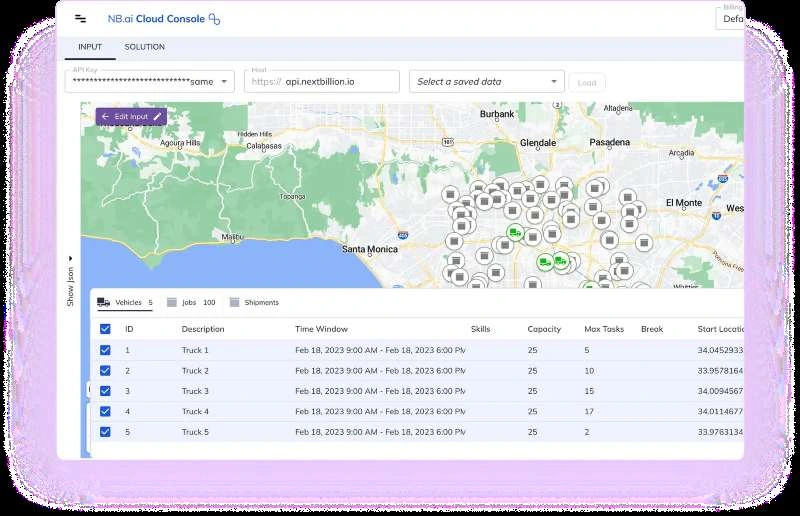
Nextbillion console showing automated hos complaints

The tool incorporates driver work-hour regulations directly into its routing engine and helps logistics companies create legal, feasible, and efficient truck routes with the least compliance risks.

Key HOS capabilities in the NextBillion route optimization API

A major strength of the NextBillion API is its constraint-based optimization framework. Different logistics industries successfully make critical transportational requirements on the routing platform, which conveniently handles time windows, Hours of Service (HOS) regulations, vehicle shift timings, route sequencing, and other such factors. Let’s see how including the HOS constraint in routing impacts the overall performance.
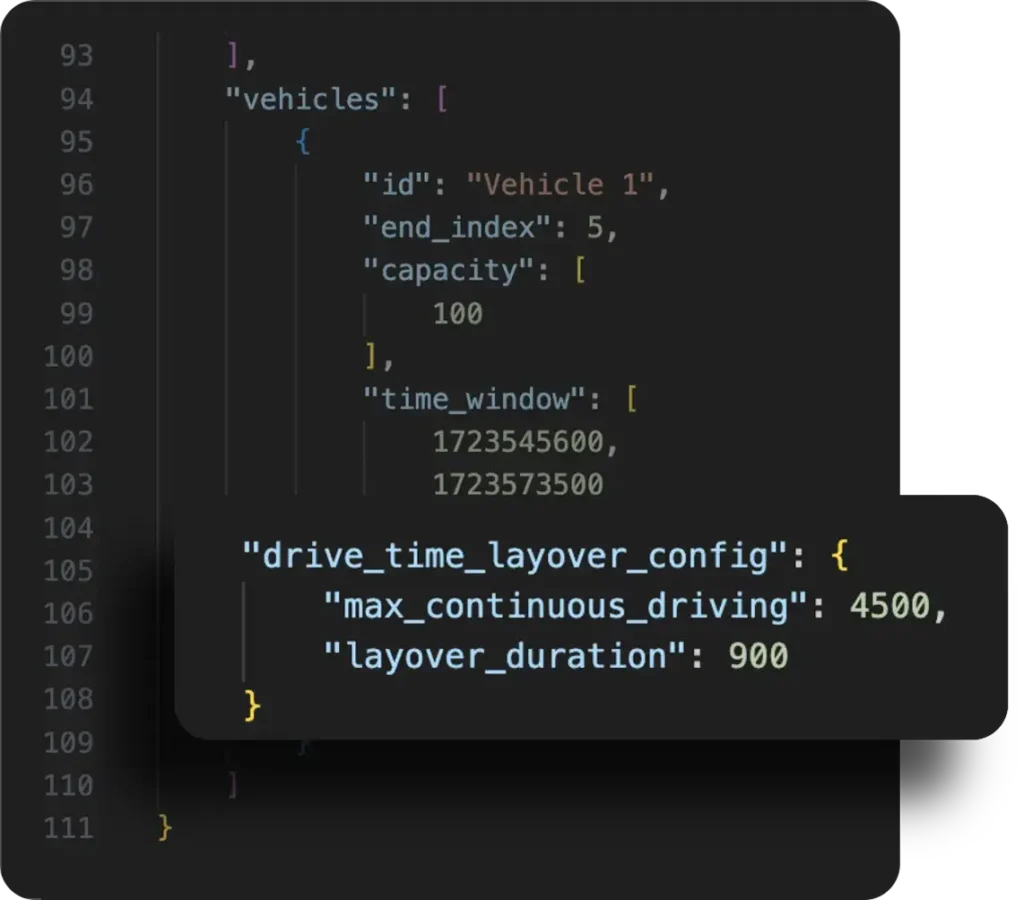
  1. Configurable driving-time limits: The platform allows developers to define HOS rules through the drive_time_layover_config parameter. This configuration specifies:
  • Maximum continuous driving time

  • Required break duration

  • Layover timing based on accumulated driving hours


built in hos constaints in nextbillion platform

Once configured, the optimizer automatically schedules breaks into the driver’s itinerary instead of treating them as manual stops.

  1. Automatic break scheduling: The NextBillion route optimization API acts at multiple fronts.
  • Calculates driving time between stops.

  • Detects when a driver would exceed the configured HOS limit.

  • Inserts mandatory rest or layover periods.

  • Reorders tasks when necessary to maintain compliance while optimizing travel time or other business objectives.

  1. Multi-constraint optimization: The tool works over optimizing a long list of constraints alongside HOS.
  • Delivery time windows

  • Vehicle capacities

  • Driver shift timings

  • Pickup and delivery precedence

  • Vehicle skills and assignments

  • Depot locations

  • Revenue or cost optimization

  • Zone restrictions

  • Truck dimensions and permit requirements

This enables fleets to generate routes that satisfy both regulatory and operational requirements simultaneously.

  1. Long-haul and multi-day routing: The platform supports planning for long-distance trucking operations by:
  • Scheduling overnight or extended layovers.

  • Respecting driver shift limits.

  • Planning routes that span multiple days while remaining HOS compliant.
     
  1. Truck-specific routing: HOS compliance is combined with truck-aware navigation features such as:

This ensures routes are both legally drivable and suitable for the vehicle being dispatched. 

NextBillion API suites that support HOS-compliant route planning and execution

Hours of Service (HOS)-aware routing requires more than simply inserting mandatory driver breaks. It depends on accurate travel times, truck-specific routing, dynamic route optimization, navigation, and real-time fleet visibility. 

NextBillion APIs supporting HOS-compliant route optimization

API

HOS-Aware Routing

HOS Benefits

Route Optimization API

Considers HOS, driver shifts, load, pickups & deliveries, and custom business rules. 

Automatic scheduling of breaks, efficient management of travel time with regulations

Directions API

Calculates the most feasible route

Realistic analysis to determine HOS limits

Navigation API

Considers vehicle details, load type, tolls, traffic, restrictions, etc.

Ensures legal routes are followed, avoids HOS violations 

Distance Matrix API

Computes travel times and distances between multiple origins and destinations

With accurate ETAs, it schedules breaks before exceeding HOS limits

Live Tracking API

Continuously tracks vehicles and driver locations

Dispatchers can monitor trip progress, compare planned HOS, and respond to delays

Route Reconstruction API

Reconstructs completed trips from GPS traces 

Post-trip HOS auditing with actual routes, travel time, and stop locations 

Snap to Roads API

Matches raw GPS coordinates to the road network. 

Accuracy of driving-time calculations used for HOS compliance 

Route Dispatch API

Sends optimized routes directly to drivers. 

Ensures drivers receive HOS-compliant schedules

Road Segment and Traffic API

Provide real-time road and traffic conditions

Reroute vehicles around congestion while preserving HOS compliance 

NextBillion APIs and their relevance to HOS-aware routing

Route Optimization API: Core API for HOS-aware routing. 

It optimizes routes while considering multiple constraints and custom business rules that can induce time-related activities. 

Driver Assignment API: Assigns jobs to the most suitable drivers. 

The tool analyzes staff availability, workload, shifts, and operational constraints to prevent HOS violations by balancing driver utilization.

Clustering API: Groups nearby stops before optimization. 

It reduces overall driving time, which suites HOS-compliant routes.

Directions API: Provides accurate truck-aware routes and travel times. 

It is useful in calculating average driving hours for HOS integrated routes.

Distance Matrix API: Computes travel times between multiple locations.

It enables generating accurate ETAs with mandatory breaks.

Snap to Roads API: Matches GPS traces to actual roads.

It improves the accuracy of recorded driving times for HOS monitoring and reporting.

Isochrone API: Identifies areas reachable within a given driving time. 

Route dispatch managers use the details to understand service coverage within HOS driving limits.

Navigation API: Provides turn-by-turn navigation.

Guides the drivers through traffic and road restrictions, keeping the vehicle on HOS-compliant routes.

Route Report API: Generates detailed route analytics.

The tool verifies travel times, delays, and route efficiency for HOS compliance analysis.

Batch Routing API: Processes large numbers of routing requests.

Though not directly relevant, it helps dispatchers to plan HOS-compliant routes across large fleets.

Live Tracking API: Monitors vehicle locations in real time.

The dispatchers can track progress and intervene before HOS limits are exceeded.

Geofence API: Detects vehicle entry and exit from predefined locations.

It supports automated recording of arrivals, departures, and rest-stop events.

Route Reconstruction API: Reconstructs actual routes from GPS data.

It enables the back office staff to analyze the performance of assignments, which significantly includes post-trip HOS audits and compliance verification.

Route Dispatch API: Dispatches HOS-compliant routes.

Drivers can directly receive the route plans on their digital devices, and they do not have to worry about mandatory breaks after specific time intervals.

Road Segments API: Supplies detailed road attributes.

It improves truck routing accuracy and travel-time estimation.

Traffic Incidents API: Provides real-time incident information.

It enables rerouting to reduce delays and helps drivers remain within HOS limits.

Weather Forecast API: Anticipates weather-related delays.

It is an important tool because extreme weather events can dramatically impact the driving hours and route schedules, which may also require reassessment of HOS breaks.

Places API: Helps locate depots, customer sites, or rest areas.

It has a critical role in digitally scanning regions and attaching HOS-compliant rest spaces in the route plans.

Take Away

Hours of Service, or HOS, regulations determine when commercial drivers are legally allowed to drive. Any route optimization solution that aims to improve delivery efficiency must account for these constraints to ensure routes are practical and compliant. Incorporating HOS regulations into route optimization enables more accurate ETAs, reduces the risk of violations, improves driver utilization, and supports safer fleet operations.

For modern fleets, compliance is no longer a manual process. Route optimization platforms that account for HOS constraints help dispatchers assign realistic routes that drivers can complete legally, minimizing violations and avoiding costly delays.

NextBillion API integrates HOS constraints directly into its route optimization engine, automatically generating routes that include mandatory breaks while simultaneously optimizing for logistics objectives such as travel time, delivery windows, fleet utilization, and operational cost.

FAQs

By planning routes around driver work-hour limits from the outset, fleets can reduce last-minute schedule changes, improve vehicle utilization, minimize unnecessary downtime, and deliver more reliable ETAs.

Yes. Optimizing routes with HOS constraints reduces unplanned stops, overtime, empty miles, and manual dispatch interventions, helping lower overall transportation costs.

Yes. By ensuring mandatory breaks and adequate rest periods are included in the route plan, HOS-aware routing helps reduce driver fatigue, improving road safety and reducing accident risk.

It produces more realistic delivery schedules by accounting for mandatory breaks and driving limits, resulting in more accurate ETAs and improved customer expectations.

Modern routing solutions can incorporate real-time traffic, weather, and operational updates to re-optimize routes while continuing to respect HOS regulations whenever possible.

Industries operating commercial fleets—such as long-haul trucking, freight transportation, last-mile delivery, field services, retail distribution, and logistics providers—benefit significantly from HOS-aware planning.

Manual planning becomes difficult as fleet size and delivery volume grow. HOS-aware route optimization automatically evaluates thousands of routing possibilities while enforcing work-hour constraints, producing compliant and efficient schedules much faster than manual planning.

About Author

Nitesh Malviya

Nitesh Malviya is a research-oriented professional with a background in Computer Science & Engineering. He served for 7 years as a software consultant and wrote passively in the tech niche before becoming a full-time technical writer.

Ready to get started?

Table of Contents