


Table of Contents
HOS, or Hours of Service, compliances are a major concern for fleet managers. These are regulations directed by FMCSA, which are strict and mandatory for commercial vehicles.
Dispatchers can definitely avoid penalties by following the rules, but that’s just one part of the equation. The fleet managers are expected to keep a balance between delivery deadlines, maximizing vehicle utilization, and ensuring drivers remain compliant with Hours of Service (HOS) regulations.
Business competition and rising orders generate continuous pressure to maintain operational efficiency. To speed up the job, logistics companies have transitioned from manual logbooks towards ELDs, or Electronic Logging Devices. But the question is, are these machines getting utilized for their full potential? The fleet managers need a lot more information and data analysis rather than just recordkeeping.
This is where modern fleet management platforms make a significant difference. Instead of identifying violations after they occur, it automates the inclusion of HOS compliances into the route plans. Fleet managers can now anticipate compliance risks, optimize dispatch decisions, and keep drivers on schedule without compromising safety or regulatory requirements.

We’ll find out about the technological capabilities in advanced fleet management platforms and their automated integration of HOS compliances. The article will also elaborate on routing intelligence and compliance workflows, which are essential for fleets to improve efficiency, reduce operational costs, and deliver a better experience for both drivers and customers.
To put it simply, Hours of Service, or HOS, is the calculation of working hours of an individual for a business firm. Governments in different nations enforce HOS regulations for logistics and transportation companies to primarily monitor the driving hours of the commercial drivers engaged in interstate commerce.
In the USA the Federal Motor Carrier Safety Administration (FMCSA) has established the laws under 49 CFR Part 395. The fundamental purpose behind the HOS regulations is to ensure that the rides are not stressful for a driver.
While excessive driving raises health issues for the person, the consequences can be equally dangerous. Stressed drivers might collide their vehicles to cause minor to major accidents. Hence, the property carrying commercial drivers are expected to follow the guidelines to prevent mishappenings on the road.
The framework manages commercial drivers’ driving time, work time, breaks, and rest, but technically there are different limits for property-carrying and passenger-carrying operations.
To know more about what hours of service are: a complete guide
In practical terms, HOS answers four operational questions:

HOS carries the formula for a transport company to dynamically allot the assignments to the drivers so that the workload gets distributed in a standard format. By defining the strict rules for service hours, the regulations ensure that fatigued drivers are kept off public roads.
Here the purpose is to understand the tiredness of sitting alert on a seat for hours. The guidelines let the drivers remain awake, alert, and capable of operating safely.
HOS also addresses some major concerns of the transit operations:
For fleets, HOS compliance is therefore both a safety and planning concern. Dispatchers need to account for available driving hours, mandatory breaks, and weekly duty-cycle limits when assigning loads, planning routes, and setting delivery commitments.
Also Read: Quick tips to hire delivery drivers.
Fleet management platforms are a complete solution for a dispatcher, delivery manager, or fleet manager. Its dashboard helps them monitor, operate, maintain, and improve the vehicles, drivers, and related assets. It is a centralized software that facilitates tracking a vehicle’s live location, maintenance, fuel consumption, driver behavior, and compliance records.
So in a nutshell, the fleet management platform serves multiple benefits. It enables the dispatchers to track the delivery vehicle’s exact location and review its maintenance issues to allot for another task. At the same time, they can also analyze the driver’s hours of service to ensure they can attempt another task.
Read: fleet management platform vs fleet management software
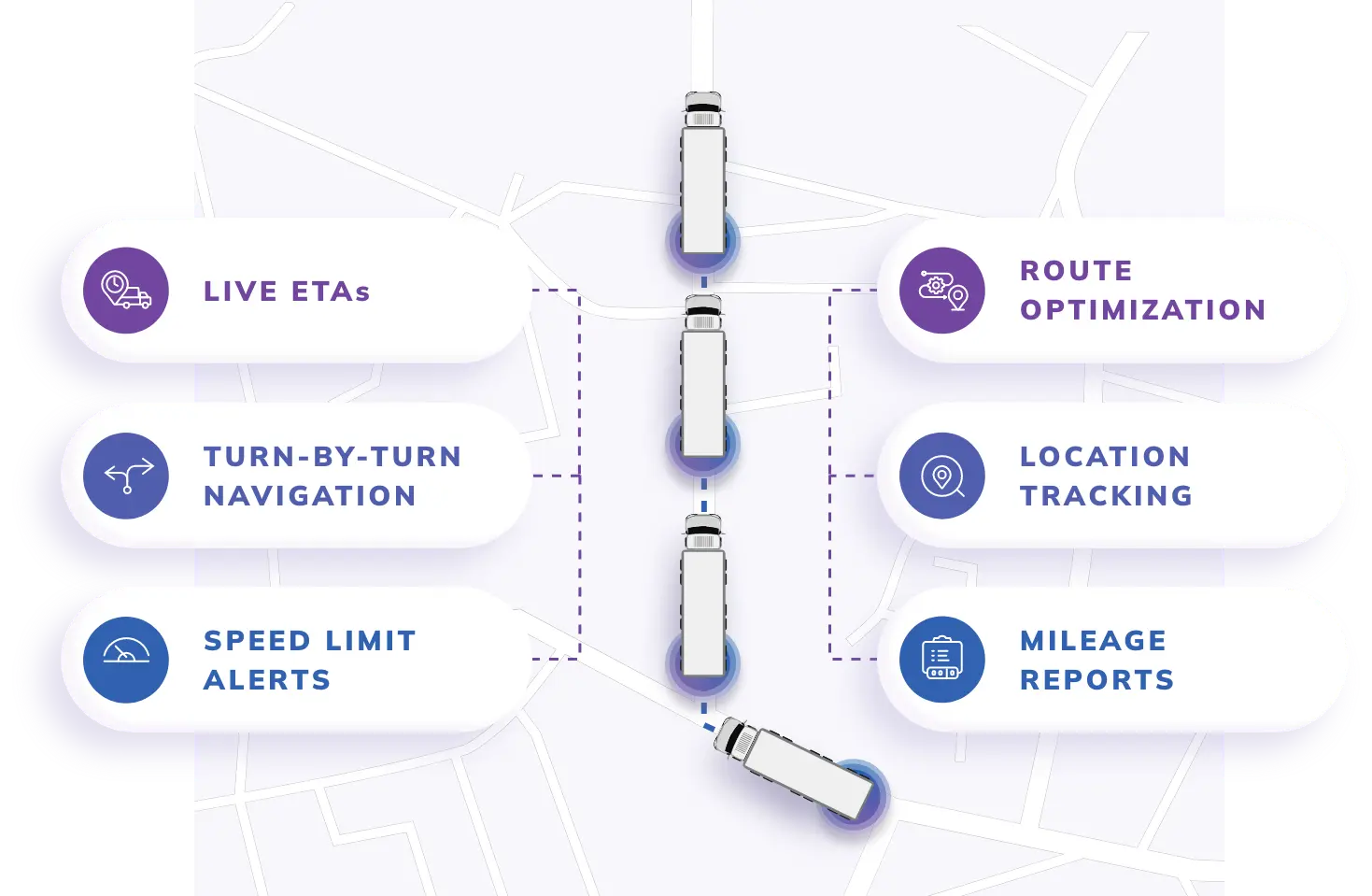
Fleet management platforms have improved with technological upgrades and are serving way beyond GPS tracking and dispatch. Modern fleet operations require a solution that simplifies compliance, optimizes routing, provides end-to-end visibility, and integrates seamlessly with existing business systems.
Here are the essential capabilities to evaluate.
FMCSA-Compliant ELD Integration:
The first and foremost requirement for a fleet management platform is that it should be integrated with HOS regulations. To automatically capture live data from the vehicles, the FMCSA-compliant Electronic Logging Devices (ELDs) have to be synced with it. This integration minimizes manual data entry, reduces errors, and streamlines audits.
Digital driver logs should be easy to access, update, and audit. Centralized log management improves record accuracy, simplifies compliance reporting, and helps fleet managers quickly address discrepancies or inspection requests.
Routing & Dispatch Intelligence
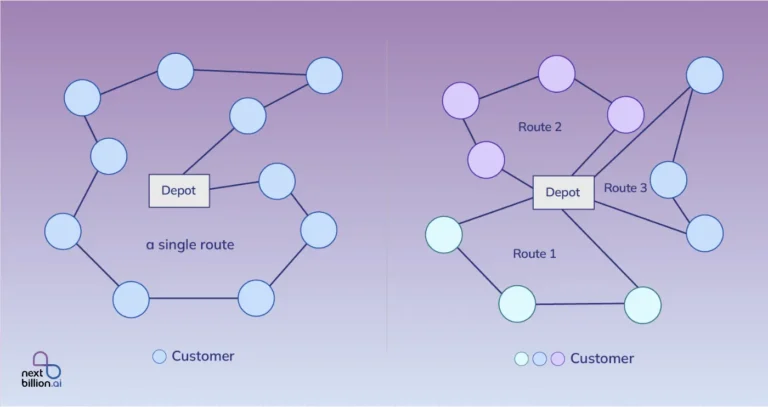
Efficient route optimization is essential for delivery tasks. Ideal fleet management platforms should also add constraints such as vehicle capacity, delivery windows, road restrictions, and driver schedules. It should also handle instant route adjustments during road closures or last-minute delivery requests.
Live Data Updates
Access to live traffic information enables dispatchers and drivers to avoid congestion, accidents, and road closures to improve route efficiency and enhances delivery reliability. It also factors in ETAs accuracy to improve customer communication and smart operational planning by reviewing driver location and route progress.

Geofencing
Fleet managers frequently use the geofencing feature to control the vehicle’s movement in a specific area. They manage operational visibility through alerts around the virtual boundary.
Fleet Visibility
The GPS tracking system facilitates real-time visibility into the exact location, helping managers monitor fleet activity, improve dispatch decisions, and respond quickly to operational issues.
Driver & Vehicle Monitoring
It is essential for a platform to not just track the live movement of the asset but also monitor the behavior of the driver and vehicle’s performance status. These parameters impact the safety and operating costs. It should analyze the points like acceleration, braking pattern of the driver, engine diagnostics, maintenance alerts, etc.
Centralized Dashboard
Central control and instant view of the parameters are a must for a fleet manager. Vehicles, drivers, routes, deliveries, compliance, and operational KPIs from a single interface enable faster and more informed decision-making.
Enterprise Integrations
Fleet management systems should seamlessly integrate with Transportation Management Systems (TMS) to ensure smooth data flow between planning, dispatch, and execution. Automated job assignments, real-time status updates, and improved communication between dispatchers and drivers improve operational efficiency.
APIs for Custom Workflows
Modern tools and technologies promote API support for integration and improve operational activities. An API-first platform is a credible mechanism for quick-connect with ERP, CRM, telematics, and other enterprise applications while supporting custom workflows tailored to unique operational requirements.
Reporting & Analytics Tools
Comprehensive reporting tools transform fleet data into actionable insights. Custom dashboards, operational reports, driver performance metrics, fuel consumption analysis, and compliance reporting help organizations identify trends, improve efficiency, and make data-driven decisions.
NextBillion.ai serves a critical role in maintaining HOS compliance in the transit journeys. Fleet managers highly depend on routing, dispatch, tracking, and location intelligence. They need to keep the drivers within legal driving limits while maintaining efficient operations, and this is where mapping and location APIs become an important part of the technology stack.

NextBillion’s APIs and SDKs can be integrated with transportation management systems (TMS), dispatch platforms, fleet management applications, and logistics software. Hence, live data through ELDs are important; these capabilities complement fleets by enabling HOS-aware routing, dispatch, and operational workflows.
Four connected layers in the HOS-compliant fleet management platform | ||
Layer | Responsibility | NextBillion’s role |
Compliance data | Captures duty status, driving time, breaks, sleeper-berth use, and HOS availability through an ELD or compliance provider | Consumes the resulting driver availability and operational constraints |
Planning & dispatch | Selects vehicles, assigns work, balances capacity, and schedules appointments | Supplies routing, travel time, distance, and optimization intelligence |
Driver Execution | Provides routes, navigation, task status, and location updates | Supports map rendering, turn-by-turn guidance, tracking, and geofence events |
Operations control | Monitors progress, manages exceptions, recalculates ETAs, and informs customers. | Provides live location intelligence, deviation signals, and ETA inputs. |
The HOS-derived constraints pass into the route planning engine, which handles vehicle capacity, driver skills, delivery time windows, service duration, depot rules, and other specific routing requirements.
Now the platform manages the responsibility of deriving HOS-compliant routes. It not only shortens the path but also optimizes the entire transit directions to integrate HOS regulations. It is designed to assign stops only when a driver can legally complete the work, including required breaks or rest periods.
NextBillion.ai’s Route Optimization API accommodates multi-vehicle routing, vehicle configurations, task preferences, and customized objectives. Its fleet management supports more than 50 routing constraints such as shortest distance, lowest cost, or quickest ETA.
A fleet software provider could use this approach to:
Route Optimization APIs
Route optimization is essential for planning trips that balance operational efficiency with driver availability. It enables developers to generate routes based on multiple operational constraints. The generated optimized routes are conveniently combined with HOS data from ELD systems.
It helps dispatchers to assign deliveries that are more likely to fit within available driving hours, while reducing fuel consumption and minimizing compliance risks. The API also resolves multi-stop and multi-vehicle planning problems after the system has calculated each driver’s usable HOS capacity.
Distance Matrix API
The Distance Matrix API uses current road network data to calculate travel distance and approximate travel time between multiple origins and destinations. Dispatch planners can utilize this information to estimate trip duration. Now before assigning a job, they can review which available drivers with sufficient available HOS can reach a stop, serve it, and still remain within their available hours. It is useful to improve decisions across large fleets by evaluating vehicle-to-job combinations at scale before optimization or dispatch assignment.
Directions API
It provides turn-by-turn directions based on real-world road conditions and routing preferences. Developers incorporate this tool in navigation to consider commercial vehicle restrictions, road closures, or preferred routes. The purpose is to help drivers follow compliant and efficient paths while reducing unexpected delays that could affect HOS schedules.
For HOS operations, this execution layer matters because a well-planned route still fails if drivers cannot follow it safely and consistently in the field.
Maps SDKs
Interactive Maps SDKs serve as a wonderful feature in the fleet management platform. It enables the developers to build custom mapping experiences directly into web and mobile applications. Once the map is loaded, the dispatchers can check the vehicle locations, assigned routes, customer stops, geofences, driver status, and operational events, giving a centralized view of fleet activity without relying on multiple systems.
Live Traffic Intelligence
It is always helpful to get pre-informed about the traffic condition on the road network ahead on the chosen route. Traffic congestion can significantly impact delivery schedules and driver hours.
NextBillion enables live traffic intelligence on the platform to refine ETAs, routing logic, navigation, and travel-time estimates as conditions change. Its routing and distance-matrix capabilities allow fleet systems to reassess delivery sequences and resting points. This prevents the route plans from disorganizing with HOS regulations due to the predicted traffic congestion. Hence, the dispatchers make informed decisions and reduce the likelihood that drivers exceed planned working hours due to unexpected delays.
Custom Routing
Every fleet operates under different business rules. Considering long-haul trucking, last-mile delivery, field services, HAZMAT, or refrigerated transport, they all have unique routing requirements.
NextBillion supports customizable routing logic. It enables developers to configure vehicle dimensions, road restrictions, hazardous material regulations, toll preferences, and other business-specific logics. These capabilities help organizations build routing workflows that align with both operational objectives and compliance requirements.
Fleet Tracking
Fleet managers should always be informed about the current position of the vehicles and drivers. Real-time fleet tracking provides continuous visibility into vehicle locations and trip progress.
The platform tracks the movement of vehicles to monitor driver progress and compliance with HOS regulations. It identifies potential delays and proactively adjusts schedules before compliance issues arise. Live tracking also improves communication between dispatchers, drivers, and customers throughout the delivery lifecycle.
Geofencing
Geofencing enables applications to create virtual boundaries around depots, customer locations, terminals, and restricted zones.
Automated arrival and departure events generated through geofences can simplify operational workflows. It verifys proof-of-service processes, triggers dispatch automation, and improves visibility into trip progress.
ETA Prediction
Accurate estimated arrival times improve planning across dispatch, customer service, and logistics operations.
ETA predictions are a combined analysis of routing, live traffic, and vehicle location. It helps fleet platforms continuously update delivery expectations and instigates dispatchers to respond quickly when schedules change while also letting the customers receive more reliable delivery information.
Enterprise-Grade Location Intelligence
Modern fleet applications often require more than routing and navigation. Enterprise-grade location intelligence enables organizations to analyze fleet performance, optimize territories, monitor asset utilization, and build data-driven operational workflows.
These capabilities are enabled in a modular set of APIs and SDKs that can be integrated into existing TMS, dispatch tools, or proprietary logistics applications to create solutions tailored to their operational requirements. The developers can build an HOS-aware experience tailored to their operating model.
HOS-aware fleet management platforms are backed by different sets of technologies working together. ELDs serve the major role with compliance systems to capture drivers’ driving hours and pause schedules. On the other hand, routing, mapping, tracking, and location intelligence help fleets make better operational decisions based on those constraints.
Also Read: How routing algorithms actually decide.
Workflow of NextBillion’s API with fleet management platform

NextBillion.ai provides the APIs and SDKs for the developers to build these capabilities into their own software systems. They can swiftly enable features such as intelligent dispatch, optimized route planning, real-time fleet visibility, dynamic rerouting, ETA prediction, and geofencing. Along with the existing compliance and fleet management systems, these tools help organizations create more efficient workflows and support both operational performance and regulatory requirements.
Fleet management platforms simplify Hours of Service (HOS) compliance by automating driver duty tracking, log management, and regulatory reporting. Its purpose is to reduce manual errors and ensure a legally adopted routing session while improving operational efficiency with electronic logging devices (ELDs), GPS, and real-time monitoring.
Integration of HOS compliance is not enough! ELDs record the vehicle’s engine and send the data in real-time to the fleet management platforms. The process ensures automated HOS tracking in real-time, route calculation, and implementation with minimal administrative overhead.
Automatic Driving Time Capture: ELD integration automatically records a driver’s driving time as soon as the vehicle is in motion. This ensures accurate duty status records and allows dispatchers to make informed scheduling decisions using current HOS information.
Engine Synchronization: Modern ELDs are synchronized with the commercial vehicle’s engine control module (ECM) to reliably collect operational data such as engine power status, vehicle movement, engine hours, and mileage. The data supports regulatory compliance during roadside inspections and audits.
Elimination of Manual Logs: Automatic data capture eliminates repetitive manual entries, minimizes human error, and reduces the possibility of logbook falsification.
Continuous HOS Calculations: Fleet management platforms continuously calculate a driver’s driving time, breaks, and duty status change. The system automatically updates available hours and alerts drivers or dispatchers when regulatory limits are approaching.
This real-time visibility enables fleets to assign routes more effectively, avoid HOS violations, and keep operations running smoothly without disrupting delivery schedules.
The driver can use their smart devices to review logs and account for duty states that vehicle telemetry alone cannot reliably determine, such as off-duty time, sleeper-berth time, on-duty-not-driving work, personal conveyance, and yard moves.
NextBillion’s fleet management platform enables a real-time view of every driver’s duty status, helping them make informed dispatch decisions while maintaining Hours of Service (HOS) compliance. Integration of location intelligence with telematics and ELD data helps in tracking driver activity and updates duty status throughout the workday.
Instead of relying on manual status updates or periodic check-ins, dispatchers can instantly see whether a driver is currently driving, performing work-related tasks, resting, or available for a new assignment.
Driving: The platform automatically records the driver’s driving time to accurately calculate the available HOS hours. This enables dispatchers to review active vehicles, monitor available legal hours, and possibly finish the current or next trip.
On Duty: Apart from driving hours, activities like loading and unloading cargo, refueling, vehicle maintenance, etc. are recorded as on duty.
NextBillion tracks the total on-duty hours for each driver, understands their workflow patterns, and ensures compliance.
Off Duty: The tool also records off-duty hours of the drivers when they no longer perform work-related activities. This particularly ensures HOS regulations are adopted for regular rest periods.
Sleeper Berth: Long-haul trucks specifically require a sleeper berth installed to qualify for HOS guidelines. NextBillion automatically records sleeper berth time and incorporates it into ongoing HOS calculations. This helps drivers to remain compliant without interrupting their workflow.
To create an HOS-compliant route, NextBillion combines advanced route optimization, live traffic, accurate ETAs, and location intelligence APIs. This is beneficial for the fleet managers in planning trips that are both operationally efficient and HOS compliant.
Dispatchers can also find out the driver’s remaining available hours, real-time road conditions, and delivery schedules before assigning a trip. The result is smarter dispatch decisions that reduce compliance risks while maximizing fleet productivity.

Calculating Legal Routes: Traffic congestion, road restrictions, or multiple delivery stops may exceed a driver’s remaining legal driving hours. NextBillion.ai’s routing engine evaluates these variables to generate routes that align with a driver’s available HOS time. The calculation involves multiple factors like remaining hours, distance, ETA, traffic, stoppages, etc.
ETAs include HOS Availability: If the driver is closing towards the HOS-compliant break point, then the delivery ETAs would also include the driver’s available slot. NextBillion combines remaining HOS availability, live & historic traffic updates, road restrictions, etc. ETA predictions also improve customer communication and reduce uncertainty across the supply chain.
Avoiding Routes That Could Trigger Violations: NextBillion evaluates route feasibility by identifying trips that may exceed a driver’s available driving or on-duty hours. The platform recommends shorter or faster routes and identifies alternate roads with lower congestion. Suggest different driver assignments when required, and balance workloads across the fleet based on driver availability.
By identifying compliance risks during the planning stage, fleets can avoid costly violations, delivery delays, and unnecessary operational disruptions.
Dynamic Rerouting Without Breaking Compliance: NextBillion supports dynamic rerouting, continuously analyzing live traffic conditions and recalculating routes when disruptions occur. Importantly, rerouting decisions can be made while considering the driver’s remaining HOS availability.
Smarter Planning with Advanced Routing Intelligence: NextBillion’s location intelligence capabilities extend beyond basic navigation. Features such as route optimization, distance matrix calculations, live traffic analysis, multiple stops route planning, and high-precision ETAs help dispatchers make better operational decisions while supporting HOS compliance.
For example:
It is next to impossible for fleet managers to monitor drivers on different routes without an automated system. NextBillion ensures that the drivers follow legal routes and HOS regulations with the real-time compliance alerts throughout until they reach the end point of the task. This additionally keeps the driver and the dispatcher notified about the HOS limits and makes informed decisions.
NextBillion is capable of identifying violations before they have occurred and sends early warnings that allow the fleet managers to take corrective action before compliance is compromised. The can adjust the routes, reassign deliveries, or schedule mandatory breaks to maintain uninterrupted compliance throughout the workday.
Upcoming Driving Limits: Based on continuously updated HOS data NextBillion’s platform generates automated alerts as drivers approach legally permitted driving hours.
Required Rest Breaks: It tracks driving and on-duty time in real time and alerts drivers when a required break is approaching.
Shift Completion: When the driver’s shift is nearing its legal limit, the platform alerts both the driver and dispatcher. This visibility allows dispatchers to schedule deliveries within available work hours and plan driver replacements or handoffs when necessary.
Weekly Hour Limits: Nextbillion securely manages the database and tracks the HOS-regulated working hours. It calculates each driver’s accumulated work hours and provides alerts as weekly thresholds approach.
It is hard to implement HOS compliances without maintaining accurate driver logs. ELDs integrated with the vehicle and fleet management platforms deliver real-time data for every parameter change. NextBillion’s automated driver log management ensures that fleets maintain accurate, up-to-date, and audit-ready records with minimal manual effort.
Electronic Logbooks: Digitally recording a driver’s duty status changes, driving hours, and rest periods eliminates manual entry on paper-based recordkeeping and improves data accuracy and accessibility from a centralized dashboard.
Automatic Record Updates: NextBillion automatically records events such as vehicle movement, driving time, and duty status changes. It is highly accurate on the logs and ensures HOS compliances.
Easy Driver Certification: HOS regulations often require drivers to review and certify the accuracy of their daily logs. Our fleet management platform provides a simple digital workflow for drivers to review, verify, and certify their electronic records directly from their device.
Secure Storage: NextBillion ensures secure storage of electronic logs in a centralized cloud-based environment, which remains accessible whenever needed. The platform maintains a complete history of driver activity and enables controlled access for authorized personnel.
Simplified Audit Preparation: There is a simplified audit preparation in an organized format of driver logs, duty status history, and HOS records in a single platform. It makes inspection procedures fast and efficient from readily available centralized records.
NextBillion provides a centralized dashboard for entire fleet operations. It brings together driver status, HOS data, routing insights, and operational metrics into a single interface, and fleet managers can live monitor compliance issues at every route. The fleet managers can access real-time insights for faster decision-making, improved resource allocation, and better regulatory compliance.
Driver Availability: The dashboard provides real-time visibility into each driver’s current duty status and remaining HOS hours. This live visibility helps dispatchers assign loads to the right drivers while avoiding HOS violations and unnecessary delays.
Active Violations: The dashboard highlights active or potential HOS violations as they occur. This enables fleet managers to intervene before minor issues become regulatory violations. Events that can be monitored include:
Compliance Scores: NextBillion.ai helps fleets measure compliance through driver- and fleet-level indicators that highlight adherence to HOS requirements and operational best practices. Compliance scores provide managers with a clear way to track performance and focus improvement efforts where they will have the greatest impact.
Fleet Health Overview: The compliance data along with operational intelligence provides a broader view of fleet health, enabling managers to monitor how compliance affects daily operations. A fleet-wide overview may include:
Custom Reports: With NextBillion, the fleet managers can easily generate customized reports about actionable insights into HOS compliance and fleet performance. The reports may include the driver’s available hours, violation trends, workload distribution, compliance performance, and other such factors.
Historical and operational data is beneficial for anticipating compliance risks before they affect fleet operations. This is where NextBillion’s location intelligence and routing capabilities help fleets move from reactive compliance to predictive planning. Dispatchers can identify potential HOS challenges early and make smarter decisions.
Historical Trips: Data from past assignments uncover patterns that influence HOS compliance, such as routes that consistently take longer than expected or deliveries that frequently require additional driving time.
Driver Behavior: The platform records driver behavior insights with fleet operations. Fleet managers can identify driving habits that contribute to schedule delays, improve driver coaching, balance workloads based on driver efficiency, and support safer driving while maintaining HOS compliance.
Route Performance: Road construction, recurring congestion, toll roads, difficult intersections, or inefficient stop sequences can all increase travel time and affect HOS availability. NextBillion continuously evaluates route performance to help fleets:
These insights enable dispatchers to select routes that maximize productivity without pushing drivers beyond their legal limits.
Traffic Trends: Traffic conditions change throughout the day and can significantly impact driving hours. A route that is compliant during off-peak hours may become impractical during rush hour. We incorporate both live and historical traffic intelligence into the optimized route plan to help fleets anticipate delays before dispatching drivers.
Delivery Schedules: An optimized delivery planning by the fleet management platform considers:
This creates more realistic schedules that improve on-time delivery performance while reducing compliance risks.
Fewer HOS Violations: When historical fleet data is combined with intelligent routing and predictive analytics, compliance becomes part of the planning process rather than a post-trip review.
Dispatchers can identify trips that are likely to exceed legal driving limits, assign work to drivers with sufficient available hours, and adjust schedules before problems arise.