


Table of Contents
Saudi Arabia’s transport sector is undergoing a significant digital transformation. As the Kingdom strengthens its position as a global logistics hub, commercial fleet operators are expected to deliver more than transportation capacity. They must also provide accurate, continuous, and reliable operational data.
The WASL platform is central to this transformation. WASL connects regulated transport operators, vehicles, drivers, and telematics providers with Saudi Arabia’s Transport General Authority (TGA). It enables relevant fleet information to be shared digitally, helping authorities improve transport safety, oversight, and regulatory compliance.
For fleet operators, however, WASL should not be viewed simply as another registration requirement. It represents a move toward a connected transport ecosystem in which vehicle data must remain accurate, available, and operationally useful.
In this blog, we examine how WASL works, what it means for commercial fleets, and how operators can build routing and fleet-management workflows that support both compliance and business performance.
What Is the WASL Platform?
WASL is an electronic platform used to connect land-transport establishments and commercial fleets with the Transport General Authority in Saudi Arabia.
The platform is operated by Elm, while the TGA is responsible for regulating and developing the Kingdom’s land, maritime, and rail-transport sectors. Through approved telematics and tracking service providers, relevant fleet data can be transmitted to the platform.
Depending on the transport activity and vehicle category, this information may include:
- Operator details
- Vehicle identification
- Driver information
- Vehicle location
- Speed and movement data
- Trip-related information
- Vehicle-weight data for applicable operations
- Tracking-device status
The exact technical and operational requirements vary between transport activities. Fleet operators should confirm their obligations through the Transport General Authority and their authorized WASL-connected service provider.
WASL Is a Data-Connectivity Requirement
A common mistake is to treat WASL compliance as a one-time exercise:
- Register the company.
- Install tracking devices.
- Connect the vehicles.
- Consider the process complete.
In practice, compliance depends on the continued flow of valid information. A vehicle may be registered correctly but later develop a reporting problem because of:
- An inactive tracking device
- Poor network connectivity
- Incorrect vehicle information
- A mismatched driver assignment
- An expired document
- A disconnected sensor
- An incorrect device identifier
- Delayed or incomplete data transmission
- Changes to the vehicle that were not updated in the system
This makes WASL as much a data-governance challenge as a hardware-installation requirement. Fleet operators need to know whether every vehicle is connected, whether the data is being transmitted correctly, and whether the information held across different systems remains consistent.
The Four Data Layers Behind a WASL-Connected Fleet
Operator Data
The operator layer identifies the company licensed to provide the regulated transport activity. Information held in internal fleet systems should align with the legal and commercial records used during registration. Changes to the company, authorized manager, contact information, or licensed activity may need to be reflected across the relevant platforms.
Vehicle Data
Every vehicle must be associated with the correct registration, plate, device, and operating activity. For fleets with hundreds or thousands of vehicles, maintaining these relationships can become difficult. Vehicles may be sold, replaced, reassigned between depots, temporarily removed from service, or transferred to different contracts.
If vehicle records are not synchronized, the fleet may appear operationally correct in one system but incomplete in another.
Driver Data
The driver operating a vehicle must have the correct credentials and authorization for the relevant activity.
Driver-to-vehicle assignments can change daily. Fleet operators therefore need processes that prevent outdated, incorrect, or incomplete assignment data from moving between their workforce, dispatch, telematics, and compliance systems.
Live Telematics Data
GPS devices and other applicable sensors provide the operational data associated with the vehicle. For this data to remain reliable, operators must monitor:
- Device connectivity
- Location-update continuity
- Data-transmission failures
- Sensor health
- Unexpected gaps in movement history
- Device tampering or removal
- Communication latency
- Vehicle-device mismatches
Together, these four layers determine whether a fleet is merely registered or continuously connected.
The Operational Challenges of Managing WASL at Scale
WASL connectivity can become more complex as a fleet expands across cities, depots, business units, and transport activities.
Managing Multiple Systems
A large transport company may use separate platforms for:
- Regulatory registration
- Vehicle tracking
- Route planning
- Driver management
- Maintenance
- Order management
- Fuel monitoring
- Warehouse operations
- Customer communication
When these systems are not integrated, teams may enter the same information multiple times. This increases the risk of data discrepancies and delays.
Monitoring Device Availability
A GPS device going offline is not only a tracking problem. It can create a gap in the vehicle’s operational and compliance records.
Without automated monitoring, the fleet team may not discover the issue until a report is reviewed or the vehicle is required for a regulatory process.
Controlling Driver and Vehicle Assignments
Dispatchers often reassign drivers or vehicles to manage absences, breakdowns, urgent orders, or capacity shortages.
If the reassignment is updated only in the dispatch system, other platforms may continue to show the old relationship. This creates inconsistent records and reduces operational visibility.
Operating Across Long Distances
Saudi fleets frequently cover long distances between cities, industrial regions, ports, distribution centres, and remote customer locations.
These journeys introduce operational challenges such as:
- Variable network coverage
- Driver-hour limitations
- Fuel and rest-stop planning
- Extreme weather
- Vehicle breakdowns
- Road and vehicle restrictions
- Long recovery times
- Inaccurate ETAs
- Limited alternative vehicle availability
Fleet operators need workflows that continue to function even when a journey does not go according to plan.
From Regulatory Reporting to a Connected Fleet Ecosystem
WASL creates a strong reason for fleet operators to standardize their vehicle and driver data. The same connected infrastructure can also support better operational planning.
Instead of maintaining separate workflows for compliance and fleet management, businesses can build an ecosystem in which information flows between telematics, routing, dispatch, and enterprise applications.
This does not mean that every piece of operational information must be sent to WASL. It means that the same reliable vehicle-data foundation can be used across multiple authorized business workflows.
For example, the location feed used to monitor a vehicle can also help the fleet-management system:
- Compare actual movement with the planned route
- Recalculate the vehicle’s ETA
- Identify an extended stop
- Detect an unplanned deviation
- Estimate remaining driver time
- Reassign incomplete jobs
- Notify the receiving location
- Reconstruct a completed trip
Why Routing Must Be Connected to Telematics
Telematics tells an operator what a vehicle is doing. Route planning determines what the vehicle should be doing. When the two operate separately, dispatchers see vehicle locations but lack the context needed to make decisions.
A vehicle may appear to be moving normally while still:
- Following an unsuitable road
- Approaching a restricted area
- Running behind schedule
- Exceeding its planned route duration
- Carrying an inefficient stop sequence
- Heading toward a customer that is not ready
- Creating a future driver-hours problem
- Missing a more suitable rest or refuelling stop
Connecting live vehicle data with the original route plan allows the system to identify the difference between expected and actual performance.
Creating More Reliable Routes for Saudi Operations
Route planning in Saudi Arabia must account for more than the fastest road between two points.
Commercial operators may need to consider:
Vehicle Specifications
Routes should reflect the dimensions, weight, axle load, cargo type, and road suitability of the assigned vehicle.
A route appropriate for a light commercial van may not be suitable for a heavy truck or tanker.
Driver Working Conditions
Long-distance planning must incorporate driver shifts, breaks, maximum route duration, and appropriate rest locations.
Planning these requirements in advance helps reduce the need for unsafe or expensive last-minute changes.
Customer Time Windows
Warehouses, retail stores, construction sites, and industrial facilities may accept deliveries only during specific hours.
Routes should be built around these operating windows rather than relying solely on distance.
Depot and Loading Constraints
Vehicles may need to start or finish at specific depots. Some jobs may require loading in a defined order, returning equipment, collecting documentation, or visiting a weighbridge.
These requirements affect both route sequence and vehicle selection.
Restricted and Private Roads
Industrial estates, oil and gas facilities, construction projects, ports, and large commercial sites may contain private roads or access conditions that are not accurately represented in standard maps.
Operators may need to add their own road permissions, closures, entry points, or speed policies.
How NextBillion.ai Can Support WASL-Connected Fleet Operations
NextBillion.ai does not replace WASL, the Transport General Authority, or an authorized telematics provider. It provides the mapping, routing, optimization, navigation, and tracking capabilities businesses can use around their regulatory and operational systems.
Connect Telematics with Route Planning
Vehicle locations from a telematics platform can be used within an operational workflow to monitor route progress, update ETAs, and trigger re-optimization.
This helps fleet teams move from simply recording vehicle movements to acting on live information.
Optimize Complex Fleet Assignments
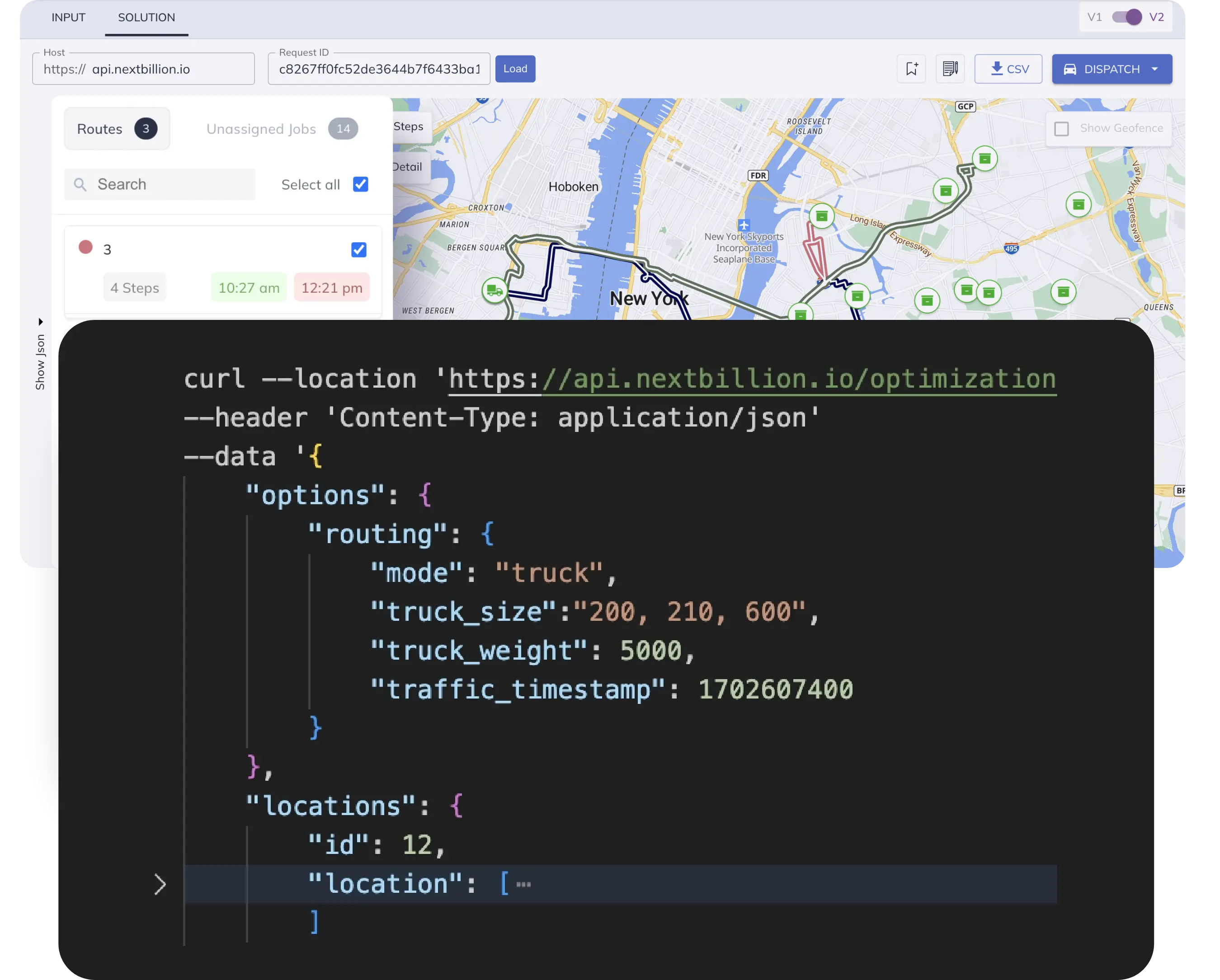
NextBillion.ai’s Route Optimization API can assign vehicles and sequence stops using constraints such as:
- Vehicle capacities
- Pickup and delivery relationships
- Customer time windows
- Driver shifts and breaks
- Maximum route distance
- Maximum route duration
- Job priorities
- Vehicle-job compatibility
- Multiple depots
- Optional start and end locations
- Loading and unloading relationships
These constraints help operators generate routes that reflect the realities of Saudi freight, distribution, service, and last-mile operations.
Build Vehicle-Specific Routes
Businesses can define vehicle attributes such as height, width, weight, and axle load when calculating routes for commercial fleets.
Truck-aware routing helps reduce the risk of assigning roads that are unsuitable for the vehicle being dispatched.
Configure Private Operational Maps
Using NextBillion.ai’s mapping customization capabilities, businesses can apply their own information to the road network.
Operators can configure:
- Private-road access
- Restricted road segments
- Custom speed limits
- Vehicle-specific permissions
- Time-based restrictions
- Prohibited turns
- Approved facility entrances
- Recurring road closures
- High-risk or no-go areas
These edits can then influence the routes generated for the fleet.
Re-Optimize After Disruptions
If a vehicle becomes unavailable, a delivery is cancelled, or an urgent order is added, the remaining work can be re-optimized using updated fleet information.
The routing system can evaluate the location, capacity, schedule, and suitability of available vehicles before recommending a revised assignment.
Integrate with the Existing Technology Stack
NextBillion.ai APIs can work as part of a broader transport ecosystem that includes:
- Telematics systems
- Fleet-management platforms
- Transport-management systems
- Warehouse-management systems
- ERP applications
- Order-management platforms
- Driver applications
- Customer-tracking interfaces
This allows operators to introduce advanced routing and mapping capabilities without replacing every system they already use.
Preparing for Saudi Arabia’s Connected Transport Future
WASL demonstrates how Saudi Arabia is using digital infrastructure to strengthen the quality, safety, and oversight of commercial transportation.
For fleet operators, the immediate priority is to understand the requirements associated with their transport activity and establish a reliable connection through the appropriate service provider.
The longer-term opportunity is to build on that connectivity. When vehicle, driver, telematics, routing, and order data work together, businesses can create a fleet operation that is easier to monitor, optimize, and scale. Compliance becomes part of the operational architecture instead of a separate administrative process.
NextBillion.ai helps logistics and transportation businesses add customizable routing, optimization, maps, navigation, and tracking capabilities to their existing fleet ecosystems.
Looking to connect your Saudi telematics data with smarter route planning and dispatch workflows? Talk to NextBillion.ai to build a routing solution around your fleet, vehicles, and operational requirements.
Ready to get started?
Request a DemoTable of Contents
Subscribe to our Newsletters
Get the best practices for route planning & optimization, delivered to your inbox.
Subscribe