

Dispatch Mapping Software Optimizes Last-Mile Delivery

How Dispatch Mapping Software Optimizes Last-Mile Delivery

Published: September 22, 2026

Ask a logistics operator where their money disappears, and most will point to the same stretch of the journey: the last few miles between a hub and a customer’s door. Depending on which report you trust, that final leg eats up somewhere between 40% and just over half of total shipping cost, despite usually covering the shortest distance in the entire supply chain. A truck moves a thousand packages efficiently down a highway without much drama. Getting each one to an individual porch, apartment buzzer, or loading dock is a completely different problem, and it’s the one that ends up deciding whether a delivery business turns a profit at all.

That’s the gap last-mile dispatch software exists to close. Not by making trucks faster, but by making every decision around those trucks sharper: which order goes to which driver, in what order, adjusted the second something changes. This piece breaks down exactly how that works in practice, using the mechanics behind modern platforms, NextBillion.ai included, to show what “optimization” actually means once you strip away the marketing language.

Why Last-Mile Delivery Resists Easy Fixes

Before getting into how dispatch mapping software helps, it’s worth pinning down what makes this leg so hard to simplify in the first place.

A long-haul truck runs a predictable route between two fixed points, mostly on highways, mostly at consistent speeds. A last-mile driver might handle anywhere from 50 to 150 stops in a single shift, and no two are quite alike. Different building, different customer availability, different parking situation, different odds the recipient isn’t even home. Multiply that across dozens of drivers and hundreds of daily orders, and manual dispatch (someone with a spreadsheet, a phone, and a lot of patience) simply runs out of road. Throw same-day and on-demand promises into the mix, where new orders show up after routes are already locked in, and the job stops being about planning well once a day. It turns into replanning, more or less nonstop.

Three things drive most of the added cost:

  • Labor intensity: Every stop means parking, walking, waiting, and confirming delivery, and drivers get paid whether the stop goes smoothly or drags on for ten minutes.

  • Failed attempts: A customer who isn’t home turns one delivery into two, which roughly doubles the cost of fulfilling that single order.

  • Density mismatch: Tightly packed urban routes can be efficient with the right sequencing. Sparse suburban or rural routes rarely are, no matter how cleverly the stops get ordered.

Dispatch mapping software attacks all three by changing how routes get built in the first place, and how dispatchers respond the moment a plan stops matching reality.

Read more: Dispatch Mapping Software: A Complete Guide for Modern Fleet Operations
 

Manual Dispatch vs. Software-Driven Dispatch, Side by Side

Seeing the two approaches next to each other makes the gap clearer, because it isn’t just about speed. It’s about what becomes possible once the manual ceiling gets removed entirely.


Manual Dispatch

Dispatch Mapping Software

Route planning

Built by hand or with a basic map tool, once per shift

Generated automatically in seconds, weighing dozens of constraints at once

Reacting to change

Dispatcher calls or messages drivers to re-route on the fly

Routes re-optimize on their own and push updates straight to driver apps

Visibility

Relies on driver check-ins or phone calls

Live GPS tracking with ETAs that keep updating

Proof of delivery

Manual photo or signature, logged later

Captured automatically, triggered by geofencing the moment a driver arrives

Scaling with volume

Needs more dispatchers as order volume climbs

Handles ten orders or ten thousand without adding headcount

None of this makes dispatchers obsolete, to be clear. It shifts their time away from manually building and rebuilding routes and toward managing genuine exceptions, the small number of situations a system correctly flags as needing a human call.

What "Dispatch Mapping Software" Actually Does

At a functional level, dispatch mapping software sits between the order queue and the driver’s phone. It looks at every open order, factors in where drivers currently are, what they’re carrying, when customers expect delivery, and whatever operational rules apply, then produces a route plan that a human dispatcher would need hours to build by hand, and would probably still get wrong in a few places.

The output isn’t just a map with pins scattered across it. A usable system produces an actual sequence: stop one, then stop two, then stop three, timed against real road conditions, sent straight to a driver’s app, and able to shift the moment conditions do. That last piece, the ability to shift, is where most of the real value lives, so it’s worth unpacking one layer at a time.

How the Optimization Actually Happens

Knowing what dispatch mapping software is supposed to do is one thing. Seeing how it actually pulls that off, one layer at a time, is where the real substance is. The seven pieces below are what typically separate a genuinely capable platform from a basic mapping tool wearing a dispatch label. 

1. Route Optimization Built on Real Constraints, Not Just Distance

The most common misconception about route optimization is that it’s just finding the shortest path between points, the way a personal navigation app would. Last-mile dispatch is a considerably harder version of that problem, because the “shortest” route is frequently the wrong one once real constraints get applied.

route optimization
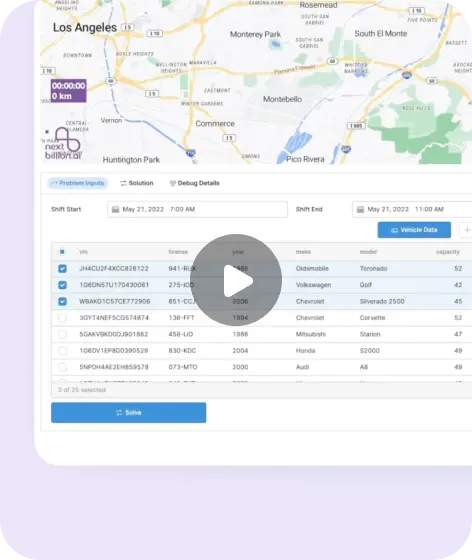
A serious optimization engine has to weigh dozens of variables at once: delivery time windows a customer already agreed to, how much a vehicle can physically hold, how long a driver’s shift is legally allowed to run, whether a stop needs a refrigerated truck, whether a particular order should jump the queue because it’s time-sensitive. NextBillion.ai’s routing engine, for one, handles more than 50 hard and soft constraints in a single optimization pass, covering vehicle capacity, driver shifts, time windows, truck dimensions, and priority stops, and it produces a dispatch-ready plan in seconds rather than the minutes or hours a manual process would eat up.

The line between hard and soft constraints matters here. A hard constraint (a vehicle can’t exceed its weight limit, a driver can’t work past a legal shift length) can never be broken, full stop. A soft constraint (a customer would rather have morning delivery, but it isn’t guaranteed) gets weighed against everything else and honored when it’s possible without wrecking the rest of the plan. Good dispatch mapping software works out that tradeoff on its own, instead of leaving a dispatcher to juggle priorities stop by stop.

2. AI Routing That Learns From How a Fleet Actually Operates

A theoretical shortest path assumes every stop takes the same amount of time and every road behaves exactly the way a map says it should. Real operations don’t cooperate like that. A stop at a high-rise takes longer than one at a single-family home. A particular intersection backs up every single afternoon, no matter what live traffic data claims at the moment a route gets planned. A specific driver is consistently quicker through certain neighborhoods simply because they know the shortcuts.

More advanced platforms build AI routing layers on top of the core optimizer that learn from a fleet’s own operational history: actual service times per stop type, observed driver behavior, real traffic patterns rather than generic estimates pulled from a map API. NextBillion.ai’s Last Mile Delivery API for eCommerce leans into exactly this, pairing AI route optimization with live ETAs so same-day and on-demand windows stay realistic instead of aspirational. Over time, the routes it generates start reflecting how the fleet genuinely performs, not some textbook version of it, and that shows up directly in on-time rates and in how often a “planned” delivery window turns out to mean anything.

3. Dynamic Dispatch That Reacts Mid-Shift

A route plan built at 7 a.m. is often obsolete by 9. An order gets added. A customer cancels. A driver’s vehicle breaks down on the side of the road. Traffic collapses a route that looked perfectly fine an hour earlier. This is exactly where a lot of delivery operations still fall back on manual intervention: a dispatcher on the phone, trying to shuffle stops between drivers in real time while everything else keeps moving.
Dispatch Mapping Software
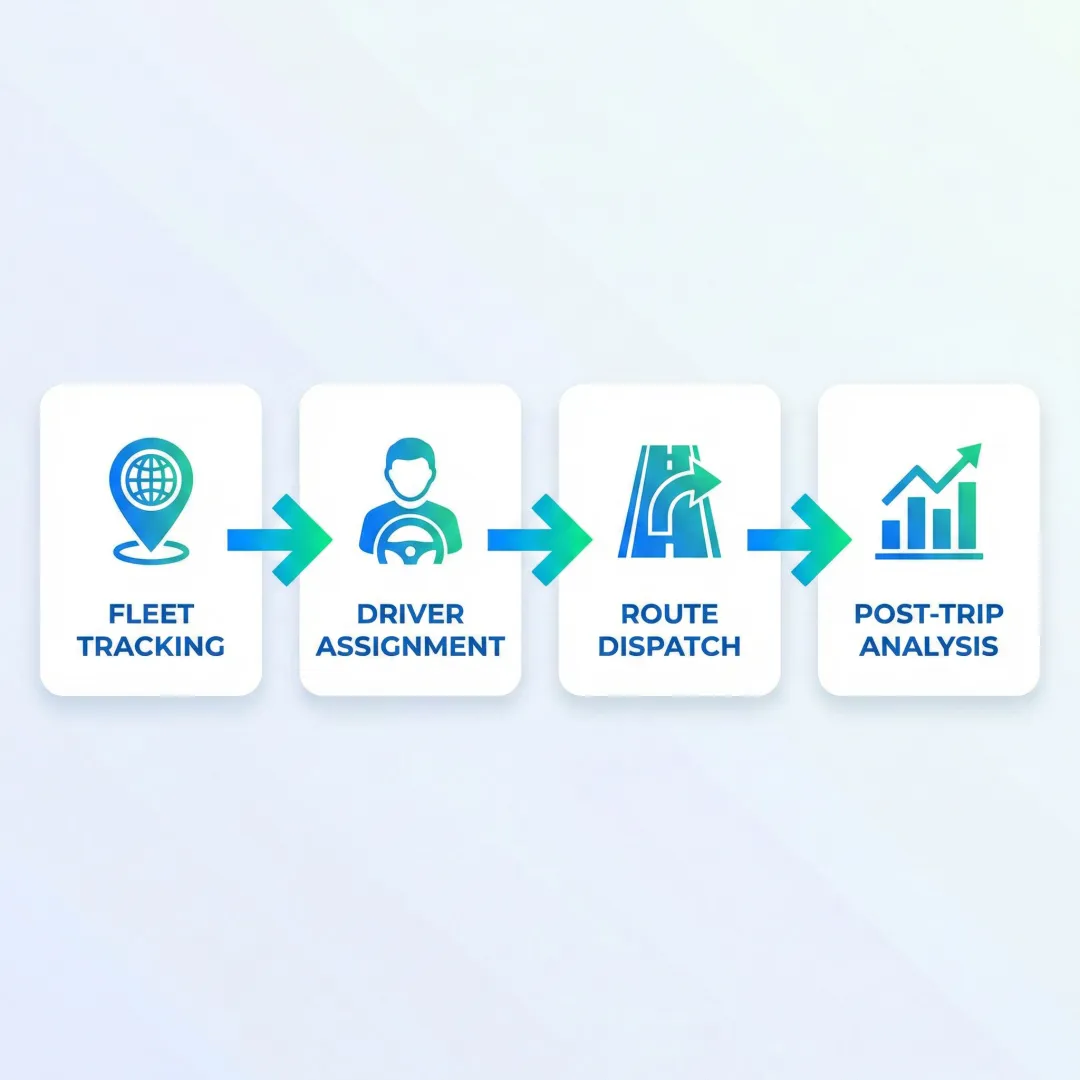
Dispatch mapping software automates that handoff instead. When conditions change, the system re-optimizes the affected routes and pushes the updated plan straight to driver apps, no human required to manually rebuild the sequence from scratch. NextBillion.ai’s Route Dispatch API is built around precisely this handoff, moving an optimized plan into a driver’s hands in seconds and handling dynamic reassignment automatically whenever orders change or a disruption hits mid-shift. The practical result is that dispatchers spend their time managing exceptions rather than re-sequencing every route by hand each time something shifts.

Read more: 10 Best Dispatch Management Software in 2026
 

4. Real-Time Tracking and ETAs That Mean Something

Optimization only matters if a dispatcher and a customer can actually see whether the plan is holding up. Real-time tracking gives operations visibility into exactly where every vehicle sits against its planned route, and it’s what turns a static plan into something a dispatcher can genuinely manage across a full shift instead of just hoping for the best.

It also changes what customers get told. Rather than a generic delivery window set the instant an order goes in, live tracking data lets ETAs update as the day actually unfolds, based on where a driver really is instead of where they were supposed to be three hours ago. That one change, an ETA that’s actually accurate, has an outsized effect on customer satisfaction and on how many “where’s my order” calls a support team has to field.

5. Geofencing and Automated Proof of Delivery

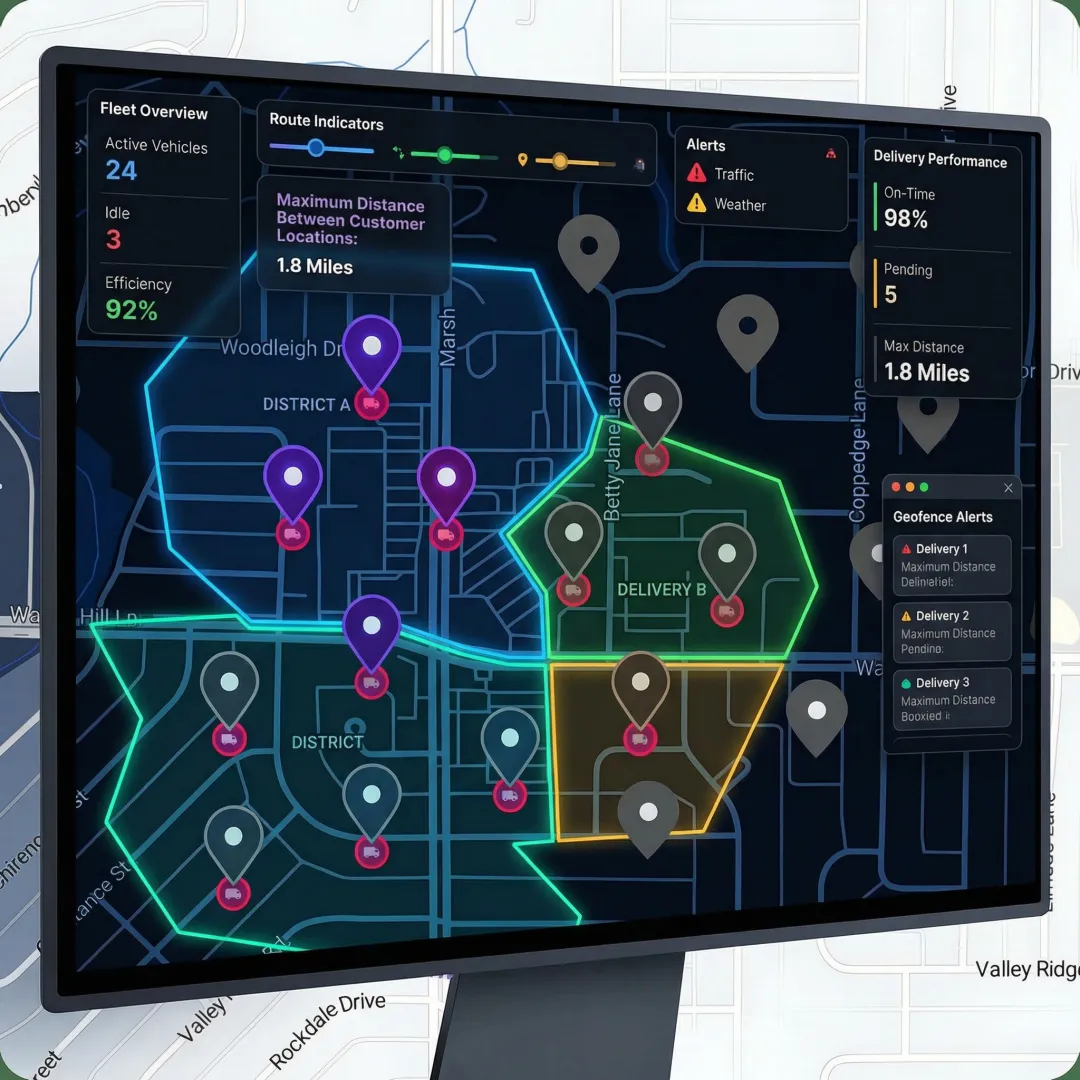
A meaningful chunk of last-mile overhead isn’t the driving at all. It’s everything that has to happen around each stop: confirming arrival, capturing proof of delivery, notifying the customer that their package landed. NextBillion.ai’s Geofencing API automates most of that by drawing a virtual boundary around a delivery zone or depot and triggering an action the instant a driver crosses it, whether that’s a proof-of-delivery prompt, a customer notification, or a territory-based dispatch rule.
geofencing
This matters more than it sounds like it should. Manual proof-of-delivery workflows are slow and prone to error, and delayed customer notifications rank among the more common sources of complaint in last-mile operations. Automating the trigger takes away a step drivers would otherwise have to remember on their own, stop after stop, for an entire shift.

6. Pricing That Doesn’t Punish Growth

This part rarely gets framed as an “optimization” feature, but functionally, it is one. Plenty of routing and mapping tools charge per API call, which sounds fine right up until order volume spikes during a holiday season, or a re-optimization cycle runs several times on the same route as conditions shift. Costs that climb with every recalculation quietly discourage the very re-optimization that makes dispatch smarter to begin with.

Platforms priced per vehicle or per order, rather than per API call, remove that disincentive entirely. NextBillion.ai’s pricing model is built around exactly this problem: predictable per-vehicle and per-order costs that don’t spike with demand surges or repeated re-optimization, which means an operations team can let the system re-optimize as often as it actually needs to without watching the bill nervously.

7. Integration Into the Systems Already in Place

Almost no delivery operation starts from a blank slate. There’s usually an existing TMS, a CRM, a telematics platform, or a custom-built driver app already running, and tearing all of that out to adopt a new dispatch tool is rarely realistic, or even desirable. This is why API-first platforms tend to win enterprise evaluations: they slot routing, dispatch, and tracking intelligence into what’s already there instead of demanding a full rebuild.

NextBillion.ai, for instance, offers native integrations with systems like Geotab, Samsara, Salesforce, SAP, and Microsoft Dynamics 365, so the optimization engine can sit underneath an existing stack rather than becoming yet another disconnected screen a dispatcher has to keep checking.

Read more: What Problems Does Dispatch Mapping Software Solve for Fleet Managers?
What This Looks Like at Scale

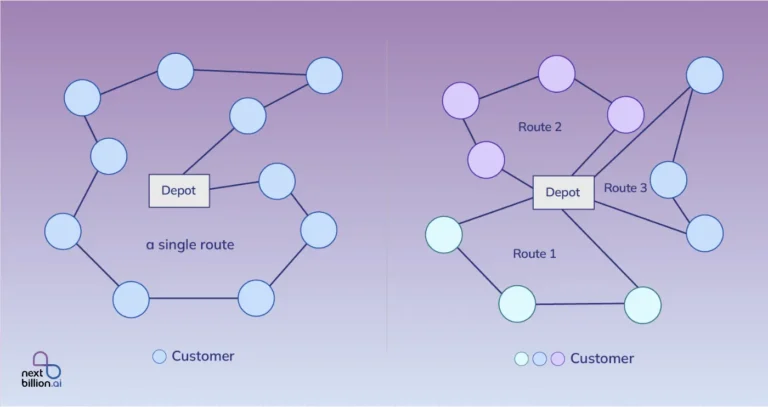
The theory behind route optimization is easy enough to accept. The harder question is whether it actually holds up once volume gets large and messy. A few numbers help here. NextBillion.ai’s platform has optimized more than 10.9 million deliveries and documented over $11 million in customer savings, working with 150-plus businesses globally, including names like DoorDash, Zepto, and AB InBev. That scale matters because last-mile routing problems don’t get easier as order volume grows. They get exponentially harder, since the number of possible route combinations multiplies with every additional stop and vehicle added to the mix. A routing engine that performs fine on a hundred daily orders can fall apart completely at ten thousand unless it was built to handle that kind of complexity from day one.

Picture a single day for a mid-sized delivery operation running, say, 40 vehicles and a few thousand daily orders. Without dynamic dispatch, a dispatcher building routes by hand each morning has no realistic way to account for an order added at 11 a.m., a driver stuck behind an accident at noon, and a customer requesting a delivery-window change at 2 p.m., all while still trying to hit the day’s overall on-time target. Any one of those events, on its own, is manageable. Stacked together across dozens of vehicles, they overwhelm a manual process fast, which is exactly why the businesses running this kind of volume tend to be first in line for dynamic, software-driven dispatch rather than last.

Read more: NextBillion.ai Last-Mile Delivery Dispatch & Logistics Platform

What to Look for When Evaluating Last-Mile Dispatch Software

If you’re comparing platforms rather than just reading about the concept in the abstract, a handful of questions cut through most of the marketing noise fast.

  • How many real-world constraints does the optimization engine actually support? A platform that only handles basic time windows will struggle the moment your operation adds vehicle capacity limits, driver shift rules, or specialized equipment requirements.

  • Does it re-optimize dynamically, or only at the start of the day? Static routing solves yesterday’s problem. Dynamic dispatch is what actually matters once orders start changing mid-shift, which they always, without fail, do.

  • How is it priced once volume grows past a pilot? Per-API-call pricing that looked cheap during a demo can turn unpredictable fast during a seasonal spike. Ask specifically how costs behave under peak demand, not just at baseline volume.

  • Can it plug into what you already run? A platform that requires ripping out an existing TMS or driver app adds months to a rollout that could otherwise take days. API-first tools with pre-built integrations save real engineering time.

  • Is proof of delivery and customer notification automated, or does it depend on drivers remembering extra steps? Geofencing-triggered workflows remove a common source of manual error and delayed customer communication.

  • What does it look like at your actual scale, not the vendor’s demo scale? Ask for evidence the platform has handled volume comparable to yours, not just a clean demonstration involving a handful of stops.

Final Thoughts

Optimizing last-mile delivery was never really about drawing a shorter line on a map. It’s about handling constant change: new orders, shifting traffic, drivers who go offline, customers who aren’t home, all while keeping costs predictable as volume climbs. That’s a fundamentally different problem than the one basic mapping tools were built to solve, which is why purpose-built dispatch software, with real constraint-based optimization, dynamic re-dispatch, live tracking, and automated proof of delivery, has become the standard for operations that can’t afford to guess anymore.

For teams evaluating this space, the platforms worth a serious look are the ones that can show real numbers at real scale, not just a tidy feature list. NextBillion.ai’s combination of 50-plus routing constraints, AI-driven optimization trained on actual fleet behavior, and pricing that doesn’t penalize frequent re-optimization is a useful benchmark for what “optimized” should actually mean in a last-mile operation.

Frequently Asked Questions

Dispatch mapping software is a system that plans, assigns, and adjusts delivery routes in real time, combining route optimization, live tracking, and automated dispatch to move drivers efficiently through changing conditions rather than relying on a fixed plan set once a day and left alone.

Basic route planning typically produces one optimized sequence at the start of a shift and stops there. Last-mile dispatch software goes further, re-optimizing dynamically as orders change, tracking vehicles live, and automating tasks like proof of delivery and customer notifications all the way through the day.

Yes, mainly by cutting wasted mileage, reducing failed delivery attempts through more accurate ETAs, and cutting down the manual dispatcher time needed to manage route changes. Platforms that have optimized millions of real deliveries, NextBillion.ai among them, have documented measurable savings at scale rather than theoretical ones.

Most modern platforms are built API-first specifically so they can plug into an existing TMS, CRM, or telematics system instead of replacing it outright. Confirm native integration support with your specific systems before settling on a platform.

Lightweight, cloud-based platforms can go live within days using a trial API key. Enterprise rollouts with deeper integrations typically take one to a few weeks, depending on how much custom integration work is involved on your end.

Not usually, at least not in operations running any real volume. What tends to change is the nature of the work. Dispatchers spend less time manually building and re-building routes and more time handling the exceptions a system flags, like a driver emergency or a high-priority customer escalation that genuinely needs a human decision.

It scales down reasonably well. A fleet running a handful of vehicles won’t see the same dollar savings as an enterprise operation moving thousands of daily orders, but the core benefits, fewer missed windows, less manual re-routing, more accurate customer ETAs, still apply well below enterprise scale. The main thing to check is whether a given platform’s pricing model actually makes sense at your size, since some tools are priced in a way that only becomes cost-effective past a certain volume threshold.

About Author

Joseph Jacob

Joseph Jacob is a seasoned author with over 7 years of business writing experience behind him. After graduating as an aerospace engineer, he briefly dipped his toes into the world of sports journalism before finding his vocation in B2B SaaS content writing.

Ready to get started?

Table of Contents