




Table of Contents
Transporting hazardous materials involves far more than moving cargo from one location to another. A single mistake in classification, packaging, documentation, placarding, or route selection can endanger drivers and surrounding communities, disrupt operations, and expose businesses to substantial penalties.
In the United States, hazardous materials transportation is governed primarily by the Hazardous Materials Regulations (HMR) under 49 CFR Parts 171–180. Administered by the Pipeline and Hazardous Materials Safety Administration (PHMSA). These regulations establish requirements for classifying, packaging, marking, labeling, documenting, handling, and transporting hazardous materials. Highway carriers must also follow applicable routing requirements, including federal, state, and local restrictions on designated roads, tunnels, bridges, and densely populated areas.
For fleet operators, compliance must extend into daily route planning. The fastest or shortest route is not necessarily safe or legally suitable for a vehicle carrying hazardous cargo. This guide explains the principal HMR requirements, the penalties associated with non-compliance, and how hazmat-aware route planning can help fleets operate more safely, efficiently, and consistently.
What Are the Hazardous Materials Regulations?
The Hazardous Materials Regulations, or HMR, are the federal rules governing the transportation of materials that could pose an unreasonable risk to public health, safety, property, or the environment. Administered by the Pipeline and Hazardous Materials Safety Administration (PHMSA), these regulations primarily appear in Title 49 CFR Parts 171–180.
The HMR applies to hazardous materials transported in commerce by highway, rail, air, and water. It covers the complete transportation process; from preparing and offering a shipment to loading, handling, transporting, unloading, and storing materials temporarily during transit.
The regulations establish requirements for:
- Identifying and classifying hazardous materials
- Selecting and testing appropriate packaging
- Marking and labeling packages
- Placarding vehicles and freight containers
- Preparing shipping papers
- Providing emergency-response information
- Loading, unloading, and segregating incompatible materials
- Training employees who handle or transport hazardous materials
- Maintaining security plans and transportation records
- Reporting qualifying incidents
Compliance responsibilities may apply to shippers, carriers, freight forwarders, packaging manufacturers, drivers, and other employees whose work affects hazmat transportation safety. A carrier performing a shipper’s function such as preparing shipping documents or loading packages, also becomes responsible for completing that function according to the applicable regulations.
For highway transportation, fleet operators must consider additional driving, parking, and routing requirements under 49 CFR Part 397. These rules can affect which roads a placarded hazmat vehicle may use and may require carriers to avoid tunnels, restricted corridors, densely populated areas, or other sensitive locations. Therefore, HMR compliance is not limited to preparing the cargo correctly; it must also be reflected in how the journey is planned and executed.
How Are Hazardous Materials Classified Under the HMR?
Correct classification is the foundation of hazardous materials compliance. Before a shipment is packaged, labeled, documented, or assigned to a route, the material must be evaluated to determine the hazards it presents.
Under 49 CFR § 173.22, the person offering a hazardous material for transportation is responsible for correctly classifying and describing it. The classification process generally identifies:
- The proper shipping name
- The UN or NA identification number
- The primary hazard class or division
- Any subsidiary hazards
- The applicable packing group
- Required labels and placards
- Packaging authorizations and special provisions
- Quantity limitations and transportation restrictions
The Hazardous Materials Table under 49 CFR § 172.101 is the principal reference for determining these requirements.
The Nine Hazard Classes
The HMR organizes hazardous materials into nine primary hazard classes:
- Class 1 – Explosives: Materials capable of producing an explosion, projection hazard, fire hazard, or mass detonation.
- Class 2 – Gases: Flammable gases, non-flammable compressed gases, and poisonous or toxic gases.
- Class 3 – Flammable and Combustible Liquids: Liquids that can ignite under specified temperature conditions, including fuels, solvents, and certain industrial chemicals.
- Class 4 – Flammable Solids: Flammable solids, spontaneously combustible materials, and substances that produce flammable gases when they come into contact with water.
- Class 5 – Oxidizers and Organic Peroxides: Materials that can intensify combustion or undergo dangerous decomposition.
- Class 6 – Toxic and Infectious Substances: Poisonous materials and substances containing pathogens capable of causing disease.
- Class 7 – Radioactive Materials: Materials that emit ionizing radiation and meet the applicable regulatory thresholds.
- Class 8 – Corrosive Materials: Liquids or solids that can damage human tissue or corrode certain metals.
- Class 9 – Miscellaneous Hazardous Materials: Materials that present a transportation hazard but do not fall within Classes 1 through 8, such as certain lithium batteries and environmentally hazardous substances.
The complete class and division definitions are provided under 49 CFR § 173.2.
Primary and Subsidiary Hazards
Some materials meet the criteria for more than one hazard class. In these cases, the shipper must identify the material’s primary hazard and any subsidiary hazards. The precedence rules under 49 CFR § 173.2a help determine which hazard takes priority when a material is not specifically listed by name in the Hazardous Materials Table.
For example, a chemical may be both flammable and corrosive. Its primary classification determines the main hazard label and shipping description, while the subsidiary hazard may require an additional label and affect packaging, segregation, and handling requirements.
Understanding Packing Groups
Where applicable, hazardous materials are also assigned a packing group based on the degree of danger they present:
- Packing Group I: Great danger
- Packing Group II: Medium danger
- Packing Group III: Minor danger
Packing groups influence the required performance level of the packaging. Materials presenting a greater danger generally require packaging capable of meeting more stringent testing and performance standards. However, packing groups are not assigned to every hazard class.
Classification errors can affect every subsequent compliance decision. An incorrectly classified material may be placed in unsuitable packaging, marked with the wrong identification number, transported without the necessary placards, or assigned to a route that does not permit that type or quantity of hazardous cargo.
Fleet operators should therefore verify classification details before dispatch and ensure that the material description, shipping papers, vehicle placards, driver instructions, and planned route are aligned. Safety Data Sheets can support this process, but they should not replace verification against the Hazardous Materials Table and applicable HMR requirements.
How Hazard Classification Influences Hazmat Route Planning
Hazard classification affects more than packaging, labeling, and documentation. It can also determine which roads, tunnels, bridges, urban areas, and transportation corridors a vehicle may use.
Two vehicles traveling between the same origin and destination may require completely different routes depending on the materials they carry. For example, a tanker transporting Class 3 flammable liquid may be prohibited from using a particular tunnel, while a vehicle transporting a different type or quantity of hazardous material may be permitted to use it.
Route planning must therefore account for shipment-specific information such as:
- Hazard class and division
- UN or NA identification number
- Placarding requirements
- Quantity and packaging type
- Primary and subsidiary hazards
- Vehicle type, weight, height, width, length, and axle load
- Applicable state, tribal, and local routing restrictions
- Required permits or designated hazmat corridors
Under 49 CFR Part 397, carriers transporting placarded or marked non-radioactive hazardous materials must comply with applicable routing designations. These may include mandatory routes, prohibited roads, tunnel restrictions, curfews, lane restrictions, and route weight limitations.
Where a specific routing designation does not apply, carriers may still need to avoid heavily populated areas, places where crowds assemble, tunnels, narrow streets, and alleys unless there is no practicable alternative or a reasonable deviation is necessary to reach a terminal, delivery point, fuel station, repair facility, rest location, or safe haven.
Consequently, the shortest route is not always the safest, most efficient, or legally appropriate route.
Why Standard Route Planning Is Not Enough
General-purpose navigation systems typically optimize routes based on distance, estimated travel time, or traffic conditions. They may not understand the vehicle’s hazardous cargo classification, placarding status, physical dimensions, or the restrictions that apply within each jurisdiction.
This can result in routes that:
- Pass through prohibited tunnels or bridges
- Enter restricted residential or urban areas
- Use roads that do not support the vehicle’s weight or dimensions
- Violate time-based hazmat restrictions
- Direct drivers away from designated hazmat corridors
- Leave insufficient time for deliveries within the driver’s available Hours of Service
- Increase the risk of last-minute detours and driver confusion
Dispatchers can verify routes manually, but this becomes difficult when fleets operate across multiple states or manage hundreds of vehicles and delivery stops. Restrictions may vary between jurisdictions, vehicle types, cargo classes, and times of day.
Hazmat fleets therefore need route optimization that treats regulatory and operational requirements as part of the route calculation itself.
Turning HMR Requirements Into Routing Constraints
Hazmat-aware route optimization begins by removing roads and route combinations that are unsuitable for the shipment. The system can then optimize the remaining compliant options based on distance, travel time, fuel consumption, delivery windows, driver availability, and operating costs.
A typical route-planning process includes:
- Identifying the hazardous material and its applicable classification
- Assigning a suitable vehicle and qualified driver
- Applying vehicle dimensions and cargo-specific restrictions
- Excluding prohibited roads, tunnels, bridges, and no-entry zones
- Applying time-of-day and jurisdiction-specific restrictions
- Calculating compliant travel times and distances
- Optimizing the sequence of delivery or pickup stops
- Dispatching the approved route to the driver
- Monitoring route execution and responding to deviations
This changes route compliance from a manual post-planning check into an integral part of the optimization process.
How NextBillion.ai Supports Hazmat-Aware Route Planning
NextBillion.ai helps logistics and transportation companies create routes based on the characteristics of the vehicle, cargo, and operating environment.
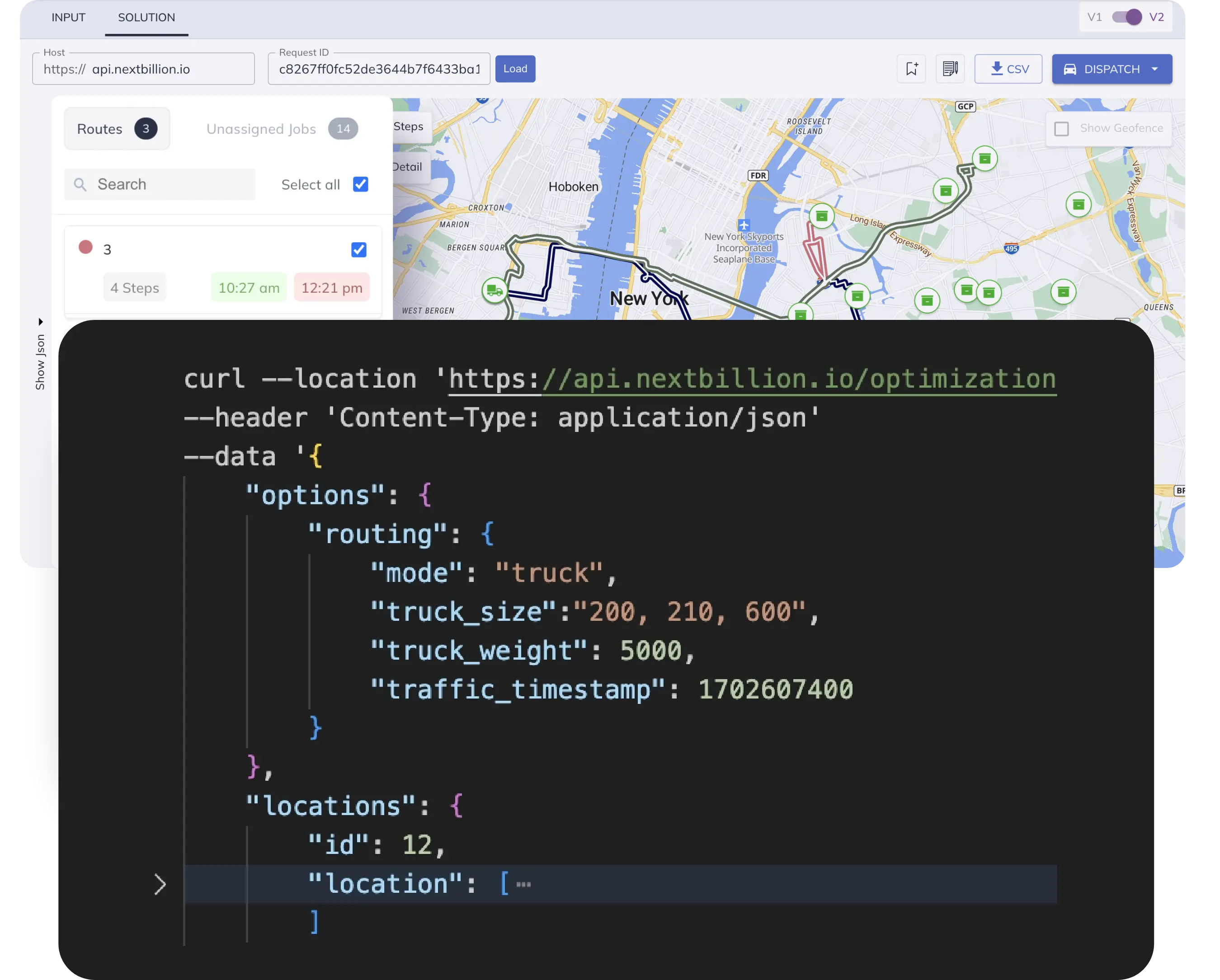
Its truck-aware routing capabilities can incorporate parameters such as vehicle height, weight, width, length, axle load, and hazardous cargo type. This helps prevent routes from being generated over physically unsuitable or restricted road segments.
Fleet operators can also use the Road Editor App to apply custom operational rules, including:
- Hazmat no-entry zones
- Restricted tunnels and bridges
- Temporary or permanent road closures
- Site-specific access restrictions
- Time-based road restrictions
- Preferred and prohibited road segments
For multi-stop operations, NextBillion.ai’s Route Optimization API can calculate an efficient stop sequence while considering vehicle restrictions, delivery windows, driver shifts, vehicle capacity, and other operational constraints.
The Distance Matrix API can calculate truck-appropriate travel times and distances between large numbers of origins and destinations. These results can then support vehicle assignment, delivery scheduling, and route optimization without relying on estimates generated for passenger vehicles.
By combining hazmat restrictions with vehicle and operational constraints, NextBillion.ai’s hazmat routing capabilities help fleets create routes that are safer, more practical, and better aligned with their compliance requirements.
However, routing technology should support, not replace, a fleet’s compliance procedures. Operators remain responsible for verifying current regulations, permits, emergency requirements, and jurisdiction-specific restrictions before dispatch.
Conclusion
Hazardous materials compliance begins with correct classification, packaging, documentation, but it continues throughout every mile of the journey. Fleet operators must ensure that routes reflect the shipment’s hazard class, vehicle specifications, designated hazmat corridors, tunnel and bridge restrictions, local access rules, delivery windows, and driver operating limits.
For these operations, the shortest route is not necessarily the best route. A suitable hazmat route must balance regulatory compliance and public safety with travel time, fuel consumption, driver availability, and delivery commitments. Attempting to manage these requirements through general-purpose navigation or manual route checks can increase operational risk and make consistent planning difficult at scale.
NextBillion.ai helps fleets incorporate hazmat, truck, and business-specific constraints directly into the route-planning process. With truck-aware routing, multi-stop route optimization, custom road restrictions, and accurate travel-time calculations, businesses can create safer and more operationally practical routes while reducing the burden on dispatch teams.
Routing technology does not replace a carrier’s responsibility to verify applicable regulations, permits, and local restrictions. However, it can make compliance easier to apply consistently across vehicles, drivers, and daily operations.
Talk to a NextBillion.ai routing expert to learn how hazmat-aware route optimization can support your fleet’s safety, compliance, and operational-efficiency goals.
Ready to get started?
Request a DemoTable of Contents
Subscribe to our Newsletters
Get the best practices for route planning & optimization, delivered to your inbox.
Subscribe