


Table of Contents
AT A GLANCE
- Thousands of monthly delivery stops optimized
- 10–20 stops per load, sequenced in seconds
- Under 10 seconds route optimization response time
- 100% hazmat-compliant routing
BACKGROUND
This company operates a comprehensive SaaS platform purpose-built for the downstream oil and gas industry. Its suite spans demand forecasting, logistics dispatch, carrier management, pricing, and reconciliation — serving customers across fuel delivery, marine operations, and transport.
Its customers — from fuel retailers and equipment rental companies to construction firms — rely on the platform to orchestrate thousands of deliveries daily. A core segment of this business involves short-truck (LTL) fuel delivery: drivers completing multiple stops per shift, drawing from various terminal lift points and delivering to time-sensitive, geocoded locations.
Despite a sophisticated dispatch platform, one critical gap had remained on the roadmap for years: intelligent route optimization for short-truck loads.
THE CHALLENGE
Route sequencing was done manually. Dispatchers building loads would open a separate browser tab, consult Google Maps, mentally determine the best stop order, and then re-enter that sequence into the platform. This process was slow, error-prone, and unscalable — particularly as load complexity grew.
Key Pain Points
- Manual routing via Google Maps — outside the core dispatch workflow
- No hazmat-aware routing: fuel trucks face enormous fines if routed near schools or hospitals
- Complex constraints: multiple loads per shift, mixed products, compartment configurations, and changing lift points
- Time window and capacity restrictions varied by truck and customer
- Legacy alternatives used outdated static maps updated only per software release
- No real-time traffic awareness or dynamic rerouting capability
THE NEXTBILLION.AI SOLUTION
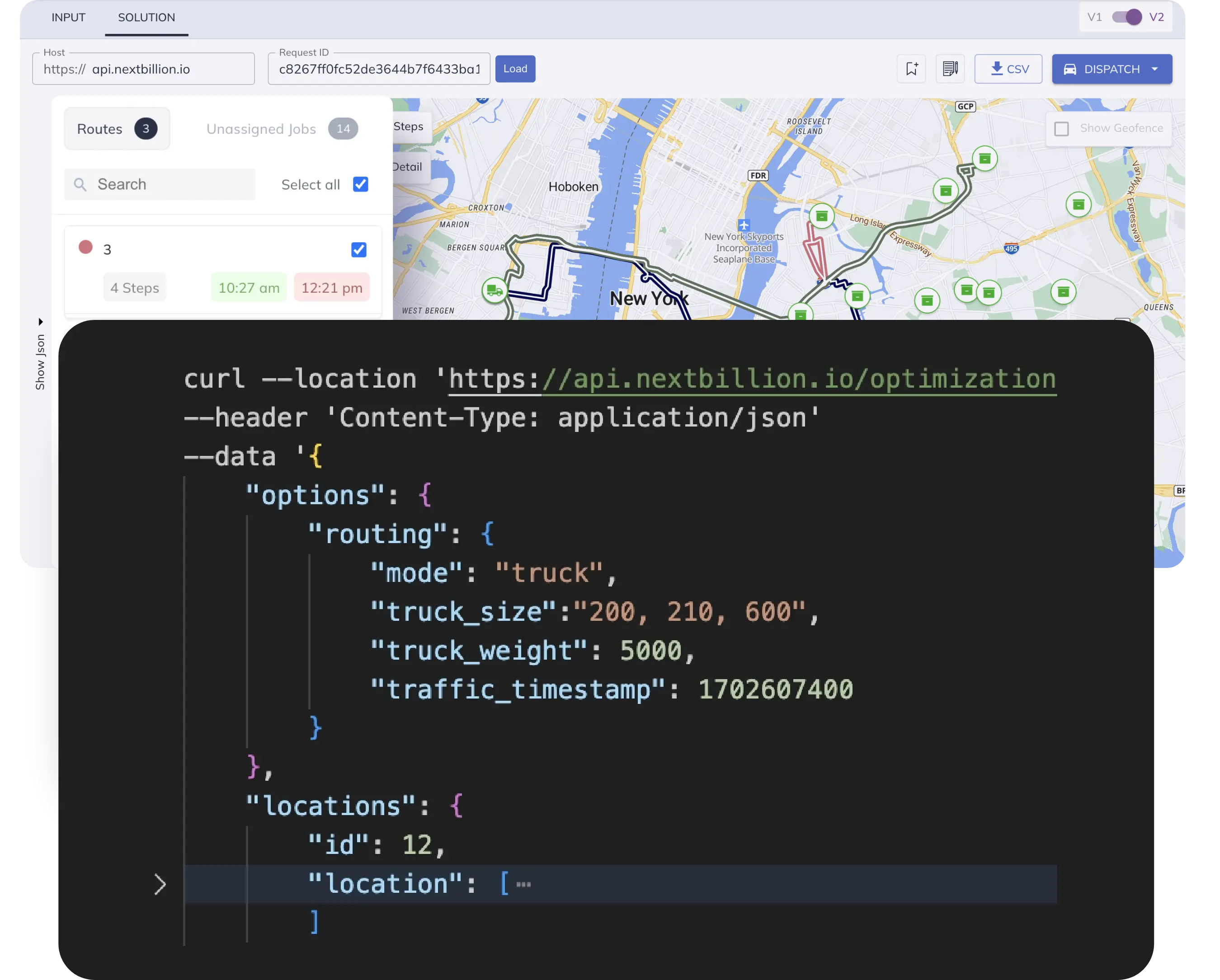
The platform integrated NextBillion.ai’s Route Optimization API and Directions API to bring intelligent, constraint-aware routing directly into its dispatch workflow — eliminating the need for any manual step outside the system.
Route Optimization API
- Automated sequencing of driver stops based on geocoded delivery locations, time windows, truck capacity, product constraints, and multi-compartment tank configurations
- Supports multi-compartment fuel trucks, enabling precise allocation and routing of different fuel types (e.g., petrol, diesel) within the same vehicle while respecting compartment-level capacity constraints
- Ensures optimal utilization of each compartment by factoring in product compatibility, fill limits, and delivery sequencing requirements
- Hazmat routing flag ensures fuel trucks are routed away from restricted zones — schools, hospitals, and other sensitive areas — avoiding catastrophic fines
- Supports multiple loads per shift per driver, variable origin/depot locations, and open-ended or return-to-base route endings
- Asynchronous architecture with polling handles complex optimization problems, returning sequenced routes within 5–10 seconds for typical loads of 10–20 stops
Directions API (Turn-by-Turn Navigation)
- Provides turn-by-turn navigation instructions embedded in the driver mobile app, overlaid on existing mapping components
- Real-time traffic integration surfaces construction, closures, and live conditions during route execution
- Threshold-based deviation detection: when a driver deviates beyond a defined corridor, the system fetches an updated route — avoiding unnecessary API calls while maintaining accuracy
- ETA cascade updates notify downstream stops of projected delays when a driver significantly deviates
Traffic Intelligence
- Pre-planned routes (day-before dispatch) use historical traffic patterns for accurate ETA estimation
- Day-of and live execution incorporates real-time traffic signals for dynamic adjustment
- Global Cloud infrastructure ensures low-latency responses regardless of fleet geography
RESULTS
Eliminated manual routing — Dispatchers no longer leave the platform to sequence loads — optimization is triggered directly from the dispatch workbench.
Hazmat compliance at scale — Every route generated adheres to hazardous materials routing regulations, removing legal and financial exposure for customers.
Competitive differentiation — The platform now offers capabilities that legacy competitors cannot match — including real-time traffic awareness and modern API-first integration.
Production-ready in weeks — From initial discovery to live deployment took a matter of weeks, enabled by NextBillion.ai’s well-documented REST API and dedicated solutions engineering support.
Ready to get started?
Request a DemoTable of Contents
Subscribe to our Newsletters
Get the best practices for route planning & optimization, delivered to your inbox.
Subscribe