

How Does AI Improve Route Optimization

How Does AI Improve Route Optimization?

Published: July 2, 2026

Efficient route plans are the core of the logistics and transportation business. Powerful routing tools run engineered programs in the background to calculate distance, time, locations, potential speed, and other behaviors. But integrating AI technology with the routing software can analyze real-time data and anticipate transit troubles before they arise.

While the algorithms in the routing tools are designed to generate logically accurate solutions, the analytical viewpoint struggles to reach the podium of consideration. At this point the AI not only fetches the real-time traffic, weather conditions, or other delivery constraints but also analyzes a vast amount of historical and current data to predict an efficient solution.

AI, or artificial intelligence, is playing a credible role in improving the efficacy of route optimization. It uses machine learning and predictive analytics to generate precise routes and quickly adapt to the possibilities of the changing conditions on the road. The results continuously improve the operational costs while significantly speeding up delivery times.

Read how routing algorithms actually decide.

What Makes AI Essential for Route Planning and Optimization?

The transportation business is highly competitive in the current scenario. While the customers keep expectations from the service provider, the transporters also face multiple problems, as deciphering directions to the destination is not sufficient for service efficiency. Logistics teams need to think on a day-to-day basis for service levels, cost factors, and unprecedented operating conditions.

Customers expectations from delivery operators

Logistics are equally important to direct customers and business firms. Factors like delivery time and service cost have huge importance in the transportation business. Companies have to manage multiple parameters for customer satisfaction.

  • Every order must reach its buyer safely.

  • The deliveries should take the least possible time. 

  • Delays reduce the rating. Sometimes longer ETAs can backfire.

  • Delivery charges should be cost-effective.

  • ETAs should be accurate and reliable, irrespective of geographical or other issues in the area.

  • Live tracking facility is non-negotiable.

  • Last-minute delivery scheduling.

Logistics and transportation troubles for companies

The logistics and transportation businesses have been booming incredibly in America since the 1950s. Successive benchmarks of the Motor Carrier Act of 1980, the e-commerce shift in the 2010s, and now the pandemic and industrial surge in the 2020s have attracted companies to invest in this segment. 

  • Rising fuel prices bound the companies to increase the delivery charges.

  • Vehicle maintenance, driver’s wages, and compliances are unavoidable costs.

  • Fleets are under pressure to run accurately and save each extra mile on the journey.

  • Powerful routing software is evident to generate greater productivity on each ride. Manual approaches or simple data-backed systems are usually ineffective to tackle current scenarios.

What are the operational constraints in the logistics business?

Transportation service providers often face undesirable conditions on the journey. These situations are unpredictable for manual analysis, especially for bulk delivery operations. 

  • It could be the adverse weather, traffic, road blocks, etc. that may cause failed deliveries. 

  • At other times there can be vehicle breakdowns, delivery reschedules, and other exception handling.
AI routing with multiple constraints

Why are Traditional Route Planning and Optimization Tools Ineffective?

Traditional routing tools are not completely outdated. They are specifically designed to generate the most suitable geographical directions between stoppages while following a prioritized sequence. For limited orders or one-to-one links, these software systems deliver quick and reliable responses. 

But once the conditions expand with longer or jumbled route networks, multiple orders, and dynamically changing limitations, an intelligent tool becomes essential for real-time data assessment and route optimization.

Limitations of traditional route optimization tool


There are specific conditions when a normal route planner tool is unable to serve the purpose of efficient navigation.

Challenges of traditional route optimization tool

Static routing

Based on fixed details, cannot adapt to changing situations

Limited variables

Limited constraints, unreliable with complex data

Not predictive

Cannot forecast adversities, traffic delays, or demands

Manual support

Dispatchers manage exceptions, creates inconsistency 


  • Static routing: Traditional routing tools generate routes based on fixed details like distance, average travelling time, and predefined delivery windows. They cannot adapt to traffic congestion, weather disruptions, last-minute customer requests, vehicle breakdowns, etc.
  • Limited Variables: Conventional optimization algorithms usually work with a limited set of constraints. They become unreliable with complex conditions. and a wide range of data sets. They may not adapt with vehicle capacities, fuel costs, regulations, priorities, etc.
  • Reactive rather than predictive: Traditional tools cannot predict the changing conditions by evaluating the historical and real-time data. They cannot predict traffic patterns, transit delays, or demand fluctuations or recommend preventive adjustments.
  • Manual intervention required: Many traditional systems require dispatchers to manually adjust routes, reassign deliveries, and handle exceptions. It leads to inconsistent decisions and reduced efficiency.

Traditional Vs. AI Route Optimization: Comparison

Features

Traditional Route Optimization

AI Route Optimization

Approach

Static & Rule-Based

Dynamic & Predictive

Data Source

Simple Historical Data

Real-time Big Data

Variables

Limited (Distance/Time)

Multi-factor (Weather/Traffic/Behavior)

Processing

Batch Processing

Real-time Adjustments

Learning

No Learning Capability

Continuously Improves

Efficiency

Good for Simple Tasks

Optimal for Complex Logistics

The Emergence of AI-Powered Route Optimization

For the past few years artificial intelligence has been immersed in different sectors of business and governance. With the ability to analyze datasets and forecast output, AI is tremendously enhancing fleet performances for logistics companies. The dispatchers are now generating more precise and accurate directions for the drivers, optimizing loads for vehicles and warehouses, managing delivery clusters, and performing other logistical activities.

How AI Is Transforming Logistics, Transportation, and Field Operations

AI is bringing a major breakthrough in goods transportation, fleet management, and team coordination. Companies that were earlier working with static plans and human decision-making roles are now transitioning over to artificial intelligence for real-time task management and consistent monitoring.  

For instance, an AI optimizer can learn that a specific dock consistently takes 15 minutes longer to service on Monday mornings and then automatically bake that into ETAs and route sequencing—without a dispatcher needing to remember this nuance. 

  • Real-time route optimization: AI-powered routing tools are capable of optimizing and re-planning the route directions in real-time. Hence, if the delivery route gets obstructed due to the following:
  • Sudden crowd rush 

  • Road accident 

  • Uncertain rain-water clogging

  • Road closures

Or in any such scenario that blocks the movement of the vehicle, the AI routing tool can recalculate an alternate and better navigation that avoids the obstructions.

  • Predictive decision-making: The AI route optimization  mechanism utilizes historical and real-time data to logically preempt the following situation and act accordingly, i.e., avoid the problems before they arise. It can predict 
  • traffic congestion based on patterns 

  • Forecast delivery demand by region

  • Estimating travel times more accurately

  • Anticipating vehicle maintenance needs

  • Identifying periods of peak resource utilization

This allows businesses to proactively allocate resources instead of reacting to disruptions after they occur.

  1. Intelligent fleet management: AI-enabled routing tools are highly reliable in managing fleets for logistics and transportation providers. It handles multiple tasks.
  • Assigning the right vehicle to each job 

  • Balancing workloads across drivers 

  • Reducing empty miles and unnecessary travel 

  • Improving vehicle capacity utilization 

  • Monitoring driver performance and safety

The result is more deliveries with the same resources.

  • Enhanced last-mile delivery operations: AI makes accurate and efficient decisions in managing the critical stages of transportation. You need no human interventions here. 
  • Multiple delivery windows 

  • Dense urban traffic 

  • Customer availability issues 

  • Same-day and on-demand delivery expectations

AI continuously adjusts delivery schedules and routes to maximize efficiency while maintaining customer satisfaction.

  • Smarter field service operations: AI-powered route optimization is also beneficial for field services like healthcare, road cleaning, waterworks, etc. 
  • Automatically assign technicians based on skills and availability 

  • Minimize travel time between service calls 

  • Prioritize urgent work orders 

  • Optimize daily schedules

It helps in covering more jobs per day without compromising with staff working hours or adding delivery agents to the fleet.

  • Sustainability and environmental benefits: AI follows all the instructions carefully and also keeps the sustainability goals. It ensures the following goals are reduced: 
  • Fuel consumption 

  • Vehicle idle time 

  • Carbon emissions 

  • Unnecessary mileage

Many organizations are increasingly using AI-driven routing to support environmental, social, and governance (ESG) initiatives while simultaneously lowering operating costs.

Benefits of AI Route Optimization for Logistics and Transportation Companies

Empowering routing tools with AI technology can have significant advantages for the entire transit business management. 

Advantages of AI Route Optimization

Factors

Reason

Reduced operational cost

Accurate navigation, minimal repetition, no overtime required, vehicle’s long life

Improved performance 

Accurate ETAs and reliable service ensure SLA

Increased productivity

Optimized resource utilization, feasible loading, accurate route plans

Customer relationship

Scheduled and safe deliveries, higher retention

Agile and resilient

Learning capacity, adaptation, flexible

Data-driven insights

Document valuable data, further analysis and strategizing.

Sustainable

Reduces carbon footprints by less fuel consumption


  1. Reduced operational costs: Intelligent navigation plans reduce unnecessary travelling or route repetition for delivery vehicles, which saves fuel consumption, lowers overtime payment for delivery agents, increases vehicles’ life, improves asset utilization, and minimizes administrative efforts. Credible efforts and small amounts can save substantially across large fleets.

  2. Improved performance: The tool helps in serving the customers up to their highest expectations. It is more reliable with delivery accuracy and ensures SLA (Service Level Agreements) compliance. The logistics company gains trust among their customers.

  3. Increased productivity: Organizations are able to optimize resources for better solutions and increase work efficiency. Optimized loading and accurate route plans can serve more orders or services per vehicle/ agent. 

  4. Customer satisfaction: The buyers or customers feel more satisfied with scheduled and safe deliveries. AI-powered tools ensure accurate ETAs, live tracking, quick responses, minimal failed orders, and reliability. This results in higher retention rates and a stable brand reputation.

  5. Increased agility and resilience: AI routing tools have learning capacity through historical and real-time data sets. It helps in quickly adapting to the changes such as supply chains disruptions, demand spikes, traffic incidents, weather-related delays, or workforce shortages. The flexibility improves business continuity.

  6. Data-driven insights: Smart routing tools generate and document valuable data from each task, which helps in improving operational intelligence. Further businesses can analyze them for route efficiency, driver performance, fleet utilization, customer service patterns, geographical demands, etc. These are helpful in strategizing the business growth plans.

  7. Sustainability and reduced emissions: Controlled and optimized movements of delivery vehicles considerably save fuel consumption and directly impact reducing carbon footprints. The whole mechanism not only improves business outcomes with enhanced efficiency but also enforces sustainability in the procedures by saving vehicle maintenance, reducing workloads, and enabling systematic developments.

Also read: Quick tips to hire delivery drivers

Typical scenario of logistics and transport workday

A mid-size courier company can have 100-200 delivery vehicles and furnish nearly 2000 orders each day on average. 

A regular routing system would only generate the routes once for each vehicle, and any disruption further during the task is handled by the dispatchers manually. 

But an AI-powered route optimization system continuously monitors the vehicle till the task completes and it reaches the end point. It can predict the traffic by evaluating the real-time data, much before the vehicle reaches a particular road network on the route, and automatically suggests an alternate path to the drivers. 

The result is typically lower operating costs, a balanced workload, scheduled delivery completion, and better resource utilization.

Industries Benefiting From AI Route Optimization

AI integration is now an essential component of operationally intensive industries. Logistics and transportation are a backbone of global trade that majorly involves planning, coordination, and physical movement to connect consumers with suppliers and manufacturers.

Routing tools are empowered with artificial intelligence and machine learning techniques to serve specific requirements of transit service providers. The business objective, constraints, and integration points are managed in real time for TMS, WMS, OMS, FSM, etc.

Example of industries benefiting from AI route optimization

Industry 

Type of business

Last-mile delivery

Local logistics, courier

Supply chain

Global logistics, ocean freight, 3PL, trucking

Field services

Industrial equipment, energy utilities, telecom

Retail e-commerce

Online retail stores

Food & grocery 

Online food and grocery delivery partners


Last-mile Delivery

Last-mile delivery services are complex in nature with dense stoppages and high customer expectations.

  • AI engines handle the dynamic constraints involving time windows, building access rules, customer preferences, and other priorities.

  • Route re-optimization helps the drivers during failed deliveries, vehicle breakdowns, traffic incidents, or urgent same-day orders.

  • Lowers travelling distance, fuel charges, and overtime while increasing the potential of drop-per-route.

  • ETAs’ fulfillment enhances brand reputation and customer satisfaction with positive feedback.

Logistics and Supply Chain 

AI routing configures an end-to-end workflow managing warehouse, load segregation, order sequencing, load management, and final delivery. 

  • AI engines are utilized in different settings to evaluate route combinations of road networks, rail, ships, and air travel.

  • It assesses the load for FTL/LTL conditions, shipment consolidation, and warehouse management.

  • Carrier selection, load assessment, racks, lanes, and packaging.

  • Dynamic re-planning: port delays, customs holds, or plant outages feed into re-optimized downstream distribution routes.

Field Service Management

Field services are often considered under VRP, or vehicle routing problems, but there are separate attributes and SLA breaches attached to it.

  • AI understands the service criticalities of technicians serving in the field and accordingly manages their time and availability.

  • It manages fair workloads among the available staff and assigns the right workload to the right person.

  •  Depending upon the job durations and actual conditions, the tool adjusts the remaining tasks in real-time.

  • Inventory systems are also attached to the routing systems to avoid discrepancies.

Retail and E-Commerce

An AI routing system operates demand forecasting, fulfillment choice, and last-mile deliveries for online retail stores and e-commerce businesses.

  • If the ordered item is available at the physical store, DCs, and dark store, the AI system selects a suitable node or splits it into a combination that minimizes the total cost to serve and successfully completes the delivery after considering all the constraints. 

  • The routing system can design the walking paths for the laborers working inside the warehouse to efficiently manage the load.

Food Delivery and Grocery

Food products and groceries have a definite expiry date and often require strict temperature-specific storage conditions. Route plans become more complex in this category. 

  • AI finds the fastest route from restaurants to the customer’s location to fulfill the hot-meal orders.

  • Grocery delivery persons often take multiple orders, and an AI system finds a feasible path to deliver the orders in sequence while also considering the temperature-specific products that must be delivered in quick time.

  • AI route optimization tool clusters the nearby orders with aligned time windows to maximize vehicle utilization. 

  • It can position drivers and vehicles based on historical data analysis.

  • AI tools effectively decides the vehicle types to complete the orders

Transportation and Mobility Services

This spans ride-hailing, shared mobility, shuttles, and even public transport adaptations like demand-responsive transit.

  • AI-powered routing tool can predict demand and supply problems and routes idle vehicles to the hot spots to cut wait times and improve driver utilization.

  • It manages multi-passenger trips for time windows, pooling, and stoppages.

  • In mobility-as-a-service platforms, routing spans multiple legs: e-scooter to metro, metro to on‑demand shuttle, etc.

What is the Technology Behind AI Route Optimization?

AI-powered routing systems are complex programs that do not work on a fixed formula to generate the fastest or shortest distance between two points. Instead, it combines artificial intelligence, data science, geospatial technologies, and advanced mathematical optimization to determine the most efficient routes. AI takes a fraction of a second to evaluate real-world constraints in real-time with historical data such as traffic, weather, delivery windows, fuel consumption, vehicle capacity, and customer priorities. 

The algorithms in artificial intelligence are layered into structural components, with each having a specific role. 

Machine Learning

The ML models calculate the trends from historical data and gain intelligence about the logistics and transportation. The data feeds are important to improve routing decisions consistently. 

AI uses supervised learning models to train the system, which analyzes traffic patterns, driver behavior, time taken in delivery completion, road networks, vehicle performance, etc. A delivery van may take only 20 minutes in the morning to reach point B from point A, but the same vehicle may take an hour to cover the same path in the afternoon. 

While AI can learn from it to make decisions, humans will observe and overlook most of the critical portion leading to inaccuracy. Random Forest, Gradient Boosting, Neural Networks, and Support Vector Machines are some of the algorithms working in the background.

The deep learning mechanism handles the complex tasks in transportation by processing millions of data to make relationships between non-linear variables.

Real-time Mapping and Traffic Data

AI-enabled routing systems constantly generate data from different sources. These tools regressively work on real-time locations and traffic data, and captures actual latitude/longitude, speed, and direction of the vehicle to enable live monitoring Traffic cameras, roadside sensors, and connected vehicles are relevant resources for data analysis. 

NextBillion.ai is a prominent mapping API platform that provides road network details, closures, speed limits, compliances, etc. It helps in planning and optimizing routes in real-time, and drivers instantly receive the alternate plans whenever they are at potential risk of getting stuck. The purpose is to reduce travel time, lower fuel consumption, and improve customer satisfaction.

Predictive Analytics

A combination of time series forecasting, neural networks, regression models, and reinforcement learning generates predictability in the routing system. The algorithms analyze the data and allows the AI routing tools to predict future scenarios in the delivery task. It covers historical routes, current traffic, weather details, and driver’s performance to generate accurate ETAs.

For example, the system can forecast an increase in traffic within 45 minutes on highway A, so the vehicle should change the route and, accordingly, change the delivery points and ETAs.

The drivers and dispatchers get alerts about traffic conditions, particular rush hours, weekend rushes, events, or seasonal patterns. They can also deduce delivery demands in a specific segment and manage potential order volumes and warehouse workload. 

Geospatial Intelligence

The function of geospatial intelligence is to analyze location-based data and can tell you about the vehicle’s position, best routes, obstacles, or nearest delivery point. It uses GIS platforms to analyze the geographical structures and evaluates distance, route density, and delivery clusters.

The geofencing technology creates virtual boundaries to seclude the task and movement of a designated person or vehicle in a controlled region. It is also useful in restricting regions, creating warehouse zones, and other transit purposes.

Optimization Algorithms

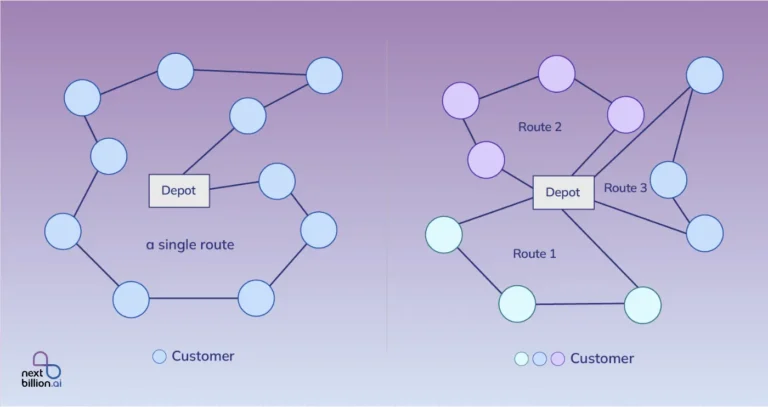
It is a combination of algorithms that work together to determine the best route from all the possible routes and takes seconds to process ample information. For transporters with 500 deliveries, 100 vehicles, multiple depots, vehicle capacity limits, and delivery windows, the possible route combinations become quite large.

AI uses optimization algorithms to solve these problems efficiently.

Dijkstra algorithm finds the shortest path between two points

The A* (A-Star) algorithm enhances the shortest-path algorithm that uses heuristics. Also beneficial for calculating faster andreduced computational cost

Vehicle Routing Problem (VRP) solvers consider vehicle capacity, driver schedules, delivery deadlines, and fuel costs.

A genetic algorithm generates route candidates, evaluates performance, combines successful solutions, and repeats until optimal routes emerge.

Simulated annealing is a probabilistic optimization technique that explores many route combinations and gradually converges toward the best solution.

AI

How Does AI Route Optimization Work? 

A modern AI route optimization platform integrates AI and LLM technologies at specific levels of routing. It takes a few seconds to enable faster deliveries, lower costs, and reliable operations.

  1. The GPS reports the exact location of the vehicle on the route.

  2. The traffic sensors work in real-time to detect uneasiness on the road or an incident that can potentially increase the traffic.

  3. The predictive models analyze the data to forecast the probability of route congestion.

  4. GIS system instantly looks for an alternate road to avoid getting stuck.

  5. Optimization algorithms select the best available route for the movement of the vehicle.

  6. The driver quickly receives the updated route plan with navigation.

Also read: AI and LLM in freight permit processing 

A flowchart of how AI routing system works 

GPS + Traffic Data


Geospatial Intelligence


Machine Learning Models


Predictive Analytics


Optimization Algorithms


Best Route Recommendation


Continuous Real-Time Updates

How NextBillion.ai Helps Businesses Build Smarter Routing Solutions

NextBillion.ai offers an advanced routing platform powered with AI & ML technology. Its route optimization engine supports heuristics and metaheuristics for margin-sensitive operations.

This API-first routing platform handles logistics-grade constraints and takes a blink of a second to generate the most feasible and optimized solution. It gives product and engineering teams the building blocks to embed truck‑specific, multi‑constraint routing directly into their logistics, delivery, and field service systems.

NextBillion AI route optimization

Features of NextBillion’s AI Route Optimization Platform

NextBillion is a high-performing routing tool that serves long-haul and last-mile deliveries, manages field services to match perfect staff with the required skills, eliminates inefficient routes, minimizes transit costs, and ensures on-time deliveries. It understands your fleet to plan optimized routes. 

NextBillion’s AI Route Optimization Platform

Features 

Functions

Advanced Route Optimization APIs 

  • Multi-stop route planning
  • Vehicle routing optimization
  • Constraint-based routing

AI-Powered ETA and Traffic Intelligence 

  • Real-time updates
  • Predictive travel times 

Customizable Routing for Complex Operations 

  • Industry-specific requirements
  • Territory-based routing
  • Custom business rules 

Global Coverage with Enterprise-Grade Performance 

  • Routing across diverse geographies
  • High-volume optimization 

Seamless Integration into Existing Systems 

  • API-first deployment
  • Integration with TMS, OMS, and fleet platforms 

API-First Routing and Optimization Platform

It is a multi-functional routing API platform. You can rely on it for mapping, optimization, navigation, and live tracking facilities. The API is capable of managing multi-vehicle routing with multiple stoppages, specific schedules, and large-scale VRPs. Route planning is constraint-based, and the distance matrix tool generates ETAs for each location without manual editing.

The integration procedures are seamless, as it allows developers to plug routing into TMS, DMS, WMS, FSM, and custom logistics platforms without rebuilding their stack. SDKs are also provided for navigation and tracking.
navigation api and sdk by nextbillion


Logistics‑Grade Constraints (50+ Real‑World Rules)

Our engineers have thoroughly researched the realistic issues faced by logistics and transport companies in the American continent. The NextBillion AI-based routing tool understands more than 50 constraints, while the platform also provides the facility to add customized conditions at the user end.

The built-in constraints include time windows, driver shifts, vehicle capacities (including multi‑dimensional capacities), depot assignments, and skill‑based task allocation. While for truck-specific routing there are constraints like legal truck roads, permits, bridge heights, and other trucking regulations.

Enterprises can define driver skills, customer priorities, preferred depots, delivery sequence rules, and similar business logic in the request payload. The engine can incorporate new constraints over time for unique use cases, giving teams a way to evolve their routing model as operations mature. Google Maps or other such apps become incompetent in such cases.

AI‑Driven Route Optimization Engine

NextBillion.ai’s engine uses advanced AI and heuristics to search millions of route combinations and select efficient plans under multiple objectives. It learns from every assignment completed in the past. This historical data includes fleet performance, route plans, driver’s behavior, etc. The continuous learning improvises route efficiency, ETAs, and adherence to operational realities like actual service times or typical sequence preferences.

Route optimization integrates live traffic feeds to provide accurate ETAs and trigger instant rerouting when conditions change. Manual intervention is not needed for dispatches or deviation handling

Scale, Performance, and Large Problem Sizes

Both large-scale logistics firms and small delivery firms can utilize the NextBillion AI route optimization. It supports multiple orders, stoppages, and any number of delivery vehicle routings and can handle complex networks. Customers are satisfied with the scheduled order completion, which reduces complaints by them.

For someone building a multi‑tenant logistics application, this scale lets you serve both SMB and enterprise fleets on the same routing backbone.

Pricing, Deployment, and Support for Enterprises

The platform is structured for enterprise use, with flexibility in cost, deployment, and solution engineering. Pricing is typically tied to vehicles or orders, rather than generic map transactions. Large-scale enterprises can choose the private cloud deployment for customers needing data residency, security, or tight integration with internal systems.

Explore NextBillion AI Routing Tools

NextBillion routing solutions support all sorts of logistics and transportation activity without leading to human interventions. We have secure and essential tools for route management and other critical tasks in the routing business. A brief explanation is given here to showcase the feasibility of NextBillion API solutions for various logistics services and departments.

Route Optimization API

Route optimization API is the fundamental location technology software that satisfies the corporate needs of creating effective routes. In addition to saving delivery time, fuel cost, and unnecessary movement, the routes are controlled and safe.

Our AI-powered route planning software can also think while the transportation activity is underway. When there is unexpected traffic or a chance of a road rush, the tool makes the decision to modify the route plan.

New packages or packs of orders are promptly routed categorically to the racks while managing logistical activities in the inventory.

Driver Assignment API

The Driver Assignment API can identify the most qualified driver to do a task by evaluating the driving abilities needed to convey specific commodities or people.

One of its benefits is the selection of drivers with comparable abilities who can safely operate the designated vehicle on the road and cover the necessary distance or trip time.

It acknowledges the drivers’ shifts and permits them to make consecutive trips. In the event that the designated driver is unavailable, the program also recommends backup possibilities. Prioritizing the assignments can help match preferred vehicles with high-value orders.

Clustering API

The Clustering API’s function is to combine orders that are closely connected to one another. The user or dispatcher can add circumstances such as short distance, trip time, or orders in a locality; however, this is only one restriction.

From a selected central point, it locates a geolocation inside each cluster. The goal is to deliver the clustered orders to a central location so that customers can receive them.

Depending on the limits, the cluster algorithms can also find a central location that facilitates quick logistical operations and supply chain optimization. 

Directions API

In field services, the Directions API is useful for determining the best path between two particular places. In order to determine the best routes and forecast ETAs, it is able to comprehend the current traffic circumstances.

For a particular load or type of vehicle, you can also check for safe and legal instructions. Suggestions for avoiding schools, toll booths, U-turns, etc. 

Distance Matrix API

The distance or arrival time between sites can be found using the Distance Matrix API. It can extract the necessary information in both one-to-many and many-to-many formats; it is not restricted to one-to-one places.

This indicates that the journey distance and estimated time of arrival from each origin to each destination can be found using this robust API. It can handle a large number of use cases because of its versatility in computing up to 5000 X 5000 points.

With optimization for both current and past traffic data, you can alter the route preferences for compliances, tolls, lanes, etc. It enables the addition of certain limitations, such as vehicle specifications, load kinds, and modes of transportation. 

Snap to Roads API

In order to examine the roads that connect the various sites on the map, the API can take pictures of them. It assists in examining the most practical path that delivery agents have previously used to reach these places. It also gives the desired route’s segment-wise speed restriction. 

Isochrone API

The Isochrone API is an ideal way to extract routes to destinations that can be reached from a specified place in a given amount of time. Additionally, it displays the locations with comparable travel lengths from a particular point.

Dispatch managers from logistics organizations use the API to examine the serviceable places within their range in terms of time or distance. The results are shown as contour lines on the map. 

Navigation API

For service companies involved in the transportation of people and products, the Navigation API is quite helpful. The tool’s goal is to give drivers an interactive route visualization. Managing the fleet for particular delivery duties becomes simpler.

Turn-by-turn navigation can be added to digital devices by developers using the Navigation SDK. Because it provides drivers with precise instructions to reach the target, it is useful in last-mile deliveries and other field activities.

An extra feature for accuracy, personalization, and sophisticated navigation constraints is the Navigation Flexible API. In order to determine the route together with vehicle-specific factors and routing preferences, it retrieves the live traffic feed combined with previous data. 

Route Report API

Excellent information on the team’s previous transportation assignments is provided by the Route Report API. It enables the managers to retrieve a comprehensive report regarding the precise routes that the drivers took for each duty.

You can determine the maximum speed in various segments, the overall distance traveled between various sites, the time required to complete a task or travel between two or more spots, etc. Segments based on region, state, or nation may be included in the report. Additionally, it allows you to compare several routes in detail and provides information on the number of bridges, tunnels, and tolls. 

Batch Routing API

For fleets awaiting their next transit assignments, the Batch Routing API is an ideal alternative. It provides several routing requests in a single step and synchronizes the ERP data with the Isochrone API. The technology can improve the routing procedure and send out the trucks on time when there are a lot of delivery requests. 

Live Tracking API

Monitoring the fleet while traveling is made possible with the Live Tracking API. It offers an exact asset status at the spot and is very effective at processing real-time data.
live traffic intelligence in AI routing
The position of the vehicle can be tracked by clients and customers as well as managers. You can also receive notifications on the cars or drivers when they arrive at a specific location or are close to their destinations. 

Geofence API

The Geofence API is intended for use in fleet management, asset tracking, and other field logistics systems. In order to regulate the movement of the designated vehicles, it allows dispatchers to build virtual walls on the route map.

When a vehicle crosses the geofence, our API notifies both the dispatch managers and the drivers. On the digital map, you can draw boundaries in any shape and at any location. Using geofence technology, industrial centers’ logistics departments can also regulate delivery truck movement within a designated area of the plant. 

Route Reconstruction API

Dispatch managers can determine the driver’s actual route between two waypoints using the Route Reconstruction API. Knowing the specifics of a trip, such as the distance traveled or the route’s geometry, is helpful. 

Route Dispatch API

Dispatch managers can instantly exchange assigned routes with jobs, destinations, breaks, and layovers with drivers using the Route Dispatch API on their digital devices. It helps drivers with route guidance, proof of task completion forms, and transit instructions. 

Document API

By allowing the addition of crucial documents to the route plan, the Document API improves the routing task’s viability. In order to create proof of delivery forms at the delivery place, it offers templates for adding fields like names and product kinds with validation rules like signatures or codes.

Maps

Making interactive route maps for drivers is made possible by the Maps function. You can add road names or locations as lines and points using the Vector Tiles API. In order to add pertinent photographs of the locations, the Raster Tiles API generates a grid format of pixels. On the map-based platforms, the maps appear as a grid of pictures.

The route map’s real picture is created via the Static Images API and can be shown immediately on the web or mobile application without the need for an interactive control. 

Road Segments API

An essential component of the field services is the Road Segments API. It is capable of extracting comprehensive data regarding the road network inside a designated geographic or circulated area on the map. The list of roads, their shapes, midpoints, the fastest speed that is allowed, and other important facts are all available. 

Road Editor API

An enterprise plan for the Road Restriction Tool includes the Road Editor API. The dispatchers can use it to add instructions for parking zones, speed limits, turnings, closures, and other road limitations. The drivers can navigate with ease thanks to the route modification. 

Traffic Incidents API

Another important role for the logistics and transportation sector is provided by the Traffic Incidents API. It offers up-to-date details on any events, updates, or recently implemented changes to the road segments.

It is an effective tool that can offer a list of incidents or make it possible to search for incidents based on time periods or particular categories. An region can be virtually enclosed, and all events and changes, as well as their effects on traffic and vehicle movement delays, can be retrieved. 

Places API

When little is known about a location’s address, the Places API can be used to look for it on a map.

The geo-coordinates of a location or region can be extracted using the Forward Geocode API.

From the provided coordinates, the Reverse Geocode API returns the precise address.

The coordinates are obtained from the postal code using the Geocode Postcode API.

A structured address can be used to extract the location’s name using the Structured Geocode API.

With a single request, the Batch Geocode API can query up to 100 locations. 

By displaying the address and coordinates from several data sources, the Multi-Geocode provides a breakthrough in some situations.

While the Autocomplete API completes the potential search locations from the entered queries, the Autosuggest API makes recommendations for locations based on incomplete queries.

By using its unique identity, the Places Lookup API locates POI, address, or street details and gives postal information such as coordinates, access points, contacts, etc.

While the Browse API permits the addition of some filters for more sophisticated search, the Discover API uses incomplete addresses to discover matching locations.

The place of interest close to the journey path is displayed using the Search Along Route API.
Conclusion

AI-powered route optimization is now a business necessity for logistics companies. Supply chains are more dynamic, while customer expectations are always on the edge. By analyzing real-time traffic, weather, delivery constraints, vehicle capacity, and historical patterns, AI enables logistics teams to make faster, smarter routing decisions that reduce costs, improve on-time performance, and maximize fleet efficiency. Its learning process is continuous and adapts knowledge after each new task. This ensures that the most feasible routing solution is advised.

It is now evident that investing in AI-driven route optimization is a strategic step toward building a more resilient and efficient logistics network. NextBillion.ai empowers enterprises with customizable routing APIs, real-time data integration, and intelligent optimization capabilities that support complex delivery operations across industries.

FAQs

AI route optimization uses artificial intelligence to analyze traffic, weather, road conditions, delivery priorities, and historical data to determine the most efficient routes for vehicles. It helps businesses reduce travel time, fuel costs, and operational inefficiencies.

Industries such as logistics, transportation, food delivery, e-commerce, field services, healthcare, waste management, and ride-sharing benefit significantly from AI-powered route optimization due to improved efficiency and reduced operating costs.

AI provides more accurate estimated arrival times (ETAs), reduces delivery delays, enables real-time tracking, and helps businesses complete more deliveries on schedule, improving the overall customer experience.

Traditional planning usually relies on fixed routes, dispatcher intuition, and generic mapping tools, updated infrequently. AI route optimization recalculates routes dynamically and incorporates live traffic and operational signals. It automatically balances multiple objectives that may include cost, time, SLA performance, and even emissions without requiring planners to manually juggle all those variables.

Absolutely. Many cloud-based AI route optimization platforms are affordable and scalable, allowing small and medium-sized businesses to improve delivery efficiency without significant infrastructure investments.

AI uses various data sources, including GPS locations, traffic updates, weather forecasts, historical travel patterns, customer delivery schedules, vehicle capacity, fuel consumption, and driver performance.

Yes. Machine learning algorithms continuously analyze historical routing data and delivery outcomes, enabling AI systems to improve routing accuracy and operational efficiency over time.

AI helps solve common logistics challenges such as traffic congestion, inefficient route planning, missed delivery windows, rising fuel costs, vehicle underutilization, and unpredictable road conditions.

About Author

Nitesh Malviya

Nitesh Malviya is a research-oriented professional with a background in Computer Science & Engineering. He served for 7 years as a software consultant and wrote passively in the tech niche before becoming a full-time technical writer.

Ready to get started?

Table of Contents