

Route Optimization API
Optimize routing, task allocation and dispatch
Distance Matrix API
Calculate accurate ETAs, distances and directions
Directions API
Compute routes between two locations
Navigation API & SDK
Turn by Turn Instructions for Drivers & Technicians
Route Optimization Software
Plan optimized routes with 50+ Constraints
Product Demos
See NextBillion.ai APIs & SDKs In action
AI Route Optimization
Learns from Your Fleet’s Past Performance
Platform Overview
Learn about how Nextbillion.ai's platform is designed
Road Editor App
Private Routing Preferences For Custom Routing
On-Premise Deployments
Take Full Control of Your Maps and Routing
About Us
Our story, vision
and mission
Contact Us
Reach out to us for any product- or media-related queries
Write to us at

Table of Contents
Grocery and convenience stores often operate within strict delivery time windows that leave little room for delay. Traffic, limited unloading space, changing order volumes, and store-specific receiving schedules can quickly disrupt even well-planned routes. A structured route planning strategy allows distributors to optimize their on-time delivery, minimize their waiting time, and increase the efficiency of their vehicles.
Read this route planning playbook to learn how to manage delivery time windows and improve on-time performance across grocery and convenience store routes.
Managing delivery time windows requires accurate store constraints, realistic service times, suitable vehicle assignments, traffic-aware routing, and continuous monitoring. Grocery distributors can improve on-time performance by balancing strict customer commitments with fleet capacity, driver availability, road restrictions, and changing delivery conditions
.
Delivery time windows are the periods during which stores can accept and unload orders. They help distributors coordinate vehicles, drivers, warehouse operations, and store personnel.
Windows can be fixed, flexible, recurring, or store-specific. Poor time-window planning can cause rejected deliveries, excessive waiting, missed appointments, and higher costs. This is particularly important because last-mile delivery accounts for 41% of overall supply chain costs, according to Capgemini Research Institute.
Let us now look at the key components of delivery time windows-
Hard delivery windows are specific time periods during which drivers are required to be at the delivery location. A supermarket may accept deliveries only between 6:00 a.m. and 8:00 a.m.
Late arrivals may result in rejection, rescheduling, detention charges, or service penalties. Early arrivals can also cause delays if vehicles must wait.
Departure time, traffic, travel time, service time, and previous stops must all be considered when creating routes to keep every appointment feasible.
Soft delivery windows are preferred delivery windows that offer some flexibility. Slightly early or late deliveries might be accepted by stores, but penalties or waiting charges may be imposed.
A convenience store might prefer delivery from 10:00 a.m. to noon but accept delivery until 1:00 p.m.
These windows allow routing flexibility, but clear early and late limits should be agreed upon by the business to maintain service quality.
Stores can operate on regular schedules depending on the delivery day, product type, staff availability, and customer demand.
Ambient, frozen, and beverage deliveries can be made within separate supermarket windows. Dark stores may require multiple replenishment runs each day, while convenience stores might need smaller orders more frequently.
Independent retailers might offer more flexibility but may have limited storage space and staff. The receiving hours, service time, access rules, vehicle restrictions, and contact information for each store should be entered into route planning systems.
Here are the main reasons grocery and convenience stores have strict delivery windows:
Here is how route planning software manages delivery time windows while balancing store commitments, vehicle capacity, traffic, and driver availability.
Time-constrained route optimization sequences deliveries by the time intervals when the store can receive an order. The routing engine also determines the travel time between locations and ensures that each vehicle will arrive at the next store before its delivery window expires.
The sequence may not always include a nearby store at the very beginning. If serving it is further away than another location that has an earlier or more stringent receiving deadline, then that location may be given priority.
The optimizer also takes into account the effect that each stop will have on the remaining deliveries. If the store has a long unloading time, then all other appointments can be delayed. The software is able to test various stop combinations to find one that fulfills the most delivery commitments using the available vehicles.
Hard windows are typically considered fixed constraints. Routes that are unable to satisfy them may be rejected or marked as not feasible. Soft windows may permit controlled early or late arrivals based on service penalties or business priorities. Time-constrained optimization helps distributors reduce manual scheduling, missed appointments, delivery rejection, and excessive waiting outside stores.
Vehicle capacity is different for each grocery order. The weight of beverage cases can build up rapidly, while packaged snacks can take up a lot of space without a lot of weight.
Route planning software can consider several capacity dimensions for the evaluation of orders, such as:
The system matches each order with a vehicle that can safely and legally transport it. Ambient-only vehicles should not be assigned temperature-controlled orders. Vans should not be used for large pallet deliveries if they do not have adequate access or unloading equipment.
Compartment-aware planning is particularly crucial for mixed grocery loads. Frozen foods, chilled dairy products, ambient groceries, beverages, and non-food items may need to be stored separately.
Delivery sequence must also be considered when assigning vehicles. Products required at the first stop should be accessible without unloading goods intended for later stops. Capacity-aware routing therefore supports route feasibility and practical warehouse loading.
Service time represents the period spent completing work at a delivery location. It can encompass the process of parking, dock check-in, unloading, product verification, return collection, invoice reconciliation and proof of delivery capture.
If the same service duration is used for all stores, then the routes will not be reliable. A ten-minute order at a small convenience store can be delivered in ten minutes, while a multi-pallet order at a supermarket can take an hour.
Route planning software can assign service time according to:
Accurate service times improve estimated arrival times for every later stop. They also contribute to the system knowing if a route can be finished during the driver’s shift.
These estimates can be further refined using historical data. If stores are frequently running over schedule, then they can be given shortened service times when routes are scheduled next.
Depending on road conditions, delivery time, vehicle type, and location, travel time may vary. A 25-minute route in the afternoon can take twice as long during the morning rush.
Traffic-aware route planning relies on historical traffic data to predict road speeds for the planned departure time. This enables the optimizer to create routes that account for congestion instead of relying on free-flow travel estimates.
Real-time traffic data can support route execution once vehicles have departed from the depot. Dispatchers can identify delays caused by accidents, road closures, construction, or unusual traffic congestion.
Traffic-aware scheduling can improve:
Urban convenience store routes particularly benefit from time-dependent travel estimates. Dense delivery areas may appear geographically compact but still require substantial travel time because of congestion, traffic signals, parking, and access restrictions.
All deliveries are not of equal commercial or operational significance. When it is not possible to complete all the commitments, route planning software can be used to prioritize orders.
High-priority deliveries may include:
Priority scores are used to compare alternatives and help the optimizer make a decision. If serving a high-value supermarket delivery requires an extra mile, it can still be assigned to the driver. If the order is flexible and the volume is low, it can be transferred to another route or delivery time.
Priority rules should be based on measurable business needs, not the planner’s informal preferences. Clear policies allow for more consistent decisions across dispatch teams and distribution centres.
Reliable time-window management starts with accurate operational data. Route optimization cannot correct incomplete store schedules, unrealistic service times, or unsuitable vehicle assignments.
The following playbook includes some helpful guidance for grocery distributors to develop realistic plans and enhance them through ongoing performance analysis.
The first step is to gather accurate store constraints. A full operational profile should be in place in the routing or transportation management system for each store.
Important data includes:
Data should be periodically checked. Hours of operation may change during holidays, promotions, renovations, and staffing changes. Drivers and Dispatchers can also provide valuable operational information. They frequently find the wrong entries, challenging parking, slow receiving, and local restrictions not listed in the customer records.
Each delivery window should have a definite degree of flexibility. Hard windows are required for receiving windows that can’t be missed. Soft windows allow for some early/late arrival. Preferred slots are the best time for the store to receive the product, but may not be penalized. Deliveries are made at any location outside of its operating hours if it is unrestricted.
This classification assists the optimizer in making the optimum trade-off. A hard appointment should be given more priority than a preferred appointment. It’s important for businesses to also establish:
Clear classifications reduce inconsistent decisions and help planners identify which commitments can be adjusted during disruptions.
The service time should be based on the actual service needed at each store. General estimates based on just the type of store may not be sufficiently accurate.
Some practical calculations can be based on:
Average historical values can be used to enhance the estimate. A base unloading time can be added to other pallet, case, return or documentation times. Seasonal variation should also be taken into consideration. Orders for the holidays or for special promotions may take longer than regular replenishment orders.
While geographic clustering can help minimize unnecessary travel, effective delivery groups need to take into account more than just locality.
Stores can be classified on the basis of:
Two nearby stores may not belong on the same route where their delivery windows overlap or require different vehicle types. A more distant location may fit better where its receiving schedule aligns with the route.
Clustering may also allow the differentiation of dense urban stores from supermarkets in the suburbs. The vehicles, services assumed, and routes may vary among groups.
The detailed stop sequencing should be done after vehicle assignment. All routes must have a vehicle that can transport the entire load and can access all assigned stops.
Planners should consider:
In more urban environments where space is limited, the smallest appropriate vehicle might be a good fit. Supermarket pallet deliveries might be more economical using larger vehicles. Product compatibility must remain part of the decision. Frozen, chilled, ambient, and non-food goods may require controlled separation throughout the route.
Optimizer should optimize stores in terms of time window, travel time, service time, capacity of the vehicles and business priority. The shortest sequence is the sequence that reduces:
The shortest distance route may result in sub-optimal solutions. A longer sequence might be able to complete more deliveries in the time they have outlined.
The loading order should be the same as the sequence of the final stop. Early stops products should be easily accessible, minimizing search time and unnecessary load movement when delivering products.
Operational buffers protect routes from normal variations in traffic, parking, security checks, and unloading times.
Buffers should be controlled and based on evidence. Excessive padding lowers vehicle utilization and may create the need for additional routes.
The length of buffer time can vary depending on:
High-risk stops may need specific buffers while predictable stops may need little to no extra time. The data from routes should be examined to identify the areas where buffers are consistently used and where they are creating unnecessary idle time.
Drivers need more than a list of addresses. Clear route information helps to minimize confusion and aids in following the planned route.
The following should be included in driver instructions:
Route updates should reach drivers through a mobile application or connected navigation system. Dispatchers should avoid relying on phone calls for every operational change. It is particularly important to have clear instructions for substitute drivers who may not be familiar with the store or route.
Real-time visibility helps dispatchers identify delivery risks before appointments are missed. Route monitoring should track:
Alerts can warn dispatchers what a vehicle is expected to be late for. The operations team can then call the store to make the necessary changes to the stop sequence or to move a delivery to another vehicle.
Real-time monitoring should be based on exceptions that can be acted upon, rather than having dispatchers constantly monitor each vehicle.
Route performance analysis reveals where planning assumptions differ from daily execution. Important comparisons include:
If delays occur at the same location repeatedly, receiving windows may be too broad, dock congestion may be a problem, or service times may be inaccurate. If routes are running regularly over time, this could suggest that traffic levels or vehicle loads are incorrect.
Data corrections should follow from performance reviews and planning changes should follow from data corrections. Over time, routes become more accurate as a result of continuous improvement.
Retail formats differ in order size, delivery frequency, receiving processes, and physical access. A single route planning model is not suitable for all types of stores, such as supermarkets, convenience stores, dark stores, and fuel stations.
Planning strategies at the store level increase the feasibility of delivery and minimize disruption of operations.
High volume orders are usually made by large supermarkets for pallets, roll cages or several product categories. Booked dock appointments and documentation may be required for deliveries.
When creating route plans, consider the following:
Drivers may have to arrive before the appointment to go through security, but arriving excessively early may result in dock congestion.
Supermarket deliveries are another time-consuming way to fill up a car, as they can take up a lot of space. These stores might require specific routes or early depot in a multi-stop. The service-time estimates should take into account the order size and receiving procedure for each store individually.
Convenience stores usually place smaller orders more frequently. Routes may include many stops across dense urban or suburban areas.
Common challenges include:
Smaller vehicles can improve access and parking flexibility. Dense route planning should minimize backtracking and take into account the time to locate legal loading space. Orders must be arranged in such a way that they can be retrieved quickly, as it can be a cumulative effect across a route with numerous stores if unloading isn’t done quickly.
Independent stores may not be as formal as big retail stores when it comes to receiving. Deliveries may be made directly to the store owner or a few employees who personally take and check deliveries.
Availability may vary based on:
While direct communication may offer more flexibility, receiving windows and contact instructions should still be established.
There can be cash collections, invoice settlements, product exchanges and manual reconciliations for some deliveries. Such activities should be part of the service time estimates. Store-specific notes are used to assist drivers in managing narrow entrances, informal unloading areas and local access conditions.
Dark stores are used to fulfil online grocery orders and not for walk-in customers. They need to have a stock that can be picked continuously, and fulfillments can be done quickly.
Several replenishment deliveries may be needed during the day in these facilities. Route planning needs to facilitate:
Delivery priority may depend on real-time inventory levels and customer demand. If a dark store runs out of stock, many online orders may be impacted in a matter of hours.
Dynamic route optimization helps to add critical replenishment requests to an active route. With short lead times, it is crucial that information on inventory, orders, and vehicles is accurate across connected systems.
The convenience stores at fuel stations are frequently subject to frequent deliveries of beverages, snacks, groceries, and ambient products. Their locations have varying safety and access issues.
When planning for delivery, the following factors should be taken into account:
Retail delivery vehicles may be required to avoid the time of fuel tankers being present on site. Large trucks may block customer access or pose a safety hazard for fuel-handling activities.
Narrow entrances or limited turning space could be appropriate for smaller vehicles. Store instructions to include the approved unloading location and any coordination with site personnel.
A reliable schedule helps to ensure product availability at the reliable fuel station without impacting the fuel delivery or customer flow.

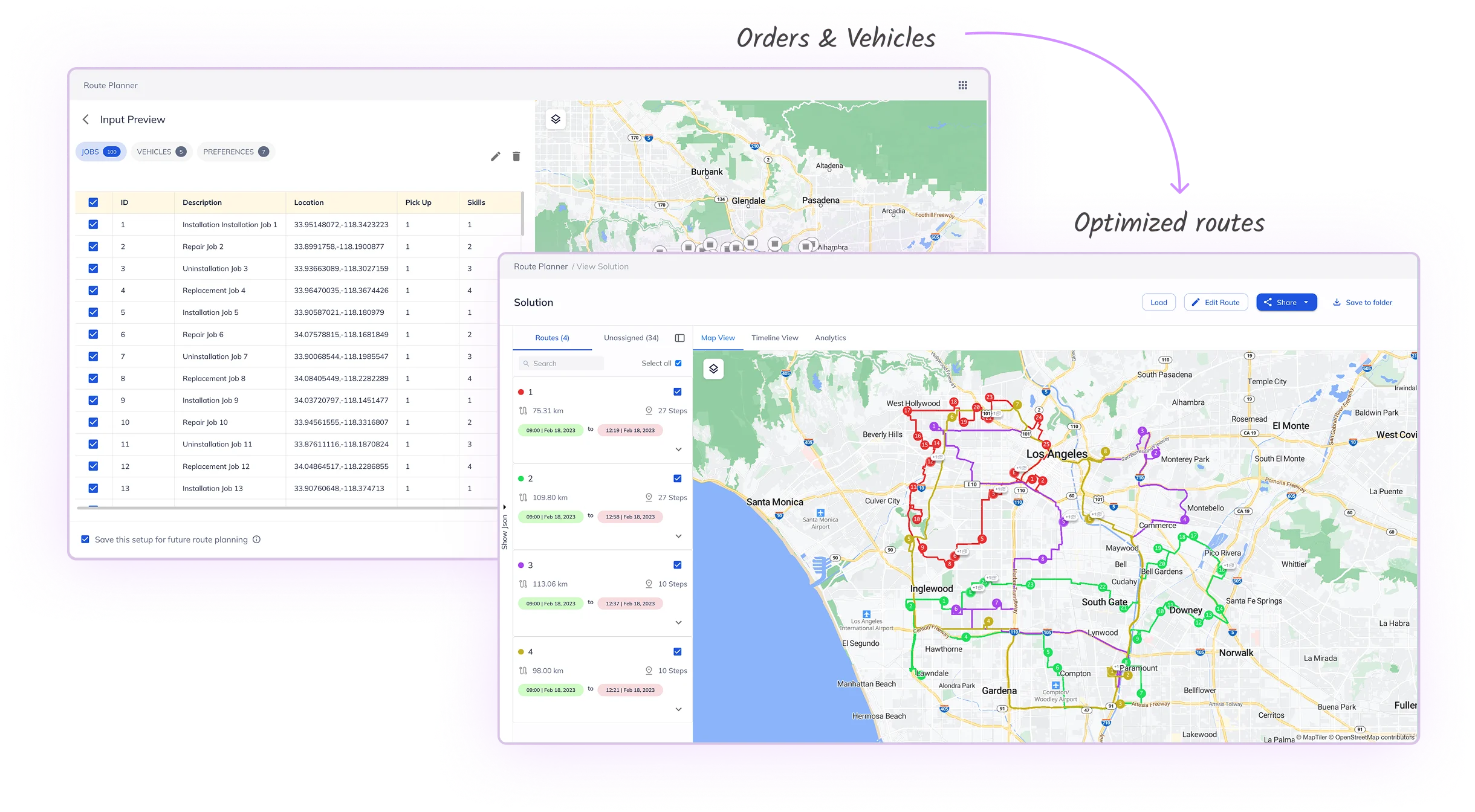
Strict store receiving schedules require more than finding the shortest route. Grocery distributors must coordinate store time windows, unloading durations, vehicle capacity, driver availability, traffic, and road restrictions within one feasible plan. Our Route Optimization API processes these connected constraints to create practical routes for multi-vehicle grocery and convenience store operations.
NextBillion.ai lets businesses define when each delivery must begin or finish. The optimizer considers these windows during vehicle assignment and stop sequencing.
Hard windows represent fixed appointments, while soft windows allow controlled flexibility through lateness limits and penalties. Stores can also have multiple receiving periods during the morning, afternoon, or evening.
The optimizer selects a feasible window based on travel time, service duration, vehicle availability, and surrounding stops.
The delivery windows need to be scheduled along with other factors such as capacity, driver shifts, service times, depot location, traffic, and vehicle availability.
Our Route Optimization API takes these constraints into account and generates sensible routes. Orders may contain delivery quantities, required service time and operational requirements. Capacity, shift timing, start/end locations and task limits are all examples of vehicle attributes.
Realistic service times are especially important. A small convenience store delivery may take minutes, whereas a supermarket delivery involving pallets, returns, and invoice checks may take much longer. Traffic-aware travel estimates also help determine whether each vehicle can reach a store before its window closes.
Consumer maps do not necessarily reflect the roads on which grocery fleets are safe or legal to use. Trucks may be restricted from crossing bridges, driving down private roads, and loading restrictions, and access to stores.
With the Map Editor, businesses can map any roads and add various permissions, speed limits, private turn restrictions, depot roads, temporary closures, and approved delivery corridors.
Routes also may include consideration of vehicle weight, dimensions, axle limits, emission class and cargo requirements. Planners do not have to deal with inappropriate roads, tolls, sharp turns, and limited areas. Drivers can access the appropriate receiving entrance more safely and practically via preferred roads and store access instructions
Balancing the customer’s delivery window and the efficiency of the fleet is critical when it comes to grocery and convenience stores. Routes need to consider store receiving times, realistic loading times, vehicle capacity, driver shifts, road constraints, traffic and any changes of last minute working.
Correct constraint information provides planners with a good starting point. Realistic service times increase the feasibility of the schedule, disruption management is addressed with dynamic reoptimization, and the planned-versus-actual analysis shows recurring delays. All these practices help to minimize the lost windows, driver waiting, over mileage and delivery attempt failures.
NextBillion.ai helps grocery distributors build routes around the conditions their fleets face every day. Our Route Optimization API combines time-window management, multi-constraint optimization, custom mapping, commercial vehicle routing, and dynamic adjustments within a scalable routing framework.
Explore NextBillion.ai’s Route Optimization API to create reliable grocery delivery routes that protect service levels without compromising fleet efficiency.
A delivery time window is a specified time frame when a delivery vehicle should arrive at or start to serve a delivery address. A grocery store can only accept deliveries during a specific time, say 7:00 a.m. to 9:00 a.m., because the employees, loading space and receiving equipment are available during that time.
This window is used by route planning software to decide on the proper vehicle assignment, departure time, and stop sequence. Before the software determines that the route is viable, travel time, unloading time, traffic and previous deliveries need to be taken into account.
Using realistic service times, accurate store schedules, and an understanding of traffic patterns, as well as only adding the necessary operational buffers, can help grocery distributors minimize missed windows. Considerations should also be taken of vehicle capacity, driver shifts, access to stores, and loading sequence during planning.
A hard delivery time window is a specific time window that must be delivered at. The store can refuse the shipment or impose a penalty if the driver does not arrive during the agreed time. The optimizer might not be able to find a route that satisfies the hard window and assign an order to it.
A soft delivery time window is a desired delivery window that you can be flexible with. The route may also be one that permits an early or late arrival, typically with a penalty. This enables planners to be able to provide service to more stores for which a slight delay is acceptable.
Yes. A single store may have several delivery windows, such as early morning and late afternoon. The optimizer analyzes all available periods and selects the window best suited to the vehicle’s route, capacity, travel time, and other commitments.
Real-time route optimization recalculates remaining routes after traffic delays, urgent orders, cancellations, breakdowns, or changes in store availability. It can resequence stops, transfer deliveries, update vehicle assignments, and calculate revised ETAs using current operational conditions.
Bhavisha Bhatia is a Computer Science graduate with a passion for writing technical blogs that make complex technical concepts engaging and easy to understand. She is intrigued by the technological developments shaping the course of the world and the beautiful nature around us.