
Building AI-Powered Dispatch Workflows with MCP

Building AI-Powered Dispatch Workflows with MCP: Automation, Approvals, and Exception Handling

Published: November 17, 2026

Increased requisition of AI agents in enterprise applications has raised credible discussion on MCPs, which serve as an essential integration layer for existing APIs, data sources, and business services. Dispatch operations at transport companies are critical tasks that have a dire need for intelligent, coordinated, efficient, and responsive tools. 

Bulk orders, global market reach, and competition have complicated logistics and fleet management. The earlier dispatch solutions relied on predefined rules and workflows that were suitable for repetitive tasks. But the dynamic scenarios, which include driver availability, load assessment, road conditions, weather, route, etc., require coordination for quick decision-making.

Building a trusted dispatch workflow requires combined analysis and action of driver assignments, route optimization, dispatch execution, and real-time operational updates. This is where the Model Context Protocol (MCP) becomes relevant. 

Integrating an AI-enabled mechanism with MCP into the dispatch system gives immense power of natural language interpretation for a precise solution. MCP ensures reliable accessibility to the existing fleet management platforms, routing engines, and dispatch applications for retrieving operational data or evaluating available options. 

But the fundamentals of dispatch automation with AI agents cannot ignore establishing approval mechanisms for high-impact actions. The tool requires access permissions and manages exceptions such as vehicle breakdowns, driver unavailability, and unexpected delays.

This article explores how to build AI-powered dispatch workflows using MCP, covering workflow architecture, automation opportunities, human-in-the-loop approvals, and exception-handling strategies. It also examines how routing and location intelligence APIs can support these workflows and help businesses move towards more connected and responsive fleet operations.

Why Traditional Dispatch Workflows Fail Dynamically

With the expansion in numbers of delivery assignments and territories, it is hard for the dispatchers to manage the workforce and operations through spreadsheets. Conventional dispatch systems involve automated software solutions that manage driver assignment, order allocation, and route planning, but with predefined business rules. Traditional dispatch workflows may help businesses organize routine operations, but they often lack the flexibility needed to respond to changing conditions in real time.

Typical issues faced in regular dispatch systems

  • Mis-alligned systems and manual coordination: Dispatchers work across multiple platforms, as order management, driver management, fleet tracking, and route planning may operate independently. Switching between systems slows down decision-making.

  • Limited flexibility in rule-based automation: Traditional automation follows predefined instructions. It struggles when unexpected conditions require contextual decisions. New operational scenarios often require additional rules and configurations.

  • Delayed responses to operational exceptions: It is the unpredictability about the events, environment, mechanical devices, urgent schedules, etc. it may include driver unavailability, vehicle breakdowns, unexpected traffic, last-minute orders, or delivery delays. 

The need for connected and context-aware workflows


Task automation is merely a part of the larger picture. Therefore, a dispatch workflow ideally gets appreciated if it can retrieve information from multiple systems, interpret operational context, evaluate available options, and initiate appropriate actions. AI integration linked with external tools has no alternative for fast and efficient coordination in dispatch process management, which is only possible with MCP tools.

Why the traditional dispatch workflow needs an upgrade

Traditional rule-based automation

MCP-enabled AI-agent workflow

Executes predefined rules and instructions.

Interprets requests and coordinates tools based on context and instructions.

Often follows fixed workflow sequences.

Can select and sequence relevant tools depending on the situation.

May require additional rules for new scenarios.

Can evaluate new information and request alternative actions within defined permissions.

Usually relies on application-specific integrations.

Can use MCP as a standardized interface to connected capabilities.


How MCP Enables AI-Powered Dispatch Workflows

For an AI-powered dispatch workflow, the capabilities and information across the business system must have direct accessibility. It means orders, fleets, the driver database, and routing capabilities must be integrated not only with the enterprise solution but also with the AI application. Integrating each system individually may require custom connectors and application-specific logic, making it difficult to scale and maintain AI-driven workflows.

The Model Context Protocol, or MCP, fills the gap of interconnectivity between AI apps and external capability tools. Instead of separate integration programs, MCP exposes system capabilities through a consistent interface.

For example, when a dispatcher asks the AI agent to assign pending deliveries to available drivers, the MCP tool enables accessing external tools exposed by connected dispatch systems. With accurate order details, driver availability, and route details, the agent generates assignment recommendations or initiates authorized actions.

This makes it possible to coordinate multiple operational capabilities within a single workflow while keeping the underlying systems responsible for their respective functions.

MCP also supports resources, which provide contextual information to AI applications. For example, a dispatch-related resource could expose vehicle details, delivery policies, or operational documentation that helps an agent understand the context of a task.

AI agents access relevant operational information and coordinate actions across connected systems. This provides the foundation for building dispatch workflows that combine automated execution, contextual decision-making, and human oversight.

Components and Architecture of an MCP-Powered Dispatch Workflow

The MCP-powered dispatch system has a complex structure with specific components fulfilling the responsibilities. The AI agent interprets instructions and determines which capabilities to use, MCP provides a standardized interface for accessing external tools, and connected systems execute the underlying dispatch and routing operations.

Understanding how these components interact is important when designing workflows that can automate dispatch activities without compromising operational control.

Core components of the architecture


An MCP-powered dispatch architecture typically consists of the following components:

  1. AI Agent or LLM-Powered Application: It interprets the instructions, identifies the information required to complete a task, selects appropriate tools, and evaluates the responses returned by connected systems.

  2. MCP Client: It operates within the AI application and establishes connections with MCP servers.

  3. MCP Server: It exposes capabilities from external applications and services through the MCP interface. This includes access to tools connected to order management systems, fleet management platforms, and routing services.

  4. Dispatch and Fleet Management APIs: They allow connected applications to retrieve order information, check driver availability, create assignments, update dispatch statuses, and access fleet data.

  5. Routing and Optimization Engine: It handles computational tasks such as calculating travel times, generating optimized routes, and evaluating vehicle and delivery constraints.

  6. Human Approval Interface: The purpose is to review AI-generated recommendations before specific actions are executed. Approval may be required for driver reassignment, major route changes, or cancellation of dispatch assignments.

  7. Logging and Monitoring Systems: These systems record tool invocations, API responses, approval decisions, execution results, and workflow failures. They help operations teams monitor performance, investigate errors, and maintain accountability.

MCP-Powered Dispatch Workflow Architecture

Example: An illustrative MCP tool-call request for retrieving available drivers. 

{

  “jsonrpc”: “2.0”,

  “id”: 1,

  “method”: “tools/call”,

  “params”: {

    “name”: “get_available_drivers”,

    “arguments”: {

      “service_area”: “Ohio”,

      “vehicle_type”: “van”,

      “availability”: “now”

    }

  }

}

What this demonstrates:

  • jsonrpc identifies the JSON-RPC protocol version.

  • method specifies that the client is invoking an MCP tool.

  • name identifies the tool being called.

  • arguments contains the input parameters supplied to the tool.

The tool name get_available_drivers is illustrative. A custom MCP server would need to expose and implement this tool.

How dispatch components coordinate through MCP?


Consider a delivery business that receives multiple orders and needs to assign them to available drivers while meeting delivery time windows.

Step 1. Dispatcher Instruction: “Assign pending deliveries to available drivers.”

Step 2. AI Agent: Interprets the request and determines which tools are needed.

Step 3. MCP Client and Server: Connect the AI application to available dispatch tools.

Step 4. External Systems and APIs: 

  1. Order management

  2. Driver management

  3. Fleet management

  4. Route optimization

Step 5. AI Agent Evaluates Results: Reviews assignments, routes, ETAs, and potential conflicts.

Step 6. Human Approval (When Required): The dispatcher reviews and authorizes selected actions.

Step 7. Dispatch Execution and Monitoring: Approved assignments are executed, and their progress is monitored.

The process is not necessarily a one-way sequence. The AI agent utilizes multiple tools, evaluates their responses, and requests additional information before proceeding. The response may differ when an API returns an error or an operational exception is detected.

Read more about: How MCP Tools Enable AI Models to Interact With External Systems

Building an AI-Powered Dispatch Workflow with MCP: A Step-by-Step Approach

Multiple tools, APIs, AI agents, and enterprise data solutions make the dispatch workflow a complicated process. Integrating an AI approach is not enough for obtaining a desired output, as the developers need to ensure the operational tasks are exposed to relevant information, system capabilities, and validation.

Step 1: Defining Dispatch Objectives and Workflow Requirements

Incoming orders, driver assessment, route optimization, delivery progress, or operational exceptions are some of the tasks that need AI-based analysis. The dispatchers define the business objectives here, like improve vehicle utilization or minimize delivery delays.

Now each activity requires appropriate data and system accessibility. For example, a driver assignment workflow may need details about:

  • Pending orders and time windows.

  • Driver availability, current locations, and working schedules.

  • Vehicle capacity, type, and availability.

  • Existing delivery assignments and route information.

  • Business rules, such as driver eligibility and vehicle restrictions.

This assessment helps determine which systems need to be connected and which operations the AI agent should be allowed to perform.

Step 2: Connecting the AI Agent to Dispatch Systems Through MCP

An MCP client within the AI application connects to a number of MCP servers that fetch the functions from backend applications, such as order management platforms, fleet management systems, and routing services. Due to the MCP client, the AI agents directly connect to any specific API for operational requirements.

Potential MCP tools in dispatch workflow

MCP tool

Purpose

get_pending_orders 

Retrieve unassigned delivery orders 

get_vehicle_status

Retrieve vehicle availability and status

get_available_drivers 

Identify available drivers 

get_route_details 

Retrieve route information 

calculate_eta 

Estimate arrival times 

optimize_routes 

Request optimized delivery routes 

assign_driver 

Assign a driver to an order 

update_dispatch_status

Update dispatch information

Step 3: Retrieve and Validate Operational Data

The AI application is able to retrieve complete details about the delivery orders. However, it is essential to cancel out any possibility of discrepancy in changable data, such as driver availability, vehicles, etc. Hence, the data is validated on priority, and potential issues are eliminated after verification before proceeding with any further action.

Step 4: Generate Dispatch Recommendations Using AI and Optimization Services

With the required information available, the AI agent evaluates possible dispatch decisions against the business’s operational requirements, such as route recommendations for feasible assignments.

The AI agent coordinates the decision-making workflow, while the underlying routing or optimization engine performs the relevant calculations. MCP critically provides the interface through which the agent accesses these capabilities.

Step 5: Review and Execute Dispatch Assignments

Not every dispatch decision needs the same level of human involvement. The AI agent automates tasks with pre-defined conditions. But assignments with specific instructions, such as changed schedules, multiple orders, or midway operational constraints, are requested for human approval.

The dispatcher reviews the proposed action, its supporting information, and any relevant risks before approving, rejecting, or modifying it.

Step 6: Monitor Dispatch Progress and Reassess Decisions

Delivery operations continue to change, often leading to unexpected events. AI agents are highly effective in comparing actual progress against planned schedules. MCP smoothens the entire process of retrieving updated information, travel-time estimates, evaluating alternative routes, or identifying another eligible driver.  

By combining connected data, AI-assisted decision-making, controlled execution, and ongoing monitoring, businesses can build dispatch workflows that adapt to operational changes while maintaining visibility and control over important decisions.

Automating Dispatch Decisions: Where AI Agents Add Value

AI agents conveniently handle the traditional tasks in the dispatch workflow that require decisive analysis from dispatch managers. But instead of simply automating the work, the tool coordinates different steps based on changing operational conditions and business requirements. 

Here are some key areas where AI agents can support dispatch automation.

How AI agents add value to the dispatch workflow

Dispatch function

How AI agents add value

Automated Order Allocation

Evaluates incoming orders, delivery requirements, and available capacity to recommend suitable order allocations.

Driver and Vehicle Assignment

Assesses driver availability, vehicle capacity, eligibility, and existing commitments to recommend assignments.

Dynamic Route Optimization

Retrieves updated operational data and re-routes the vehicle when conditions change.

Dispatch Prioritization

Identifies high-priority orders based on delivery deadlines, urgency, and predefined business rules.

Automated Notifications and Status Updates

Triggers driver notifications and updates dispatch statuses based on operational events and configured rules.

Automated Order Allocation

When new delivery orders enter the system, an AI agent retrieves order details and evaluates them against current dispatch capacity. It may consider factors such as delivery locations, time windows, order priorities, and existing commitments before recommending how orders should be allocated.

With a huge number of orders within a short period, the agent checks for an available driver with its vehicle information. It groups the compatible deliveries and requests an optimized route plan for feasible combinations. This helps dispatch teams process incoming orders more efficiently while reducing manual coordination.

Intelligent Driver and Vehicle Assignment

A dispatcher may not always choose the nearest available driver to finish the task. Vehicle capacity, driver eligibility, working hours, delivery requirements, and existing assignments are also considered.

The AI agent fetches these details through connected MCP tools and evaluates potential assignments against predefined business rules. It then recommends a suitable driver and vehicle or initiates an authorized assignment.

Dynamic Route Optimization

Traffic congestion, road closures, new orders, and delivery delays can make previously planned routes less efficient. AI agents can respond to these changes by retrieving updated operational information and invoking routing or optimization services. During uncertainities the AI agent also suggests alternative delivery strategies to avoid the risk of missing time windows. 

Dispatch Prioritization

Some orders have strict delivery windows, urgent service requirements, or greater consequences if delayed. While others do not have the same operational priorities.

An AI agent evaluates orders using configured business rules and operational context to identify which deliveries need attention first. It can also help dispatchers understand why an order has been prioritized, making it easier to manage competing demands.

Automated Notifications and Status Updates

AI agents coordinate routine communication through notifications or status-update tools. For example, when an assignment is confirmed, the workflow could trigger a driver notification or update the order’s dispatch status. Similarly, when a delivery is delayed, the agent could identify the relevant event and initiate an appropriate notification workflow, subject to configured permissions and communication policies.

Human-in-the-Loop Approvals: Balancing Automation with Operational Control

In an MCP-powered dispatch workflow, the AI agent can retrieve operational data, evaluate available options, and propose actions through connected tools. But these tools should not be authorized for complete automation because sometimes data-backed decisions and executions can adversely impact delivery commitments, operating costs, driver schedules, and customer experience. Human-in-the-loop (HITL) approvals provide a mechanism for reviewing important AI-generated recommendations before they are executed.

A human approval interface adds a review step between the recommendation and execution, allowing dispatchers or managers to retain control over decisions that require judgment or authorization.

Why human approvals matter

Incomplete data, unexpected conditions, or business constraints that are not fully represented in the connected systems often deter the AI agents from performing the expected solutions.

Benefits of human oversight for logistics businesses

  • Reduce operational risks: Review decisions that could cause significant delivery disruptions or additional costs.

  • Validate AI recommendations: Check whether proposed assignments and route changes are practical.

  • Maintain accountability: Ensure authorized personnel remain responsible for high-impact decisions.

  • Handle unusual situations: Apply human judgment when an exception cannot be resolved through predefined rules.

Example: A sample approval request generated by an AI dispatch workflow.

{

  “approval_request_id”: “APR-2048”,

  “order_id”: “ORD-1042”,

  “proposed_assignment”: {

    “driver_id”: “DRV-018”,

    “vehicle_id”: “VEH-025”,

    “estimated_travel_time_minutes”: 35

  },

  “approval_required”: true,

  “reason”: “High-priority delivery”,

  “status”: “pending_approval”

}

What this demonstrates:

The workflow can separate the AI agent’s recommendation from the actual dispatch action. The assignment remains pending until an authorized dispatcher approves it.


Human-in-the-loop approval process:

  1. Generate a recommendation: The AI agent evaluates operational data and proposes a dispatch action.

  2. Check approval requirements: Whether the proposed action falls within the agent’s authorized permissions.

  3. Submit for review: The recommendation is sent to the appropriate dispatcher or manager.

  4. Review the proposed action: The reviewer examines relevant details.

  5. Approve, reject, or modify: The authorized person makes the decision.

  6. Execute and record: Connect with the appropriate MCP tool to execute the action.

The outcome and approval decision are recorded.

Delivery tasks that require human intervention

Dispatch action

Suggested approval approach

Retrieving order and driver information

No approval required

Assigning an order to an eligible driver

Can be automated with predefined rules

Reassigning multiple deliveries

Dispatcher approval may be required.

Changing critical delivery commitments

Manager or dispatcher approval

Overriding vehicle or driver constraints

Authorized personnel approval

Cancelling a dispatch or delivery

Approval based on business policy


Exception Handling in AI-Powered Dispatch Workflows

Unavailability of drivers, vehicle breakdown midway, unexpected traffic delay, or new orders often affect the dispatch decisions. Technical issues, such as API timeouts or failed system updates, are other typical exceptions that interrupt automated workflows. 

AI agents powered with MCP tools are able to identify exceptions against available information and evaluate appropriate esponse.

Dispatch exceptions handling by AI agents

Exception type

Example

Potential impact

Driver unavailability

Driver falls sick and becomes unavailable.

Orders remain unassigned or deliveries are delayed.

Vehicle breakdown

Vehicle develops a sudden mechanical issue 

Deliveries may need to be reassigned.

Traffic disruptions

Congestion, road closures, or accidents block movements

Increased travel time and missed delivery windows.

Last-minute orders

New orders arrive after dispatch finalized.

Existing routes and schedules need adjustment.

API or integration failure

A routing API times out or a dispatch update fails.

Unable to retrieve data or complete an action.

Inconsistent operational data

Driver availability or vehicle status is outdated.

Incorrect recommendations or invalid assignments.

How AI agents identify and respond to exceptions


AI agents monitor dispatch information by retrieving updates from connected fleet, order management, and tracking systems through MCP tools. They compare current operational data against planned assignments, delivery schedules, and predefined business rules to identify potential disruptions.

Once an exception is detected, the agent follows a structured response process:

  1. Identify the exception: Retrieve updated information and determine which order, driver, vehicle, or system operation is affected.

  2. Assess the impact: Evaluate how the issue affects delivery schedules, route feasibility, and other assignments.

  3. Retrieve additional information: Check alternative driver availability, vehicle capacity, updated traffic conditions, or system status.

  4. Evaluate possible responses: Generate alternatives, such as reassigning a delivery, recalculating a route, or escalating the issue.

  5. Execute or request approval: Carry out authorized corrective actions or submit the recommendation for human review.

  6. Verify the outcome: Confirm that the underlying dispatch system reflects the intended change and monitor the affected operation.

This approach allows the agent to coordinate responses across connected systems instead of treating each exception as an isolated event.

Example: A structured representation of a vehicle breakdown event.

{

  “event_id”: “EVT-3091”,

  “event_type”: “vehicle_breakdown”,

  “vehicle_id”: “VEH-025”,

  “driver_id”: “DRV-018”,

  “affected_orders”: [

    “ORD-1042”,

    “ORD-1043”

  ],

  “location”: {

    “latitude”: 12.9560,

    “longitude”: 77.6100

  },

  “event_status”: “requires_reassignment”

}

What this demonstrates:

The agent can use the event information to identify affected orders, retrieve alternative drivers and vehicles, and request updated route or assignment recommendations. Depending on the business rules, it can execute an authorized reassignment or request dispatcher approval.

Practical exception-handling scenarios


Scenario 1: Driver Becomes Unavailable

Suppose a driver becomes unavailable after receiving several delivery assignments. The AI agent then retrieves the affected orders, checks the availability of other eligible drivers, and evaluates whether the deliveries can be reassigned without violating capacity or scheduling constraints.

Scenario 2: Unexpected Traffic Disruption

Consider a delivery vehicle encountering unexpected congestion that puts its scheduled arrival time at risk. Now the agent retrieves updated traffic and travel-time information to evaluate alternative routes through route optimization API integrated via MCP.

Based on the results, it recommends a revised route or initiates an authorized route update. If the delivery is still likely to miss its time window, the agent alerts the dispatcher or trigger the appropriate customer communication workflow.

Scenario 3: Vehicle Breakdown During Delivery

If a vehicle breaks down while carrying multiple orders, the agent identify alternative vehicles or drivers appropriate to complete the deliveries.

Since this situation may affect multiple deliveries and involve additional operational costs, the proposed reassignment may require fleet manager approval before execution.

Handling technical failures and workflow errors


Not all exceptions originate in physical dispatch operations. Automated workflows also depend on reliable communication between MCP servers, APIs, and backend applications. A timeout, authentication failure, invalid request, or unavailable service can prevent an operation from completing.

Businesses should implement safeguards such as:

  • Retries and timeouts: Retry temporary failures using controlled retry limits and appropriate delays. Avoid repeatedly submitting requests when the outcome of an earlier operation is uncertain.

  • Error classification: Distinguish temporary failures, such as service timeouts, from errors requiring corrective action, such as invalid input or insufficient permissions.

  • Fallback mechanisms: Provide alternative processing paths or manual dispatch procedures when a connected service becomes unavailable.

  • Idempotency: Use idempotency controls for supported operations to prevent duplicate assignments or updates when requests are retried.

  • Logging and monitoring: Record failed tool calls, API responses, and execution outcomes to support troubleshooting and operational visibility.

  • Human escalation: Route unresolved or high-impact failures to the appropriate dispatcher or technical support team.

For example, if an AI agent submits a driver assignment but the API times out, it should not immediately assume that the assignment failed and submit the same request again. The original operation may have succeeded even though the response was not received. The workflow should first verify the assignment status or use an appropriate idempotency mechanism before attempting another update.

Implementing MCP-Based Dispatch Automation: Technical Considerations

Building an MCP-powered dispatch workflow requires more than exposing existing APIs as MCP tools. Businesses must also ensure that AI agents interact with operational systems securely, process reliable data, and execute actions without disrupting ongoing dispatch operations.

The following technical considerations can help developers build reliable and scalable MCP-based dispatch automation.

Design Clear and Purpose-Specific MCP Tools

MCP tools act as interfaces through which AI agents access external system capabilities. Each tool should have a clearly defined function, input parameters, expected output, and error-handling behavior.

For example, a dispatch integration could expose tools for retrieving pending orders, checking driver availability, calculating ETAs, or creating dispatch assignments.

Developers should avoid combining unrelated operations into a single tool. Instead, use smaller, purpose-specific tools with well-defined input schemas. This makes it easier for AI agents to select the appropriate operation and reduces the risk of unintended actions.

Implement Authentication and Access Controls

Dispatch systems contain operational information and support actions that can directly affect business activities. Therefore, MCP integrations must follow appropriate authentication and authorization practices.

Key considerations include:

  • Authentication: Verify the identity of the AI application or client connecting to the MCP server.

  • Authorization: Restrict access to tools and operations based on user roles and permissions.

  • Least privilege: Give agents access only to the information and actions required for their assigned tasks.

  • Credential security: Store API keys, access tokens, and other credentials securely rather than exposing them in prompts or tool responses.

  • Read/write separation: Apply stricter controls to action-oriented tools that create assignments, modify routes, or update dispatch records.

For example, an agent may be allowed to retrieve driver availability automatically but require additional authorization before reassigning multiple deliveries.

Validate Data and Maintain System Consistency

AI-generated recommendations are only as reliable as the information used to produce them. In dispatch environments, outdated driver availability, incorrect vehicle capacity, or incomplete delivery details can result in unsuitable assignments.

MCP servers and the underlying APIs should validate incoming requests before executing operations. Developers should also account for changing operational data, particularly when multiple users or systems can update the same records.

Useful safeguards include input validation, duplicate-request prevention, consistency checks, and verification of action results.

For example, before creating an assignment, the backend should confirm that the selected driver and vehicle are still available. This prevents the workflow from acting on information that may have changed after the agent retrieved it.

Establish Monitoring and Observability

Monitoring helps businesses understand how AI agents interact with connected systems and whether dispatch workflows are functioning as expected.

Implementation should include logging and monitoring of:

  • MCP tool invocations and their parameters.

  • API responses and execution status.

  • AI-generated recommendations and decisions.

  • Human approval or rejection events.

  • Failed operations, retries, and exception-handling outcomes.

  • Workflow execution time and performance.

Sensitive information, such as authentication credentials and personal data, should be excluded or appropriately protected in logs.

These records help developers troubleshoot integration failures, investigate incorrect actions, and identify areas where workflows need improvement.

Test Workflows Before Production Deployment

MCP-based dispatch automation should be tested under realistic operational conditions before being deployed in a live environment.

Testing should cover both individual tools and complete workflows. Developers can verify whether tools return the expected data, whether input validation works correctly, and whether action-oriented tools execute the intended operations.

Important test scenarios include:

  • Assigning orders when multiple drivers are available.

  • Handling cases where no eligible driver is available.

  • Recalculating routes after traffic disruptions.

  • Processing incomplete or invalid order information.

  • Recovering from API timeouts and temporary service failures.
  • Preventing duplicate assignments when requests are retried.

  • Ensuring approval requirements are enforced for restricted actions.

A development or staging environment allows teams to test these scenarios without affecting live dispatch operations. Production deployment can then be introduced gradually, starting with read-only capabilities or human-approved actions before expanding automation permissions.

By addressing tool design, security, data validation, monitoring, and testing, businesses can establish a dependable foundation for MCP-based dispatch automation. These safeguards help ensure that AI agents can coordinate operational tasks while the underlying systems retain control over data integrity, permissions, and business-critical execution.

How NextBillion.AI APIs and MCP Capabilities Support AI-Powered Dispatch Workflows

MCP-enabled dispatch workflows need access to accurate location data, routing intelligence, driver assignment capabilities, and dispatch systems. NextBillion.ai provides APIs and an MCP server that help AI applications access several of these capabilities, enabling developers to build location-aware dispatch workflows.

Rather than replacing existing dispatch infrastructure, these integrations allow AI agents to coordinate NextBillion.ai services with a business’s internal fleet management and order management systems.

NextBillion offers various API solutions to support dispatch, navigation, order management, and location intelligence. The road segment API, vector tiles API, and other tools help dispatchers visualize map details and thus are highly supportive in dispatch functions.

How NextBillion APIs enforce overall AI-powered dispatch workflow

Function

NextBillion API

Solution

Location and orders validation

Forward Geocode API, Place Lookup API 

Convert delivery addresses into coordinates and retrieve destination details. 

Organize orders and resources 

Clustering API

Group orders based on location and defined constraints. 

Plan driver assignments and routes 

Distance Matrix, Driver Assignment, Route Optimization 

Evaluate driver suitability and generate route recommendations. 

Execute and navigate 

Route Dispatch API · Navigation API 

Send approved assignments to drivers and provide navigation instructions. 

Monitor and handle exceptions 

Live Tracking, Traffic Incidents, Weather Forecast 

Identify disruptions and recommend corrective action when necessary. 


Clustering API

Groups orders or jobs based on locations and defined constraints. An AI agent uses the resulting clusters to organize deliveries into geographic service areas before assigning drivers or optimizing routes. 

Geocode API 

Converts addresses, place names, and other location descriptions into geographic coordinates, and vice versa. This helps translate order addresses into usable location data for distance calculations, routing, and driver assignment.

Place lookup API

Retrieves detailed information about a place using its unique identifier, including its address, coordinates, and access points. This helps validate delivery locations and retrieve more precise destination information.
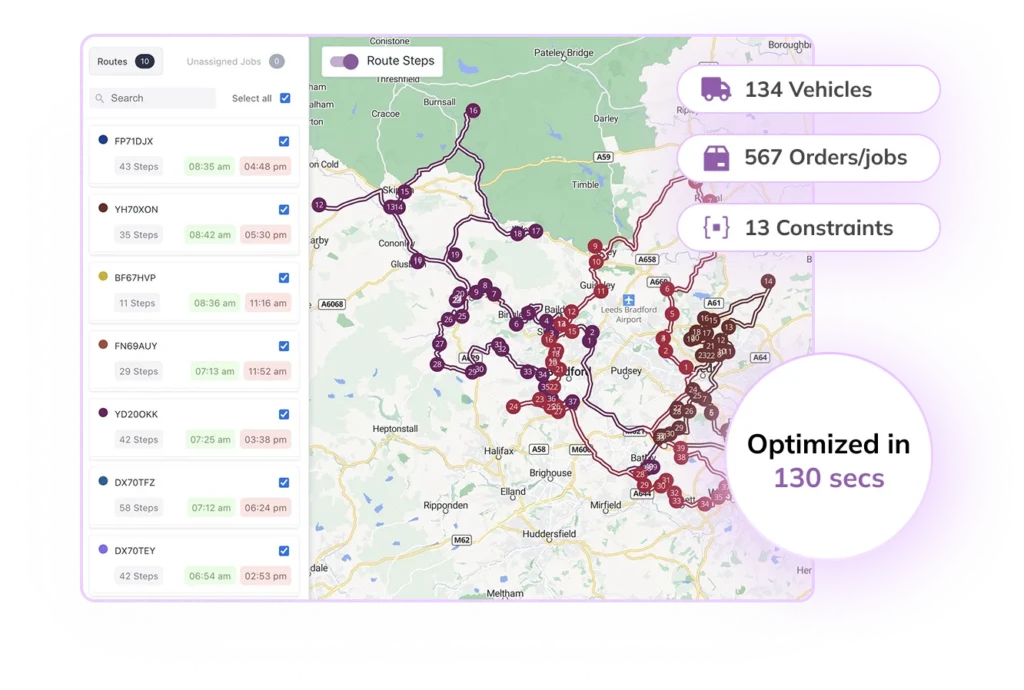
nextbillion route optimization apiRoute optimization API for planning and replanning

The route optimization API helps businesses generate optimized routes for multiple vehicles while considering operational constraints such as vehicle capacity, delivery time windows, job priorities, and available resources.

In an MCP-enabled workflow, an AI agent can gather order and vehicle information from connected systems, prepare the optimization request, and communicate with the relevant routing capability through an integration layer. The optimization service calculates the route plan, which the agent can then evaluate and present for approval or further execution.

Distance matrix API for driver-to-order matching

The distance matrix API calculates travel distances and estimated travel times between multiple origins and destinations. This makes it useful for comparing how quickly available drivers can reach pending pickup or delivery locations.

For example, an AI agent connected to a fleet management system can retrieve the current locations of available drivers and use the distance matrix API to compare their travel times to a new pickup location. It can use these results to identify suitable candidates before proceeding with driver assignment.

Driver assignment API 

The driver assignment API helps match available drivers to open tasks based on configurable constraints and preferences. These can include distance, travel time, vehicle specifications, order priorities, and other assignment requirements.

An AI-powered workflow can use this capability to evaluate driver-to-task assignments rather than relying only on proximity. The agent can retrieve relevant order and vehicle information, coordinate the assignment request, and interpret the returned recommendations, including unassigned orders or alternative vehicle options.

Route dispatch API for executing assignments

Once routes have been planned and assignments finalized, the route dispatch API can be used to share routes with registered drivers through NextBillion.ai’s driver application. Route information can include stops, task details, instructions, breaks, and other relevant information.

In an MCP-enabled workflow, the AI agent can coordinate this dispatch operation after the required approval checks have been completed. The API then handles the route-dispatch operation, allowing the planned work to reach the driver.

Navigation API 

Provides routes and turn-by-turn directions. Its flexible version supports traffic-aware routing and truck-specific constraints, making it useful after dispatch when drivers need navigation instructions.

Live tracking and geospatial capabilities

Dispatch workflows also need visibility into what happens after a route is assigned. NextBillion’s live tracking API and SDKs support real-time monitoring of fleets, personnel, and orders. Geofencing capabilities can also help businesses identify when vehicles or drivers enter or leave predefined geographical areas.

An AI agent can use information from connected tracking systems to identify delivery delays, deviations, or other operational events. It can then coordinate further actions, such as requesting updated travel-time estimates, evaluating alternative routes, or notifying a dispatcher.

Traffic incidents API

Provides information about incidents, road closures, severity, affected roads, and estimated travel-time impact. An AI agent uses this information to identify disruptions and trigger route reassessment or dispatcher approval. 

Weather forecast API 

Provides hourly and daily weather forecasts for specific coordinates. An AI agent uses this information to flag weather-related delivery risks and recommend schedule or route adjustments. 

Bringing These Capabilities Together Through MCP


NextBillion.ai’s MCP server exposes location-related capabilities, including geocoding, reverse geocoding, place search, routing, distance matrices, isochrones, and static route maps, as tools that compatible AI applications can discover and invoke.

For broader dispatch operations, developers can also expose relevant NextBillion.ai REST API operations through a custom MCP server or another integration layer. For example, driver assignment and route dispatch operations can be made available as purpose-specific tools, alongside tools connected to internal order and fleet management systems.

Consider a dispatcher asking an AI assistant to find a suitable driver for an urgent pickup. The workflow could:

  1. Retrieve available driver and vehicle locations from the fleet management system.

  2. Use geocoding to resolve the pickup address, if necessary.

  3. Invoke the Distance Matrix API to compare travel times from available drivers.

  4. Use routing or driver assignment capabilities to evaluate suitable options.

  5. Present the recommended driver and route to the dispatcher for approval.

  6. Invoke the appropriate dispatch operation after approval.

  7. Monitor the assignment through connected tracking systems.

This architecture combines NextBillion.ai’s location intelligence with AI-driven workflow coordination and existing fleet systems. The result is a more connected approach to dispatch automation, where AI agents can retrieve operational context, coordinate routing and assignment capabilities, and initiate authorized actions while human teams retain oversight of critical decisions.

To Sum Up

As logistics operations become more dynamic, businesses need dispatch workflows that can adapt to changing delivery requirements, driver availability, and road conditions. Traditional rule-based automation can streamline repetitive tasks, but coordinating decisions across multiple systems and responding to unexpected disruptions often requires greater flexibility.

MCP supports AI agents to seamlessly coordinate with externally connected systems and utilize operational data for routing and dispatch capabilities. However, building an AI-powered dispatch workflow requires businesses to establish appropriate access controls, validate data, define approval requirements for consequential actions, and implement reliable exception-handling mechanisms. On the other hand, human oversight remains essential for decisions that carry significant operational or customer impact.

NextBillion.ai provides routing, optimization, dispatch, tracking, and location intelligence APIs that can support these connected workflows. Its MCP capabilities also offer an integration path for AI applications to access location-based services through a standardized interface. By bringing these capabilities together with internal fleet and order management systems, logistics businesses can build more responsive dispatch operations while retaining control over critical decisions.

What Is MCP in AI-Powered Dispatch Automation?

The Model Context Protocol (MCP) is an open standard that enables AI applications to connect with external systems, access contextual information, and invoke tools. In dispatch automation, MCP allows AI agents to interact with connected fleet management platforms, order management systems, routing services, and dispatch applications. This enables agents to coordinate tasks such as retrieving driver availability, evaluating delivery requirements, and initiating dispatch actions through authorized tools.

An MCP server exposes selected capabilities of external systems as tools that an AI application can discover and invoke. For example, a custom dispatch MCP server could expose tools for retrieving pending orders, checking driver availability, requesting route optimization, and assigning drivers. When an AI agent needs to perform a task, the MCP client communicates with the relevant server, which processes the request through the underlying APIs or services and returns the result. This allows AI agents to interact with existing dispatch infrastructure without requiring every system to be rebuilt specifically for AI.

Yes. AI agents can retrieve order details, driver availability, vehicle capacity, and delivery constraints before requesting driver assignment or route optimization through connected services. They can evaluate the returned results and, depending on configured business rules, either execute eligible assignments or submit recommendations for human approval. The actual assignment and route calculations are performed by the connected dispatch and optimization services, while the AI agent coordinates the workflow.

Human approvals help maintain operational control over decisions that could affect delivery commitments, customer experience, costs, or driver workloads. For example, a routine assignment may be automated, while reassigning several deliveries, overriding delivery constraints, or cancelling an order may require dispatcher approval. Approval mechanisms also provide an opportunity to review AI recommendations, correct inaccurate information, and maintain accountability for consequential actions.

AI agents can respond to dispatch exceptions by retrieving updated operational information, assessing the impact of a disruption, and evaluating possible corrective actions. If a vehicle breaks down, for example, an agent can identify the affected deliveries, check the availability of alternative vehicles and drivers, and request updated route or assignment recommendations. Depending on business policies, it can execute an authorized action or send the recommendation to a dispatcher for approval. The workflow should then verify that the reassignment was successful and update the relevant systems.

The APIs depend on the workflow’s requirements, but a typical implementation may use several categories of services:

  • Geocoding and Places APIs: Convert delivery addresses into coordinates and retrieve destination details.
  • Distance Matrix API: Calculate distances and estimated travel times between drivers, pickup points, and delivery locations.
  • Clustering API: Group geographically close orders to support delivery planning.
  • Driver Assignment API: Identify suitable drivers for available delivery tasks based on defined constraints.
  • Route Optimization API: Generate efficient routes while considering factors such as time windows, vehicle capacity, and availability.
  • Route Dispatch API: Send approved routes and assignments to drivers.
  • Navigation and Tracking APIs: Support driver navigation and monitor delivery progress.
  • Traffic and Weather APIs: Provide information that can help identify disruptions and assess the need for route or schedule adjustments.

About Author

Nitesh Malviya

Nitesh Malviya is a research-oriented professional with a background in Computer Science & Engineering. He served for 7 years as a software consultant and wrote passively in the tech niche before becoming a full-time technical writer.

Ready to get started?

Table of Contents