


Table of Contents
It’s been a packed Q3 2026 at NextBillion.ai, with plenty of exciting updates and milestones along the way. From major launches such as Hours of Service capabilities, Navigation SDK to upgraded Route Optimization APIs with powerful features like pinned technician availability, we have introduced meaningful improvements across the platform.
We have also rolled out several valuable enhancements to tools such as Map Editor, Route Planner App and more. Let’s take a closer look at these updates and how they can help you plan smarter, operate more efficiently, and get more from the NextBillion.ai platform.
What’s New: Products We Launched in Q3
This quarter, we expanded the NextBillion.ai platform with new capabilities across regulatory compliance, reliable navigation and AI-powered location reasoning. These launches will help our users to build safer, more reliable and more intelligent logistics and mobility applications.
Hours of Service API
A route is only practical if the driver can complete it within the applicable driving and rest limits. The new NextBillion.ai Hours of Service API brings HOS compliance directly into the trip-planning process.
The new API considers the driver’s current duty status, accumulated driving and on-duty time, remaining available hours and planned itinerary. It then evaluates whether the trip is feasible and automatically identifies where mandatory breaks, rest periods and layovers should be added.

Businesses can apply region-specific HOS regulations and integrate driver-hours data from ELD and telematics systems. This helps fleets reduce manual planning, minimize compliance risks, generate more realistic ETAs and create routes that drivers can safely execute. Read detailed Hours Of Service API documentation.
Offline Navigation SDK
Truck drivers often operate in areas where mobile connectivity is weak, inconsistent or completely unavailable. With Offline Navigation SDK, businesses can provide uninterrupted route guidance even when the network drops.
Regional map data can be downloaded to the driver’s device before the journey, allowing drivers to continue accessing maps, route information and turn-by-turn guidance without an active internet connection. On-device navigation capabilities also support rerouting and off-route detection when connectivity is limited. Read Doc Here.

Once the device reconnects, locally stored trip progress and activity can be synchronized with the central system. This helps businesses maintain operational continuity, reduce navigation-related delays and provide a more reliable driver experience across rural areas, remote highways and other low-connectivity locations.
Also Read: Offline Routing & Navigation for Fleets
NextBillion.ai Location Reasoning AI
AI applications can understand natural language text queries, but they need access to real-world location intelligence to make real world decisions. The NextBillion.ai Location Reasoning AI connects AI agents and assistants with NextBillion.ai’s geospatial capabilities through a standardized interface.
Using natural-language instructions, developers can enable AI applications to geocode addresses, discover places, calculate road-based distances and travel times, generate directions, evaluate service areas and optimize multi-stop routes. This allows AI agents to reason about real-world factors such as road networks, traffic conditions, vehicle restrictions, time windows and geographic accessibility.

The NextBillion.ai MCP makes it easier to prototype and build location-aware AI applications for logistics, mobility, transportation and field-service operations – without requiring developers to manually connect every location API to their AI workflows.
Good Read: Build Location-Reasoning AI Applications with NextBillion.ai MCP
Major Product Enhancements
Beyond the new launches, this quarter our team also focused on improving flexibility, control and visibility across the APIs, SDKs and route-planning applications.
Route Optimization API
The Route Optimization API received several updates to support more complex planning requirements:
- Pinned Technician Assignments: Users can now assign specific tasks to designated technicians or vehicles while allowing the optimizer to plan the remaining tasks efficiently. Read here in detail.
- Estimated Break Locations: View the estimated location where a scheduled driver break will occur, making route plans more practical and transparent.
- Split Orders: Divide large orders across multiple vehicles when a single vehicle does not have sufficient capacity. Read here in detail.
- Unassigned Reasons for Vehicles: Understand the vehicle-related constraints that prevented a task from being assigned, making it easier to adjust the plan.
- One-to-Many Shipments: Model scenarios where one pickup is connected to multiple delivery locations within the same shipment workflow.
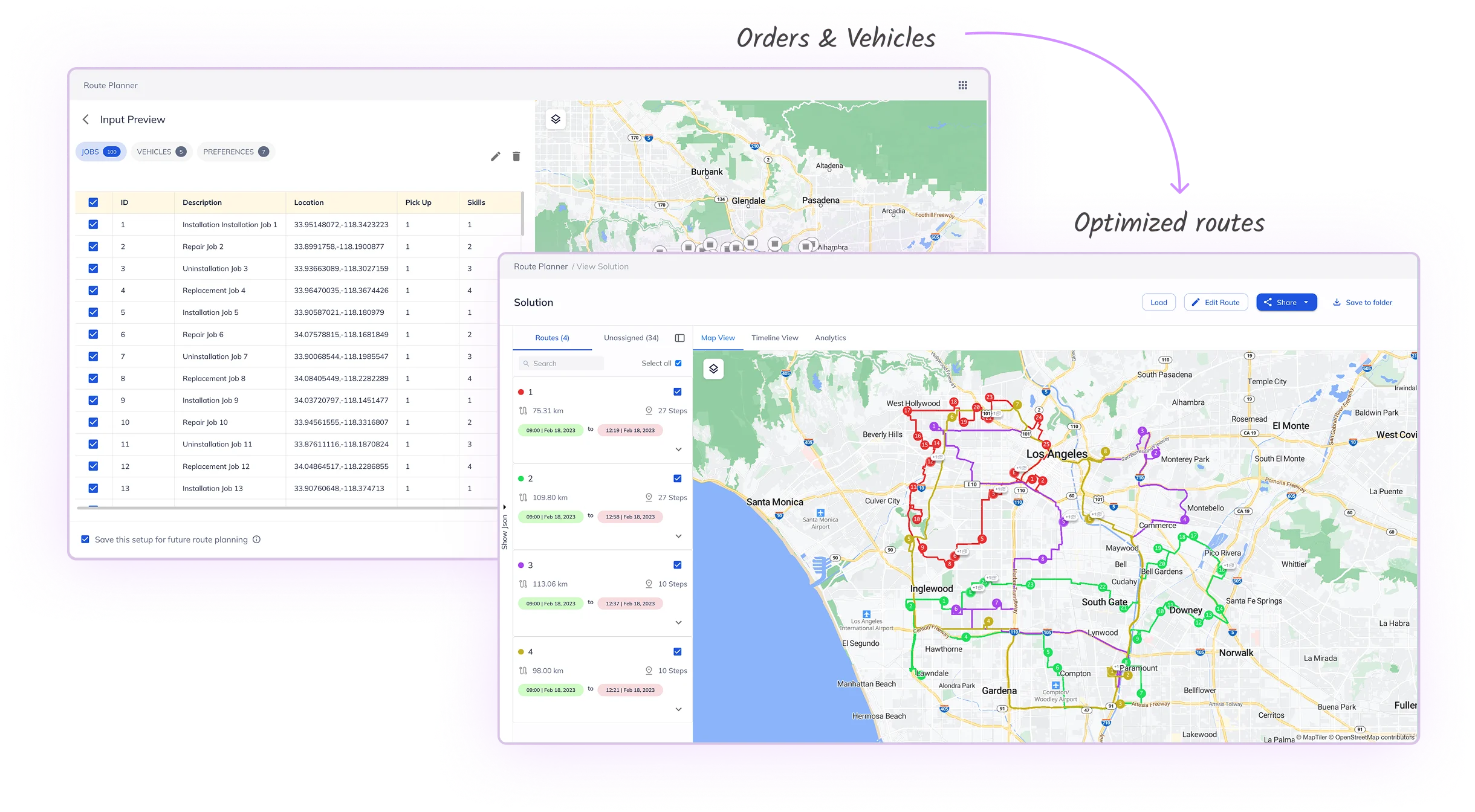
Route Planner App
The Route Planner App now supports importing JSON files, making it easier to bring structured routing data directly into the application. This reduces manual formatting and helps teams configure route-planning problems faster.
Routing APIs
We introduced two enhancements across our routing services:
- Honor Restrictions: Directions, Synchronous Distance Matrix and Navigation APIs can now generate routes that respect applicable road and vehicle restrictions.
- Traffic Lights and Stop Signs: Directions and Navigation APIs now provide traffic lights and stop signs as road-information items, offering richer context for navigation and driver applications. Directions API
Improvements Across the Platform
Alongside our major launches, we introduced several focused improvements across the platform to make location data, custom maps and developer resources easier to use.
Geocode APIs
The Geocode, Structured Geocode and Batch Geocode APIs now support address types, making it easier to classify and work with different categories of address results across geocoding workflows.
Map Editor
We improved the Map Editor experience to make custom road data easier to create and manage. Teams can configure access permissions, speed limits, turn restrictions and truck-specific limits so routes better reflect private roads and operational requirements.
AI-Friendly Documentation
Our developer documentation is now easier to use with AI coding assistants. New View Markdown and Copy for LLM options let developers quickly provide clean, structured API documentation to AI tools, simplifying integration, code generation and troubleshooting.
Looking Ahead to Q4 2026
In next quarter, we plan to build on this quarter’s progress by expanding our Hours of Service and Offline Navigation capabilities, enhancing route optimization workflows, and improving the Route Planner App and Map Editor experience. We will also continue developing NextBillion.ai Location Reasoning capabilities and making our APIs and documentation easier for developers to discover, understand and integrate. And there is much more to come. Stay tuned for bigger, more practical announcements in our next quarterly update.
Want to speak with one of our technical experts? Book a quick consultation with the team today.
Ready to get started?
Request a DemoTable of Contents
Subscribe to our Newsletters
Get the best practices for route planning & optimization, delivered to your inbox.
Subscribe