


Table of Contents
Cities worldwide are introducing stricter vehicle-access regulations to improve air quality, reduce transport emissions, and encourage cleaner mobility. Two terms appear frequently in these regulations: Low-Emission Zones (LEZs) and Zero-Emission Zones (ZEZs).
Although they share similar environmental goals, they impose very different requirements on vehicles and fleet operators. A vehicle permitted in a low-emission zone may still be restricted or charged in a zero-emission zone.
For logistics companies, these differences influence vehicle selection, delivery schedules, routing costs, depot strategies, long-term fleet planning, and the adoption of logistics technology. Understanding this distinction is essential for maintaining compliant, cost-effective, and efficient urban logistics operations.
What is a Low-Emission Zone?
A Low-Emission Zone is a defined geographical area where access is restricted or charged based on a vehicle’s emissions performance. The primary purpose of an LEZ is to prevent the most polluting vehicles from entering areas with poor air quality. Cities generally determine eligibility using factors such as:
- Vehicle category
- Fuel type
- Euro emission standard
- Vehicle age
- Nitrogen oxide and particulate emissions
- Local registration or permit status
Vehicles meeting the required emissions standard can usually enter without restriction. Non-compliant vehicles may have to pay a daily charge, operate only during certain hours, or avoid the zone entirely.
For example, London’s Ultra Low Emission Zone requires most vehicles to meet specific Euro emission standards or pay a daily charge. Diesel and petrol vehicles are still permitted as long as they meet the applicable standard or the operator pays the charge.
Also Read: Low Emission Zones in Europe: The Complete Guide to Route Planning and Compliance
What Is a Zero-Emission Zone?
A Zero-Emission Zone is an area designed to give unrestricted or preferential access to vehicles that produce no emissions at the point of use.
Eligible vehicles generally include:
- Battery-electric vehicles
- Hydrogen fuel-cell vehicles
- Fully electric vans and trucks
- Electric motorcycles and cargo bikes
Petrol, diesel, and conventional hybrid vehicles may be restricted, charged, or prohibited, depending on the local rules. Plug-in hybrids may also be treated as non-zero-emission vehicles because they can still operate using an internal-combustion engine.
The European Commission’s urban mobility resources broadly distinguish the two concepts as follows; an LEZ restricts high-emission vehicles, while a ZEZ allows only zero-emission vehicles, subject to the design and exemptions of the individual scheme. European Urban Mobility Observatory
However, the term “zero-emission zone” does not always mean that every non-zero-emission vehicle is immediately banned. Some cities use charges, exemptions, permits, phased implementation, or limited operating hours before introducing stricter access rules.
ZEZ vs LEZ: Key Differences
| Area of Comparison | Low-Emission Zone | Zero- Emission Zone |
| Primary objective | Reduce emissions from the most polluting vehicles | Move toward eliminating vehicle emissions within the zone |
| Vehicle eligibility | Cleaner petrol, diesel, hybrid, and zero-emission vehicles may qualify | Primarily zero-emission vehicles receive unrestricted access |
| Common compliance basis | Euro emission standard, vehicle type, age, or fuel | Zero-emission capability and locally defined vehicle classification |
| Internal Combustion Vehicles | Usually permitted if compliant or after paying a charge | Often charged, restricted, or prohibited |
| Hybrid vehicles | Frequently permitted if they meet the required standard | May be treated as non-zero-emission vehicles |
| Operational Impact | Older vehicles may need replacement or rerouting | Operators may require electric vehicles, transshipment, or alternative fulfilment models |
ZEZ and LEZ Rules Are Not Standardised
One of the biggest challenges for fleet operators is that emission-zone rules are not uniform. Each city or authority may define:
- Zone boundaries
- Eligible vehicle classes
- Minimum emission standards
- Charging hours
- Daily access fees
- Exemptions and permits
- Registration requirements
- Enforcement mechanisms
- Implementation timelines
An LEZ in one city may apply only to heavy commercial vehicles, while another may cover passenger cars, vans, buses, and trucks. A zero-emission zone may completely prohibit diesel vehicles, or it may allow them temporarily after payment of a charge.
The rules may also overlap with other restrictions, including congestion charges, truck bans, weight limits, pedestrian zones, and time-based delivery windows. As a result, fleets cannot rely on a single vehicle-compliance policy across every city.
Why the Difference Matters for Commercial Fleets
For an individual driver, entering an emission zone may result in a daily charge. For a commercial fleet completing hundreds or thousands of deliveries, the impact can be much larger.
Vehicle assignment becomes more complex
Dispatchers must assign vehicles according to the emission rules of each delivery area. A Euro 6 diesel van may be suitable for an LEZ but may attract a charge or restriction in a ZEZ.
An electric vehicle could complete the same delivery without an access charge, but its range, capacity, charging requirements, and remaining battery level must also be considered.Vehicle assignment therefore needs to account for both operational suitability and zone eligibility.
Route costs extend beyond distance and time
The shortest route is not always the most economical route. A route passing through an emission zone may create:
- Daily access charges
- Penalty risks
- Additional permit requirements
- Charging requirements
- Longer dwell times
- Operational restrictions during certain hours
Routing decisions should evaluate these costs alongside distance, fuel consumption, tolls, driver hours, and delivery windows.
Mixed fleets require coordinated planning
Many companies will operate mixed fleets during the transition to zero-emission transport. These may include electric vans, diesel trucks, hybrid vehicles, cargo bikes, and vehicles from third-party carriers.
Planners must decide where each vehicle can operate, which orders it can handle, and whether it can complete the route within its capacity and range. Without intelligent planning, zero-emission vehicles may be underutilised while combustion vehicles continue to incur avoidable zone charges.
Last-mile fulfilment models may need to change
Zero-emission zones can encourage businesses to rethink how goods enter city centres. Instead of sending a large diesel truck directly to every destination, an operator might:
- Transport consolidated shipments to a micro-hub outside the ZEZ.
- Transfer goods to electric vans or cargo bikes.
- Complete the final delivery within the restricted area using zero-emission vehicles.
This approach can reduce access costs while making better use of vehicles suited to dense urban environments.
Compliance errors become expensive
Static spreadsheets and manually maintained maps can quickly become outdated when cities expand boundaries or change eligibility standards. A single planning error could lead to repeated charges or penalties across an entire fleet. Operators must know not only whether a zone exists, but also:
- When it operates
- Which vehicle classes it covers
- Whether the vehicle is registered
- Which exemptions apply
- Whether an alternative route is available
How Route Planning Solutions Can Support LEZ and ZEZ Operations
Route optimization cannot change a vehicle’s emissions classification. However, it can help fleet operators deploy compliant vehicles more effectively, reduce unnecessary restricted-zone travel, and make better use of depots, charging infrastructure, and urban distribution hubs.
Avoid or Minimise Restricted-Zone Travel
When a vehicle does not meet a zone’s emissions requirements, route planning can determine whether it is more cost-effective to avoid the restricted area or pay the applicable access charge.
This decision should consider the total operational cost including:
- Access charges
- Additional mileage
- Fuel or energy consumption
- Driver time
- Delivery delays
- Customer time windows
In some cases, paying the charge may be more economical than taking a lengthy diversion.
Match the Right Vehicles to the Right Orders
Deliveries within a ZEZ can be prioritized for electric or other eligible vehicles, while compliant combustion-engine vehicles serve destinations in less restrictive areas.
The planning system should assign orders based on factors such as:
- Emission-zone eligibility
- Vehicle capacity
- Driver availability
- Delivery time windows
- Battery range
- Charging requirements
- Depot location
- Vehicle operating costs
This helps fleets maintain compliance without compromising vehicle utilisation or delivery performance.
Support Multi-Depot and Micro-Hub Operations
Fleet operators can use depots, urban consolidation centres, or micro-hubs located outside restricted zones. Shipments can then be transferred to smaller zero-emission vehicles for the final stage of delivery.
Route optimization coordinates movements between primary depots, micro-hubs, and customer locations, helping reduce unnecessary mileage, avoid delays, and improve last-mile efficiency.
Plan Around Time-Dependent Restrictions
Some emission zones operate only during specified hours. A vehicle restricted during the day may still be permitted to enter before or after the zone’s operating window.
Time-aware route planning can schedule these deliveries during permitted periods while continuing to account for customer time windows, driver-hour rules, depot schedules, and expected travel times.
Evaluate Fleet-Transition Scenarios
Before investing in new vehicles or infrastructure, fleet operators can simulate different fleet combinations and operating models. For example, they can assess:
- How many electric vehicles are required
- Which orders should be assigned to each vehicle type
- Which depots should serve specific emission zones
- Where charging stations or micro-hubs should be located
- Whether access charges or diversions are more economical
- How different fleet mixes affect cost, mileage, utilisation, and service levels
This allows organisations to evaluate fleet-transition strategies using real operational data, supporting more confident and cost-effective investment decisions.
How NextBillion.ai Can Help
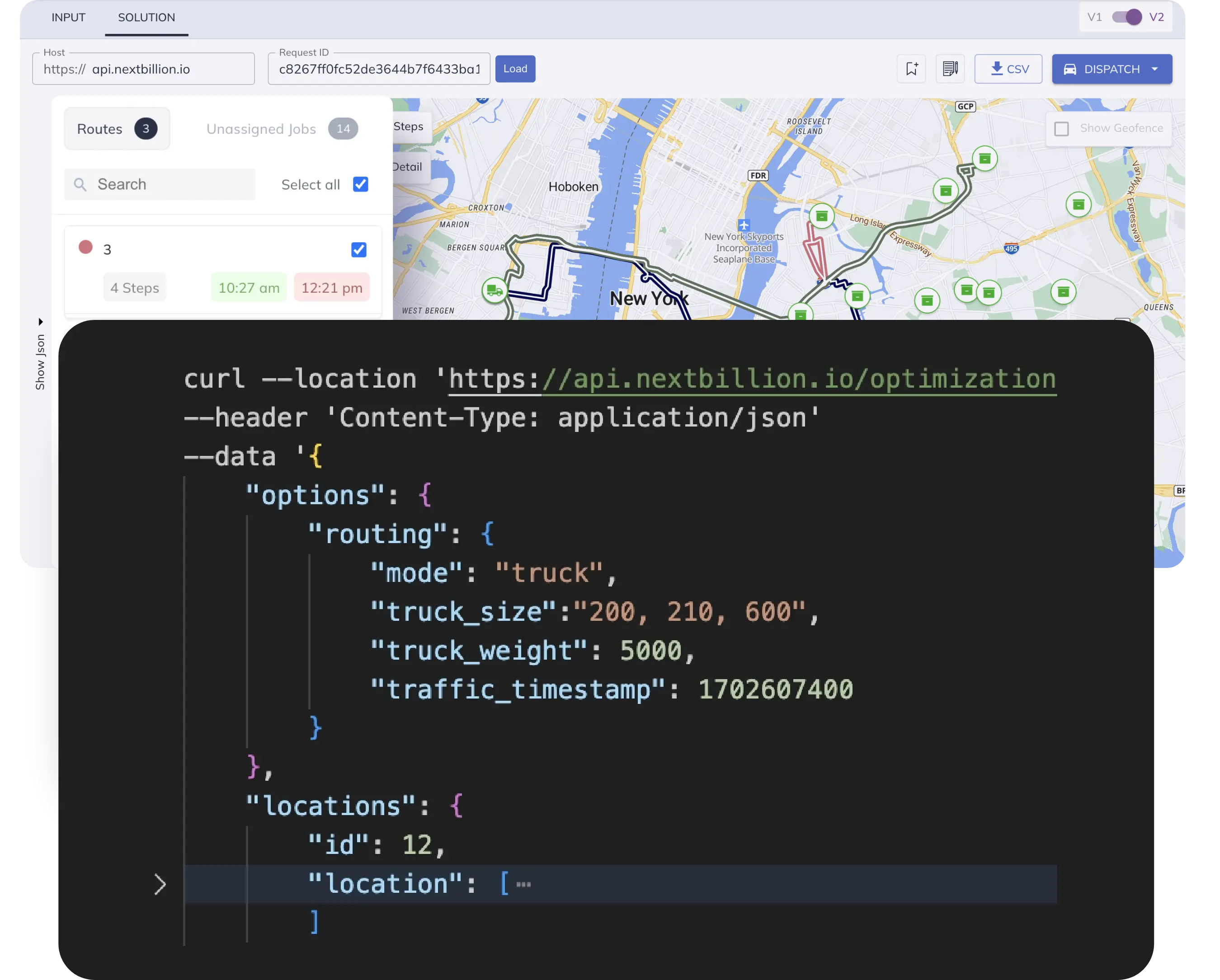
NextBillion.ai enables businesses to build routing and optimization workflows around their fleet profiles, operating constraints, service areas, and local access requirements.
Using customizable routing capabilities, fleet operators can:
- Model low- and zero-emission zone boundaries
- Restrict specific vehicle types from entering regulated areas
- Assign eligible vehicles to deliveries within LEZs and ZEZs
- Avoid restricted roads or zones when required
- Incorporate access charges and other custom costs into route calculations
- Coordinate electric and combustion vehicles across mixed fleets
- Plan around delivery time windows, vehicle capacities, depot locations, battery range, and driver constraints
- Create private maps for industrial sites, gated communities, and other delivery environments not accurately represented on standard maps
- Compare alternative fleet configurations and urban fulfilment strategies
Rather than managing emission-zone compliance as a separate manual task, businesses can incorporate vehicle eligibility, access restrictions, and zone-related costs directly into the route-planning process.
This helps planners generate routes that are efficient, operationally feasible, and aligned with local access requirements.
Preparing for the Transition from LEZs to ZEZs
For many cities, low-emission zones are part of a broader transition towards stricter zero-emission access policies. Fleet operators should therefore treat LEZ compliance as an important step in a longer-term fleet transformation, not as the final objective.
Businesses can begin preparing by:
- Mapping current and planned LEZs and ZEZs across their operating regions
- Auditing vehicles by fuel type, emissions standard, age, and zone eligibility
- Identifying routes and customers that regularly require entry into regulated areas
- Tracking access charges, exemptions, enforcement rules, and penalties
- Testing electric vehicles on routes suited to their range and payload capabilities
- Assessing charging infrastructure, depot capacity, and vehicle dwell times
- Exploring micro-hubs, urban consolidation centres, and consolidated delivery models
- Incorporating access restrictions into dispatch and route-planning workflows
- Monitoring regulatory changes across every city in which the fleet operates
- Modelling different fleet-transition scenarios before making major investments
A phased, data-led approach allows organisations to evaluate operational requirements before committing to large-scale vehicle or infrastructure investments. It can reduce transition risk while helping fleets remain prepared for increasingly stringent urban access requirements.
Conclusion
The difference between Low-Emission Zones and Zero-Emission Zones is clear: LEZs restrict the most polluting vehicles, while ZEZs prioritise vehicles that produce no emissions at the point of use. However, complying with these regulations across complex commercial fleet operations is not always straightforward.
NextBillion.ai helps logistics companies incorporate emission-zone restrictions into their route-planning and optimization workflows. Using vehicle-specific routing, custom avoidance zones, operating-hour restrictions, vehicle capacities, access costs, and other real-world constraints, businesses can generate routes suited to both regulatory and operational requirements.
The platform also enables fleets to assign compliant vehicles to restricted areas, coordinate electric and combustion vehicles, plan charging-aware routes, and support multi-depot or micro-hub delivery models. Instead of managing regulations through static maps and manual checks, operators can account for relevant zone requirements directly during route planning.
With NextBillion.ai , logistics companies can reduce compliance risks and avoidable access costs while maintaining delivery efficiency, helping them prepare for the transition towards zero-emission urban logistics.
Ready to get started?
Request a DemoTable of Contents
Subscribe to our Newsletters
Get the best practices for route planning & optimization, delivered to your inbox.
Subscribe