
Scaling MCP Integrations for High-Volume Routing and Location Data Workloads

Scaling MCP Integrations for High-Volume Routing and Location Data Workloads

Published: November 21, 2026

AI agents are rapidly evolving from conversational assistants into operational coordinators assigning drivers, validating delivery zones, comparing fulfillment facilities, sequencing service visits, and explaining route trade-offs in real time. Yet an AI agent can only make dependable operational decisions if it has direct, reliable access to accurate location intelligence at production scale.

This is where the Model Context Protocol (MCP) becomes a strategic differentiator. MCP gives AI applications a standardized way to discover and invoke external tools, while NextBillion.ai MCP exposes enterprise-grade location capabilities including geocoding, place search, road-network routing, distance matrices, isochrones, and static maps, as callable tools for AI agents.

For product, engineering, and operations leaders running high-volume routing workloads, however, “it works in a demo” is not a production strategy. When you are evaluating how to move AI agents into core operations, the real questions are architectural and commercial:

  • Can your MCP integration handle tens of thousands of geocodes and multi-origin distance matrices without latency spikes?

  • How do you prevent an AI agent from generating routes that violate commercial truck restrictions, driver shift rules, or customer time windows?

  • How do you govern API fan-out, auditability, and unit economics as agent adoption scales across dispatch, customer support, and planning teams?

This guide is designed for teams evaluating production MCP architectures for location intelligence. It breaks down the failure modes of naive MCP implementations, compares generic mapping wrappers against enterprise routing engines, and outlines how NextBillion.ai provides the deterministic backbone required to scale agentic location workflows.

What is MCP in a Location-Intelligence Context?

Model Context Protocol (MCP) is an open standard that connects AI models and agent frameworks with external tools, data sources, and enterprise systems through a unified interface. Instead of writing bespoke glue code, custom schemas, and individual authentication wrappers for every AI client or internal copilot, engineering teams expose capabilities once via an MCP server. Any MCP-compatible client can then discover and execute those tools at runtime.
MCP
In a location-intelligence context, MCP acts as the connective layer between an AI agent’s reasoning loop and the geospatial engines that model the physical world:

  • Geocoding: Converts unstructured addresses or place descriptions into precise latitude/longitude coordinates.

  • Reverse Geocoding: Translates raw GPS coordinates from telematics or mobile devices into human-readable street addresses.

  • Place and POI Search: Discovers businesses, landmarks, facilities, and stops including points of interest along a specific route corridor.

  • Routing: Calculates optimal paths across a real-world road network based on vehicle profiles and traffic conditions.

  • Distance Matrices: Computes travel times and distances across many-to-many origin and destination pairs simultaneously.

  • Isochrones: Identifies geographic polygons reachable within a specific travel-time or distance threshold.

  • Static Maps: Generates visual map snapshots of routes, stops, and service zones for human verification or customer notifications.

The critical architectural distinction is that MCP is not merely a thin API wrapper. It provides a governed, reusable integration surface. Once location capabilities are exposed through NextBillion.ai’s MCP server, multiple AI applications from a dispatcher copilot in Claude or Cursor to a custom internal operations agent can discover and consume the exact same schemas, business guardrails, and routing logic.

Why High-Volume Location Workloads Break Naive MCP Setups

Making a single location API call inside an agent prototype is trivial. Scaling that interaction across a live enterprise operation is an entirely different engineering challenge.

Consider a last-mile delivery or field-service organization processing 50,000 orders per day. A single order lifecycle may require geocoding the customer address, verifying service-territory eligibility, querying a distance matrix across 15 regional hubs, building a multi-stop route constrained by vehicle weight and customer time windows, generating accurate ETAs, and dynamically re-optimizing when a driver hits unexpected congestion or a customer cancels mid-shift.

At low volume, a simple request-response loop works. At enterprise volume, teams run into seven compounding bottlenecks:

  • Address Quality & Ambiguity: Incomplete or non-standard addresses (like rear loading docks) produce poor geocodes, leading to failed deliveries, missed SLAs, and wasted miles.

  • Request Fan-Out: Single natural-language prompts trigger dozens of sequential API calls, compounding latency and driving up token and API costs.

  • Dynamic Real-World Conditions: Live traffic, closures, weather, and mid-day cancellations quickly invalidate static routes calculated hours earlier.

  • Complex Operational Constraints: Ignoring time windows, vehicle dimensions, hazmat rules, or shift limits turns a mathematically “short” route into a physically or legally impossible path for commercial fleets.

  • Agent Hallucination & Tool Misuse: LLMs selecting wrong tools, passing malformed coordinates, or estimating ETAs with straight-line math erodes dispatcher and customer trust.

  • Security & Governance: Scattered API keys, permissions, and audit trails across agent workflows increase security risks and prevent accurate cost attribution.

  • Concurrency Under Peak Load: Simultaneous optimization spikes during morning dispatches or flash sales degrade response times, delaying fleet departures and hurting customer experience.

These pressures are most acute in logistics, last-mile delivery, field service, fleet management, and on-demand mobility, where every routing decision directly impacts margin per stop and SLA compliance.

Consumer Mapping Wrappers vs. Enterprise Routing Platforms

When evaluating MCP integrations for location workloads, many engineering teams start by wrapping a standard consumer mapping API such as Google Maps or Mapbox in a basic MCP server. While that approach works for simple store locators or basic point-to-point directions, it quickly hits a ceiling in commercial operations.

  • Primary Design Focus: Generic APIs focus on consumer navigation and passenger vehicles, whereas NextBillion.ai is built for high-volume commercial fleets, logistics, field service, and mobility.

  • Constraint Modeling: Generic APIs offer only basic avoidances (tolls, highways, ferries), while NextBillion.ai supports 50+ enterprise routing constraints, including multi-dimensional capacity (weight, volume, pallets), axle load, truck height, and driver shift rules.

  • Multi-Stop Optimization: Generic APIs have limited waypoint caps and lack deep combinatorial optimization, whereas NextBillion.ai provides an industrial-grade engine built for thousands of stops, mixed fleets, and complex pickup-and-delivery dependencies.

  • Re-Optimization: Generic APIs require rebuilding routes from scratch, disrupting driver workflows, while NextBillion.ai uses stateful re-optimization to insert new orders or handle delays while preserving existing route stability.

  • Custom Map Data: Generic APIs lock you into proprietary global map layers, whereas NextBillion.ai supports custom road networks, private facility roads, custom speed profiles, and proprietary territory boundaries.

  • Cost Predictability at Scale: Generic APIs rely on per-request pricing that spikes sharply with high fan-out matrix and optimization calls, while NextBillion.ai offers flexible enterprise pricing engineered for high-frequency distance matrices and continuous optimization.

For organizations comparing solutions in the consideration stage, the takeaway is clear: an MCP server is only as capable as the geospatial engine behind it. If your underlying routing engine cannot model commercial vehicle constraints or re-optimize dynamically, wrapping it in MCP simply allows an AI agent to generate infeasible plans faster.

The Core Architectural Question: What Should MCP Own?

A scalable MCP architecture does not put deterministic business logic or mathematical optimization inside the Large Language Model (LLM). Instead, it uses MCP to give the AI agent a clean, controlled interface to specialized engines while keeping deterministic computation, business rules, and data governance in their proper layers.

Architectural Layer

Core Responsibility

Concrete Examples

AI Agent (Reasoning Layer)

Interpret natural-language intent, select appropriate tools, synthesize structured outputs, and explain trade-offs

“Identify which regional depot can fulfill this urgent cold-chain order before 2:00 PM.”

MCP Server (Interface Layer)

Expose location capabilities through standardized, strongly typed tool schemas and runtime discovery

geocode_forward, distance_matrix, directions, isochrone, static_route_map

Location Platform (NextBillion.ai)

Execute high-throughput, deterministic geospatial computation and combinatorial optimization

Road-network routing, truck-restricted ETAs, multi-origin matrices, 50+ constraint optimization

Application & Business Logic

Enforce company-specific policies, inventory checks, and workflow orchestration

Verifying warehouse stock, checking driver union break rules, triggering approval workflows

System of Record (Data Layer)

Maintain authoritative state for operational entities

Orders, customer SLAs, vehicle specs, driver schedules, depot coordinates

Observability & Governance

Track latency, token/API spend, tool accuracy, permissions, and audit trails

OpenTelemetry traces, role-based tool access, human-in-the-loop approval logs


This separation of concerns is non-negotiable in production. An LLM should never estimate travel times, guess whether a 40-ton truck can cross a bridge, or manually sequence 80 delivery stops. The agent’s role is to translate operational intent into structured tool calls, let NextBillion.ai compute the exact geospatial truth, and present validated, explainable recommendations to operators or downstream systems.

Deep Dive: What High-Volume Routing and Location Workloads Actually Require

In enterprise operations, “high volume” is rarely just a high QPS (queries per second) metric. It is a measure of decision density, meaning how many interdependent spatial calculations must occur accurately within a tight operational window.

Geocoding at Scale: Moving Beyond Raw Coordinates

Geocoding is the entry point for almost every location workflow and the most common source of silent downstream failure. Customers type “Suite 4B, behind the old mill on Main,” order management systems pass legacy postal codes, and GPS pings drift into adjacent alleyways.

At scale, teams need confidence scores and deterministic fallbacks, not just a pair of coordinates. A production geocoding pipeline using NextBillion.ai MCP should incorporate:

  • Pre-geocoding normalization: Standardizing street suffixes, unit numbers, and regional formats before invoking the tool.

  • Match-quality and confidence scoring: Evaluating whether a result matched to a rooftop, street segment, or postal centroid and routing low-confidence results to an exception queue.

  • Reverse geocoding for telematics: Converting real-time driver GPS breadcrumbs into verifiable street locations for proof-of-delivery and arrival detection.

  • Deterministic caching: Storing verified rooftop coordinates for recurring customer addresses and depots to eliminate redundant API calls.

Routing Under Real-World Operational Constraints


A route that looks optimal on a consumer map often fails on the road. A commercial box truck may encounter a low-clearance underpass, a weight-restricted residential zone, a gated loading dock with strict receiving hours, or a driver nearing maximum legal driving hours.
route optimiztion api
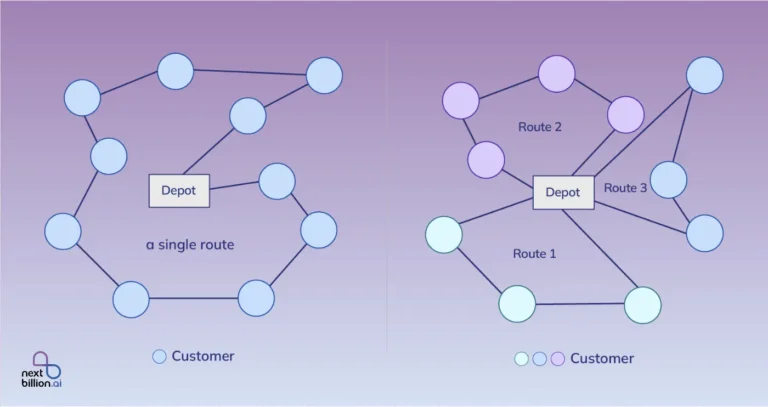
NextBillion.ai’s Route Optimization engine is purpose-built for these constraints, supporting multi-dimensional capacity (weight, volume, pallets, item counts) and more than 50 operational routing constraints, including:

  • Vehicle-specific profiles: Height, width, length, total weight, axle count, and hazmat classifications.

  • Road and turn restrictions: Avoiding U-turns, left turns across multi-lane traffic, tolls, ferries, or restricted commercial zones.

  • Time-dependent traffic and departure windows: Modeling rush-hour congestion profiles rather than static free-flow speeds.

  • Hard and soft time windows: Balancing strict customer appointment slots against overall fleet efficiency.

  • Driver shift and break rules: Enforcing shift start/end locations, mandatory rest breaks, and overtime thresholds.

When exposed to AI agents via MCP, the agent does not need to hard-code these rules into its prompt. It simply passes the relevant vehicle profile and constraint parameters to NextBillion.ai’s routing tools, guaranteeing that every recommended route is physically and legally executable.

Distance Matrices and Isochrones for Rapid Triage

Many operational decisions are comparative rather than sequential. Dispatchers and automated workflows constantly ask:

  • “Which of our 25 field technicians can reach this emergency repair site fastest?”

  • “Which fulfillment center offers the lowest drive-time cost for this order?”

  • “Which customers fall within a 30-minute cold-chain delivery radius of our new micro-hub?”

Using straight-line (Haversine) distance for these decisions produces severe errors: two points three miles apart across a river or highway interchange may require a 25-minute drive.

By equipping AI agents with NextBillion.ai’s Distance Matrix and Isochrone tools, agents can evaluate true road-network travel times across hundreds of origin-destination pairs in a single call, or generate exact drive-time polygons to validate serviceability before promising a delivery slot to a customer.
Inside NextBillion.ai MCP: Capabilities Built for Agentic Workflows

NextBillion.ai MCP connects AI agents directly to production geospatial APIs, eliminating custom function-calling schemas with a unified suite of out-of-the-box tools:

  • Geocoding & Search (geocode_forward, geocode_reverse, place_search, search_along_route): Validate addresses, translate vehicle telematics, and find nearby depots or compliant stops along active routes.

  • Routing & Matrix (directions, distance_matrix): Calculate commercial-vehicle ETAs and many-to-many travel times to dispatch the closest drivers.

  • Zones & Visuals (isochrone, static_route_map): Define SLA coverage polygons and render visual route maps for alerts or dispatcher copilots.

Why It Accelerates Scaling

  • Build Once, Reuse Everywhere: Power dispatcher assistants, customer bots, and exception pipelines from a single server that automatically inherits API upgrades without schema rewrites.

  • Composable Workflows: Consistent data structures let agents seamlessly chain tasks like geocoding an address,scoring nearby drivers, routing the best match, and generating a map preview in one step.

Four Proven Architecture Patterns for Production MCP Deployments

Organizations successfully scaling MCP location workloads rarely deploy fully autonomous “black-box” agents on day one. Instead, they adopt structured architectural patterns that match the risk profile and latency requirements of each workflow.

Pattern 1: Agent-Assisted Dispatch Copilot


In high-stakes dispatch environments, speed and explainability are paramount. A dispatcher interacts with an AI copilot via natural language to resolve urgent exceptions while retaining final sign-off authority.

  1. Trigger: A dispatcher asks: “Driver 14’s van just broke down. Who can absorb their remaining six priority stops before 5:00 PM?”

  2. State Retrieval: The agent queries the fleet management system for active nearby vehicles, current capacities, and remaining shift hours.

  3. Spatial Evaluation: The agent invokes NextBillion.ai MCP’s distance_matrix and directions tools to calculate detour times and verify time-window feasibility for each candidate driver.

  4. Recommendation & Approval: The copilot presents the top two reassignment options alongside updated ETAs and a static_route_map visual. The dispatcher clicks Approve to push the updated manifest to the driver’s mobile app.

Pattern 2: Automated Morning Pre-Processing with Exception Triage


For scheduled delivery and field-service operations, MCP workflows can run overnight or early morning to prepare daily plans and isolate anomalies before human planners arrive.

  • Every morning at 5:00 AM, an orchestration pipeline ingests new orders and uses NextBillion.ai MCP tools to geocode addresses, validate isochrone territory boundaries, and generate baseline route plans.

  • Orders with low geocode confidence, missing apartment numbers, or impossible time-window combinations are automatically flagged into a priority exception queue.

  • Dispatchers spend their morning resolving the 5% of edge cases rather than manually building 100% of the routes.

Pattern 3: Event-Driven Dynamic Re-Optimization

Real-world operations are volatile: traffic spikes, orders cancel, and urgent VIP requests arrive mid-day. Event-driven architectures connect streaming operational events (via Kafka, webhooks, or message queues) to MCP-enabled agents.

  • When a high-priority order arrives or a vehicle reports a 30-minute delay, an event triggers a scoped agent workflow.

  • The agent evaluates affected routes using NextBillion.ai’s re-optimization capabilities, recalculating stop sequences and ETAs without unnecessarily reshuffling drivers who are already on track.

  • Downstream systems automatically notify impacted customers if their delivery window shifts.

Pattern 4: Location-Aware Customer Experience Agents

Customer support chatbots often frustrate users because they lack real-world spatial awareness, offering generic “your package is in transit” responses.

  • By connecting customer-facing AI assistants to read-only NextBillion.ai MCP tools (directions, isochrone, geocode_forward), brands can let customers check real-time delivery eligibility, reschedule deliveries into valid neighborhood time slots, and receive accurate, traffic-adjusted ETAs grounded in live routing data.

Performance & Cost Optimization for High-Volume Workloads

At thousands of workflows per hour, unoptimized MCP integrations can suffer from unnecessary latency and inflated API bills. Engineering teams should apply four core optimization patterns:

  1. Tiered Caching with Freshness Policies: Cache static spatial entities such as verified customer rooftop geocodes, depot coordinates, and static service-zone polygons with long TTLs (time-to-live). Conversely, apply short TTLs (e.g., 2–5 minutes) or bypass caching entirely for traffic-sensitive ETAs and live route calculations.

  2. Matrix Batching Over Sequential Loops: Never allow an AI agent to loop through 30 individual directions calls to find the closest driver. Instruct the agent and enforce via tool schemas to use a single distance_matrix call to evaluate all 30 candidates simultaneously, reducing network overhead and latency by an order of magnitude.

  3. Asynchronous Execution for Heavy Optimization: Interactive copilot queries require sub-second to 2-second responses. Overnight route optimization across 5,000 stops and 200 vehicles should run asynchronously: the MCP tool submits the optimization job, returns a job_id, and polls or listens for a webhook completion event before presenting results.

  4. Workload Isolation: Separate interactive dispatch traffic from bulk batch-planning pipelines using distinct API keys, rate-limit pools, and worker queues so an overnight re-planning spike never degrades live customer or dispatcher responsiveness.

Vendor Evaluation Checklist: Choosing an MCP Location Partner

If your organization is actively comparing location platforms to power your AI agents, use this checklist to evaluate production readiness beyond surface-level MCP compatibility:

  1. Comprehensive Geospatial Coverage: Does the platform natively expose geocoding, reverse geocoding, POI search, route search, directions, distance matrices, isochrones, and static maps through a unified MCP server?

  2. Enterprise Constraint Depth: Can the underlying routing engine enforce commercial truck dimensions, weight limits, multi-dimensional load capacities, driver shift rules, and custom time windows?

  3. Dynamic Re-Optimization: Can the platform incrementally update active routes when mid-day disruptions occur without scrambling unaffected drivers?

  4. Custom Map & Data Ingestion: Can you incorporate private facility roads, proprietary speed data, or custom territory polygons into your routing calculations?

  5. High-Concurrency Throughput: Are the underlying APIs engineered to handle peak dispatch bursts and large many-to-many distance matrices with predictable low latency?

  6. Governance & Security Posture: Does the architecture support server-side secret management, granular tool scoping, and full request auditability?

  7. Transparent Unit Economics: Does the pricing model scale predictably as your agent workflows grow in stop volume and matrix complexity?

  8. Enterprise Implementation Support: Does the vendor provide solution architects and technical onboarding to help tune constraints and validate production accuracy?

How NextBillion.ai Powers Production MCP Location Workloads

NextBillion.ai is purpose-built for organizations embedding high-precision routing and location intelligence into operational software and AI-driven workflows. Rather than retrofitting consumer navigation tools for commercial use, NextBillion.ai combines an API-first geospatial architecture, an enterprise Route Optimization engine, and a production-ready MCP server.

Why Engineering and Operations Leaders Choose NextBillion.ai 

  • Built for Operational Complexity: NextBillion.ai supports multi-dimensional capacity constraints, over 50 specialized routing rules, mixed-fleet modeling, and stateful re-optimization ensuring AI agents generate plans your fleet can actually execute.

  • Seamless MCP Integration: With NextBillion.ai MCP, engineering teams can connect AI agents in Claude, Cursor, Windsurf, or custom LangGraph/Agentic frameworks directly to NextBillion.ai’s location suite in minutes, while retaining full control over business logic and approval workflows.

  • Customizable to Your Operational Reality: From custom map layers and private road networks to tailored speed profiles and territory definitions, NextBillion.ai adapts to your physical operations rather than forcing your fleet into generic map assumptions.

A Phased Roadmap from Pilot to Production Scale

To minimize operational risk while proving ROI quickly, follow a five-stage rollout:

Phase 1: Scope One High-Value Operational Workflow

Select a single, measurable workflow such as automated technician assignment, address serviceability validation, or dispatcher exception handling. Define baseline KPIs (e.g., dispatch decision time, ETA accuracy, or cost per delivery) before writing code.

Phase 2: Connect and Configure NextBillion.ai MCP


Deploy the NextBillion.ai MCP server in a secure server-side environment and connect it to your target agent client. For local development and testing, you can initialize the server via
npx:

Bash

NBAI_API_KEY=YOUR_SECURE_KEY npx -y nextbillion-mcp

Verify that your agent can discover the core location tools (geocode_forward, directions, distance_matrix, isochrone, static_route_map) and inspect their input schemas.

Phase 3: Build a Scoped, Deterministic Workflow


Start with a tightly constrained workflow, for example, taking an incoming order address and three candidate fulfillment centers, geocoding the destination, running a distance matrix, and recommending the fastest facility with a visual static map.

Phase 4: Layer Business Guardrails and Human Approval

Integrate your internal business rules (inventory availability, driver shift limits, SLA windows) and enforce mandatory human confirmation before any recommendation triggers a live dispatch or customer notification.

Phase 5: Load-Test, Instrument, and Scale

Test the end-to-end pipeline against historical production data including messy addresses, peak-hour concurrency, and multi-stop vehicle constraints. Instrument latency, geocode confidence rates, tool-selection accuracy, and per-workflow API spend before expanding to additional operational teams.

Conclusion: Moving from AI Demos to Dependable Scale

Scaling MCP integrations for high-volume routing and location workloads requires balancing AI flexibility with geospatial determinism. AI agents excel at interpreting complex operational requests, coordinating multi-step workflows, and explaining trade-offs, but they must never be left to guess travel times, ignore truck restrictions, or improvise delivery schedules.

By pairing the open interoperability of the Model Context Protocol with NextBillion.ai’s enterprise routing, distance matrix, and location intelligence platform, product and engineering leaders can move beyond fragile prototypes and deploy AI agents that drive measurable efficiency across every mile.

Ready to Scale Your Location Workloads?

If your team is evaluating MCP for routing, dispatch, delivery, field service, or mobility workloads, start with a controlled pilot:

  • Connect NextBillion.ai MCP to one high-value workflow.

  • Test it with production-like addresses and operational constraints.

  • Measure latency, accuracy, exception rates, and cost.

  • Add human approval for high-impact actions.

  • Expand only after the workflow proves reliable at scale.

NextBillion.ai’s MCP server, location APIs, and route-optimization capabilities provide a foundation for building AI applications that understand not only what needs to happen, but where and how it can happen. Don’t let fragile prototypes slow down your production roadmap – book a demo with NextBillion.ai today to scope your pilot and validate your routing constraints at scale.

About Author

Prabhavathi Madhusudan

Prabhavathi is a technical writer based in India. She has diverse experience in documentation, spanning more than 10 years with the ability to transform complex concepts into clear, concise, and user-friendly documentation.

Ready to get started?

Table of Contents