


Route Optimization API
Optimize routing, task allocation and dispatch
Distance Matrix API
Calculate accurate ETAs, distances and directions
Directions API
Compute routes between two locations
Navigation API & SDK
Turn by Turn Instructions for Drivers & Technicians
Route Optimization Software
Plan optimized routes with 50+ Constraints
Product Demos
See NextBillion.ai APIs & SDKs In action
AI Route Optimization
Learns from Your Fleet’s Past Performance
Platform Overview
Learn about how Nextbillion.ai's platform is designed
Road Editor App
Private Routing Preferences For Custom Routing
On-Premise Deployments
Take Full Control of Your Maps and Routing
About Us
Our story, vision
and mission
Contact Us
Reach out to us for any product- or media-related queries
Write to us at

Table of Contents
If routing is already handled by software, why do deliveries still miss time windows, drivers exceed working hours, and fleets waste fuel correcting plans throughout the day? The assumption that routes automatically become efficient once mapped is one of the most common misconceptions in logistics. AI-driven route optimization addresses this misconception by transforming routing into a system-level decision process.
In this guide, understand how companies use AI to optimize routes in practice. Let’s learn more:
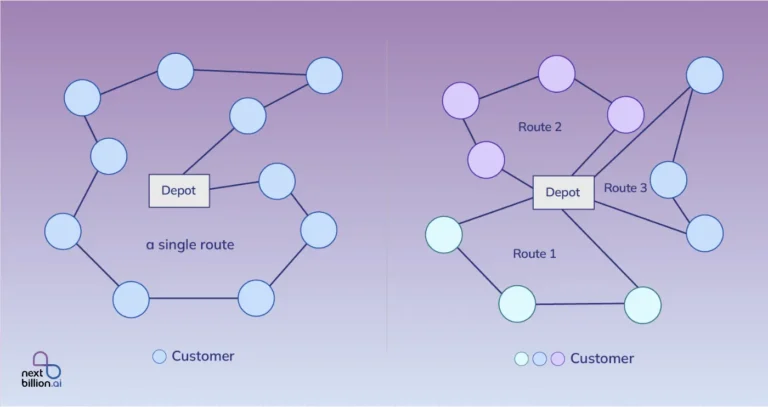
AI route optimization is an advanced planning field where computational intelligence is applied to optimize delivery route planning by combining assignments, sequences, schedules, and constraints to an entire fleet prior to actual implementation. It represents the routing process as a high-dimensional decision space in which vehicle capacities, time windows, labor regulations, geography, costs, and service priorities interact, instead of treating routing as a point-to-point problem. Through search, exploration, and pruning of large sets of potential plans, AI generates routes that are provably possible, resistant to variability, and optimized based on business goals, and not on distance or ETA.
Here is what AI-driven route optimization means: designing feasible, constraint-aware fleet routes using intelligent planning before navigation begins:
AI-based route optimization is essentially a decision problem and not a routing or navigation problem. The system must determine which routes should exist, which vehicle should serve which stops, in what sequence, and at what time, while simultaneously respecting a large set of operational constraints. Every extra stop, vehicle, or rule increases the number of possible solutions, and exhaustive evaluation cannot be done with any simple search and pruning methods.
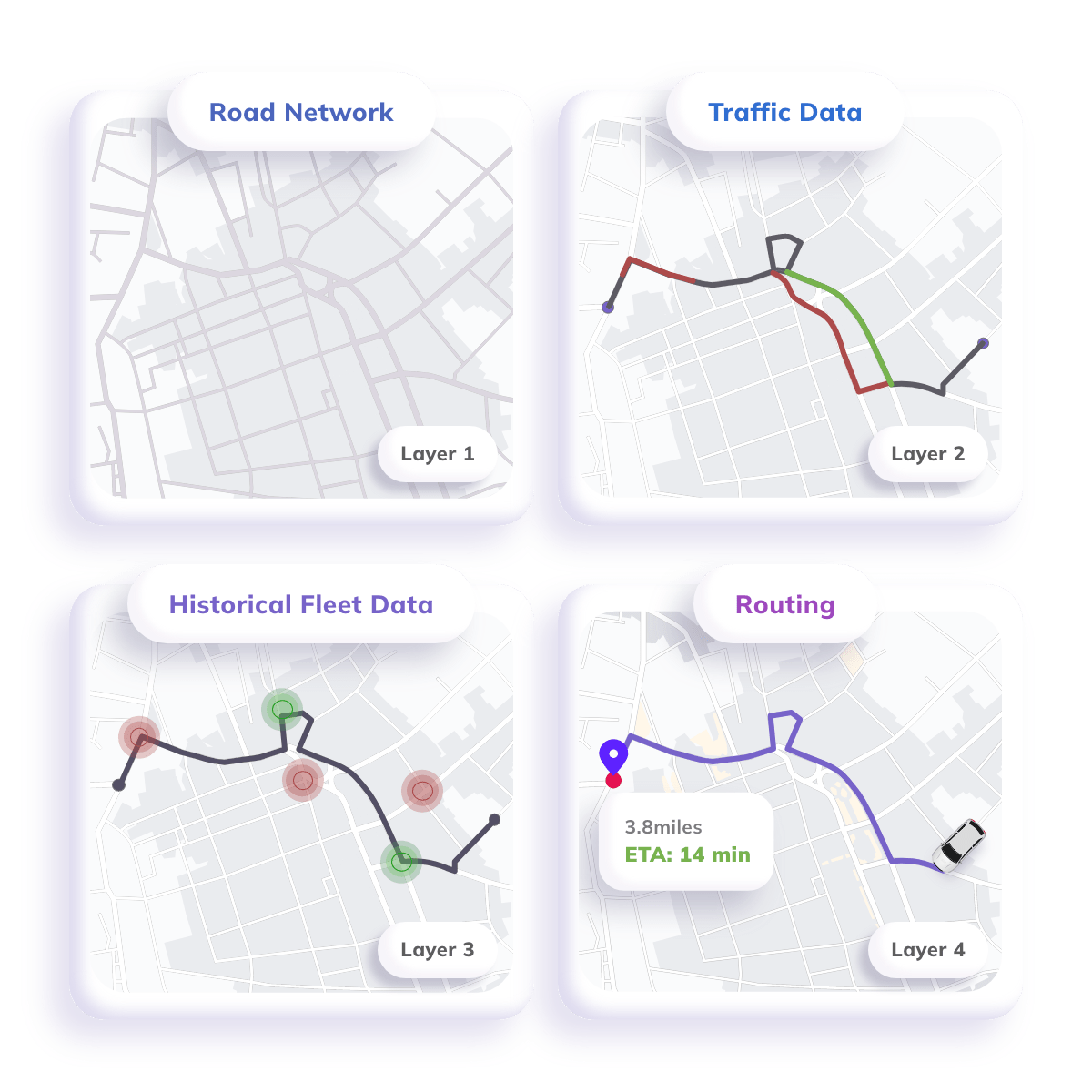
Route optimization problems, including variants of the Vehicle Routing Problem (VRP), belong to a class of NP-hard problems. This implies that the number of solutions that are feasible increases exponentially with the size of the operation. Even a modest fleet with dozens of vehicles and hundreds of stops creates millions to billions of potential route combinations.
Computationally, it becomes impossible to consider all possible assignments and sequences at scale. This is solved by AI optimization engines that selectively search the solution space, discarding infeasible paths early and converging to near-optimal solutions when time and compute resources are limited.
Difference Between Pathfinding and Combinatorial Optimization
Pathfinding provides the solution to the narrow problem: what is the optimal route between two known points, having a cost measure? Combinatorial optimization answers a broader question: What set of paths should exist at all, and how should work be distributed across resources?
Navigation systems are used to find the shortest paths on road graphs. Optimization systems address assignment, sequencing, and scheduling problems with fleets, time horizons, and constraints. The first one is movement optimization, and the second one is decision optimization.
Conventional routing systems are based on the use of fixed rules and heuristic routing. Such methods are effective in controlled conditions, but they deteriorate quickly in the conditions of reality. AI-driven optimization replaces rigid logic with adaptive decision models capable of handling uncertainty, conflicting objectives, and large search spaces.
The rule-based systems presuppose predictable conditions. They capture logic like predetermined delivery areas, distance limits, or stop limits. When traffic fluctuates, orders arrive late, drivers call in sick, or service times vary, these rules either conflict or must be overridden manually. The larger the variability, the larger and weaker the rule sets. The rules eventually become fewer than the exceptions, resulting in inconsistent planning and operational risk.
Heuristics vs Learned Decision-Making
Greedy heuristics are locally optimal, and they include giving the closest stop or the shortest next leg. These approaches are fast, but they do not take into account the downstream effects and route interdependencies.
AI-based optimization considers decisions on a global scale. It is trained to understand the effects of decisions on the results of the fleet, including overall miles covered, SLA adherence, and driver usage. AI does not make early commitments to local improvements; instead balancing trade-offs on a global scale and generates plans that are resistant to changing conditions.

AI route optimization is not a replacement for the existing systems. It is placed at a certain layer within the delivery architecture. It plays the role of coming up with viable, effective plans prior to the commencement of the execution and modifying the plans in a safe manner as circumstances evolve.
Upstream planning decides the route structure: the assignments of stops, the order, the choice of the vehicle, and the schedules. Downstream execution is concerned with turn-by-turn navigation, traffic response, and driver guidance.
AI works on an upstream level, where the decisions are still flexible, and trade-offs can be considered as a whole. Navigation systems work downwards, where decisions are already determined, and only path corrections can be made.
Modern delivery layers divide the responsibilities into three layers:
This isolation enables each element to specialize, scale, and be independent, as well as sustain the stability of the system. The effectiveness of AI-driven optimization lies in the fact that it is planning intelligence, not execution mechanics.
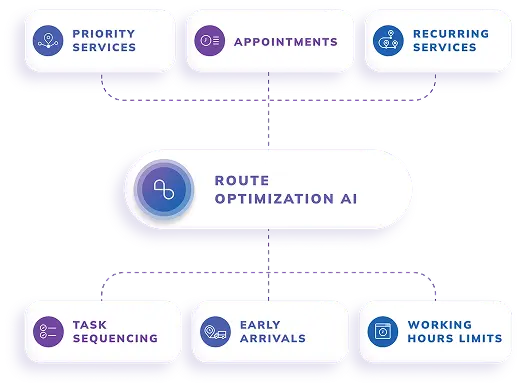
The mechanism of AI route optimization is that it considers several types of constraints at the same time. These constraints are interdependent, i.e., choices cannot be made separately on vehicles, time, drivers, and geography. Rather than solving routes sequentially, AI finds a solution to a combined planning problem in which feasibility, efficiency, and compliance are mutually verified.
The following are some of the significant limitations that AI takes into account to optimize routes.
Vehicle constraints are the restrictions on what each vehicle is capable of performing on a route. These constraints are constantly checked, and routes are constructed and modified by AI.
AI models represent vehicle capacity as a multi-dimensional constraint, as opposed to a single one. All stops have varying capacity requirements in terms of weight, volume, pallet positions, temperature-controlled compartments, and separation of hazardous materials. Vehicle availability and stop limits are also enforced to ensure that no route is overloaded or operationally impractical.
Example: A company has three delivery vans, which have a maximum load of 800 kg each. The number of incoming orders is 2,100 kg, and they consist of fragile and non-fragile products. AI route optimization allocates orders such that no vehicle has surplus capacity, no vehicles transport incompatible types of loads, and the number of stops per van is restricted. This prevents overloads and does not require manual reshuffling when running it.
Time constraints determine whether a route can be executed within operational and customer-defined time boundaries.
AI plans routes by verifying arrival time with delivery windows based on the amassed travel time and service period. Early arrivals bring penalties to waiting, and late arrivals bring SLA violations or unfeasible routes. Depot opening time, loading cut-off, and return deadlines are imposed during the planning process to ensure that routes are not reliant on unavailable facilities.
Example: A delivery operation serves customers with fixed morning and flexible afternoon windows. AI plans early-window stops in advance, assigns service buffers to absorb variability, and ensures vehicles return to the depot before time runs out. This prevents late fines and waiting without adding to the overall route length.
Driver constraints are hard compliance requirements that cannot be corrected after dispatch.
AI models accumulated driving time, on-duty time, required breaks, and shift limits throughout the route schedule. Breaks are explicitly placed in schedules at legally acceptable times and locations. Routes exceeding labor limits at any point are rejected during planning rather than corrected mid-route.
Example: The maximum number of hours a driver can drive is eight, with a mandatory break after four hours. AI introduces a break into the route schedule and adjusts stop sequencing to ensure the route finishes within the shift limit despite delays.
Geographic limitations provide spatial efficiency and operational consistency across the fleet.
AI allocates stops according to service areas, depot proximity, and territory policies. Spatial compactness is applied to ensure vehicles operate in coherent areas, reducing cross-zone overlaps, deadhead mileage, and execution complexity. Shared vehicles, drivers, or depots are centrally coordinated to avoid resource conflicts.
Example: Two vehicles operate from a common depot but serve different territories. AI clustering prevents geographic overlap. It ensures that each vehicle operates within a compact area, reducing total fleet mileage without creating imbalanced workloads.
AI-powered route optimization introduces planning intelligence that goes far beyond fixed routing or rule-based systems. It evaluates constraints holistically, adapts to operational changes, and generates executable plans that scale as business complexity increases.
Below are the core features that define modern AI-driven route optimization.
Dynamic re-optimization enables routes to be recalculated safely when real-life conditions change after dispatch. AI continuously analyzes live vehicle state, completed stops, delays, cancellations, and new order injections. The optimizer modifies plans incrementally without compromising feasibility under capacity, time, and labor constraints. This eliminates cascading violations and minimizes manual intervention during execution.
AI-powered optimizers are designed to handle combinatorial complexity at scale. Whether planning for a small regional fleet or thousands of vehicles across multiple depots, the optimization engine evaluates millions of possible route combinations efficiently. Cloud-native designs allow compute resources to scale dynamically during peak planning windows, maintaining consistent performance as fleet size and stop density increase.
Zone and territory intelligence ensures routes remain geographically consistent and operationally efficient. AI systems understand service regions, geofences, depot territories, and preferred operating zones. Routes are computed to reduce overlap, deadhead travel, and comply with territory ownership rules, creating clearer execution boundaries and more predictable operations.
Advanced AI optimization evaluates cargo in three dimensions rather than relying only on weight or item count. Length, width, height, orientation, stacking rules, and compartment constraints are modeled together to ensure physical feasibility throughout the route. Capabilities supported by platforms like NextBillion.ai help avoid mid-route failures caused by pallet geometry or incorrect load sequencing that traditional capacity checks cannot detect.
AI-powered route optimization sequences tasks based on logical and operational dependencies rather than distance or travel time alone. Pickup-before-delivery rules, service prerequisites, equipment dependencies, or workflow constraints can be applied to task ordering. Implementations similar to those found in NextBillion.ai allow such relationships to be encoded directly into the planning model, producing execution-ready sequences that align with real operational processes.
Rather than maximizing a single metric, AI allows planners to define goal-based preferences aligned with business priorities. Objectives such as reducing total fleet miles, balancing driver workloads, protecting SLA-critical deliveries, or limiting overtime can be weighted and optimized simultaneously. This ensures routing decisions align with strategic KPIs rather than heuristic or distance-based logic.

Here is what AI route optimization delivers in business impact by reducing operating costs, improving delivery reliability, and giving organizations consistent, auditable control over fleet planning decisions.
AI-driven route optimization improves cost efficiency by reducing waste across fuel, labor, and asset utilization simultaneously. AI reduces the total miles travelled by maximizing the allocation of stops and sequencing at fleet scale, as opposed to route-based optimization. This reduces fuel consumption and wear of vehicles directly. Meanwhile, the even distribution of work among vehicles and drivers ensures that there is no overtime on the overloaded routes and no underutilized routes.
Since the issues of capacity, time, and labor are solved in the planning process, organizations do not have last-minute solutions that invariably cost more in terms of detours, long working shifts, and manual reassignments, which are time-consuming and inefficient.
Service reliability improves when delivery plans are feasible by design rather than corrected during execution. AI optimization plans the routes with clear knowledge of the delivery windows, service time, and regulatory restrictions, which greatly boosts on-time arrival rates.
Sequencing and buffer allocation help in high-risk or high-penalty deliveries, and compliance constraints are imposed prior to delivery. Because of this, SLA compliance is predictive rather than reactive, and enforcement of regulatory violations of driver hours or service commitments is avoided, rather than found out once the failure has occurred.
Operational control increases because AI replaces ad hoc decision-making with consistent, system-level planning logic. The amount of manual intervention is minimized because the issues of route feasibility, compliance, and trade-offs are solved algorithmically rather than by time-starved planners.
Routes are explainable and auditable, with each decision in the planning process being traceable to explicit constraints, objectives, and penalties. Such transparency allows the teams to analyze the results, improve policies, and become more efficient over time without disrupting the daily business.
Here is how NextBillion.ai enables AI-driven route optimization by transforming complex delivery constraints into feasible and executable route plans before navigation begins:
NextBillion.ai converts the real-world constraints of operations to a structured planning model prior to the implementation of any route. The vehicle capacities, customer time windows, service time, driver working hours, and business policies are not considered separately but as a combination.
Routes are created only when all constraints are satisfied simultaneously, ensuring feasibility is proven at planning time instead of discovered during execution. This avoids operational failures that normally emerge once the vehicles are on the road.
Instead of considering each route as a problem by itself, NextBillion.ai considers the fleet as a system. Stop assignments, vehicle usage, and depot alignment are planned in such a way that they minimize the total miles, balance the workload, and enhance the utilization of the assets. This global view eliminates overlapping of routes, unequal distribution of drivers, and ineffective coverage of the territory that develops when routing choices are made on a vehicle-to-vehicle basis. The result is systemic efficiency rather than local optimization.
Delivery planning involves competing objectives such as cost, time, service reliability, and compliance. NextBillion.ai uses AI optimization to calculate trade-offs over all these dimensions rather than optimizing over one metric like distance or ETA. The decisions are made on the basis of the priorities in operations so that routes can serve the obligation of service without posing any risk or cost to other parts of the network. This turns routing into a decision framework rather than a rule-based sequence generator.
Delivery conditions rarely remain static after dispatch. NextBillion.ai constantly tracks the execution indicators, including traffic modifications, delays, broken stops, and new order inserts. In the event of disruptions, routes are re-optimized dynamically and without violating the current constraints, such as the number of hours that a driver should work and delivery commitments. This ensures that adjustments improve outcomes without introducing new violations, maintaining operational stability throughout the day.
NextBillion.ai operates upstream of navigation systems by producing optimized, constraint-safe route plans. After the routes have been decided, turn-by-turn directions and real-time responsiveness to traffic can be done with navigation APIs. This stacked architecture enables each system to specialize in its area of strength, planning intelligence of the optimizer, and accuracy of execution of the navigation system, to form a scalable and resilient delivery stack.
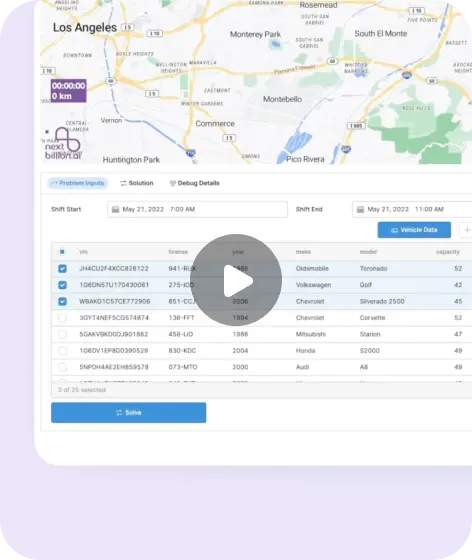
If you want to see these capabilities in action, you can explore them hands-on using the free route planner app here: https://tools.nextbillion.ai/free-route-planner.
The following workflow turns raw delivery requirements into constraint-safe, dispatch-ready plan output by: structuring input, encoding real-world constraints, submitting to the solver, and retrieving optimization results for deployment.
AI-driven route optimization changes routing into a more intelligent planning rather than a straightforward navigation. Companies develop routes that are viable, legal, and expandable in advance by assessing constraints, trade-offs across the whole fleet, and the current state of affairs. This minimizes manual involvement, upgrades on-time delivery, and manages cost as delivery activities become increasingly complex
If you are scaling delivery operations and need routes that remain feasible under real-world constraints, we can help you move beyond navigation-first routing. We will work with you to design AI-driven route optimization that plans fleet-wide decisions before execution begins, reducing cost, improving reliability, and maintaining compliance at scale. Explore how NextBillion.ai helps you turn complex delivery planning into consistent, executable routes.
Companies using AI route optimization typically reduce total fleet mileage by 10-25 percent, which directly lowers fuel consumption and vehicle wear. With platforms like NextBillion.ai, additional savings come from reduced overtime, better asset utilization, and fewer manual replanning efforts, resulting in measurable reductions in overall delivery cost per stop.
Google Maps is not a fleet-wide route optimization tool but a navigation tool. It supports turn-by-turn navigation and traffic-sensitive routing among fixed destinations but does not allocate destinations, apportion workloads, impose capacity limits, or test labor compliance. NextBillion.ai supplements mapping services by performing upstream planning and executing it with the help of navigation APIs.
Yes. Large enterprises are not the only ones who can use AI route optimization. Small and mid-sized fleets benefit from reduced manual planning effort, fewer missed delivery windows, and improved cost control.
Yes. NextBillion.ai assists in dynamic re-optimization of same-day orders, delays, and route disruptions by comparing them to the live fleet state. New deliveries are inserted only when they are viable under capacity, time, and compliance requirements, and changes are made to improve outcomes without disrupting existing routes.
The majority of AI route optimization systems can be deployed in a few weeks in an incremental manner. Initial implementation is usually done through route planning and simulation and then more closely integrated with order systems, navigation systems, and driver processes as operational requirements increase.
Bhavisha Bhatia is a Computer Science graduate with a passion for writing technical blogs that make complex technical concepts engaging and easy to understand. She is intrigued by the technological developments shaping the course of the world and the beautiful nature around us.