


Route Optimization API
Optimize routing, task allocation and dispatch
Distance Matrix API
Calculate accurate ETAs, distances and directions
Directions API
Compute routes between two locations
Navigation API & SDK
Turn by Turn Instructions for Drivers & Technicians
Route Optimization Software
Plan optimized routes with 50+ Constraints
Product Demos
See NextBillion.ai APIs & SDKs In action
AI Route Optimization
Learns from Your Fleet’s Past Performance
Platform Overview
Learn about how Nextbillion.ai's platform is designed
Road Editor App
Private Routing Preferences For Custom Routing
On-Premise Deployments
Take Full Control of Your Maps and Routing
About Us
Our story, vision
and mission
Contact Us
Reach out to us for any product- or media-related queries
Write to us at

Table of Contents
Fuel costs remain one of the biggest operational expenses for fleet businesses, and small inefficiencies can quickly become expensive at scale. Extra mileage, traffic delays, unnecessary idling, and poor route planning may seem minor, but across hundreds of vehicles, they significantly increase fuel consumption and operating costs.
Modern fleet operations need more than fuel tracking. Fuel management software combined with route optimization uses real-time GPS, telematics, and traffic intelligence to reduce waste, optimize routes, and improve efficiency.
Read this blog to understand how fuel management software helps organizations cut costs through smarter route optimization in 2026.
Quick Answer: Fuel management software cuts fleet fuel costs by combining fuel tracking with route optimization, GPS, telematics, traffic data, and real-time dispatch insights. It reduces unnecessary mileage, idle time, poor stop sequencing, repeated trips, and inefficient vehicle assignments.
Key Insights
Moves fuel management beyond expense tracking into fleet intelligence.
Reduces mileage, traffic delays, idle time, and route overlap.
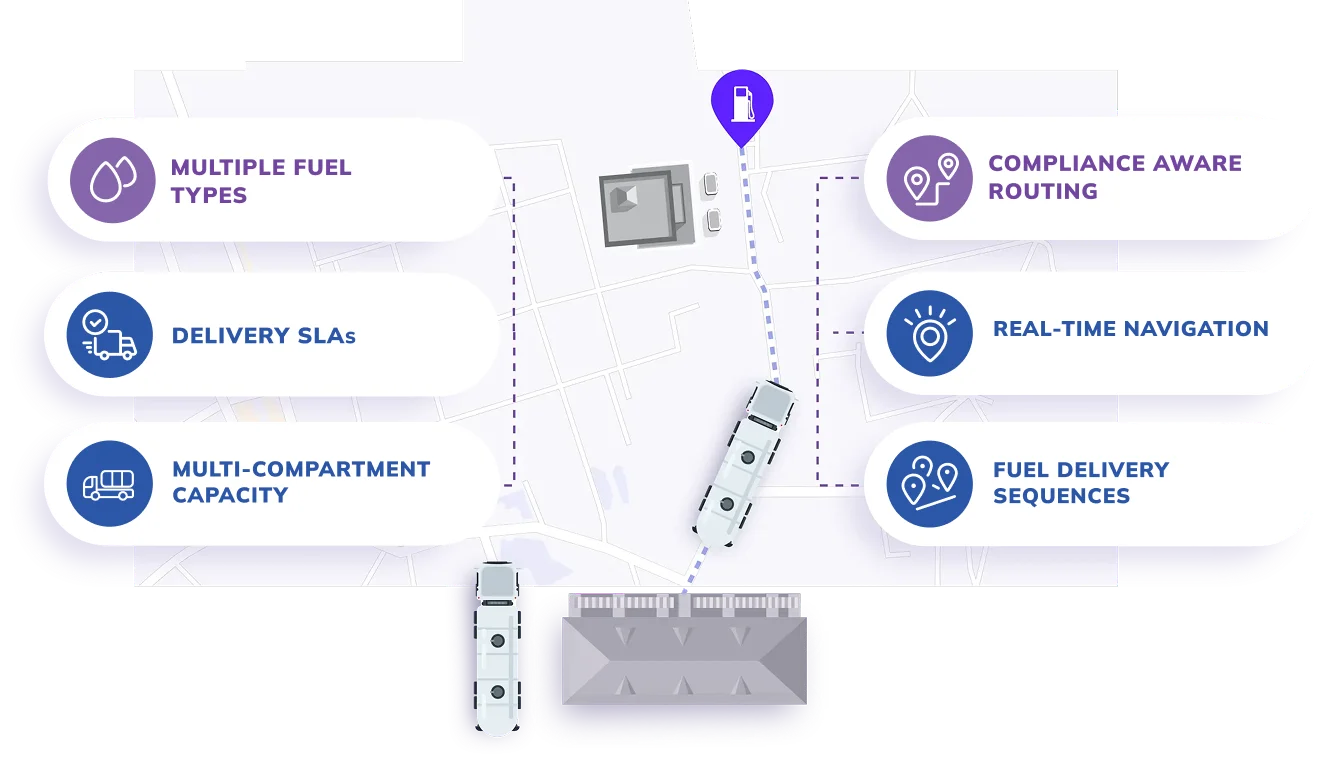
Fuel management software is a fleet intelligence software that measures, analyzes, and optimizes the fuel usage in a vehicle based on real-time operational information. It combines GPS monitoring, telematics, onboard diagnostics (OBD), fuel sensors, route planning, and analytics to gather information, including fuel consumption, mileage, idle, vehicle health, driver behavior, and route movement. Through continuous processing of this information, the software can detect fuel inefficiencies, unusual consumption behaviors, unauthorized use, and aid route optimization plans.
Here are the most prominent features and measurable benefits that modern fuel management software offers to improve fuel efficiency, reduce operational costs, and support smarter fleet decision-making.
Fuel management software constantly monitors fuel consumption through telematics systems, fuel sensors, GPS devices, and onboard diagnostics. Live tracking provides fleet managers with insight into consumption patterns at the vehicle level, route level, and driver level. Organizations can identify excessive usage patterns, compare fleet performance, detect inefficiencies early, and make quick operational decisions before fuel waste becomes significant.
Route optimization engines consider the travel distance, road networks, traffic conditions, delivery windows, stop sequencing, vehicle constraints, and priorities in operations to produce fuel-efficient routes. Instead of using fixed route planning, the current systems keep on optimizing the route based on the real-time operational inputs. The decrease in mileage and the number of route inefficiencies leads directly to decreased fuel costs and an increase in fleet productivity.
Idling also wastes fuel, which is not needed to generate output. The fuel management software keeps tracking the engine-on idle time, stop time, and waiting time throughout the fleet operations. The operations teams can spot inefficiencies that occur regularly, implement idling policies, and minimize unnecessary fuel waste in the daily movement of vehicles.
Driver actions significantly influence fuel efficiency. The system tracks driving parameters like overspeeding, rough acceleration, rough braking, deviations, overloading of the engine and aggressive driving habits. The insights of driver performance fetched with the assistance of fuel management software can assist organizations to enhance their fuel consumption. It also promotes safer driving behavior and creates accountability in large fleets.
Stealing of fuel and unauthorized consumption of fuel bring about massive losses in operations. The modern fuel management systems are based on fuel sensors, tank-level sensors, refueling logs and anomaly detection algorithms to detect abnormal decreases in fuel levels or suspicious behavior. Automated alerts assist organizations in investigating discrepancies in a short time and enhance the accountability of fuel
The efficiency of fuel consumption is usually dependent on the state of the vehicles. The fuel management platforms can track engine faults, tire pressure, maintenance warnings, battery health and performance anomalies when integrated with onboard diagnostics systems. Mechanical issues are detected early, helping avoid conditions that increase fuel consumption.
Predictive models are becoming more popular in modern platforms to predict the future consumption of fuel based on the historical trends, routes, seasonal demand, traffic conditions, and operational behavior. Predictive insights are used to enable organizations to predict fuel costs and make proactive planning decisions.
Fleet operations often involve complex multi-stop deliveries rather than simple point-to-point routing. Fuel management systems streamline delivery routes, minimize backtracking, empty travel, and enhance the efficiency of routes in large delivery networks.
Fuel management software assists organizations in knowing the way vehicles are utilized in their operations. The proficiency to see the activity of vehicles, their frequency, the duration of trips, and the use of the fleet helps the companies to estimate the underutilization of assets and optimize resources.
Reducing fuel consumption also reduces operational emissions. Through enhancing route efficiency, minimizing idle time and unnecessary mileage, organizations can sustain efforts in addition to enhancing operational efficiency.

Here is how route optimization directly cuts fuel costs for fleet operators using fuel management software:
One of the most direct causes of increased fuel consumption in fleet operations is unnecessary mileage. When vehicles are on poorly planned routes, they may take longer routes, repeat the same parts of the road, make inefficient turns, or drive through areas that do not support the shortest or fastest route. This waste can be minimized by using fuel management software that optimizes routes by analyzing road networks, delivery points, vehicle locations, distance matrices, traffic conditions, and service constraints before allocating routes.
The system also uses real operational data to compute the most efficient route instead of relying on manual route planning. It can find shorter routes, eliminate redundant routes, minimize backtracking, and allocate vehicles to routes based on proximity and workload. In the case of large fleets, a slight decrease in kilometers per trip can result in substantial fuel savings in the long run.
Traffic congestion increases fuel consumption because vehicles spend more time idling, braking, accelerating, and moving at slow, inefficient speeds. Stop-and-go traffic puts extra load on the engine and reduces fuel efficiency, especially for delivery vans, trucks, and service vehicles operating in urban areas. Fuel management software connected with live traffic intelligence helps fleets avoid these fuel-intensive conditions by using real-time traffic data, congestion alerts, road closure updates, and estimated travel times.
Route optimization engines continuously analyze traffic patterns and recommend better routes when delays occur. If a road becomes congested, the software can suggest an alternate path that reduces waiting time and keeps vehicles moving at more fuel-efficient speeds. This is especially useful for time-sensitive delivery operations where delays can affect both fuel costs and service reliability.
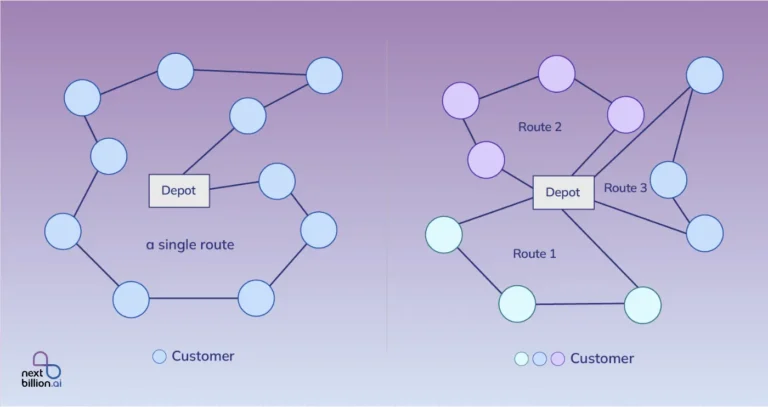
Multi-stop movement is more complicated than point-to-point movement. A truck may need to make dozens of stops in a single trip, and the sequence of those stops directly affects fuel consumption. Poor stop sequencing can lead to unnecessary detours, repeated road coverage, longer travel distances, and increased idle time. Fuel management software solves this by optimizing stop order based on location clustering, delivery time windows, vehicle capacity, service priority, and road network conditions.
The system calculates the most efficient stop sequence so vehicles can move through routes in a logical flow. It minimizes zigzag movement between service areas and helps drivers complete more stops with less travel distance. Advanced systems can also dynamically adjust stop sequencing when new orders are added, customers reschedule deliveries, or traffic conditions change.
The distance of the route is not the only factor influencing the fuel consumption. It is also based on the assignment of the right vehicle to the right job. A heavy truck that is on a low-volume delivery, a small van that is overloaded and is operating outside its efficient operating scope, or a vehicle that is on a route that it does not serve best can all contribute to fuel consumption. Fuel management software can be used to minimize this mismatch by integrating vehicle capacity, fuel efficiency, payload limits, engine type, route length, terrain and delivery needs and then assigning the route.
The route optimization engines can precisely compare the vehicles available and allocate the most appropriate one based on the cost-per-kilometer, the load-carrying capacity, closeness to pickup locations, and the anticipated difficulty of the route. An example of this is that a small delivery van might be suitable for dense urban routes, whereas a bigger vehicle might be more efficient to consolidate long-distance deliveries.
Idle time is one of the most common hidden fuel drains in fleet operations. Vehicles may remain stationary with the engine running at loading bays, customer locations, traffic signals, toll points, warehouses, checkpoints, or service zones. While the vehicle is not moving, it continues consuming fuel. Fuel management software identifies idle-heavy routes by analyzing engine-on duration, stop duration, GPS location, trip timelines, and telematics data.
Route optimization minimizes idle time by calculating routes to bypass high-delay areas, better arrival times, and to order stops in a more efficient way. As an example, when a delivery point habitually results in excessive waiting periods at a particular point in time, then the system can book that stop at a more appropriate time or can change the route sequence. More sophisticated platforms may also notify the fleet managers when idle limits are surpassed. This assists in imposing idle policies and enhancing driver responsibility.
Manual dispatch decisions often rely on limited visibility. A dispatcher may assign a job based only on vehicle availability without knowing the traffic status, fuel performance, driver location, route delays, vehicle health, or current workload. This can result in inefficient route assignments and higher fuel consumption. Fuel management software improves dispatch decision-making by giving fleet teams real-time operational data from GPS, telematics, fuel sensors, traffic systems, and route analytics.
This visibility allows dispatchers to assign the closest suitable vehicle, avoid congested routes, reduce unnecessary repositioning, and respond faster to route disruptions. When a new delivery request comes in, the system can identify which vehicle can complete it with the least additional distance and fuel cost. This is especially useful for logistics, field service, emergency response, and last-mile delivery fleets.
Repeated trips increase fuel costs because vehicles travel the same or similar routes multiple times when loads are not planned efficiently. Fuel management software helps prevent this by connecting route optimization with load planning, vehicle capacity data, order volume, delivery time windows, and service area clustering.
The system groups similar orders into fewer, better-planned trips while ensuring vehicles remain within legal and operational load limits. It also helps distribute loads properly so one vehicle is not underutilized while another is overworked. This reduces the number of trips needed to complete the same delivery or logistics workload. Fewer trips lead to lower fuel consumption, fewer driver hours, reduced vehicle wear and tear, and improved route productivity.
Fleet routes rarely remain perfect once vehicles are on the road. During live operations, route efficiency may vary due to traffic jams, road closures, weather disruptions, urgent orders, customer delays, failed deliveries, and vehicle problems. In the absence of dynamic re-routing, drivers could still stick to inefficient routes which consume more fuel and slow down deliveries. This can be solved with fuel management software that has a route optimization feature which recalculates routes depending on live conditions.
Dynamic re-routing is a real-time GPS, traffic feed, ETA adjustments, driver status, stop progress, and operational constraints that are used to suggest improved routes as the trip progresses. When a route is inefficient, the system can re-plan the route of the driver, rearrange the order of stops, or send another passing vehicle to perform a task. This eliminates wastage of fuel due to old route plans. In the case of large fleets, live re-routing assists in preserving fuel efficiency even in the case the daily operations vary unpredictably.
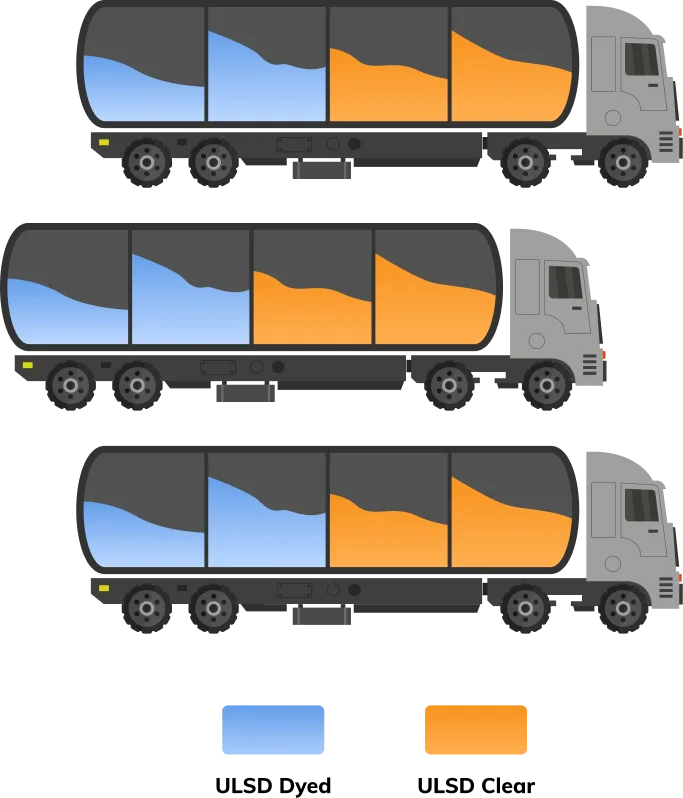
Here are the main and most notable applications of fuel management software in route optimization to save fleet fuel expenses:
Fuel management software assists last-mile fleets to cluster deliveries based on location density, real-time traffic, delivery timetable, and vehicle proximity. This saves on unnecessary kilometers, prevents traffic-congested routes, and minimizes fuel wastage due to repetitive stop-start motion.
Cold chain fleets rely on fuel management software to plan the routes in accordance with the delivery windows, traffic delays, unloading time, and refrigeration requirements. This saves fuel consumption by the engine, minimizes idle time, and preserves temperature-sensitive goods during transportation.
Fuel management software assists the service teams to allocate the closest appropriate technician depending on the location, skill, job priority, and traffic conditions. It helps eliminate unnecessary miles, minimizes unnecessary travel, and enhances daily job completion efficiency.
Fuel management software is used by construction fleets to plan site-to-site movement depending on the vehicle capacity, type of load, suitability of the road, and distance of the trip. It further assists in minimizing re-trips, idle vehicles, and the management of fuel expenses among ongoing projects.
The fuel management software enables long-haul fleets to compare routes in terms of distance, traffic, tolls, road conditions, fuel stops, and driver hours. This assists in selecting routes that minimize idle time, increase fuel efficiency, and make fuel costs more predictable.
Below are the top fleet management software platforms that help businesses improve route planning, fuel control, vehicle tracking, driver performance, and overall fleet efficiency.
NextBillion.ai is a high-volume logistics, delivery, mobility, and field service platform built on advanced fleet and routing intelligence. It helps fleet operators optimize routes based on real-world constraints such as traffic conditions, delivery time windows, vehicle capacity, driver availability, road restrictions, service zones, and stop priorities. With products such as route optimization, Distance Matrix APIs, live tracking, ETA intelligence, and geospatial analytics, NextBillion.ai enables businesses to reduce unnecessary mileage, improve dispatch accuracy, lower fuel expenses, and increase the predictability of fleet operations at scale.
Samsara is one of the most popular fleet management software platforms used by companies that need real-time visibility into vehicles, drivers, routes, and equipment. It is an integrated platform that combines GPS tracking, telematics, dashcams, fuel monitoring, driver behavior analytics, maintenance alerts, and compliance tools. Fleet operators use Samsara to reduce fuel wastage, monitor idling, improve driver safety, track vehicle health, and make faster dispatch decisions based on real-time operational data.
Geotab is a powerful fleet management system that companies require to have a high level of telematics, vehicle diagnostics, and fleet optimization based on data. It uses onboard diagnostics, GPS, engine, driver activity and fuel consumption data to enable businesses to learn about their fleet performance. Its analytics-based solution allows it to be applied in fuel management, preventive maintenance, compliance reporting, route efficiency, and long-term fleet cost control.
Verizon Connect helps fleet operators manage vehicles, drivers, routes, fuel consumption, and field operations through a centralized platform. It provides GPS tracking, route optimization, driver monitoring, vehicle health insights, fuel analytics, and dispatch management. Businesses use it to improve route visibility, reduce unnecessary mileage and idle time, and make fleet operations more predictable across delivery, logistics, construction, and service-based industries.
Fleetio is an online fleet management system focused on maintenance, inspections, fuel management, asset management, and fleet cost control. It helps companies track vehicle service history, repair schedules, fuel consumption, parts inventory, work orders, and driver inspections. Fleetio is especially useful for operators who want better control over lifecycle costs, reduced downtime, preventive maintenance, and fuel-related operating expenses.

NextBillion.ai assists fleet operators to lower fuel expenses by integrating route optimization, live tracking, ETA intelligence and logistics-ready mapping intelligence into a single scalable fuel management software environment.
NextBillion.ai allows fleets to calculate fuel-efficient routes by factoring in real-world conditions such as traffic, road restrictions, service zones, delivery time windows, vehicle capacity, and stop priorities. Instead of dispatching vehicles based on fixed or manually planned routes, the platform helps operators reduce unnecessary mileage, prevent route overlap, and deliver more packages with fewer fuel-consuming movements.
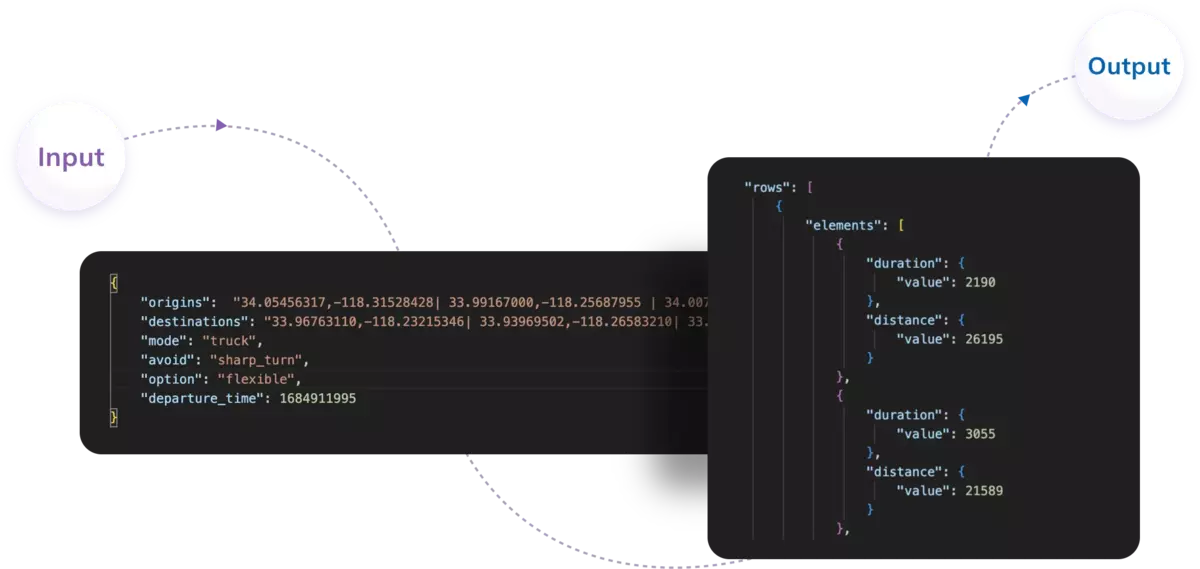
We support businesses with advanced Distance Matrix capabilities to calculate travel time, distance, and route feasibility across large volumes of origins and destinations. This enables dispatch teams to assign the closest suitable vehicle, compare route costs, improve driver allocation, and reduce empty miles. As a result, fleet operators can make better decisions through fuel management software because every dispatch decision is informed by location, distance, and operational cost data.
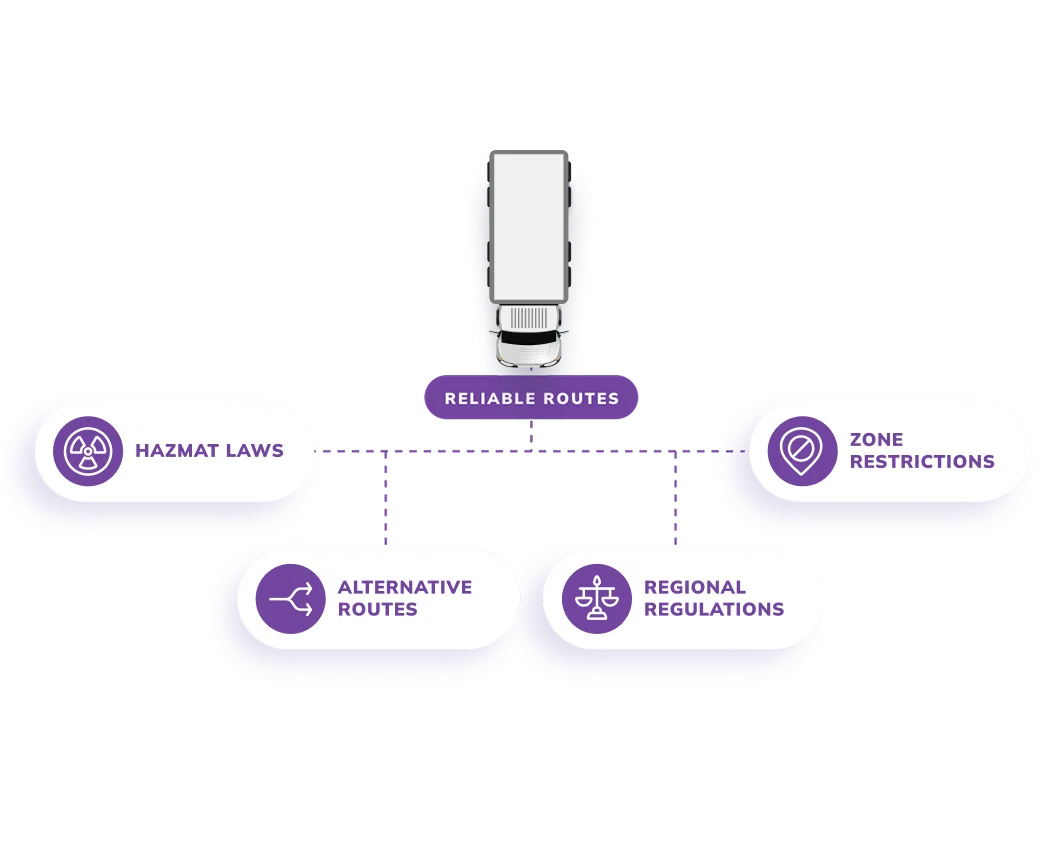
Our platform provides precise live fleet visibility through real-time tracking and ETA intelligence. Fleet managers can track vehicle movements, identify route deviations, detect delays, and respond faster to operational changes. When fleets can see where vehicles are, how routes are progressing, and where delays are building up, they can reduce idle time, avoid unnecessary rerouting, and prevent fuel wastage caused by poor visibility.
Fuel management has transformed into a wider operational intelligence role as compared to its simple expense tracking role. Modern fleet operations require systems that bridge the gap between fuel consumption and routing, performance of the vehicle, traffic, and real-time operational data.
The optimization of routes has a direct effect on fuel efficiency by minimizing unneeded miles, wastage, traffic delays, and inefficient route patterns. Minor routing optimization can generate significant savings in huge fleets and operations.
Companies using fuel management software with intelligent routing features gain better visibility, improved fleet efficiency, and stronger cost control. In 2026, as fleet ecosystems become more connected, smarter routing infrastructure will be essential for building scalable and efficient operations.
Explore how NextBillion.ai helps fleet operators build smarter, fuel-efficient routing systems with real-time optimization, traffic intelligence, and enterprise-grade route planning APIs. Connect with us to know more.
The amount of fuel saved would depend on the size of the fleet, the complexity of the route and the state of operations. Organizations tend to save fuel by cutting on the distance of travel, reducing idle time, better route sequencing and avoiding traffic jams.
The industries that benefit the most are those with vehicle-intensive operations, such as logistics, last-mile delivery, transportation, field services, construction, public transit, and cold chain operations.
Yes. Modern fuel management systems rely on fuel sensors, telematics, and anomaly detection systems that detect sudden decreases in fuel levels, unauthorized refueling operations, abnormal consumption trends, and possible fuel theft cases.
Yes. Multi-stop operations are especially important for route optimization systems because they help create efficient stop sequences, optimize delivery order, and reduce unnecessary mileage across complex route networks.
GPS positioning, fuel usage, mileage, idle time, route movement, engine diagnostics, vehicle health, traffic, and driver behavior measurements are the most common types of data gathered by fuel management software.
AI improves fuel efficiency by continuously analyzing operational data and identifying patterns that humans may miss. It can forecast inefficient routes, suggest more fuel-efficient paths, detect fuel wastage patterns, support dynamic route optimization, and improve overall fleet decision-making.
Bhavisha Bhatia is a Computer Science graduate with a passion for writing technical blogs that make complex technical concepts engaging and easy to understand. She is intrigued by the technological developments shaping the course of the world and the beautiful nature around us.