


Route Optimization API
Optimize routing, task allocation and dispatch
Distance Matrix API
Calculate accurate ETAs, distances and directions
Directions API
Compute routes between two locations
Navigation API & SDK
Turn by Turn Instructions for Drivers & Technicians
Route Optimization Software
Plan optimized routes with 50+ Constraints
Product Demos
See NextBillion.ai APIs & SDKs In action
AI Route Optimization
Learns from Your Fleet’s Past Performance
Platform Overview
Learn about how Nextbillion.ai's platform is designed
Road Editor App
Private Routing Preferences For Custom Routing
On-Premise Deployments
Take Full Control of Your Maps and Routing
About Us
Our story, vision
and mission
Contact Us
Reach out to us for any product- or media-related queries
Write to us at

Table of Contents
What happens when tools built to guide a single driver are expected to manage hundreds of vehicles, thousands of stops, and strict delivery timelines? Consumer mapping applications are designed to simplify everyday travel, enabling individuals to navigate between locations quickly and easily. But once businesses attempt to use the same tools for their logistics, field operations, or fleet management, the limitations are immediately apparent. Enterprise settings require much more than instructions. They need optimization and scaling, policy controls, and operational intelligence that consumer-grade maps did not exist to provide.
Let’s explore where the gaps exist and what organizations truly need to move from navigation to optimization.
Did you know?

Consumer mapping refers to location-based navigation platforms designed primarily for individual users seeking point-to-point directions in real time. These platforms are based on geospatial datasets on a large scale, traffic monitoring, and shortest path algorithms to create routes that are fast and convenient. Their architecture focuses on usability, quick response, and generalized routing logic that is applicable across a large population without customization. Although very useful in personal mobility, consumer mapping platforms are generally poorly configurable. They are constrained in model design and have little operational system integration in dispatch, scheduling, or fleet management applications.
The following are the main limitations that highlight the inadequacy of consumer mapping tools at enterprise scale:
Consumer mapping platforms calculate directions for one trip at a time. They cannot resolve the complicated routing situation when dozens or hundreds of stops have to be organized in the most efficient sequence. Businesses require algorithmic sequencing that minimizes distance, balances workloads, and reduces idle time, capabilities that basic navigation tools are not designed to provide.
Operational routing is based on variables like delivery time windows, driver shifts, vehicle capacity, service time, and customer priorities. Consumer maps fail to consider these variables, which in most cases create paths that do not consider the feasibility of schedules or resource constraints.
Standard navigation assumes all vehicles behave the same. It does not look at the size of trucks, cargo limits, dangerous goods regulations, or the suitability of roads. This renders it inappropriate for commercial fleets that should not use infrastructure that cannot fit their vehicles.
Consumer apps are driver-specific and have no way of sharing tasks with other vehicles. Businesses need centralized planning to allocate jobs, reassign routes, and track execution within a complete fleet system in real time.
Consumer mapping tools do not have the capability to integrate with transportation management systems, order databases, telematics, or analytics platforms. In the absence of integration, businesses depend on manual data transfers, which makes the process of decision-making slow and prone to mistakes.
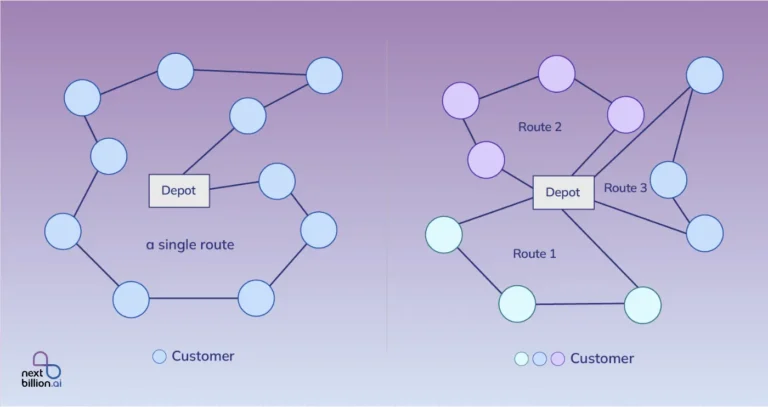
Enterprise route optimization refers to a domain of specialty logistics and decision intelligence systems that encompass sophisticated algorithms to coordinate the movements of a number of vehicles, stops, and constraints within complicated operational networks. It also solves variants of the Vehicle Routing Problem using parameters like delivery time windows, vehicle capacity, regulatory constraints, driver schedules, and cost objectives, unlike consumer navigation.
These systems are connected to enterprise systems such as transportation management systems, telematics, and order databases to constantly calculate optimal routes that are efficient, compliant, and scalable. The outcome is an active, policy-based routing environment that is not based on personal travel but on business operations.
The following are the key advantages of enterprise route optimization that make it a necessity when running complicated and large-scale operations:
Shortest path algorithms like Dijkstra or A*, which calculate only one optimal path between two points, form the basis of consumer mapping engines. Enterprise logistics, in turn, involves the solution of VRP variants, which take into account several vehicles, depot locations, stop sequencing, capacity limits, as well as service level goals. Consumer tools are not able to produce globally effective route plans without these optimization solvers.
Operational routing considers both hard and soft constraints, such as delivery time windows, maximum route length, driver hours of service regulations, and load balancing. Consumer navigation does not have a constraint engine, but considers routing a purely geometric computation, which does not work in a setting where feasibility is as important as distance.
Consumer-friendly map schema dwells on general-purpose attributes like speed of traffic and turn restrictions. Enterprise routing needs enhanced information such as truck availability, axle capacity, curbside maintenance, geofenced delivery areas, and private road systems. Lack of this field-specific metadata lowers precision in business activities.
Enterprise systems develop route decisions through telemetry, past performance information, and predictive analytics to constantly improve route decisions and model situations like demand surges or delays. Consumer apps only reroute reactively when a deviation has taken place and do not have the capability to actively reassign workloads in a fleet.
Consumer navigation is not provided as a programmable decision layer, but as an end-user interface. Businesses require API-based architectures to incorporate routing in dispatch systems, warehouse processes, and automation pipelines. In the absence of this integration layer, end-to-end logistics orchestration and real-time operational synchronization are not supported by consumer tools.
Enterprise optimization transforms routing to a strategic, automated process, and traditional planning is reactive and manual. Here are the most prominent differences between the two:
Factor | Enterprise Route Optimization | Traditional Planning |
Planning Method | Algorithm-based, data-driven routing. | Manual planning using experience or static maps. |
Multi-Stop Handling | Automatically sequences large numbers of stops efficiently. | Stops are arranged manually, often inefficiently. |
Scalability | Built to manage growing fleets and territories. | Difficult to scale as operations expand. |
Data Usage | Uses real-time traffic, constraints, and operational data. | Limited reliance on historical or static inputs. |
Adaptability | Dynamically recalculates when conditions change. | Requires manual updates during disruptions. |
Resource Allocation | Assigns jobs based on capacity and availability. | Generic distribution without optimization. |
Cost Management | Minimizes fuel, distance, and labor through optimization. | Higher hidden costs due to inefficiencies. |
ETA Accuracy | Predictive and consistently reliable. | Approximate and often inconsistent. |
Compliance Handling | Automatically factors in regulations and restrictions. | Checked manually, increasing risk. |
System Integration | Connects with dispatch, ERP, and fleet platforms. | Works in silos like spreadsheets or basic tools. |
Operational Insight | Provides analytics for continuous improvement. | Limited visibility into performance. |
These distinctions prove that enterprise route optimization is not a continuation of consumer navigation, but a separate field of technology. It is concerned with operational coordination, information management, and automated decision-making at scale.
Consumer mapping systems are closed, user-facing applications, in which routing is activated in response to a single request. Enterprise route optimization is developed as a back-end decision engine, which executes batch planning and continuous optimization with automated dispatch processes without human intervention.
Consumer systems are based on publicly available road networks and aggregated traffic signals. Proprietary datasets are often included in enterprise environments, including customer locations, depot infrastructure, service boundaries, density patterns of delivery, and access roads privately owned by the organization. These datasets provide organizations with more control over routing accuracy.
Success in consumer navigation is determined by the shortest time taken for an individual to travel. Multi-objective scoring models are employed to optimize enterprise operations. They work by minimizing operational cost, balancing workloads, fulfilling service level agreements, and maximizing asset utilization.
Consumer applications do not depend on operational processes. Enterprise routing is closely coupled with execution layers, dispatch automation, driver processes, inventory coordination, and proof of service systems, and planning decisions are easily translated into field operations.
Consumer navigation is recalculated and reactive per trip. Enterprise optimization operates periodic planning cycles, automated recalculations, and exception-based adjustments during the day to allow orchestration to be continuous instead of routing in isolation.
Consumer tools react to disruption only upon detection, which is usually rerouting notifications. Enterprise platforms actively model variability, for example, demand spikes, vehicle maintenance, or service delays, so that planners reduce risk before it affects execution.
Consumer navigation only gives minimal feedback other than estimated arrival updates. Enterprise systems produce operational intelligence, which is monitored in terms of routes followed, productivity of stops, and utilization trends, which are used to drive ongoing optimization strategies.
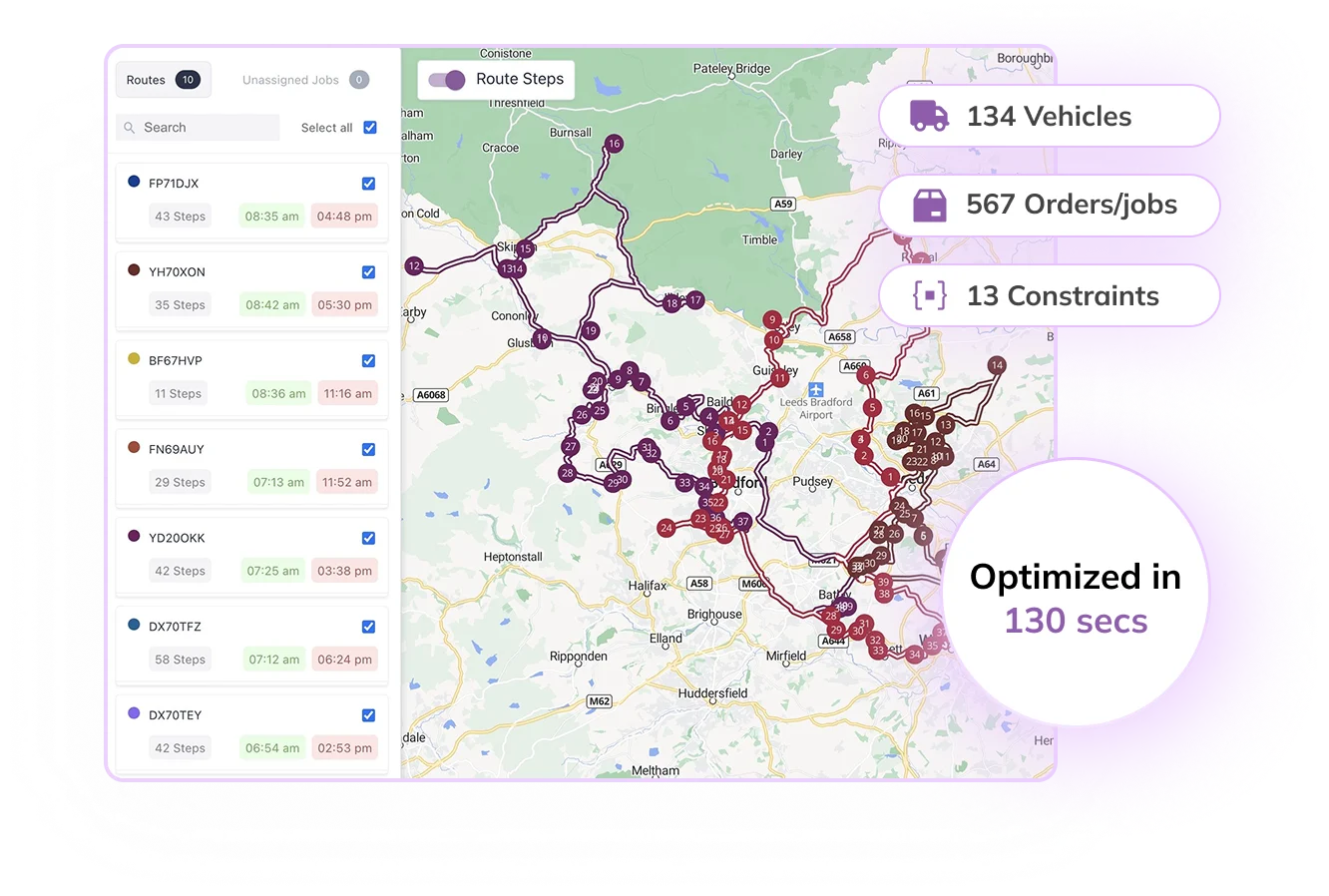
The stack below provides enterprise route optimization with capabilities that allow it to be used as a computational logistics platform. They integrate mathematics, geospatial science, real-time data engineering, and operational analytics to address the constraints of consumer-grade navigation.
Enterprise systems address more complex versions of the Vehicle Routing Problem, including Capacitated VRP and VRP with Time Windows. These models consider load capacity, delivery schedules, depot constraints, and route balancing, which allows globally optimized plans instead of locally efficient directions.
Genetic Algorithms, Tabu Search, and Simulated Annealing are some of the algorithms that systems employ to deal with real-world complexity at scale. These methods quickly give approximated solutions that are close to optimal solutions in cases where optimization is computationally infeasible with thousands of stops.
Enterprise routing adds overlay maps with logistics-related features such as truck attributes, loading areas, serviceable entrances, gated communities, and private road access. This rich data model provides route feasibility for delivery and service workflows.
Specialized constraint solvers enable companies to model operational policies like maximum route length, driver rest periods, priority clients, zone assignments, and compliance requirements. These limitations determine route feasibility prior to the optimization process.
Onboard diagnostics, vehicle GPS, and IoT sensors provide live data to the routing engine. This allows active tracking of location, speed, dwell time, and deviations, and dynamic reoptimization of the entire fleet instead of static rerouting.
Enterprise route optimization systems operate on distributed cloud computing, which parallelizes computations across a number of nodes. This evaluates millions of route permutations at once with low response times for operational decision making.
Machine learning models based on historical travel patterns, real-time congestion, and stop-level service information are integrated to generate precise ETA forecasts. These forecasting systems enhance schedule compliance and customer communication.
Enterprise solutions expose routing capabilities through APIs to combine with Transportation Management Systems, Order Management Systems, warehouse platforms, and driver applications. This forms an automated planning to execution pipeline.
Simulation modules enable planners to experiment with what-if situations, like fleet expansion, demand spikes, or territory redesign. This assists in strategic planning because operational effects are assessed prior to implementation.
Dashboards and reporting engines analyze performance metrics such as route adherence, utilization rates, cost per stop, and service level compliance. This knowledge updates optimization models that are used to constantly improve routing policies.

The following are the key applications of enterprise route optimization across modern logistics and mobility operations;
Enterprise route optimization is commonly applied to parcel, grocery, and e-commerce delivery to order hundreds of daily stops and still meet delivery time constraints, vehicle capacity, and service time constraints. Optimization engines minimize unnecessary movements, enhance drop density, and make sure that drivers take the most efficient route clusters in urban and suburban networks.
Optimization is applied by utilities, telecom providers, and maintenance services to allocate jobs depending on the skill sets of technicians, proximity, SLA commitments, and availability. The system dynamically schedules appointments and recalculates routes when new service requests or delays are encountered, which reduces downtime and increases first-time fix rates.
The way in which freight is allocated to vehicles is optimized by logistics operators based on load capacity, route length, and depot constraints. This guarantees even distribution of utilization, eliminates overloading, and minimizes empty backhaul journeys with smart backhaul planning.
This workflow illustrates how enterprise route optimization functions as an end-to-end computational logistics pipeline, integrating spatial analytics, mathematical optimization, and operational telemetry to deliver scalable and repeatable efficiency.
The system is fed with structured data like delivery orders, service tickets, geocoded customer locations, priority levels, and the time needed to service the customer. Data validation and normalization are used to make sure that the data is properly spatially referenced prior to optimization.
Vehicle profiles comprise capacity, refrigeration, size, fuel type, and range. Driver schedules, shift limits, break compliance, and skill-based eligibility are mapped to ensure realistic assignments. The platform uses historical speed profiles, live traffic feeds, and road hierarchy information to compute travel time matrices between any pair of stops and use them as the computational base to determine routing.
Constraint engines include rules that comprise delivery time windows, service level agreements, depot cut-off times, zone constraints, customer priority classes, and maximum route time. Heuristic and metaheuristic solvers are applied to evaluate stop-assignment permutations across vehicles and identify near-optimal routing plans. The optimizer minimizes total distance, cost per delivery, fleet imbalance, and penalties due to lateness, and keeps feasibility on all routes.
The system generates route manifests that are confirmed for stop order, load allocation, estimated arrival times, and compliance. Capacity validation is used to make sure that vehicles are not overloaded and are not underutilized. Optimized plans are sent to driver apps, telematics engines, or dispatch boards with navigation directions, stop level data, delivery proof procedures, and exception management directions.
The platform is updated in real time by GPS tracking, driver check-in, dwell time, and exception notifications. Fleet assignments are dynamically calculated when new orders, traffic variations, or vehicle unavailability are encountered. KPIs used in post execution analytics include route compliance, fuel efficiency, service efficiency, and SLA compliance. Machine learning models optimize ETA predictions and planning parameters to maintain continuous improvement.
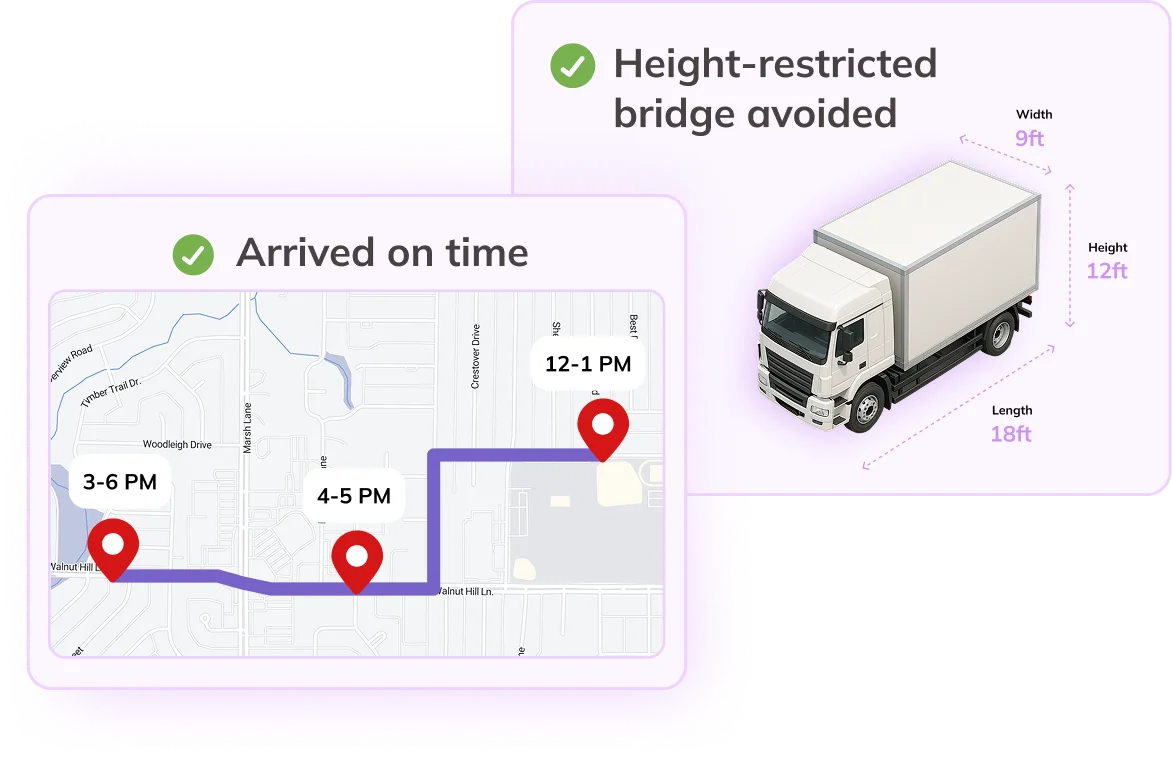
As businesses scale logistics and mobility operations, they exceed the limits of consumer-grade mapping tools that lack configurability, system-level control, and operational depth for real-world execution. What begins as simple navigation becomes a need for fleet orchestration, constraint-based optimization, and seamless integration with dispatch and analytics systems.
NextBillion.ai responds to this change by providing a developer-friendly location intelligence platform. It is specifically designed to support enterprise routing, optimization, and navigation. Rather than compelling businesses to conform to generalized mapping behavior, it allows businesses to develop specific geospatial applications that are consistent with operational processes, regulatory policies, and performance goals.
NextBillion.ai is an extension of traditional mapping by allowing organizations to write routing logic around actual rules of operation. Service delimitations, vehicle eligibility requirements, delivery priorities, stop level requirements, and compliance requirements are defined within the platform by businesses. This makes sure that generated routes are not only geographically efficient, but also operationally feasible and policy aligned. Routing is a controllable decision engine instead of a black box navigation tool.
Enterprise settings demand the capability to organize thousands of stops, numerous depots, and distributed fleets in dynamic service areas. NextBillion.ai provides high-density routing situations with optimization engines that are intended to support computation and parallel processing. This makes it suitable for last mile delivery, field service coordination, freight distribution, and on demand mobility platforms where routing must remain stable under heavy operational loads.
NextBillion.ai offers customizable APIs and SDKs that are integrated with enterprise systems to support routing, navigation, ETA prediction, and geospatial intelligence. Teams combine these capabilities with dispatch software, transportation management systems, warehouse platforms, and driver applications without recreating geospatial infrastructure. Routing becomes part of a larger automated planning to execution pipeline.
Plan generation is not the limit of enterprise routing. NextBillion.ai uses live traffic feeds, telematics data, and execution analytics to assist in real-time route adjustments and active monitoring. Organizations gain visibility into route compliance, fleet usage, service dependability, and delivery performance. This data feedback loop allows optimization models to improve continuously and operations to remain sustainable at scale.
There is no universal superiority in either of the approaches. It depends on the problem being solved. Consumer mapping is best suited to single-user navigation, which is simple, fast, and easy to use in daily commuting. Nevertheless, once routing is integrated into a bigger operational framework including fleets, schedules, constraints, and cost accountability, enterprise route optimization is the obvious option. It offers the computing power, scalability, and integration needed to handle large-scale complex logistics. Concisely, consumer maps assist individuals in traveling between point A and point B, whereas enterprise optimization assists companies in operating full mobility processes effectively.
Are you all prepped to move beyond basic navigation and build routing that truly supports your operations? Learn how NextBillion.ai is used to help enterprises design, optimize, and scale custom routing solutions using powerful APIs, sophisticated optimization, and real-time location intelligence to meet complex business requirements.
Enterprise routing systems execute bulk orders in parallel by optimizing engines that combine all stops, vehicles, and constraints, and generate coordinated route plans rather than individual directions.
Yes. Location-specific configurations of enterprise systems, like regional policies, service zones, and infrastructure considerations, are provided to enable routing behavior to be adjusted to local operating conditions.
Sophisticated platforms keep a constant check on execution data and can automatically reassign stops or resequence routes in the event of delays, cancellations, or new requests to ensure overall efficiency.
Analytics modules monitor performance measures like utilization, service time, and route compliance. It allows the organization to detect inefficiencies and improve planning strategies as time progresses.
No. Other industries like utility, healthcare services, retail distribution, and mobility providers also use optimized routing to organize field teams, schedule, and enhance service delivery.
Bhavisha Bhatia is a Computer Science graduate with a passion for writing technical blogs that make complex technical concepts engaging and easy to understand. She is intrigued by the technological developments shaping the course of the world and the beautiful nature around us.