

AI-Driven Route Optimization

AI-Driven Route Optimization in 2026 (Tools, Algorithms & Use Cases Explained)

Published: March 12, 2026

AI-driven route optimization in 2026 is no longer just “finding the shortest route.” It is an integrated decision system that blends classical optimization models (Vehicle Routing Problem (VRP), Capacitated Vehicle Routing Problem (CVRP), Traveling Salesman Problem (TSP) and variants), machine learning, live telematics, and business rules into a continuously learning control loop for fleets and field operations. At scale, this is the only practical way to orchestrate thousands of stops, dozens of constraints, and real-world uncertainty while still hitting service-level targets and cost goals.

What is AI Route Optimization?

AI route optimization refers to the use of artificial intelligence techniques to plan, execute, and continuously improve routes for vehicles and field agents throughout the entire routing process.
route optimization
Traditional routing focuses on static optimization, that is, you define a set of orders and constraints, run an algorithm once, and then hand off a schedule to operations. But, AI-driven routing extends this approach by:

  • Continuously ingesting data (orders, GPS, traffic, weather, depot status).

  • Learning from historical execution (actual vs planned times, deviations, cancellations).
  • Reoptimizing plans in response to events (urgent orders, delays, breakdowns).

  • Improving its own parameters over time (travel-time matrices, service times, penalties).

In this context, “AI” is not a single algorithm. It is a layered stack:

  • Optimization layer: Solves variants of the Vehicle Routing Problem (VRP), Traveling Salesman Problem (TSP), and their extensions with heuristics, metaheuristics, and mixed-integer programming.

  • Prediction layer: Uses machine learning to predict ETAs, demand patterns, dwell times, and risk of late or failed deliveries.

  • Control layer: Applies decision logic and rules that are often enhanced by reinforcement learning or policy search and to decide when to optimise, which constraints to relax, and how to prioritize competing objectives.

The objective is not only route efficiency (distance, fuel, driver hours) but also service performance (on-time rate, first-attempt delivery success, SLA adherence) and planner productivity. Over time, a well-designed AI routing system becomes a learning digital twin of your logistics operation, capturing the nuanced behaviors that classic rule-based systems often miss.

How Machine Learning is Used in Logistics Route Optimization

Machine learning’s role in routing is primarily to improve the quality of the optimization inputs and adapt the system to real-world behavior, rather than to directly solve the combinatorial problem from scratch in every case.

machine learning
1. Travel-time and ETA prediction

Static speed profiles or generic traffic models are rarely accurate enough at street level. Modern systems train models using GPS telemetry, map attributes, and temporal signals:

  • Features: link-level travel times, time of day, day of week, weather, incidents, road class, speed limits.

  • Models: gradient-boosted trees, random forests, deep learning models (LSTMs or temporal CNNs), or graph neural networks that exploit network topology.

The outputs are:

  • More accurate travel-time matrices between all relevant points.

  • ETA distributions instead of point estimates, enabling risk-aware planning.

These predictions directly influence cost matrices for VRP solvers and are continuously updated as more data arrives.

2. Demand and workload forecasting

Machine learning is also used to forecast:

  • Order volumes by region, customer segment, and time window.

  • Seasonal and event-driven peaks.

  • Probability of cancellations or no-shows.

These forecasts feed into tactical decisions such as:

  • How many vehicles to activate.

  • Where to position depots or micro-fulfillment hubs.

  • How to size the time-slot capacity offered to customers on e-commerce checkout pages.

By improving the upstream planning, you reduce the stress on the routing engine and avoid systematic infeasibility.

3. Service-time and time-window modeling

Real service times at stops (loading/unloading, handshake, paperwork, access control) often differ dramatically from assumptions. ML models learn:

  • Typical dwell times per customer, product type, or service type.

  • Seasonal and time-of-day variations (e.g., congested loading bays in the morning; gated communities at night).

  • Impact of driver experience or vehicle type.

These learned distributions are mapped into realistic service-time parameters and sometimes into soft time-window penalties, making the VRPTW instance much closer to reality and improving on-time performance.

4. Risk and anomaly detection

Classification and anomaly detection models monitor:

  • Likelihood of a route becoming infeasible given current progress (late starts, congestion, extended stops).

  • Probability of failed delivery based on customer history and context.

  • Outlier behaviors (excessive detours, long idle times, unauthorized stops).

The routing system uses these signals to:

  • Trigger partial reoptimization or route repair.

  • Reassign stops to other vehicles before failures happen.

  • Alert planners to potential fraud or safety issues.

5. Policy learning and meta-optimization

A more advanced use of ML is “learning to optimize”, using reinforcement learning or neural combinatorial optimization to learn policies for constructing or improving routes:

  • A policy network generates routes step by step (e.g., selecting the next customer in a sequence).

  • A value network estimates the quality of partial solutions.

  • Reinforcement learning optimizes the policy against cost functions that include distance, lateness, and various penalties.

Often, these learned policies are not used standalone but as components:

  • To generate strong initial solutions for classical metaheuristics.

  • To tune solver knobs (e.g., neighborhood sizes, time limits, penalty weights) dynamically based on instance features.

This hybrid approach preserves the robustness of mature OR techniques while benefiting from ML’s ability to capture patterns across many problem instances.
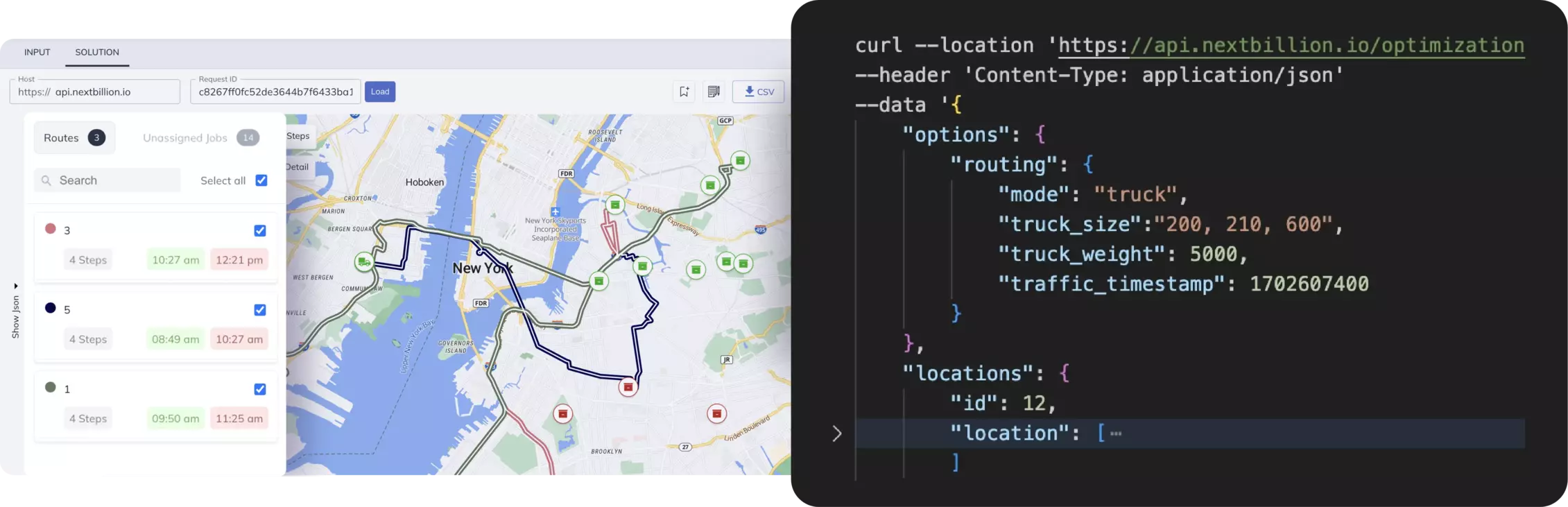
Core Route Optimization Algorithms (VRP, CVRP, TSP & More)

At the heart of AI routing are classical combinatorial optimization problems and the algorithms designed to tackle them. Understanding these is key to designing or evaluating an AI routing system.

Foundational problems

1. Traveling Salesman Problem (TSP)

  • Problem: Given a set of locations, find the shortest possible tour visiting each exactly once and returning to the start.

  • Complexity: NP-hard; exact algorithms scale poorly beyond a few hundred nodes.

  • Practical use: Benchmarks, single-vehicle routes, subproblems within larger VRPs, and basis for local improvement moves (2-opt, 3-opt, etc.).

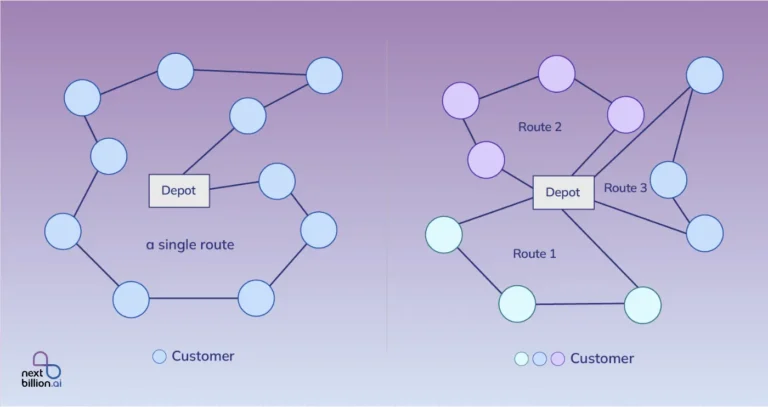
2. Vehicle Routing Problem (VRP)

  • Generalization of TSP to multiple vehicles and a shared depot (or depots).

  • Each customer must be visited exactly once by one vehicle, subject to route feasibility constraints.

  • Objective: Typically minimize total distance, total time, or the maximum route duration (to ensure balanced workloads).

3. Capacitated VRP (CVRP)

    • Extends VRP with vehicle capacity constraints.

    • Each customer has a demand; each vehicle has a capacity; no route’s total demand may exceed the vehicle capacity.

    • Common in FMCG, parcel, and bulk distribution where load weight/volume is critical.

Real-world variants

Modern logistics operations rarely fit textbook VRP. Common extensions include:

  • VRP with Time Windows (VRPTW): Each customer has a time window in which service must occur. Violations may be forbidden (hard windows) or penalized (soft windows).

  • VRP with Pickup and Delivery (VRPPD): Each request includes a pickup and a corresponding delivery, often with precedence and pairing constraints (pickup must occur before delivery, both must be served by the same route).

  • Multi-depot VRP (MDVRP): Vehicles can start from multiple depots; some variants allow cross-docking or inter-depot transfers.

  • Heterogeneous Fleet VRP: Different vehicle types with varying capacities, costs, and capabilities (e.g., reefer vs ambient, height restrictions, access limitations).

  • Open VRP: Routes do not necessarily return to depot (e.g., one-way line-haul or drop-and-leave scenarios).

  • Periodic VRP: Customers require service at certain frequencies over a planning horizon; routes are planned over multiple days.

These variants can be combined: for example, a heterogeneous-fleet VRPTW with pickups and deliveries and driver shift constraints.

Algorithmic techniques

Given the NP-hard nature and practical scale (hundreds–thousands of stops), exact solutions are often impractical in production, especially under real-time constraints. State-of-the-art systems rely on:

  1. Exact methods (for smaller or critical subproblems)

    • Mixed Integer Programming (MIP), Branch-and-Bound, Branch-and-Cut, and Constraint Programming.

    • Used to solve small instances optimally or embedded within heuristics (e.g., exact route optimization within a larger decomposition scheme).

  2. Constructive heuristics

    • Clarke–Wright savings algorithm, nearest neighbor, insertion heuristics.

    • Provide fast, decent initial solutions used as starting points for improvement phases.

  3. Local search and neighborhood-based improvement

    • Operations such as 2-opt, 3-opt, Or-opt, relocation, exchange, and cross-exchange.

    • Applied iteratively to explore the solution neighborhood and reduce cost.

  4. Metaheuristics

    • Tabu Search: Maintains a tabu list to avoid cycling and encourages exploration of new regions.

    • Simulated Annealing: Accepts worse solutions with decreasing probability to escape local minima.

    • Genetic Algorithms / Evolutionary Algorithms: Evolve a population of solutions using crossover and mutation operators.

    • Large Neighborhood Search (LNS) and Adaptive LNS: Destroy-and-repair strategies that repeatedly remove and reinsert subsets of customers, exploring very large neighborhoods efficiently.

  5. Decomposition and hybrid approaches

    • Decomposing large problems by geography, time windows, or depot clusters.

    • Combining exact methods for subproblems with metaheuristics at the master level.

    • Integrating ML for initial solution construction or parameter tuning.

Neural combinatorial optimization and RL-based solvers are increasingly used as components in such hybrid approaches rather than complete replacements, especially in 2026-era systems where robustness and explainability remain critical.

What is AI Routing and How it Works in Real-Time Systems

AI routing goes beyond static batch optimization and introduces closed-loop, event-driven control over routes as they are executed in the field.

A typical real-time AI routing system comprises:

  • Data ingestion layer: Connectors to TMS, WMS, OMS, ERP, telematics platforms, driver apps, and external data providers (traffic, weather, road incidents).

  • State store / digital twin: Maintains the current state of orders, vehicles, drivers, depots, and network conditions.

  • Prediction services: ML microservices for ETAs, demand forecasts, dwell times, risk scores, and anomaly detection.

  • Optimization engine: Routing core capable of batch planning and incremental reoptimization, often using a combination of metaheuristics and constraint programming.

  • Orchestration & events: A rules engine or workflow system listening to events (new orders, delays, cancellations, breakdowns) and deciding when and how to trigger reoptimization.

  • Execution & feedback layer: Driver mobile apps, dispatcher consoles, and APIs that apply and display route changes and collect telemetry for continuous learning.

Real-time operation lifecycle

Initial planning

At the start of a shift, a bulk set of orders is planned. The system forms one or more VRP variants and computes an initial solution under all known constraints.

Execution monitoring

Drivers start executing routes. Their positions, statuses (en route, on site, completed), and exceptions (failed, refused, rescheduled) stream back into the system in near real time.

Event detection

The system detects significant events: heavy congestion on a key corridor, a vehicle breakdown, a late start, urgent new orders, or early completion of some routes leaving capacity idle.

Decision logic

A set of policies decides whether to:

Apply a local adjustment (swap a few stops between nearby vehicles).

Trigger partial reoptimization (repair a subset of routes).

Re-plan a full cluster or region.

These policies also consider business rules: how often drivers can be re-routed, whether customers have consented to flexible time windows, and operational thresholds.

Reoptimization

The optimization engine solves a modified VRP that incorporates current progress and remaining work, often under tight time budgets (seconds to tens of seconds).

Constraints on changes (e.g., limit the number of route changes per driver) are modeled to avoid disrupting execution too much.

Application and communication

Drivers receive updated routes, new stop sequences, or instructions to transfer loads at specific rendezvous points.

Dispatchers see dashboards showing route health, on-time risk, and the impact of changes.

Learning and model updates

As the day progresses and over weeks/months, data is aggregated and fed back into ML pipelines:

Updating travel-time models.

Refining dwell time distributions.

Adjusting penalty weights to better match business priorities.

AI routing thus acts as a self-improving control loop that balances optimization quality with operational stability and human acceptance.

Best AI Tools for Route Planning and Optimization in 2026

route optimization

The 2026 tool landscape is characterized by API-first optimization engines, full-stack logistics platforms, and vertical-specific solutions (e.g., grocery, healthcare, heavy freight). Although features and branding differ, leading tools tend to share common design patterns.

Common architectural characteristics:

  • Cloud-native, horizontally scalable microservices architecture.

  • Strong separation between routing engine, ML services, and integration layer.

  • Support for both SaaS web UI users (planners/dispatchers) and headless API integrations.

  • Built-in observability (metrics, logs, tracing) and detailed route-performance analytics.

Several AI-powered routing platforms are widely used across industries. These tools provide advanced capabilities such as multi-stop route planning, dynamic dispatching, and predictive analytics.

NextBillion.ai
 

NextBillion.ai provides advanced routing APIs and logistics intelligence tools designed for large-scale logistics operations.

Key capabilities include:

These capabilities allow companies to optimize complex fleet operations at scale.

Google Maps Platform

Google Maps offers routing and navigation APIs widely used in consumer and enterprise applications.

Key features:

  • Traffic-aware routing

  • Distance matrix calculations

  • Geolocation services

  • Navigation SDKs

HERE Technologies

HERE provides advanced mapping and routing solutions used by automotive companies and logistics providers.

Capabilities include:

  • Fleet routing optimization

  • Traffic analytics

  • Location intelligence

Mapbox

Mapbox provides customizable mapping tools and routing APIs for developers building navigation applications.

Key features:

  • Custom map styling

  • Navigation SDKs

  • Routing engines

Routific

Routific specializes in last-mile delivery optimization for small and medium-sized logistics operations.

Capabilities include:

  • Route optimization

  • Driver tracking

  • Delivery scheduling

These tools enable businesses to automate complex routing decisions and scale delivery operations efficiently.

AI Route Optimization for Logistics vs Consumer Navigation Apps

Although both logistics routing engines and consumer navigation apps rely on maps and traffic data, they are solving fundamentally different problems.
AI route optimization
Optimization scope and objective

Logistics routing

Global optimization: many stops, many vehicles, shared resources, cross-dependencies.

Objectives: minimize fleet cost, maximize on-time rate, balance workloads, respect constraints, and often optimize for sustainability (fuel/CO₂).

Consumer navigation

Local optimization: mostly single origin–destination journeys, sometimes with a small set of waypoints.

Objective: minimize travel time (or distance) for an individual user, sometimes balancing network-wide traffic.

The logistics engine must think of system-level efficiency, while a navigation app optimizes for individual experience.

Constraints and data richness

Logistics

Deep integration with operational data: orders, SKUs, vehicle and driver attributes, depot capacities, merchandising rules, service priorities.

Complex constraints: time windows, capacities, skills, multi-stop sequences, contractual commitments, regulatory restrictions.

Consumer navigation

Mostly generic constraints: traffic, road closures, tolls, basic user preferences (avoid tolls, avoid ferries).

Very limited visibility into any underlying business processes for commercial deliveries, field service tasks, or SLAs.

Temporal horizon

Logistics

Plans are created for hours or entire days, sometimes days in advance, with tactical and strategic planning layers.

Needs both long-horizon planning (e.g., multi-day VRP or periodic VRP) and short-horizon adjustments during execution.

Consumer navigation

Primarily short-horizon, per-trip decisions. Re-routing can happen frequently with minimal constraint coupling.

Performance metrics

Logistics KPIs: cost per stop, on-time performance, first-attempt delivery success, driver utilization, number of vehicles required, SLA penalties, CO₂ per drop.

Consumer KPIs: user satisfaction, perceived ETA accuracy, number of active users, average travel-time savings, congestion mitigation at the network level.

This distinction matters when evaluating tools: a consumer navigation SDK rarely provides the necessary modeling capabilities and control to act as a full logistics routing engine, even if it offers routing, traffic, and ETA APIs.
Key Features to Look for in AI Route Optimization Software

To make a high-quality selection, you need to look beyond buzzwords and systematically evaluate feature sets against your operational reality.

Modeling expressiveness

The software should natively support:

  • Multi-vehicle VRP with time windows, capacities, pickups and deliveries, and multi-depot configurations.

  • Driver-level constraints: shifts, breaks, maximum driving time, legal regulations.

  • Vehicle-level constraints: height/weight limits, refrigeration, access restrictions, compartment-level capacity.

  • Business rules: customer priorities, order clustering policies, “must-visit” and “avoid” constraints, driver–customer affinities.

Look for flexibility: you want to encode new rules without waiting for a vendor release.

Optimization performance and scalability

Key questions:

  • How many stops and vehicles can the system handle within your time budgets?

  • How does performance degrade as constraint complexity grows?

  • Can you trade off optimality vs runtime via configurable parameters?

For real-time use, partial reoptimization and local repair capabilities are essential, as full re-plan runs may be too heavy.

ML and AI capabilities

Assess the maturity of:

  • Travel-time and ETA modeling, including personalization per customer/region if needed.

  • Demand forecasts and time-slot capacity management, if you operate booking windows.

  • Self-learning loops: how does the system update models and cost parameters as more data is gathered?

  • Ability to use your own ML models (bring-your-own-model), for example, plugging in a proprietary ETA service.

Real-time routing and orchestration

Look for:

  • Configurable event handling: triggers for reoptimization based on delays, new orders, cancellations, resource changes.

  • Controls to limit disruption: max number of route changes per driver, cut-off times for certain modifications.

  • Support for partial reoptimization: e.g., optimize only routes in a region or routes that cross a congested corridor.

The system should provide clear visibility into what changed and why, as well as “before vs after” metrics.

Explainability and human-in-the-loop control

Planners and dispatchers must be able to:

  • Understand cost breakdowns (distance vs time vs penalties vs soft-constraint violations).

  • Inspect why a particular customer is on a particular route at a particular time.

  • Manually adjust routes and have the engine repair/validate rather than completely override their edits.

This mix of automation and control improves trust and adoption and is crucial when routes have business nuances known only to human experts.

Integration, security, and operations

Examine:

  • API design: resource models, rate limits, authentication, versioning, webhooks.

  • Connectors or accelerators for your TMS, WMS, ERP, or custom systems.

  • Monitoring: dashboards for cost, on-time performance, route utilization, solver runtimes, and error rates.

  • Security and compliance posture: data isolation, encryption, role-based access, audit trails.

Robust operations and governance often matter more in the long run than marginal improvements in route optimality.

How to Choose the Right AI Route Planning Platform

Selecting an AI route planning platform is as much an engineering and change-management decision as it is a mathematical one. A structured selection process helps reduce risk and shorten time-to-value.

Step 1: Profile your logistics and constraints

Start with a concise but thorough operational profile:

  • Type of operations: last-mile, mid-mile, line-haul, field service, on-demand, or hybrid.

  • Volume profile: average and peak stops per day, per route, per region.

  • Time-window structure: narrow vs wide windows, presence of fixed appointments, split deliveries.

  • Resource constraints: fleet composition, owned vs contracted, multi-compartment, special handling requirements.

  • Regulatory and contractual constraints: driver hours-of-service rules, union rules, customer SLAs, access restrictions.

This profile becomes your requirements baseline and the input to vendor evaluation and pilot scenarios.

Step 2: Define KPIs and optimization priorities

Align with stakeholders on:

  • The primary objective (e.g., cost per stop vs on-time performance vs utilization).

  • Secondary constraints: “never violate hard time windows,” “respect legal driving times at all costs,” etc.

  • Success metrics for evaluation: % reduction in kilometers driven, improvement in on-time deliveries, decrease in manual planning time, fewer vehicles used, CO₂ reduction.

Codify these as quantitative targets to evaluate tool impact.

Step 3: Shortlist platforms by capability and fit

From market research and references:

  • Filter out tools that only do basic point-to-point routing or lack VRP-class modeling.

  • Prioritize platforms with proven logistics deployments in domains similar to yours (e.g., grocery, pharma, heavy freight).

  • Inspect documentation and APIs for clarity and completeness.

Step 4: Technical and functional deep dive

For each shortlisted tool:

  • Run structured workshops with vendor solution engineers to map your constraints into their configuration model.

  • Confirm support for your most complex scenarios (e.g., multi-compartment vehicles, reverse logistics, synchronized pickups and deliveries).

  • Evaluate UI and workflow fit for your planners and dispatchers.

Ask the hard questions about limitations and failure modes; understand how they handle infeasibility and edge cases.

Step 5: Design and execute pilots

Plan pilots that:

  • Use representative geographic regions, customer mixes, and peak days and not just “easy” cases.

  • Compare baseline operations vs AI-optimized plans over a significant period.

  • Capture both quantitative (cost, time, on-time rate) and qualitative (planner satisfaction, driver acceptance) metrics.

Step 6: Evaluate long-term fit and extensibility

Even if pilot KPIs are positive, consider:

  • How easy is it to adapt the platform to new business models or geographies?

  • Can it support additional use cases (reverse logistics, multi-leg, cross-docking) without major re-implementation?

  • Is the vendor’s roadmap aligned with your strategic direction (e.g., sustainability metrics, autonomous vehicles, tighter marketplace integration)?

Factor in total cost of ownership, including integration, change management, and ongoing tuning.

Conclusion

​​In 2026, AI-driven route optimization has evolved into a strategic backbone for logistics, not just a tactical way to shorten routes. By combining mature VRP-family algorithms with machine learning, real-time telematics, and rich business constraints, modern routing engines can continuously plan, monitor, and refine operations at a scale no human planner can match.

The key is understanding where each layer fits: classical optimization delivers mathematically strong route plans, ML models supply realistic inputs and forecasts, and real-time orchestration keeps those plans aligned with the messy, changing conditions on the ground. Logistics-focused AI routing also differs fundamentally from consumer navigation, targeting global fleet efficiency, SLA adherence, and cost per stop rather than individual trip convenience.

For organizations, this means that selecting an AI route planning platform is not about chasing the flashiest “AI” label, but about choosing a system that can faithfully model your constraints, integrate cleanly with your tech stack, learn from your data, and support planners instead of sidelining them. Teams that approach AI routing as a long-term operational capability anchored on clear KPIs, strong data foundations, and human-in-the-loop workflows, which will be best positioned to unlock sustained gains in efficiency, service quality, and scalability across their delivery and field operations.

About Author

Prabhavathi Madhusudan

Prabhavathi is a technical writer based in India. She has diverse experience in documentation, spanning more than 10 years with the ability to transform complex concepts into clear, concise, and user-friendly documentation.

Ready to get started?

Table of Contents